
Hubbry Logo
Electrical loadElectrical loadMain
Open search
Electrical load
Community hub
Electrical load
logo
7 pages, 0 posts
0 subscribers
Be the first to start a discussion here.
Electrical load
Electrical load
from Wikipedia

An electrical load is an electrical component or portion of a circuit that consumes (active) electric power,[1][2] such as electrical appliances and lights inside the home. The term may also refer to the power consumed by a circuit. This is opposed to a power supply source, such as a battery or generator, which provides power.[2]

The term is used more broadly in electronics for a device connected to a signal source, whether or not it consumes power.[2] If an electric circuit has an output port, a pair of terminals that produces an electrical signal, the circuit connected to this terminal (or its input impedance) is the load. For example, if a CD player is connected to an amplifier, the CD player is the source, and the amplifier is the load,[2] and to continue the concept, if loudspeakers are connected to that amplifier, then that amplifier becomes a new, second source (to the loudspeakers), and the loudspeakers will be the load for the amplifier (but not for the CD player, there are two separate sources and two separate loads, chained together in series).

Load affects the performance of circuits with respect to output voltages or currents, such as in sensors, voltage sources, and amplifiers. Mains power outlets provide an easy example: they supply power at constant voltage, with electrical appliances connected to the power circuit collectively making up the load. When a high-power appliance switches on, it dramatically reduces the load impedance.

The voltages will drop if the load impedance is not much higher than the power supply impedance. Therefore, switching on a heating appliance in a domestic environment may cause incandescent lights to dim noticeably.

A more technical approach

[edit]

When discussing the effect of load on a circuit, it is helpful to disregard the circuit's actual design and consider only the Thévenin equivalent. (The Norton equivalent could be used instead, with the same results.[3]) The Thévenin equivalent of a circuit looks like this:

The circuit is represented by an ideal voltage source Vs in series with an internal resistance Rs.

With no load (open-circuited terminals), all of falls across the output; the output voltage is . However, the circuit will behave differently if a load is added. Therefore, we would like to ignore the details of the load circuit, as we did for the power supply, and represent it as simply as possible. For example, if we use an input resistance to represent the load, the complete circuit looks like this:

The input resistance of the load stands in series with Rs.

Whereas the voltage source by itself was an open circuit, adding the load makes a closed circuit and allows charge to flow. This current places a voltage drop across , so the voltage at the output terminal is no longer . The output voltage can be determined by the voltage division rule:

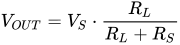
If the source resistance is not negligibly small compared to the load impedance, the output voltage will fall.

This illustration uses simple resistances, but a similar discussion can be applied in alternating current circuits using resistive, capacitive, and inductive elements.

See also

[edit]

References

[edit]
Revisions and contributorsEdit on WikipediaRead on Wikipedia
from Grokipedia
An electrical load is any component or device in an electrical circuit that consumes , converting it into other forms of such as , , or mechanical work. Common examples include household appliances, fixtures, and industrial machinery, which draw current from a power source to perform their functions. In circuit theory, loads are represented symbolically, often as resistors, and their presence is essential to prevent short circuits that could damage the system. Electrical loads are primarily classified into three types based on their impedance properties: resistive, inductive, and capacitive. Resistive loads, such as incandescent bulbs, toasters, and electric heaters, dissipate primarily as or , with voltage and current waveforms in phase, resulting in a of 1 and consumption of only active power. Inductive loads, including , fans, refrigerators, and transformers, store in magnetic fields during operation, causing current to lag voltage and introducing reactive power that reduces the below 1. Capacitive loads, such as those in banks or certain synchronous , store in , leading to current preceding voltage, though they are less common in residential settings and more prevalent in systems. Beyond impedance-based classification, electrical loads are also categorized by application and scale, including residential (e.g., home appliances), commercial (e.g., office lighting and HVAC), industrial (e.g., heavy machinery), and municipal (e.g., streetlights). In power , accurate modeling of these loads is critical for stability analysis, , and efficient resource allocation, as they directly influence , correction, and overall grid reliability. Load variations over time, known as load profiles, further complicate system design, requiring strategies like load management to balance .

Fundamentals

Definition and Classification

An electrical load is any device or component within an electrical circuit that consumes by converting into other forms, such as heat, light, mechanical motion, or . This consumption occurs as the load draws current from the power source, typically representing the endpoint or utilization aspect of an electrical system where is transformed for practical use. The concept of an electrical load originated in 19th-century during the early development of practical power distribution systems, with incandescent light bulbs serving as one of the first widespread examples of such loads in Thomas Edison's pioneering lighting networks around 1879. As electrical systems evolved from and arc lighting to centralized power , the term "load" became standard to describe elements that imposed on circuits, analogous to mechanical burdens in engineering. Electrical loads are primarily classified based on their impedance properties into resistive, inductive, and capacitive types. Resistive loads consume real power directly, converting it entirely into useful output like or without . Inductive and capacitive loads, which are reactive, temporarily store and release in magnetic or , respectively, without net consumption of real power. Loads can also be categorized as linear, where voltage and current maintain a proportional (though possibly phase-shifted) relationship, or non-linear, which distort waveforms and introduce harmonics. Non-linear loads, common in modern , introduce harmonics by drawing current in non-sinusoidal patterns, potentially causing inefficiencies in power systems. Representative examples illustrate these classifications: resistive loads include everyday heaters and incandescent bulbs, which dissipate energy solely as ; inductive loads encompass electric and transformers, which generate for motion or voltage adjustment; capacitive loads appear in banks for correction; and non-linear loads feature devices like computer power supplies or LED drivers, which rectify AC to DC and produce distortions.

Basic Principles of Operation

Electrical loads can operate on (DC) or (AC); the principles below apply generally, with AC involving additional considerations like phase and impedance. An electrical load operates based on the fundamental relationship described by . For resistive loads or DC circuits, the voltage VV across the load is equal to the current II flowing through it multiplied by the load's resistance RR, expressed as V=IRV = IR. For AC loads, the generalized form is V=IZV = IZ, where ZZ is the complex impedance. This relation indicates that the applied voltage drives the current through the load, with the opposition (resistance or impedance) determining the magnitude of the current for a given voltage. Loads convert into other forms, such as or mechanical work, through power dissipation. For DC or purely resistive AC loads, active power is given by P=VIP = VI, where power is measured in watts (W). In general AC circuits, active power P=VIcosϕP = VI \cos \phi, where VV and II are root-mean-square (RMS) values and cosϕ\cos \phi is the power factor; apparent power is S=VIS = VI in volt-amperes (VA). In (DC) circuits, the formula applies directly using instantaneous values of voltage and current. For (AC) circuits, effective (root-mean-square) values are used to account for the sinusoidal variations, ensuring the power calculation reflects the average energy transfer over a cycle. In circuit configurations, loads connected in series result in a total impedance that is the sum of individual impedances, leading to a single current path and divided voltage drops across each load. Conversely, parallel configurations yield a total impedance that is the reciprocal of the sum of the reciprocals of individual impedances, allowing multiple current paths and equal voltage across all loads. These arrangements affect the overall circuit behavior by altering the effective opposition to current flow. To maximize power delivery to a load, ensures the load impedance equals the complex conjugate of the source impedance, as per the . This condition achieves the highest possible power transfer, though it results in only 50% since half the power is dissipated in the source.

Types of Loads

Resistive Loads

Resistive loads are electrical components or devices that consume power primarily through resistance, where the current and voltage are in phase, adhering strictly to expressed as R=VIR = \frac{V}{I}, with resistance RR remaining constant regardless of applied voltage or current. This linear current-voltage (I-V) characteristic ensures predictable behavior, as the current through the load is directly proportional to the voltage across it, facilitating straightforward and analysis in both (DC) and (AC) systems. Common examples of resistive loads include incandescent light bulbs, electric heaters, and toasters, where the primary function relies on the conversion of into or via resistive elements such as wires. In these devices, the resistance material opposes the flow of electrons, generating through the collision of charge carriers, which directly illuminates the filament in bulbs or warms heating coils in appliances. The linear I-V relationship in these examples allows for consistent performance under varying supply conditions, making them suitable for applications requiring stable thermal output. Power dissipation in resistive loads occurs via , where the is converted entirely into according to the formula P=I2RP = I^2 R, with all input power contributing to generation rather than storage. In pure resistive circuits, this results in 100% for heating purposes, as there is no reactive component to return unused energy to the source, though this limits versatility to dissipative applications only. Resistive loads offer advantages in simplicity of control and circuit stability due to their non-reactive , enabling easy integration without phase-related complications that could arise in systems with energy-storing elements. However, their lack of capability restricts them to real-power consumption roles, preventing use in applications requiring temporary energy retention, such as filtering or timing circuits. This inherent stability supports reliable operation in power systems but necessitates careful to avoid overheating from continuous .

Reactive Loads

Reactive loads are electrical components or devices that store and release in the form of magnetic or , resulting in a phase difference between voltage and current waveforms. This oscillation means they consume reactive power, measured in volt-ampere reactive (VAR), without performing net work over a complete AC cycle. Reactive loads are classified into two main subtypes: inductive and capacitive. Inductive loads cause the current to lag the voltage by up to 90 degrees, while capacitive loads cause the current to lead the voltage by up to 90 degrees. The mnemonic "ELI" represents voltage (E) leading current (I) in inductors, and "" represents current (I) leading voltage (E) in capacitors. Inductive loads, such as , transformers, solenoids, and inductors, store energy in . In these devices, a coil generates a back (back EMF) that opposes changes in current, as described by . This opposition arises from the self-inductance LL, where the induced voltage is given by E=Ldidt\mathcal{E} = -L \frac{di}{dt}, with the negative sign indicating the back EMF's direction to resist the current change. For example, in electric , the back EMF is proportional to the rotational speed and reduces the net voltage across the armature as the motor accelerates. Capacitive loads, including capacitors used in filters, power supplies, and tuning circuits, store energy in between their plates. The charge QQ stored on a is related to the voltage VV across it by Q=CVQ = CV, where CC is the . In AC circuits, the current through a is the rate of change of charge, leading the voltage by 90 degrees because current peaks when voltage is changing most rapidly, such as at zero crossings. Applications include smoothing voltage fluctuations in power supplies and selecting specific frequencies in radio tuning circuits. Reactive loads often appear in combination, as in RL (resistor-inductor) and RC (resistor-capacitor) circuits, where their effects influence transient responses. In RL circuits, the inductor resists sudden current changes, causing the current to rise or fall exponentially toward steady state with a time constant τ=L/R\tau = L/R, resulting in initial high voltage across the inductor that decays as the magnetic field builds. In RC circuits, the capacitor resists sudden voltage changes, leading to exponential charging or discharging with τ=RC\tau = RC, where initial high current drops as the electric field establishes, smoothing voltage transitions. These transients highlight the energy storage dynamics without steady dissipation, contrasting with purely resistive loads.

Electrical Characteristics

Power Consumption and Ratings

Electrical loads consume power from the electrical , which is quantified in terms of apparent, real, and reactive power. Apparent power, denoted as SS, represents the total power supplied to the load and is calculated as the product of voltage VV and current II, with units in volt-amperes (VA). Real power, or active power PP, is the portion that performs useful work, such as converting into or , and is given by P=VIcosθP = VI \cos \theta, where θ\theta is the phase angle between voltage and current, with units in watts (). Reactive power QQ accounts for the energy oscillating between the source and the load without being consumed, expressed as Q=VIsinθQ = VI \sin \theta, and measured in volt-ampere reactive (VAR). These definitions are standardized in IEEE Std 1459-2025 for accurate measurement in both sinusoidal and nonsinusoidal conditions. Load ratings specify the safe operating limits for electrical devices to prevent damage or hazards. Nominal ratings indicate the designed voltage and current levels, such as 120 V and 15 A for standard household outlets and appliances in , ensuring compatibility with the power supply. Overload protection devices, including fuses and , interrupt the circuit when current exceeds these ratings, typically sized at 125% of continuous loads per (NEC) guidelines to allow for starting surges while safeguarding conductors. For instance, a 15 A protects against sustained loads above this threshold, mitigating risks of overheating. Power consumption in loads is measured using instruments tailored to direct current () and alternating current () systems. Ammeters quantify current draw, while wattmeters directly measure real power by accounting for voltage, current, and phase in AC circuits, often employing electrodynamic or principles for accuracy. For DC loads, simpler configurations suffice, but AC measurements require consideration of distortions per IEEE standards. Efficiency ratings, such as those from the program, evaluate overall use against benchmarks; certified appliances must exceed federal minimums by at least 10-15% for products like refrigerators, promoting reduced consumption without performance loss. Several factors influence the actual power consumption of electrical loads beyond their rated values. Temperature dependence affects resistance-based loads, where higher ambient temperatures increase resistivity (and decrease conductivity) in metals, slightly reducing power draw for resistive elements, while conversely boosting demand for cooling appliances like air conditioners. Duty cycles, defined as the ratio of active time to total cycle time, determine average consumption; for example, a motor operating at 50% consumes half its full-load power on average. Variable loads, such as dimmable LED lights, allow adjustable power intake—dimming to 50% typically halves consumption since power scales with the square of voltage in resistive dimming—enabling user-controlled .

Power Factor and Phase Relationships

The power factor (PF) in an electrical load is defined as the cosine of the phase angle φ between the sinusoidal voltage and current waveforms in an (AC) circuit, representing the ratio of active power to apparent power. For purely resistive loads, where voltage and current are in phase (φ = 0°), the power factor is unity (PF = 1). In contrast, reactive loads, such as inductors in motors or transformers, introduce a phase shift, resulting in a lagging (PF < 1) due to the current trailing the voltage. The relationships among power components are visualized in the power triangle, a vector diagram where active power P (in watts) forms the adjacent side to angle φ, reactive power Q (in volt-ampere reactive, VAR) forms the opposite side, and apparent power S (in volt-amperes, VA) is the . Mathematically, the power factor is expressed as: PF=cosϕ=PS\text{PF} = \cos \phi = \frac{P}{S} where S=P2+Q2S = \sqrt{P^2 + Q^2}
Add your contribution
Related Hubs
User Avatar
No comments yet.