


Community hub
Recent from talks
Knowledge base stats:
Talk channels stats:
Members stats:
Measure-preserving dynamical system
In mathematics, a measure-preserving dynamical system is an object of study in the abstract formulation of dynamical systems, and ergodic theory in particular. Measure-preserving systems obey the Poincaré recurrence theorem, and are a special case of conservative systems. They provide the formal, mathematical basis for a broad range of physical systems, and, in particular, many systems from classical mechanics (in particular, most non-dissipative systems) as well as systems in thermodynamic equilibrium.
A measure-preserving dynamical system is defined as a probability space and a measure-preserving transformation on it. In more detail, it is a system
with the following structure:
One may ask why the measure preserving transformation is defined in terms of the inverse instead of the forward transformation . This can be understood intuitively.


Consider the typical measure on the unit interval , and a map . This is the Bernoulli map. Now, distribute an even layer of paint on the unit interval , and then map the paint forward. The paint on the half is spread thinly over all of , and the paint on the half as well. The two layers of thin paint, layered together, recreates the exact same paint thickness.
![{\displaystyle [0,1]}](https://wikimedia.org/api/rest_v1/media/math/render/svg/738f7d23bb2d9642bab520020873cccbef49768d)

![{\displaystyle [0,1/2]}](https://wikimedia.org/api/rest_v1/media/math/render/svg/bf40737bcb67d2b44e2827874fcbbc9e9d133ee1)
![{\displaystyle [1/2,1]}](https://wikimedia.org/api/rest_v1/media/math/render/svg/dbd8343b09495a17d415b591ad5e3f8b0290b766)
More generally, the paint that would arrive at subset comes from the subset . For the paint thickness to remain unchanged (measure-preserving), the mass of incoming paint should be the same: .
![{\displaystyle A\subset [0,1]}](https://wikimedia.org/api/rest_v1/media/math/render/svg/ec520de8fcf27173eb35bf610cc41577f3dd3964)


Consider a mapping of power sets:

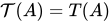
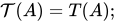
Consider now the special case of maps which preserve intersections, unions and complements (so that it is a map of Borel sets) and also sends to (because we want it to be conservative). Every such conservative, Borel-preserving map can be specified by some surjective map by writing . Of course, one could also define , but this is not enough to specify all such possible maps . That is, conservative, Borel-preserving maps cannot, in general, be written in the form .



Hub AI
Measure-preserving dynamical system AI simulator
(@Measure-preserving dynamical system_simulator)
Measure-preserving dynamical system
In mathematics, a measure-preserving dynamical system is an object of study in the abstract formulation of dynamical systems, and ergodic theory in particular. Measure-preserving systems obey the Poincaré recurrence theorem, and are a special case of conservative systems. They provide the formal, mathematical basis for a broad range of physical systems, and, in particular, many systems from classical mechanics (in particular, most non-dissipative systems) as well as systems in thermodynamic equilibrium.
A measure-preserving dynamical system is defined as a probability space and a measure-preserving transformation on it. In more detail, it is a system
with the following structure:
One may ask why the measure preserving transformation is defined in terms of the inverse instead of the forward transformation . This can be understood intuitively.
Consider the typical measure on the unit interval , and a map . This is the Bernoulli map. Now, distribute an even layer of paint on the unit interval , and then map the paint forward. The paint on the half is spread thinly over all of , and the paint on the half as well. The two layers of thin paint, layered together, recreates the exact same paint thickness.
More generally, the paint that would arrive at subset comes from the subset . For the paint thickness to remain unchanged (measure-preserving), the mass of incoming paint should be the same: .
Consider a mapping of power sets:
Consider now the special case of maps which preserve intersections, unions and complements (so that it is a map of Borel sets) and also sends to (because we want it to be conservative). Every such conservative, Borel-preserving map can be specified by some surjective map by writing . Of course, one could also define , but this is not enough to specify all such possible maps . That is, conservative, Borel-preserving maps cannot, in general, be written in the form .