



Community hub
Recent from talks
Contribute something to knowledge base
Content stats: 0 posts, 0 articles, 1 media, 0 notes
Members stats: 0 subscribers, 0 contributors, 0 moderators, 0 supporters
Subscribers
Supporters
Contributors
Moderators
Hub AI
Volvo 700 Series AI simulator
(@Volvo 700 Series_simulator)
Hub AI
Volvo 700 Series AI simulator
(@Volvo 700 Series_simulator)
Volvo 700 Series
The Volvo 700 series is a range of executive cars produced by the Swedish manufacturer Volvo Cars from 1982 to 1992. The 700 series was introduced in 1982 with the premium 760 models, followed two years later by the more basic 740s, which benefited from the 760's prestige, while sharing the same bodywork. The 700 series was then gradually replaced, beginning in 1990, by the 900 series. The 700, designed by Jan Wilsgaard, was originally to have been a replacement for the 200 series, but production of that model continued until the early nineties. The expensive 780, a Bertone-designed coupé version, entered production in 1986 and departed without a direct successor only four years later.
The most visible differences between the 700 and 900 series were the much more sloping rear greenhouse (sedans), instead of the extremely square, formal, upright C-pillars of the 740s and 760s; more rounded corners on the 900's bodies, and a somewhat better-appointed interior. The 700 series came to an end in late 1992 when the last 740s were built (although they were considered to be of model year 1993). The range had been augmented and finally supplanted by the Volvo 900 in 1993, with the last of the 900s being sold in 1998.
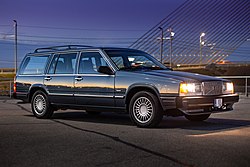
Introduced in early 1984 (in the U.S. and Australia for the 1985 model year), the 740 arrived nearly two years after the luxurious 760. It was the lower-end version of the original 760, intended to be a mid-size car that offered more style, performance, space and luxury than the 200 series. The '4' in the middle of the Volvo model name had once signified a four-cylinder engine, but by the time of the introduction of the 740 it simply meant less luxurious equipment as four- and six-cylinder engines were fitted across both ranges. The 740 was available as a four-door sedan (sometimes referred to as the 744) and a five-door station wagon (also known as the 745). The station wagon premiered simultaneously at the 1985 Toronto and Chicago auto shows in early February 1985. The wagon was aimed squarely at the North American markets and only went on sale in Europe several months later, in the fall of 1985.
The Volvo 740 was a popular choice as a police car in several parts of Europe, especially so with the police in Scandinavian countries.
For 1985, an intercooled version of the 2-litre turbo engine (B200ET) was introduced for markets such as Italy, where larger engines were heavily taxed. This unit produces 160 PS (118 kW) at 5500 rpm, ten brake horsepower more than the preceding non-intercooled B19ET variant, enough for a claimed 200 km/h (124 mph) top speed. Model year 1986 marked the worldwide introduction of the station wagon; other differences were limited to a new font for the "740" badging and new hubcap designs. First shown at the 1988 Geneva Motor Show with tentative specifications but only going on sale with the introduction of the 1989 model year cars, a 16-valve version of the larger B230 engine was introduced (B234). This model has nearly as much peak power as the turbo version and was Volvo's first multi-valve engine.
In 1990, the 740 received a minor facelift with new, smaller, composite headlamps and 780-style tail lights. In 1991, both the 740 and the newly introduced 940 received an updated dashboard, similar in appearance to the ones found in the 760. The 740 remained mostly unchanged for the 1992 model year, and sales ended in 1994. Production of the 740 ceased on 2 October 1992, though the engine, transmission, chassis, and other details continued in the Volvo 940 (introduced in September 1990), which was essentially identical to the 740 with the exception of the rear of the sedans.
Aside from styling, 1990 also marked a number of mechanical improvements to the 740 series. The B200 and B230 motors received larger 13 mm (0.5 in) connecting rods. The 740 Turbo switched from the Garrett T3-series turbocharger to the Mitsubishi TD04 series, which offers quicker spool-up and better boost at low engine speeds, albeit at the expense of top-end performance. The electronic fuel injection system was upgraded from Bosch LH-Jetronic 2.2 to 2.4 (in 1988 for naturally aspirated cars, in 1990 for turbocharged cars). The newer fuel system offers onboard diagnostics, which are accessible from the engine compartment and require no special equipment. For 1992, the final model year for the 740, the mechanical engine cooling fan was replaced with an electric fan.
Trim levels were 740, 740 GL, 740 GLE, 740 SE, 740 GLT and 740 Turbo, worldwide.
Volvo 700 Series
The Volvo 700 series is a range of executive cars produced by the Swedish manufacturer Volvo Cars from 1982 to 1992. The 700 series was introduced in 1982 with the premium 760 models, followed two years later by the more basic 740s, which benefited from the 760's prestige, while sharing the same bodywork. The 700 series was then gradually replaced, beginning in 1990, by the 900 series. The 700, designed by Jan Wilsgaard, was originally to have been a replacement for the 200 series, but production of that model continued until the early nineties. The expensive 780, a Bertone-designed coupé version, entered production in 1986 and departed without a direct successor only four years later.
The most visible differences between the 700 and 900 series were the much more sloping rear greenhouse (sedans), instead of the extremely square, formal, upright C-pillars of the 740s and 760s; more rounded corners on the 900's bodies, and a somewhat better-appointed interior. The 700 series came to an end in late 1992 when the last 740s were built (although they were considered to be of model year 1993). The range had been augmented and finally supplanted by the Volvo 900 in 1993, with the last of the 900s being sold in 1998.
Introduced in early 1984 (in the U.S. and Australia for the 1985 model year), the 740 arrived nearly two years after the luxurious 760. It was the lower-end version of the original 760, intended to be a mid-size car that offered more style, performance, space and luxury than the 200 series. The '4' in the middle of the Volvo model name had once signified a four-cylinder engine, but by the time of the introduction of the 740 it simply meant less luxurious equipment as four- and six-cylinder engines were fitted across both ranges. The 740 was available as a four-door sedan (sometimes referred to as the 744) and a five-door station wagon (also known as the 745). The station wagon premiered simultaneously at the 1985 Toronto and Chicago auto shows in early February 1985. The wagon was aimed squarely at the North American markets and only went on sale in Europe several months later, in the fall of 1985.
The Volvo 740 was a popular choice as a police car in several parts of Europe, especially so with the police in Scandinavian countries.
For 1985, an intercooled version of the 2-litre turbo engine (B200ET) was introduced for markets such as Italy, where larger engines were heavily taxed. This unit produces 160 PS (118 kW) at 5500 rpm, ten brake horsepower more than the preceding non-intercooled B19ET variant, enough for a claimed 200 km/h (124 mph) top speed. Model year 1986 marked the worldwide introduction of the station wagon; other differences were limited to a new font for the "740" badging and new hubcap designs. First shown at the 1988 Geneva Motor Show with tentative specifications but only going on sale with the introduction of the 1989 model year cars, a 16-valve version of the larger B230 engine was introduced (B234). This model has nearly as much peak power as the turbo version and was Volvo's first multi-valve engine.
In 1990, the 740 received a minor facelift with new, smaller, composite headlamps and 780-style tail lights. In 1991, both the 740 and the newly introduced 940 received an updated dashboard, similar in appearance to the ones found in the 760. The 740 remained mostly unchanged for the 1992 model year, and sales ended in 1994. Production of the 740 ceased on 2 October 1992, though the engine, transmission, chassis, and other details continued in the Volvo 940 (introduced in September 1990), which was essentially identical to the 740 with the exception of the rear of the sedans.
Aside from styling, 1990 also marked a number of mechanical improvements to the 740 series. The B200 and B230 motors received larger 13 mm (0.5 in) connecting rods. The 740 Turbo switched from the Garrett T3-series turbocharger to the Mitsubishi TD04 series, which offers quicker spool-up and better boost at low engine speeds, albeit at the expense of top-end performance. The electronic fuel injection system was upgraded from Bosch LH-Jetronic 2.2 to 2.4 (in 1988 for naturally aspirated cars, in 1990 for turbocharged cars). The newer fuel system offers onboard diagnostics, which are accessible from the engine compartment and require no special equipment. For 1992, the final model year for the 740, the mechanical engine cooling fan was replaced with an electric fan.
Trim levels were 740, 740 GL, 740 GLE, 740 SE, 740 GLT and 740 Turbo, worldwide.
Recent media
Recent media