Hubbry Logo
Naturally aspirated engineNaturally aspirated engineMain
Open search
Naturally aspirated engine
Community hub
Naturally aspirated engine
logo
8 pages, 0 posts
0 subscribers
Be the first to start a discussion here.
Naturally aspirated engine
from Wikipedia
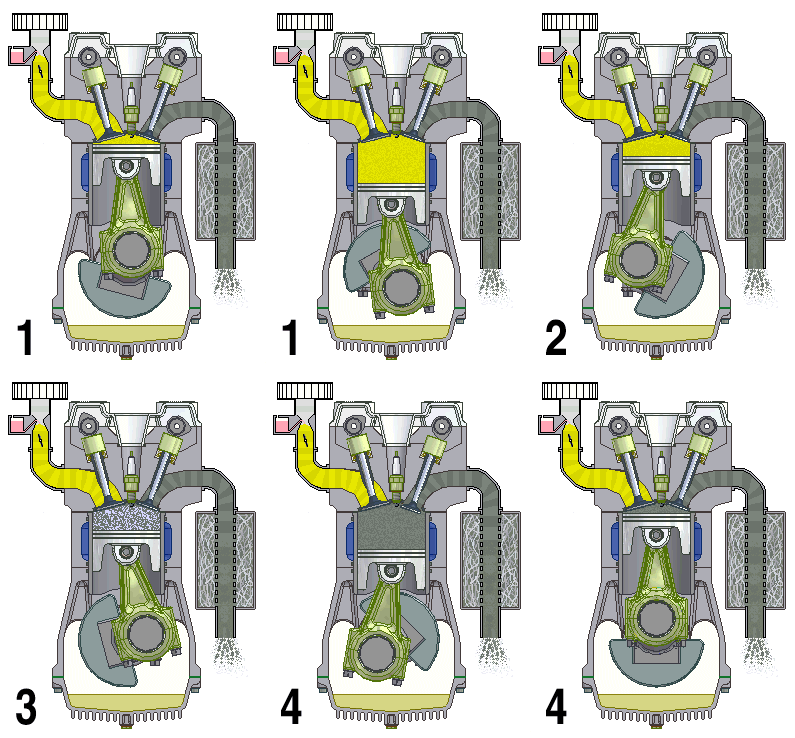
Typical airflow in a four-stroke engine:
In stroke #1, the pistons suck in (aspirate) air to the combustion chamber through the opened inlet valve.

A naturally aspirated engine, also known as a normally aspirated engine, and abbreviated to N/A or NA, is an internal combustion engine in which air intake depends solely on atmospheric pressure and does not have forced induction through a turbocharger or a supercharger.[1]

Description

[edit]

In a naturally aspirated engine, air for combustion (Diesel cycle in a diesel engine or specific types of Otto cycle in petrol engines, namely petrol direct injection) or an air/fuel mixture (traditional Otto cycle petrol engines), is drawn into the engine's cylinders by atmospheric pressure acting against a partial vacuum that occurs as the piston travels downwards toward bottom dead centre during the intake stroke. Owing to innate restriction in the engine's inlet tract, which includes the intake manifold, a small pressure drop occurs as air is drawn in, resulting in a volumetric efficiency of less than 100 percent—and a less than complete air charge in the cylinder. The density of the air charge, and therefore the engine's maximum theoretical power output, in addition to being influenced by induction system restriction, is also affected by engine speed and atmospheric pressure, the latter of which decreases as the operating altitude increases.

This is in contrast to a forced-induction engine, in which a mechanically driven supercharger or an exhaust-driven turbocharger is employed to facilitate increasing the mass of intake air beyond what could be produced by atmospheric pressure alone. Nitrous oxide can also be used to artificially increase the mass of oxygen present in the intake air. This is accomplished by injecting liquid nitrous oxide into the intake, which supplies significantly more oxygen in a given volume than is possible with atmospheric air. Nitrous oxide is 36.3% available oxygen by mass after it decomposes as compared with atmospheric air at 20.95%. Nitrous oxide also boils at −127.3 °F (−88.5 °C) at atmospheric pressures and offers significant cooling from the latent heat of vaporization, which also aids in increasing the overall air charge density significantly compared to natural aspiration.

Applications

[edit]

Most automobile petrol engines, as well as many small engines used for non-automotive purposes, are naturally aspirated.[2] Most modern diesel engines powering highway vehicles are turbocharged to produce a more favourable power-to-weight ratio, a higher torque curve, as well as better fuel efficiency and lower exhaust emissions. Turbocharging is nearly universal on diesel engines that are used in railroad, marine engines, and commercial stationary applications (electrical power generation, for example). Forced induction is also used with reciprocating aircraft engines to negate some of the power loss that occurs as the aircraft climbs to higher altitudes.

Advantages and disadvantages

[edit]

The advantages and disadvantages of a naturally aspirated engine in relation to a same-sized engine relying on forced induction include:

Advantages

[edit]
  • Easier to maintain and repair
  • Lower development and production costs
  • Increased reliability, partly due to fewer separate, moving parts
  • More direct throttle response than a turbo system due to the lack of turbo lag (an advantage also shared with superchargers)
  • Less potential for overheating and or uncontrolled combustion (pinging/ knocking)

Disadvantages

[edit]
  • Decreased efficiency
  • Decreased power-to-weight ratio
  • Decreased potential for tuning
  • Increased power loss at higher elevation (due to lower air pressure) when compared with forced induction engines

See also

[edit]

References

[edit]
Revisions and contributorsEdit on WikipediaRead on Wikipedia
from Grokipedia
A naturally aspirated engine, also referred to as a normally aspirated engine, is an that draws intake air into its cylinders solely through the vacuum created by the downward movement of the pistons during the intake stroke, relying on ambient without any mechanisms such as turbochargers or superchargers. This design contrasts with supercharged or turbocharged engines, which use mechanical or exhaust-driven compressors to increase air density and power output. The fundamental operating principle of a naturally aspirated engine follows the four-stroke in variants or the in compression-ignition types: during the intake stroke, the descends with the intake valve open, generating negative pressure that pulls filtered air through the body and intake manifold into the cylinder, where it mixes with via carburetion or . The mixture is then compressed on the upward stroke, ignited to produce power on the next downward stroke, and exhausted on the final upward stroke, with airflow volume determined by , speed, and position rather than external boosting. In diesel applications, air alone is drawn in and compressed to auto-ignition temperatures before is injected, emphasizing the role of natural aspiration in achieving efficient combustion without pre-compression. Naturally aspirated engines offer several key advantages, including mechanical simplicity due to fewer components, which reduces manufacturing costs, maintenance needs, and potential failure points compared to forced-induction systems. They provide linear and immediate response, delivering power smoothly and predictably without the lag associated with turbochargers, making them ideal for everyday driving and enthusiast vehicles. Additionally, their reliability and durability stem from operating within natural pressure limits, avoiding the stresses of boosted air that can lead to higher wear in high-performance scenarios. However, these engines have notable limitations, such as lower , requiring larger displacements to achieve levels attainable with smaller forced-induction units, which can increase and consumption under heavy loads. also diminishes at higher altitudes where drops, reducing and thus power output by up to 3% per 1,000 feet of elevation gain. Despite these drawbacks, naturally aspirated engines remain prevalent in applications ranging from standard passenger cars and light trucks to and small marine vessels, where simplicity and consistent operation outweigh the need for maximum power.

Fundamentals

Definition and Basic Operation

A naturally aspirated engine is an that ingests air into its cylinders solely through , without the aid of mechanical systems such as turbochargers or superchargers. This design relies on the natural vacuum generated by the downward movement of the to draw ambient air through the intake system. In contrast to engines, which use compressors to increase air density, naturally aspirated engines operate at or below levels. The basic operation of a naturally aspirated follows a cycle consisting of , compression, power, and exhaust strokes. During the intake stroke, the moves downward with the open and the exhaust closed, creating a partial in the . In spark-ignition engines, this pulls in an air- mixture (in carbureted systems) or air that mixes with in the (in port-injected systems) from the intake manifold. In compression-ignition engines, only air is drawn into the . In the compression stroke, the rises, compressing the charge with both valves closed, raising its temperature and pressure in preparation for ignition. The power stroke occurs when the mixture is ignited—by spark in engines or compression heat in diesels—forcing the downward and generating rotational force on the . Finally, the exhaust stroke sees the rise again, pushing out the byproducts through the open exhaust . This cycle repeats, with the engine's completing two full rotations per cycle. Air enters the engine from the ambient environment, typically passing through an air filter to remove contaminants, before reaching the throttle body, which regulates airflow volume based on accelerator input by adjusting a butterfly valve. The filtered and metered air then flows into the intake manifold, a series of runners that distribute it evenly to each cylinder for balanced filling and optimal combustion. From the manifold, the air travels through the intake ports in the cylinder head to the combustion chamber during the intake stroke, where it mixes with fuel (in port-injected spark-ignition systems) before the valve closes. In direct-injected systems, including most diesels, fuel is added directly to the cylinder after intake. While most naturally aspirated engines are four-stroke designs using valves for control, two-stroke exist and differ in their air ingestion mechanism. In two-stroke spark-ignition naturally aspirated engines, the air-fuel mixture enters through in the cylinder wall, timed by the piston's position to uncover the near the bottom of the downward , rather than dedicated valves. This timing allows for a simpler, more compact design but results in less precise control over the process compared to four-stroke systems.

Thermodynamic Principles

In naturally aspirated engines, the intake of air into the cylinders is driven solely by , which at is approximately 101 kPa, creating a differential that fills the during the intake . This process relies on the piston creating a partial , allowing ambient air to flow in without mechanical compression, distinguishing it from forced-induction systems. Volumetric efficiency (η_v) quantifies the effectiveness of this air intake and is defined as the ratio of the actual volume of air ingested per cycle to the theoretical maximum volume equal to the engine's displacement. The formula is given by: ηv=(VactualVdisplacement)×100%\eta_v = \left( \frac{V_\text{actual}}{V_\text{displacement}} \right) \times 100\% where VactualV_\text{actual} is the volume of air at ambient conditions actually drawn in, and VdisplacementV_\text{displacement} is the swept volume of the cylinders. Typical values for naturally aspirated engines range from 80% to 100%, influenced by factors such as intake valve timing, which optimizes the duration and lift for air flow, and manifold design, which minimizes restrictions and promotes even distribution. At higher engine speeds (RPM), air inertia contributes to improved efficiency through the ram effect, where tuned intake lengths create pressure waves that enhance cylinder filling, often pushing η_v above 100% in optimized designs. The air-fuel ratio (AFR) in naturally aspirated gasoline engines ideally targets a stoichiometric value of 14.7:1 by for complete , balancing power and emissions. However, achieving leaner mixtures (higher AFR) for improved is limited in these engines without additional technologies like advanced ignition or variable valve actuation, as reduced air density and flow at part load can lead to incomplete or misfires. Performance also declines with altitude due to lower air density; naturally aspirated engines experience approximately a 3% power loss per 1,000 feet of elevation gain above , as the reduced limits the of air available for .

Historical Development

Early Innovations

The invention of the four-stroke by Nikolaus Otto in 1876 marked a pivotal advancement in naturally aspirated engine technology, providing the first practical alternative to steam engines by relying on for air intake during the intake stroke. This , operating on the , compressed a gaseous fuel-air mixture within the before ignition, achieving greater efficiency than prior two-stroke designs and enabling reliable power output of around 3 horsepower at 180 . Otto's design emphasized natural aspiration, where the piston's downward motion drew in air at without mechanical assistance, establishing the foundational principle for subsequent . Building on Otto's work, advanced fuel delivery systems in 1885 by developing an early that mixed liquid with air through over a heated surface, eliminating the need for gaseous fuels and enabling more portable applications without . This innovation facilitated the integration of naturally aspirated engines into mobile vehicles, culminating in the 1886 , the first practical automobile powered by a single-cylinder, producing 0.75 horsepower from a 954 cc displacement. Simultaneously, Otto's engines gained widespread adoption in stationary roles for power generation, such as driving factory machinery and pumps through licensing agreements with manufacturers like Brothers, who produced reliable versions for industrial use by the late 1870s. Early naturally aspirated engines faced significant challenges in ignition and thermal management, which innovators addressed through rudimentary yet effective means. Ignition timing was achieved via make-and-break systems, where low-tension electrical contacts inside the separated to produce a spark at the optimal point in the compression stroke, ensuring consistent in the absence of high-voltage coils. Cooling relied on atmospheric over exposed surfaces or simple evaporative methods, dissipating heat generated during without complex liquid circuits, though this limited operation to low speeds and stationary setups. These solutions overcame the inefficiencies of external engines like powerplants, which required constant external heating, positioning naturally aspirated internal combustion as the dominant until the introduction of superchargers in the early 1900s.

20th and 21st Century Evolution

In the early 20th century, the introduction of overhead valve (OHV) designs marked a significant advancement in naturally aspirated engine technology, with pioneering the first production OHV four-cylinder engine in 1904, which improved airflow and power output compared to traditional side-valve configurations by allowing better valve placement and breathing efficiency. further advanced this in 1949 with the debut of its 331-cubic-inch OHV V8, the first production OHV V8 in the industry, featuring high compression and lightweight construction that enhanced and overall performance over prior L-head designs. Following , naturally aspirated engines saw innovations in fuel delivery, exemplified by Chevrolet's 1957 Rochester Ram-Jet mechanical system, which provided precise air-fuel mixture control for improved throttle response and efficiency in V8 engines without relying on carburetors. This system, developed since 1954, used an air meter, fuel meter, and intake manifold to ensure even distribution, boosting power in applications like the while maintaining naturally aspirated operation. The 1980s brought electronic advancements, including widespread adoption of electronic fuel injection (EFI) for more accurate metering and (VVT) systems, such as Honda's introduced in 1989 on the Integra's 1.6-liter DOHC engine, which electronically switched cam profiles to optimize valve lift and timing, achieving 100 horsepower per liter and enhancing across rpm ranges without . widened intake valve diameter to 33 mm and adjusted low-speed cam settings for early closure, broadening torque delivery in compact naturally aspirated setups. In the , naturally aspirated engines integrated with hybrid systems for better efficiency, as seen in Toyota's engines in Prius models starting from in 2003, where the 1.5-liter 1NZ-FXE uses late closing to increase expansion ratio, reducing pumping losses and improving fuel economy in hybrid applications. However, stringent emissions regulations like Euro 6, implemented in 2014, accelerated the decline of standalone naturally aspirated engines by favoring downsized turbocharged units for lower CO2 and outputs, with NA designs struggling to meet limits without hybridization. Despite this, high-performance naturally aspirated engines persist, notably Ferrari's 6.5-liter V12 in models like the 2024 12Cilindri, delivering 819 horsepower through advanced naturally aspirated architecture as regulations allow, preserving the engine's iconic character.

Design and Components

Intake and Exhaust Systems

In naturally aspirated engines, the intake manifold serves as the primary conduit for distributing air from the throttle body to the cylinders, with materials selected to balance weight, thermal properties, and durability. Aluminum alloys are commonly used for their excellent dissipation and structural strength, allowing efficient to promote , while plastic composites, such as reinforced , offer reduced weight and better insulation to minimize soak from the . Manifold design incorporates tuning techniques to optimize airflow dynamics, particularly through , where the manifold's volume and runner geometry create pressure waves that amplify charge at specific engine speeds, enhancing mid-range . This effect relies on the interaction between the plenum volume and runner length to generate inertial ramming, drawing more air into the cylinders without . The throttle body, positioned upstream of the manifold, regulates airflow using a that pivots to restrict or allow passage, directly controlling engine load in response to driver input. In modern naturally aspirated engines, (ETC) systems replace mechanical linkages with servo motors and sensors, enabling precise modulation integrated with engine management for improved responsiveness and emissions compliance. A key component of the intake system is the , which acts as a reservoir to equalize air pressure and distribution across multiple cylinders, preventing imbalances that could lead to uneven filling. By damping pressure fluctuations from pulsating strokes, the plenum ensures consistent , with its volume typically sized relative to to support broad operational ranges. Acoustic tuning in intake systems mitigates noise generated by air rush and pressure pulses while preserving flow efficiency, often achieved through tuned resonators or variable-length runners that adjust effective path length based on engine speed. For instance, BMW's DISA (Divergent Intake System Adjustment) employs a within the plenum to switch between short and long runner modes, shortening paths at higher RPMs for better high-end flow and lengthening them at low speeds to boost via , all while attenuating audible intake roar. The in naturally aspirated engines focuses on minimizing back to facilitate efficient gas expulsion, relying on tuned headers—equal-length primary tubes merging into a collector—to promote scavenging through wave dynamics. These headers exploit exhaust pulse timing to create negative pressure at the exhaust ports, drawing residual gases from cylinders without assistance, though catalytic converters introduce controlled restriction to meet emissions standards while preserving overall flow.

Cylinder Head and Valve Mechanisms

The cylinder head in naturally aspirated engines encapsulates the , where design choices critically affect airflow dynamics and combustion quality. Hemispherical (hemi) combustion chambers facilitate enhanced swirl of the air-fuel mixture, promoting greater that accelerates flame front propagation and improves combustion efficiency in spark-ignition engines. In comparison, pent-roof chambers support arrangements by providing a sloped roof that optimizes valve positioning and increases the effective port area, enabling superior in high-output naturally aspirated designs. Valve mechanisms within the are engineered for precise timing and maximal airflow in naturally aspirated operation. Single overhead (SOHC) configurations employ one per to drive both and exhaust valves via rockers or direct actuation, offering a balance of and cost-effectiveness for moderate-performance applications. Dual overhead (DOHC) setups, however, utilize separate s for and exhaust valves, reducing mass and enabling higher rotational speeds with minimal losses, which is essential for high-revving naturally aspirated engines. Four valves per —typically two and two exhaust—represent the standard in such high-revving designs, as they double the flow paths compared to two-valve setups, significantly boosting breathing capacity and without . Camshaft profiles dictate valve lift (maximum opening height) and duration (crankshaft degrees the valve remains open), directly influencing in naturally aspirated engines. Optimized profiles incorporate valve overlap—the period when both and exhaust valves are partially open—to enable natural scavenging, where incoming fresh charge expels residual exhaust gases, enhancing filling at mid-to-high engine speeds. In high-performance naturally aspirated applications, valve materials prioritize thermal management to withstand elevated temperatures. Sodium-filled exhaust valves, with a hollow stem partially filled with liquid sodium, leverage the metal's high thermal conductivity and phase-change properties to transfer heat from the valve head to the cooling more effectively than valves, significantly reducing peak temperatures and enabling sustained high-RPM operation. Piston crown designs complement cylinder head features to achieve desired compression ratios, with domed crowns raising the piston surface to increase the compression ratio up to 12:1 in naturally aspirated gasoline engines, thereby elevating thermal efficiency and power output while relying on atmospheric intake pressure.

Performance Characteristics

Power Output and Torque

The power output of a naturally aspirated engine is determined by the formula P=τ×N5252P = \frac{\tau \times N}{5252} where PP is horsepower, τ\tau is in lb-ft, and NN is rotational speed in RPM; this equation underscores the direct proportionality between , engine speed, and power. Unlike forced-induction engines, naturally aspirated designs typically peak in power at higher RPMs, often exceeding 7,000 RPM in performance-oriented configurations, as they maximize through high-revving operation without compressor assistance. Torque delivery in naturally aspirated engines is characterized by a linear and predictable curve, providing consistent response from low RPMs onward without the delay inherent in turbocharged systems. This results in flat bands across a wide RPM range, as exemplified by the Honda K20 engine, which maintains approximately 80% of peak from 2,500 RPM up to for balanced drivability. Specific power output for naturally aspirated engines generally ranges from 50 to 100 hp per liter of displacement, constrained by the limits of atmospheric air and efficiency compared to forced-induction alternatives that can exceed 150 hp/L. High-performance examples, such as the Honda S2000's F20C, approach the upper end at around 120 hp/L through optimized breathing. Redline limits in naturally aspirated engines often reach 8,000 to 9,000 , enabling higher peak power by sustaining efficient air-fuel mixtures at elevated speeds, though structural integrity and durability impose these boundaries. Factors such as influence performance balance; square configurations (bore equal to stroke, ratio of 1:1) are favored in naturally aspirated engines for their equilibrium between low-RPM and high-RPM power potential, minimizing piston speeds while supporting rev-happy operation.

Efficiency and Emissions

The of a naturally aspirated engine, based on the ideal , is determined by the formula ηth=11rγ1\eta_{th} = 1 - \frac{1}{r^{\gamma-1}}, where rr is the and γ\gamma is the specific heat ratio (approximately 1.4 for air-standard conditions). This relationship enables naturally aspirated engines with high compression ratios, such as 13:1 to 14:1, to achieve peak thermal efficiencies of 35-40%, as demonstrated in advanced designs that optimize combustion while managing knock limitations. Brake specific fuel consumption (BSFC) serves as a key metric for in naturally aspirated engines, typically ranging from 250 to 300 g/kWh under optimal operating conditions, reflecting the balance between power output and fuel use in port- or direct-injected systems. naturally aspirated engines exhibit a distinct emissions profile compared to diesel or turbocharged counterparts: they produce higher CO2_2 emissions per unit of power due to the lower overall efficiency of relative to diesel's higher and compression, though real-world vehicle data shows diesel cars emitting 12-20% less CO2_2 per mile despite higher per-gallon output. NOx emissions are generally lower in naturally aspirated setups without the elevated temperatures induced by turbocharging, which can increase NOx formation due to higher temperatures in boosted engines. Compliance with emissions standards for hydrocarbons (HC), carbon monoxide (CO), and NOx has been achieved since the late through three-way catalytic converters, which simultaneously oxidize HC and CO while reducing NOx to N2_2 under stoichiometric conditions (air-fuel ratio near 14.7:1). Lean-burn strategies in naturally aspirated engines enhance by operating at air-fuel ratios leaner than stoichiometric, reducing fuel consumption by 10-15% while maintaining stable ; Mazda's technology, introduced in , exemplifies this with a high of up to 14:1, operating at a near-stoichiometric air-fuel (approximately 14.7:1), enabled by piston bowl design, contributing to improved part-load without stratified operation. Direct injection in naturally aspirated engines facilitates stratified charge combustion, where fuel is injected late in the compression to create a rich mixture near the surrounded by leaner air, reducing HC and CO emissions by up to 30% during cold starts and enabling better catalyst light-off compared to port injection. This approach also lowers overall fuel use by improving charge stratification, though it requires precise control to avoid formation in richer zones.

Applications

Automotive and Motorsports

Naturally aspirated engines remain prevalent in passenger cars, particularly in economy models where reliability and cost-effectiveness are prioritized over high performance. For instance, the utilizes a 2.0-liter inline-four naturally aspirated engine across multiple generations through the , delivering 169 horsepower and noted for its durability due to low internal stresses and efficient systems. This configuration contributed to the model's reputation for long-term dependability, with many units exceeding 200,000 miles of service with minimal maintenance. In sports cars, naturally aspirated engines emphasize driver engagement through responsive throttle and high-revving characteristics, as exemplified by the 911's flat-six configuration. The 991-generation 911 GT3, for example, featured a 3.8-liter or 4.0-liter naturally aspirated flat-six producing up to 500 horsepower, allowing revs beyond 9,000 RPM and providing a linear power delivery that enhances track-focused handling and feedback. These engines were celebrated for their and mechanical purity, fostering a direct connection between driver and vehicle without the lag associated with . Motorsports applications have historically showcased the high-revving potential of naturally aspirated engines, particularly in Formula 1 during the V8 era from 2006 to 2013. These 2.4-liter V8 units, limited to 18,000 RPM by 2009 regulations, generated 750-800 horsepower and produced a distinctive high-pitched scream, powering dominant cars from teams like Ferrari and . In endurance racing, such as the , prototypes in the LMP1 class relied on naturally aspirated V8 or V10 engines until the regulatory shift toward hybrids in 2014, with examples like the Audi R18 e-tron quattro's predecessor models using 4.0-liter NA V8s for sustained high-output performance over long stints. Naturally aspirated engines are ubiquitous in , especially sportbikes, where compact design and immediate power response are critical. The employs a 998cc inline-four-cylinder naturally aspirated engine, inspired by MotoGP technology, which delivers 200 horsepower and a linear curve for predictable and cornering stability. This configuration reduces inertial fluctuations, providing smoother power delivery compared to traditional inline-fours, making it a staple in and street applications. Recent trends indicate a resurgence of naturally aspirated engines as range extenders in hybrids, countering the industry push toward engine downsizing and electrification. Compact units like the 1.5-liter four-cylinder from Horse Powertrain, measuring roughly 20 x 22 x 11 inches and producing 94 horsepower in naturally aspirated form, can integrate into EV platforms to recharge batteries on the go, potentially adding hundreds of miles to range without compromising electric efficiency. Manufacturers such as are incorporating similar naturally aspirated four-cylinders in upcoming extended-range EVs, reflecting a hybrid strategy to address amid evolving emissions standards.

Aviation and Industrial Uses

In aviation, naturally aspirated piston engines remain prevalent in general aviation aircraft due to their simplicity and reliability. The series, a four-cylinder, horizontally opposed, producing 180 horsepower, exemplifies this application, powering such as the without for efficient operation at low to moderate altitudes. These engines rely on efficiency—often from fixed-pitch designs—to optimize , compensating for the absence of supercharging while maintaining through natural atmospheric intake. Altitude effects pose challenges for these engines, as air density decreases with , reducing power output by approximately 3% per 1,000 feet. To address this, pilots employ controls and systems to prevent icing and enrich the fuel-air , ensuring stable ; fixed-pitch propellers further aid by providing consistent performance across altitudes without variable adjustments. Such adaptations have been essential for since the 1920s, when early naturally aspirated radial and inline engines dominated designs before widespread supercharging. In industrial applications, naturally aspirated diesel engines like the 4B—a 3.9-liter inline-four—power generators and pumps, delivering reliable backup and fluid transfer in remote or off-grid locations. Valued for their mechanical simplicity, lack of maintenance, and robust low-speed (up to 210 lb-ft), these engines suit stationary equipment where consistent operation outweighs high-altitude performance needs. Marine uses favor naturally aspirated inboard for their in saltwater environments and steady power delivery at . The MerCruiser 8.2L V8, a naturally aspirated producing up to 430 horsepower, drives recreational boats, emphasizing weight balance and long-term reliability over , as marine operations rarely encounter variations. Agricultural machinery, such as , commonly employs naturally aspirated diesel engines for their ability to generate high at low RPMs, ideal for pulling implements like plows. Examples include the V2403 series, a 2.434-liter four-cylinder naturally aspirated engine rated at 49 horsepower and 117 lb-ft of at 1,600 RPM, which provides steady power for field work without the complexity of turbo systems.

Advantages and Disadvantages

Key Benefits

Naturally aspirated engines offer significant advantages in simplicity and reliability due to their lack of components, such as turbochargers, intercoolers, and associated bearings, which reduces the number of prone to failure. This design minimizes potential breakdown points, leading to lower maintenance costs and extended service life, with many models capable of exceeding 200,000 miles with routine care. For instance, engines like the 2UZ-FE emphasize mechanical simplicity, avoiding the complexities of boost systems that can introduce heat-related wear or contamination issues. A key operational benefit is the linear power delivery, providing immediate and proportional throttle response without the delay associated with turbo spool-up. This results in predictable acceleration that builds smoothly with engine RPM, enhancing driver control and engagement, particularly in performance-oriented scenarios. In terms of cost-effectiveness, naturally aspirated engines require less expensive manufacturing processes, as they eliminate the need for precision-machined turbo components and related cooling systems. They also operate efficiently on standard fuel without the higher octane demands of boosted setups, further reducing ownership expenses. Additionally, their simpler exhaust architecture allows for more affordable emissions control, such as basic three-way catalytic converters. Naturally aspirated engines exhibit better heat management, with temperatures typically ranging from 1,200 to 1,300°F under wide-open , compared to 1,500 to 1,700°F in turbocharged variants due to denser air-fuel mixtures. Lower temperatures reduce on components like valves, pistons, and exhaust manifolds, contributing to overall . The acoustic profile of naturally aspirated engines is often prized for its pure, rev-dependent character without the high-pitched compressor whine of turbo systems, delivering a resonant exhaust note that appeals to enthusiasts.

Principal Limitations

One of the primary limitations of naturally aspirated engines is their lower compared to forced-induction alternatives, as they rely solely on to draw in air, capping the amount of air-fuel mixture that can be combusted per cycle. This results in the need for larger displacement engines to achieve equivalent power outputs; for instance, a typical 2.0-liter naturally aspirated might produce around 200 horsepower, whereas a 1.5-liter turbocharged engine can reach similar levels through . Consequently, naturally aspirated designs often require greater volume to match the performance of smaller boosted units, limiting their use in applications demanding high output from compact packaging. Naturally aspirated engines face significant challenges in meeting stringent emissions and efficiency regulations, such as the U.S. Corporate Average Fuel Economy (CAFE) standards, without incorporating advanced technologies like direct injection or variable valve timing, which add complexity and cost. These engines typically exhibit lower thermal efficiency at part-load conditions common in real-world driving, leading to higher fuel consumption and greenhouse gas emissions relative to turbocharged counterparts optimized for downsized, boosted operation. This inefficiency has contributed to their declining prevalence in some markets, as automakers shift toward electrified and forced-induction powertrains to comply with evolving global standards like Euro 7 and updated EPA rules (as of 2025). As of 2025, NA engines continue to be used in performance vehicles like the Chevrolet Corvette, Ford Mustang GT, and various Ferrari models. The reliance on larger displacements for competitive power imposes size and weight penalties on naturally aspirated engines, making them less ideal for compact vehicle designs where space and mass are critical factors. For example, achieving high-output performance often necessitates bulkier cylinder blocks and ancillary components, increasing overall vehicle curb weight compared to equivalent turbocharged setups with downsized blocks. This added mass reduces handling agility and further hampers fuel economy, exacerbating their competitive disadvantages in modern automotive applications. Performance in naturally aspirated engines is highly sensitive to environmental conditions, particularly altitude and , where reduced atmospheric leads to substantial power loss without compensatory adjustments. At elevations above , these engines can lose approximately 3% of their power for every 1,000 feet gained due to thinner air providing less oxygen for , a drop that turbocharged engines mitigate through compression. Similarly, in hot climates, elevated air further diminish , compounding the output reduction and affecting drivability in regions like high-altitude plateaus or tropical areas. To compensate for their inherent power limitations, naturally aspirated engines often operate at higher (RPM) to maximize output, imposing significant durability challenges from increased mechanical stress on components. High-RPM operation accelerates wear on elements, pistons, and bearings due to elevated inertial loads and frictional forces, typically limiting safe redlines to 6,000-8,000 RPM in production units to preserve longevity. Without the low-end boost from , this reliance on revving heightens fatigue risks, necessitating robust materials and frequent maintenance to avoid premature failure under sustained high-speed use. In used sedans intended for performance-oriented city driving and occasional highway use, small-displacement naturally aspirated engines like 1.6L units often lack sufficient power for quick acceleration and safe highway merging, leading to sluggish performance. For instance, the 2023 Nissan Versa sedan, equipped with a 1.6L naturally aspirated engine producing 122 horsepower, has been noted for its lackadaisical acceleration, which can be inadequate for highway speeds and merging. Similarly, base models of the Hyundai Elantra with a 1.6L naturally aspirated engine generating around 120 horsepower may feel underpowered on highways, particularly when compared to turbocharged alternatives offering higher output from similar displacements.

References

Add your contribution
Related Hubs
User Avatar
No comments yet.