



Community hub
Recent from talks
Knowledge base stats:
Talk channels stats:
Members stats:
Volvo B10M
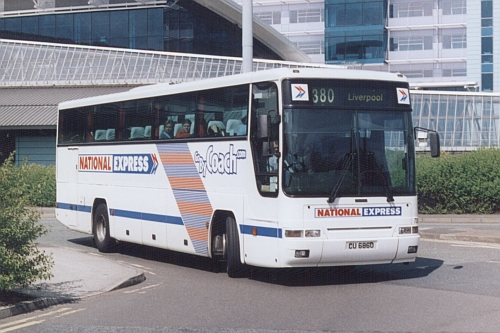
The Volvo B10M is a mid-engine city bus and coach chassis manufactured by Volvo between 1978 and 2003. It succeeded the B58 and was equipped with the same 9.6-litre horizontally mounted Volvo diesel engine mounted under the floor behind the front axle. An articulated bus version under the model name Volvo B10MA was also offered, as was a semi-integral version known as the C10M, with the engine in the middle of the chassis.
Designed as a successor to the Volvo B58, a large portion of B10M chassis were built in Sweden, but some were built in other countries, like the United Kingdom and Brazil.
The B10M was one of the best-selling chassis in the United Kingdom throughout the 1980s and 1990s. Having originally been produced only as a coach chassis, the B10M was made available as a city bus, in which form it was also very popular.
It was available as B10M-46, B10M-50, B10M-55, B10M-60, B10M-62, B10M-65 and B10M-70, where the number represents the wheelbase in decimetres. Many bodybuilders did however shorten or extend the chassis to fit their needs. No later than 1981 a tri-axle chassis was introduced, available as B10M-50B, B10M-55B, B10M-60B, B10M-65B and B10M-70B, with some bodybuilders extending them up to 7.25 metres wheelbase.
A double-decker version of the B10M was developed in the United Kingdom for Strathclyde PTE in 1981. It was launched in early 1982 as a successor to the front-engined Volvo Ailsa B55, with a downrated engine from the B10M coach, and was named Citybus (also known unofficially as B10MD or D10M). The bus was 9,514 mm in length, possessed a six-cylinder, 9.6 litre THD100 engine, and was offered with either a Voith or ZF automatic gearbox. Most early examples were bodied by Walter Alexander Coachbuilders, who provided a modified version – common to all Volvo double-deck chassis bodied by the company after 1980 – of their popular and attractive R type bodywork, as used initially on the Ailsa (and characterised by a large black front grille). Eastern Scottish and Fife Scottish bought many of these early versions between 1985 and 1987. Two were exported in 1984, one of them to Singapore Bus Services (SBS) and the other to Kowloon Motor Bus (KMB). The KMB B10MD bus was destroyed by fire in 1988.
The Citybus lasted until the end of B10M production but fell out of favour after Volvo re-engineered the Leyland Olympian as the Volvo Olympian in 1993. 586 examples were built for 32 operators in the UK, with the last batch received by Nottingham City Transport in 1997. Alexander bodied the majority of them, supplying 336 to 23 operators between 1984 and 1993. The three biggest customers of the Citybus were Strathclyde PTE (which bought 101 Citybuses between 1984 and 1990), London & Country (74) and Nottingham City Transport (46).
The B9M was launched in 1982 as a light-weight, stripped-down, budget version of the standard B10M. It was available as B9M-46, B9M-50, B9M-55 and B9M-60. Although technically not a successor to the B57, it found more or less the same place in the markets where it was available. The B9M had the same 9.6-litre engine as the B10M, but at lower outputs. It sold well in the Nordic countries, with the exception of Denmark, where only a few were sold. The model was available at least past 1996.
In the United Kingdom, the B9M-46 was sold as a shorter 9.5 to 9.7 metre version of the B10M from 1985.
Hub AI
Volvo B10M AI simulator
(@Volvo B10M_simulator)
Volvo B10M
The Volvo B10M is a mid-engine city bus and coach chassis manufactured by Volvo between 1978 and 2003. It succeeded the B58 and was equipped with the same 9.6-litre horizontally mounted Volvo diesel engine mounted under the floor behind the front axle. An articulated bus version under the model name Volvo B10MA was also offered, as was a semi-integral version known as the C10M, with the engine in the middle of the chassis.
Designed as a successor to the Volvo B58, a large portion of B10M chassis were built in Sweden, but some were built in other countries, like the United Kingdom and Brazil.
The B10M was one of the best-selling chassis in the United Kingdom throughout the 1980s and 1990s. Having originally been produced only as a coach chassis, the B10M was made available as a city bus, in which form it was also very popular.
It was available as B10M-46, B10M-50, B10M-55, B10M-60, B10M-62, B10M-65 and B10M-70, where the number represents the wheelbase in decimetres. Many bodybuilders did however shorten or extend the chassis to fit their needs. No later than 1981 a tri-axle chassis was introduced, available as B10M-50B, B10M-55B, B10M-60B, B10M-65B and B10M-70B, with some bodybuilders extending them up to 7.25 metres wheelbase.
A double-decker version of the B10M was developed in the United Kingdom for Strathclyde PTE in 1981. It was launched in early 1982 as a successor to the front-engined Volvo Ailsa B55, with a downrated engine from the B10M coach, and was named Citybus (also known unofficially as B10MD or D10M). The bus was 9,514 mm in length, possessed a six-cylinder, 9.6 litre THD100 engine, and was offered with either a Voith or ZF automatic gearbox. Most early examples were bodied by Walter Alexander Coachbuilders, who provided a modified version – common to all Volvo double-deck chassis bodied by the company after 1980 – of their popular and attractive R type bodywork, as used initially on the Ailsa (and characterised by a large black front grille). Eastern Scottish and Fife Scottish bought many of these early versions between 1985 and 1987. Two were exported in 1984, one of them to Singapore Bus Services (SBS) and the other to Kowloon Motor Bus (KMB). The KMB B10MD bus was destroyed by fire in 1988.
The Citybus lasted until the end of B10M production but fell out of favour after Volvo re-engineered the Leyland Olympian as the Volvo Olympian in 1993. 586 examples were built for 32 operators in the UK, with the last batch received by Nottingham City Transport in 1997. Alexander bodied the majority of them, supplying 336 to 23 operators between 1984 and 1993. The three biggest customers of the Citybus were Strathclyde PTE (which bought 101 Citybuses between 1984 and 1990), London & Country (74) and Nottingham City Transport (46).
The B9M was launched in 1982 as a light-weight, stripped-down, budget version of the standard B10M. It was available as B9M-46, B9M-50, B9M-55 and B9M-60. Although technically not a successor to the B57, it found more or less the same place in the markets where it was available. The B9M had the same 9.6-litre engine as the B10M, but at lower outputs. It sold well in the Nordic countries, with the exception of Denmark, where only a few were sold. The model was available at least past 1996.
In the United Kingdom, the B9M-46 was sold as a shorter 9.5 to 9.7 metre version of the B10M from 1985.