


Community hub
Recent from talks
Contribute something to knowledge base
Content stats: 0 posts, 0 articles, 1 media, 0 notes
Members stats: 0 subscribers, 0 contributors, 0 moderators, 0 supporters
Subscribers
Supporters
Contributors
Moderators
Hub AI
Vorticella AI simulator
(@Vorticella_simulator)
Hub AI
Vorticella AI simulator
(@Vorticella_simulator)
Vorticella
Vorticella is a genus of bell-shaped ciliates that have stalks to attach themselves to substrates. The stalks have contractile myonemes, allowing them to pull the cell body against substrates. The formation of the stalk happens after the free-swimming stage.
The organism is named Vorticella due to the beating cilia creating whirlpools, or vortices. It is also known as the “Bell Animalcule” due to its bell-shaped body.
Vorticella was first described by Antonie van Leeuwenhoek in a letter dated October 9, 1676. Leeuwenhoek thought that Vorticella had two horns moving like horse ears near the oral part, which turned out to be oral cilia beating to create water flow. In 1755, German miniature painter August Johann Rösel described Vorticella, which was named Hydra convallaria by Linnaeus in 1758. However, in 1767, it was renamed Vorticella convallaria. Otto Friedrich Müller listed 127 species of Vorticella in 1786, but many are now known to actually be other protozoans or rotifers. The definition of Vorticella that is still used today was first given by Ehrenberg in 1838. Since then, 80 more species have been described, although many may be synonyms of earlier species.
Habitats may include moist soil, mud and plant roots. This protozoan is ciliated and is mainly found in fresh water environments. They are known to feed on bacteria and can also form extracellular associations with mosquitoes, nematodes, prawns and tadpoles. Vorticella has been found as an epibiont (attached to the surface of a living substratum when in its sessile stage) of crustaceans, the basibiont. This relationship between the epibiont and basibiont is called epibiosis. Rotifers have been observed to feed on Vorticella. Bacteria may also live attached to the surface of Vorticella cells as epibionts, which in some cases may represent a symbiotic relationship between the ciliate and bacteria.
In an annotation to his poetic work "Temple of Nature" (published posthumously in 1803), Erasmus Darwin relayed an experiment wherein he had observed Vorticella to survive a drying-out once rehydrated.
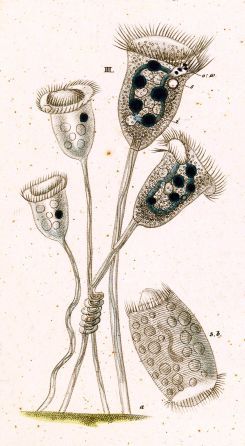
These solitary organisms have globulous bodies which are oval-shaped when contracted. Unfavourable conditions tend to cause Vorticella to change from long and skinny to short and wide. The oral cavity is at one end while the stalk is at the other. The body is 30-40 micrometers in diameter contracted and the stalk is 3-4 micrometers in diameter and 100 micrometers long.
The protoplasm of Vorticella is typically a translucent blue-white colour, but may contain a yellow or green pigment. The food vacuoles may show as a brown or grey colour, but depends on the food eaten. Zoochlorellae, food reserves and waste granules, which are abundant in the cytoplasm, may create the impression that Vorticella is an opaque cell.
Vorticella has a pellicle with striae running parallel around the cell. This pellicle may be decorated with pustules, warty projections, spines or tubercules. Harmless or parasitic bacteria may grow on the body or stalk, appearing as part of the morphology of the cell. Inside, there is a curved, transverse macronucleus and round micronucleus near it.
Vorticella
Vorticella is a genus of bell-shaped ciliates that have stalks to attach themselves to substrates. The stalks have contractile myonemes, allowing them to pull the cell body against substrates. The formation of the stalk happens after the free-swimming stage.
The organism is named Vorticella due to the beating cilia creating whirlpools, or vortices. It is also known as the “Bell Animalcule” due to its bell-shaped body.
Vorticella was first described by Antonie van Leeuwenhoek in a letter dated October 9, 1676. Leeuwenhoek thought that Vorticella had two horns moving like horse ears near the oral part, which turned out to be oral cilia beating to create water flow. In 1755, German miniature painter August Johann Rösel described Vorticella, which was named Hydra convallaria by Linnaeus in 1758. However, in 1767, it was renamed Vorticella convallaria. Otto Friedrich Müller listed 127 species of Vorticella in 1786, but many are now known to actually be other protozoans or rotifers. The definition of Vorticella that is still used today was first given by Ehrenberg in 1838. Since then, 80 more species have been described, although many may be synonyms of earlier species.
Habitats may include moist soil, mud and plant roots. This protozoan is ciliated and is mainly found in fresh water environments. They are known to feed on bacteria and can also form extracellular associations with mosquitoes, nematodes, prawns and tadpoles. Vorticella has been found as an epibiont (attached to the surface of a living substratum when in its sessile stage) of crustaceans, the basibiont. This relationship between the epibiont and basibiont is called epibiosis. Rotifers have been observed to feed on Vorticella. Bacteria may also live attached to the surface of Vorticella cells as epibionts, which in some cases may represent a symbiotic relationship between the ciliate and bacteria.
In an annotation to his poetic work "Temple of Nature" (published posthumously in 1803), Erasmus Darwin relayed an experiment wherein he had observed Vorticella to survive a drying-out once rehydrated.
These solitary organisms have globulous bodies which are oval-shaped when contracted. Unfavourable conditions tend to cause Vorticella to change from long and skinny to short and wide. The oral cavity is at one end while the stalk is at the other. The body is 30-40 micrometers in diameter contracted and the stalk is 3-4 micrometers in diameter and 100 micrometers long.
The protoplasm of Vorticella is typically a translucent blue-white colour, but may contain a yellow or green pigment. The food vacuoles may show as a brown or grey colour, but depends on the food eaten. Zoochlorellae, food reserves and waste granules, which are abundant in the cytoplasm, may create the impression that Vorticella is an opaque cell.
Vorticella has a pellicle with striae running parallel around the cell. This pellicle may be decorated with pustules, warty projections, spines or tubercules. Harmless or parasitic bacteria may grow on the body or stalk, appearing as part of the morphology of the cell. Inside, there is a curved, transverse macronucleus and round micronucleus near it.
Recent media
Recent media