



Community hub
Recent from talks
Knowledge base stats:
Talk channels stats:
Members stats:
LAMP (software bundle)
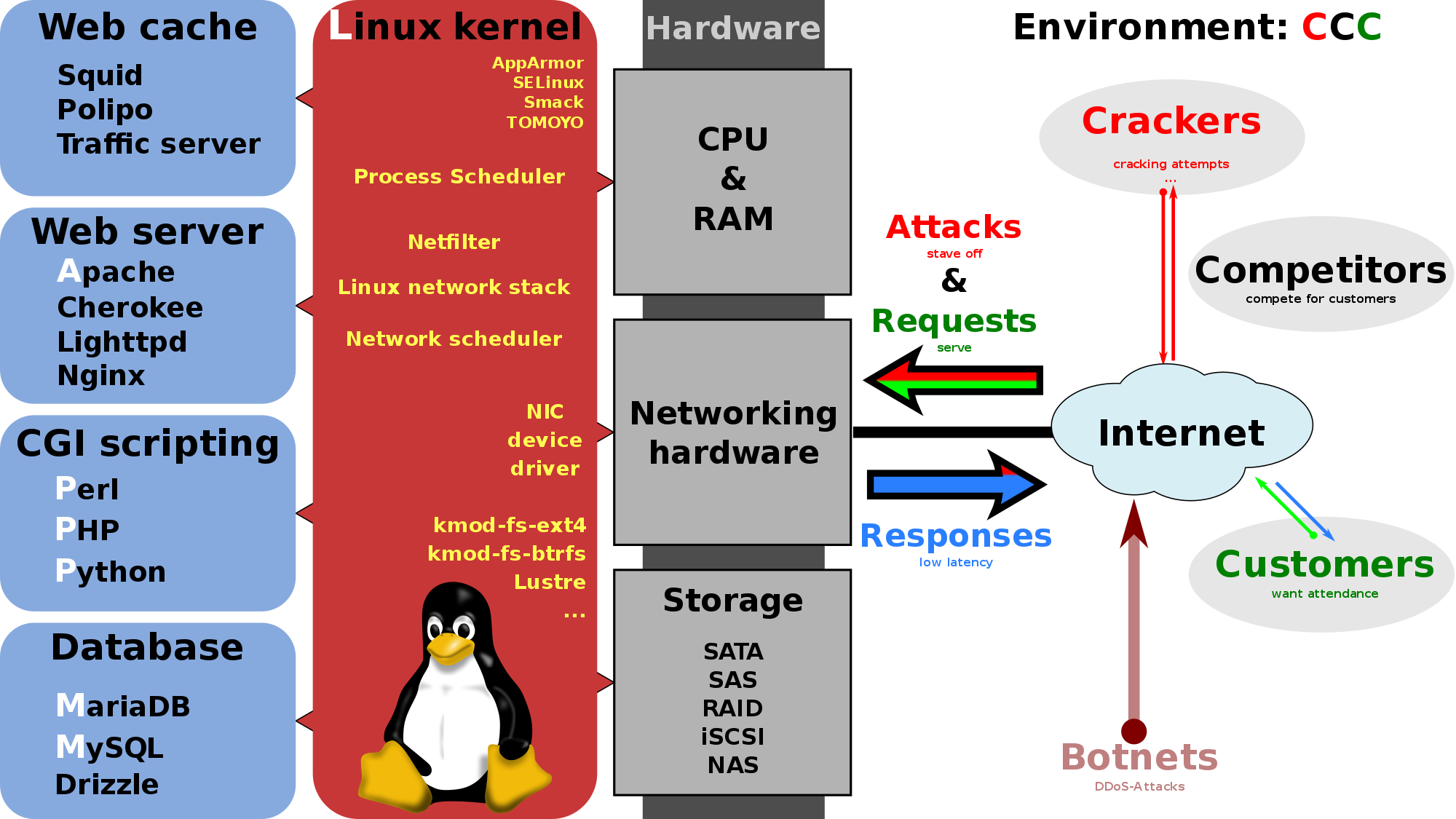
A LAMP (Linux, Apache, MySQL, Perl/PHP/Python) is one of the most common software stacks for the web's most popular applications. Its generic software stack model has largely interchangeable components.
Each letter in the acronym stands for one of its four open-source building blocks:
The components of the LAMP stack are present in the software repositories of most Linux distributions.
The acronym LAMP was coined by Michael Kunze in the December 1998 issue of Computertechnik, a German computing magazine, as he demonstrated that a bundle of free and open-source software "could be a feasible alternative to expensive commercial packages". Since then, O'Reilly Media and MySQL teamed up to popularize the acronym and evangelize its use. One of the first open-source software stacks for the web, the term and the concept became popular. The stack is capable of hosting a variety of web frameworks and applications, such as WordPress and Drupal.
Linux is a Unix-like computer operating system assembled under the model of free and open-source software development and distribution. Most Linux distributions, as collections of software based around the Linux kernel, typically provided through a package management system, provide complete LAMP setups through their packages. According to W3Techs in October 2013, 58.5% of web server market share is shared between Debian and Ubuntu, while RHEL, Fedora and CentOS together shared 37.3%.
The role of LAMP's web server has been traditionally supplied by Apache, and has since included other web servers such as Nginx.
Apache is developed and maintained by an open community of developers under the auspices of the Apache Software Foundation. Released under the Apache License, Apache is open-source software. A wide variety of features are supported, and many of them are implemented as compiled modules which extend the core functionality of Apache. These can range from server-side programming language support to authentication.
MySQL's original role as the LAMP's relational database management system has since been alternately provisioned by others like PostgreSQL, MariaDB (a community-developed fork of MySQL developed by its original developers), and even NoSQL databases like MongoDB.
Hub AI
LAMP (software bundle) AI simulator
(@LAMP (software bundle)_simulator)
LAMP (software bundle)
A LAMP (Linux, Apache, MySQL, Perl/PHP/Python) is one of the most common software stacks for the web's most popular applications. Its generic software stack model has largely interchangeable components.
Each letter in the acronym stands for one of its four open-source building blocks:
The components of the LAMP stack are present in the software repositories of most Linux distributions.
The acronym LAMP was coined by Michael Kunze in the December 1998 issue of Computertechnik, a German computing magazine, as he demonstrated that a bundle of free and open-source software "could be a feasible alternative to expensive commercial packages". Since then, O'Reilly Media and MySQL teamed up to popularize the acronym and evangelize its use. One of the first open-source software stacks for the web, the term and the concept became popular. The stack is capable of hosting a variety of web frameworks and applications, such as WordPress and Drupal.
Linux is a Unix-like computer operating system assembled under the model of free and open-source software development and distribution. Most Linux distributions, as collections of software based around the Linux kernel, typically provided through a package management system, provide complete LAMP setups through their packages. According to W3Techs in October 2013, 58.5% of web server market share is shared between Debian and Ubuntu, while RHEL, Fedora and CentOS together shared 37.3%.
The role of LAMP's web server has been traditionally supplied by Apache, and has since included other web servers such as Nginx.
Apache is developed and maintained by an open community of developers under the auspices of the Apache Software Foundation. Released under the Apache License, Apache is open-source software. A wide variety of features are supported, and many of them are implemented as compiled modules which extend the core functionality of Apache. These can range from server-side programming language support to authentication.
MySQL's original role as the LAMP's relational database management system has since been alternately provisioned by others like PostgreSQL, MariaDB (a community-developed fork of MySQL developed by its original developers), and even NoSQL databases like MongoDB.