



Community hub
LAMP (software bundle)
View on Wikipedia

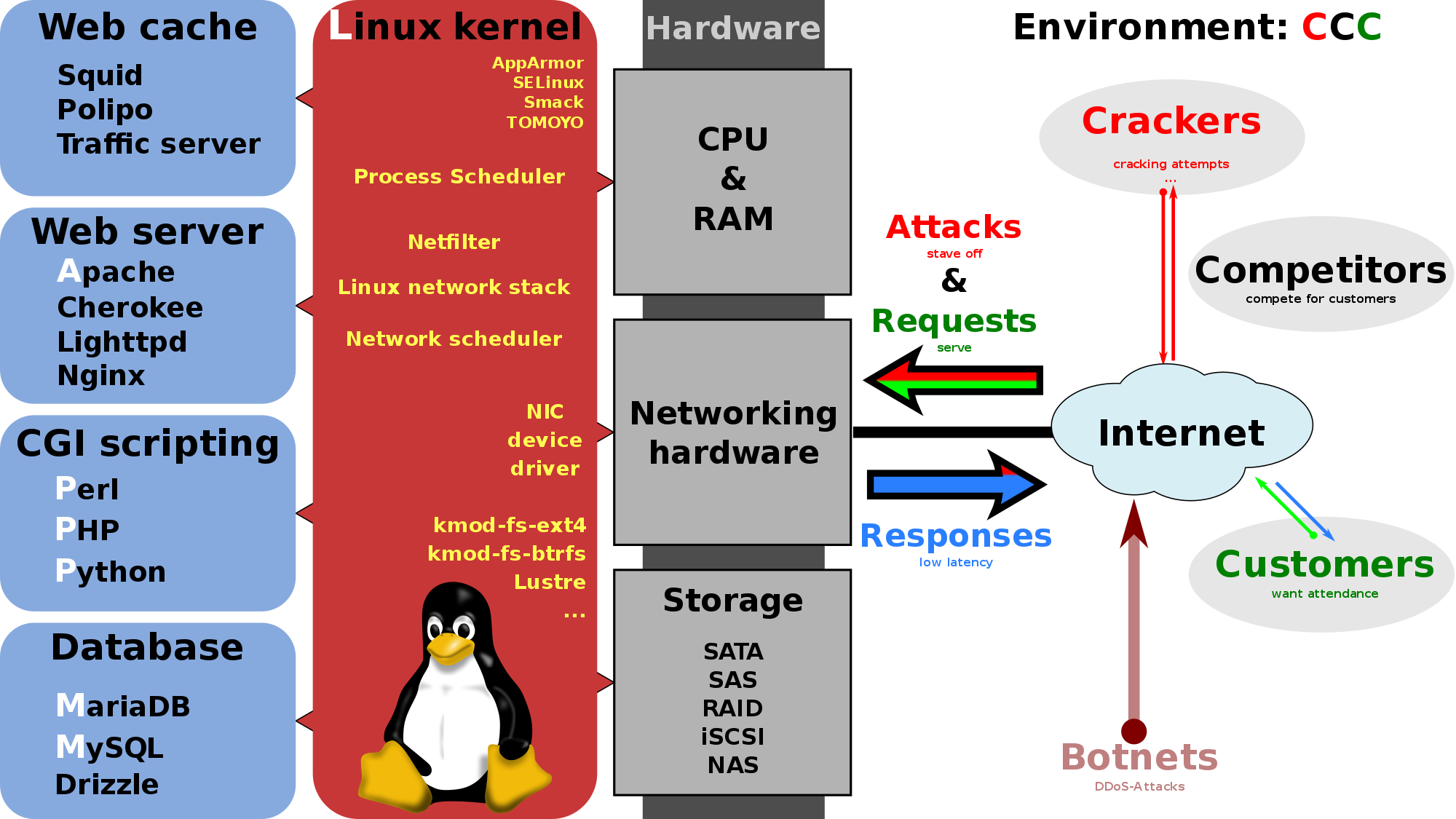
A LAMP (Linux, Apache, MySQL, Perl/PHP/Python) is one of the most common software stacks for the web's most popular applications. Its generic software stack model has largely interchangeable components.[1]
Each letter in the acronym stands for one of its four open-source building blocks:
- Linux for the operating system
- Apache HTTP Server
- Maria DB or MySQL for the relational database management system
- Perl, PHP, or Python for the programming language
The components of the LAMP stack are present in the software repositories of most Linux distributions.
History
[edit]The acronym LAMP was coined by Michael Kunze in the December 1998 issue of Computertechnik, a German computing magazine, as he demonstrated that a bundle of free and open-source software "could be a feasible alternative to expensive commercial packages".[2] Since then, O'Reilly Media and MySQL teamed up to popularize the acronym and evangelize its use.[3] One of the first open-source software stacks for the web, the term and the concept became popular. The stack is capable of hosting a variety of web frameworks and applications, such as WordPress and Drupal.[4]
Software components
[edit]
Linux
[edit]Linux is a Unix-like computer operating system assembled under the model of free and open-source software development and distribution. Most Linux distributions, as collections of software based around the Linux kernel, typically provided through a package management system, provide complete LAMP setups through their packages. According to W3Techs in October 2013, 58.5% of web server market share is shared between Debian and Ubuntu, while RHEL, Fedora and CentOS together shared 37.3%.[5]
Apache
[edit]The role of LAMP's web server has been traditionally supplied by Apache, and has since included other web servers such as Nginx.
Apache is developed and maintained by an open community of developers under the auspices of the Apache Software Foundation. Released under the Apache License, Apache is open-source software. A wide variety of features are supported, and many of them are implemented as compiled modules which extend the core functionality of Apache. These can range from server-side programming language support to authentication.
MySQL and database alternatives
[edit]MySQL's original role as the LAMP's relational database management system has since been alternately provisioned by others like PostgreSQL, MariaDB (a community-developed fork of MySQL developed by its original developers), and even NoSQL databases like MongoDB.
MySQL is a multithreaded, multi-user, SQL database management system,[6] acquired by Sun Microsystems in 2008, which was then acquired by Oracle Corporation in 2010.[7] Since its early years, the MySQL team has made its source code available under the terms of the GNU General Public License, as well as under a variety of proprietary agreements.
PostgreSQL is also an ACID-compliant object-relational database management system developed by PostgreSQL Global Development Group.
MongoDB is a NoSQL database that eschews the traditional relational database structure in favor of JSON-like documents with dynamic schemas (calling the format BSON), making the integration of data in certain types of applications easier and faster.
PHP and alternatives
[edit]PHP's role as the LAMP's application programming language has also been performed by other languages such as Perl and Python.
PHP is a server-side scripting language designed for web development but also used as a general-purpose programming language. PHP code is interpreted by a web server via a PHP processor module, which generates the resulting web page. PHP commands can optionally be embedded directly into an HTML source document rather than calling an external file to process data. It has also evolved to include a command-line interface capability and can be used in standalone graphical applications.[8] PHP is free software released under the terms of PHP License, which is incompatible with the GNU General Public License (GPL) due to restrictions the PHP License places on the usage of the term PHP.[9]
Perl is a family of high-level, general-purpose, interpreted, dynamic programming languages. The languages in this family include Perl 5 and Raku.[10] They provide advanced text processing facilities without the arbitrary data-length limits of many contemporary Unix command line tools,[11] facilitating manipulation of text files. Perl 5 gained widespread popularity in the late 1990s as a CGI scripting language for the Web, in part due to its parsing abilities.[12]
Python is a widely used general-purpose, high-level, interpreted, programming language.[13] Python supports multiple programming paradigms, including object-oriented, imperative, functional and procedural paradigms. It features a dynamic type system, automatic memory management, a standard library, and strict use of whitespace.[14] Like other dynamic languages, Python is often used as a scripting language, but is also used in a wide range of non-scripting contexts.
High availability and load balancing
[edit]Specific approaches are required for websites that serve large numbers of requests, or provide services that demand high uptime. High-availability approaches for the LAMP stack may involve multiple web and database servers, combined with additional components that perform logical aggregation of resources provided by each of the servers, as well as distribution of the workload across multiple servers. The aggregation of web servers may be provided by placing a load balancer in front of them, for example by using Linux Virtual Server (LVS). For the aggregation of database servers, MySQL provides internal replication mechanisms that implement a master/slave relationship between the original database (master) and its copies (slaves).[15]
Such high-availability setups may also improve the availability of LAMP instances by providing various forms of redundancy, making it possible for a certain number of components (separate servers) to experience downtime without interrupting the users of services provided as a whole. Such redundant setups may also handle hardware failures resulting in data loss on individual servers in a way that prevents collectively stored data from actually becoming lost. Beside higher availability, such LAMP setups are capable of providing almost linear improvements in performance for services having the number of internal database read operations much higher than the number of write/update operations.[15]
Variants
[edit]The LAMP model has been adapted to other componentry, though typically consisting of free and open-source software. With the growing use of the archetypal LAMP, variations and retronyms appeared for other combinations of operating system, web server, database, and software language. For example, an equivalent installation on the Microsoft Windows operating system family is known as WAMP. An alternative running IIS in place of Apache is called WIMP. Variants involving other operating systems include DAMP, which uses the Darwin operating system.[16]
The web server or database management system also varies. LEMP is a version where Apache has been replaced with the more lightweight web server Nginx.[17] A version where MySQL has been replaced by PostgreSQL is called LAPP, or sometimes by keeping the original acronym, LAMP (Linux / Apache / Middleware (Perl, PHP, Python, Ruby) / PostgreSQL).[18]
The LAMP bundle can be combined with many other free and open-source software packages, including:
- netsniff-ng for security testing and hardening
- Snort, an intrusion detection (IDS) and intrusion prevention (IPS) system
- RRDtool for diagrams
- Nagios, Collectd or Cacti, for monitoring.
As another example, the software which Wikipedia and other Wikimedia Foundation projects use for their underlying infrastructure is a customized LAMP stack with additions such as Linux Virtual Server (LVS) for load balancing and Ceph and Swift for distributed object storages.[citation needed]
See also
[edit]


- JAMstack
- LYME – a software stack based on Erlang
- MEAN – a JavaScript software stack for building dynamic web sites and web applications
- Solution stack
- Web content management system
- Web Platform Installer
References
[edit]- ^ "LAMP (Linux, Apache, MySQL, PHP)". SearchEnterpriseLinux. Archived from the original on 28 November 2021. Retrieved 15 December 2021.
- ^ Kunze, Michael (December 1998). "LAMP: Freeware Web Publishing System with Database Support". c't. Archived from the original on 3 February 1999. Retrieved 15 June 2024.
- ^ Kay, Russell (25 September 2006). "How To: LAMP". Computerworld. Archived from the original on 11 July 2021. Retrieved 15 December 2021.
- ^ "LAMP stack". IBM cloud learn hub. IBM. October 2015. Archived from the original on 15 December 2021. Retrieved 15 December 2021.
- ^ "Debian/Ubuntu extend the dominance in the Linux web server market". W³Techs. Retrieved 16 December 2021.
- ^ "Top reasons for product managers to embed". MySQL. Archived from the original on 2 July 2014. Retrieved 27 July 2014.
- ^ "Sun locks up MySQL, looks to future web development". InformationWeek. Archived from the original on 28 February 2008. Retrieved 27 July 2014.
- ^ "Introduction: What can PHP do?". PHP Manual. Archived from the original on 15 December 2021. Retrieved 16 December 2021.
- ^ "GPL-incompatible, free software licenses". Various licenses and comments about them. Free software foundation. Archived from the original on 16 December 2021. Retrieved 16 December 2021.
- ^ "About Perl". perl.org. Archived from the original on 22 November 2021. Retrieved 16 December 2021.
"Perl" is a family of languages, "Perl 6" is part of the family, but it is a separate language which has its own development team. Its existence has no significant impact on the continuing development of "Perl 5".
- ^ Wall, Larry; Tom Christiansen; Jon Orwant (July 2000). Programming Perl, third edition. O'Reilly Media. ISBN 0-596-00027-8.
- ^ Smith, Roderick W. (21 June 2002). Advanced Linux networking. Addison-Wesley Professional. p. 594. ISBN 978-0-201-77423-8.
- ^ "Programming language trends – O'Reilly radar". Radar.oreilly.com. 2 August 2006. Archived from the original on 24 September 2021. Retrieved 16 December 2021.
- ^ "About Python". Python software foundation. Archived from the original on 16 December 2021. Retrieved 16 December 2021.
- ^ a b Simic, Dragan; Ristic, Srecko; Obradovic, Slobodan (April 2007). "Measurement of the achieved performance levels of the web applications with distributed relational database" (PDF). Electronics and energetics. Facta Universitatis. p. 31–43. Archived (PDF) from the original on 7 October 2021. Retrieved 16 December 2021.
- ^ McIntosh, Jason; Toporek, Chuck; Stone, Chris (2003). Mac OS X in a Nutshell. O'Reilly & Associates. pp. 327–333. ISBN 978-0-596-00370-8.
- ^ "LEMP stack (Linux, Nginx, MySQL, PHP)". lemp.io. Archived from the original on 19 November 2021. Retrieved 16 December 2021.
- ^ "Featured users". PostgreSQL. Archived from the original on 22 January 2014. Retrieved 22 January 2014.
| Linux kernel | |
|---|---|
| Controversies | |
| Distributions | |
| Organizations | |
| Adoption | |
| Media | |
| Security certifications | |


| General | |||
|---|---|---|---|
| Software packages | |||
| Community | |||
| Organisations | |||
| Licenses |
| ||
| Challenges | |||
| Related topics | |||

LAMP (software bundle)
View on GrokipediaIntroduction
Definition and Acronym
The LAMP software bundle is an open-source collection of software components designed to facilitate the development and hosting of dynamic websites and web applications. It provides a complete web-serving environment by integrating an operating system, web server, database management system, and scripting language, enabling efficient server-side processing and data management.[1] The acronym LAMP expands to Linux, referring to the operating system; Apache, the web server software; MySQL, the relational database management system; and PHP, a server-side scripting language. These components work together to handle requests, serve content, store and retrieve data, and generate dynamic pages, forming a robust foundation for web development.[3] The term "LAMP" was coined in 1998 by Michael Kunze, a writer for the German computing magazine c't (short for Computertechnik), in an article demonstrating the potential of this free software combination as an alternative to proprietary systems.[6]Purpose and Applications
The LAMP stack provides a cost-effective and scalable open-source platform for server-side dynamic content generation and the development of database-driven websites, enabling developers to build robust web applications without proprietary licensing fees.[1] By combining Linux for the operating system, Apache for web serving, MySQL for database management, and PHP for scripting, it offers a complete, integrated environment tailored for handling both static and interactive web content, such as personalized user experiences or data-intensive operations.[7] This architecture supports efficient resource utilization, making it suitable for deployments ranging from small sites to high-traffic platforms.[1] Key applications of the LAMP stack include content management systems (CMS) like WordPress, which powers a significant portion of the web for blogging and site management, and e-commerce platforms such as Magento, which rely on its components for inventory tracking, transaction processing, and user authentication.[7] It is also employed in custom web applications, including social networking sites and online forums, where dynamic data retrieval and manipulation are essential.[3] These uses leverage LAMP's ability to process user inputs, query databases in real-time, and deliver tailored responses, facilitating scalable growth for businesses and organizations.[1] The stack's advantages stem from its fully open-source composition, allowing free modification and distribution of code, which reduces development costs and fosters innovation.[7] A vast global community contributes to ongoing maintenance, security updates, and a wealth of resources, including forums, plugins, and documentation, ensuring long-term reliability—open-source software underpins approximately 80% of internet applications.[3] Furthermore, its adherence to established standards like HTTP for web communication and SQL for database interactions promotes broad compatibility and ease of integration with other technologies.[1]Historical Development
Origins and Early Adoption
The term "LAMP," representing the combination of Linux, Apache, MySQL, and PHP (or Perl/Python), was coined by German author Michael Kunze in an article published in the December 1998 issue of the computing magazine c't.[8] Kunze used the acronym to describe an efficient, open-source bundle for building dynamic websites, highlighting its potential as a cost-effective alternative to commercial software stacks prevalent at the time.[6] This naming captured the growing synergy among these tools, which had individually emerged in the mid-1990s but were increasingly deployed together for web development. The LAMP stack emerged during the late 1990s dot-com boom, a period of rapid internet expansion from 1995 to 2000 characterized by explosive growth in online businesses and web traffic. As startups and entrepreneurs sought scalable web solutions amid this surge, proprietary systems like Microsoft's Internet Information Services (IIS) and expensive database servers from vendors such as Oracle proved costly and restrictive for many.[9] LAMP addressed this by offering a fully open-source ecosystem that enabled affordable, customizable web hosting on commodity hardware, democratizing access to dynamic content creation without licensing fees.[10] Early adoption was driven by small businesses, independent developers, and web agencies who leveraged the stack's free availability to rapidly prototype and deploy applications during the boom's peak. The core components—Apache HTTP Server (initial release April 1995), PHP (first public release June 1995), and MySQL (internal release May 1995)—were all licensed under open-source terms, allowing seamless integration on Linux distributions without financial barriers.[11][12][13] This accessibility fueled grassroots experimentation, with LAMP powering early e-commerce sites, forums, and content management systems that contributed to the era's web innovation.[14]Evolution and Milestones
The LAMP stack gained widespread adoption throughout the 2000s, becoming a foundational technology for dynamic web applications during the post-dot-com boom era. By the early 2000s, it powered high-profile sites such as Wikipedia, which transitioned to a PHP-based system (MediaWiki) in 2002 running on Linux, Apache, and MySQL, enabling scalable collaborative editing for millions of users. Similarly, content management systems like Drupal (launched 2001) and WordPress (launched 2003) were built on LAMP, contributing to its ubiquity in hosting blogs, forums, and e-commerce platforms.[15] This period marked LAMP's role in democratizing web development, with its open-source components allowing cost-effective deployment on shared hosting environments. Key evolutions in the mid-2000s and 2010s enhanced LAMP's capabilities and addressed community concerns. The release of PHP 5 in July 2004 introduced a robust object-oriented programming model, including support for classes, interfaces, visibility (public, protected, private), and exceptions, which significantly improved code organization and maintainability for large-scale applications.[12] Later, the 2010 acquisition of MySQL by Oracle—following Sun Microsystems' purchase in 2008—raised fears of proprietary shifts in the open-source database, prompting original MySQL co-founder Michael "Monty" Widenius to initiate the MariaDB fork in October 2009 as a drop-in compatible alternative committed to open development.[16] These changes allowed LAMP users to maintain flexibility, with many stacks transitioning to MariaDB without disruption. As of 2025, LAMP remains relevant in legacy systems and modern hybrid configurations, particularly through containerization technologies like Docker, which enable isolated, portable deployments of the full stack in cloud environments.[17] Despite the rise of JavaScript-based stacks like Node.js and MEAN, LAMP's enduring use is evident in its powering of WordPress, which supports approximately 43% of all websites as of 2023, alongside broader PHP adoption on about 77% of sites with known server-side languages.[18] This persistence underscores LAMP's reliability for maintaining vast existing infrastructures while integrating with contemporary DevOps practices.Core Components
Linux Operating System
Linux serves as the foundational operating system in the LAMP software bundle, providing a free and open-source, Unix-like runtime environment that hosts the Apache web server, MySQL database, and PHP scripting language components.[2] Developed initially in 1991 by Linus Torvalds, Linux offers a modular kernel that manages system resources, file systems, and networking, ensuring compatibility and efficient operation of the stack's upper layers.[19] Popular Linux distributions recommended for LAMP deployments include Ubuntu Server, valued for its ease of use and long-term support, and Rocky Linux, a community-driven successor to CentOS that emphasizes enterprise-grade stability.[20][21] These distributions facilitate package management through tools like apt for Ubuntu, which handles dependency resolution and updates seamlessly, and dnf (formerly yum) for Rocky Linux, enabling straightforward installation of LAMP components via repositories. Key benefits of Linux in the LAMP stack stem from its robust security features, such as SELinux in Rocky Linux and Red Hat derivatives, which implements mandatory access controls to prevent unauthorized actions and enhance server protection.[22] The Linux kernel's preemptive multitasking capabilities allow efficient handling of concurrent processes, supporting high-throughput web serving without resource contention.[23] Additionally, Linux's broad hardware compatibility spans from commodity x86 servers to ARM-based systems, enabling cost-effective deployments on affordable infrastructure while maintaining performance.[24] This foundation allows Apache to process incoming HTTP requests reliably atop the OS.[1]Apache Web Server
The Apache HTTP Server serves as the foundational web server component in the LAMP stack, functioning as a modular, open-source HTTP server that processes incoming HTTP requests and delivers both static files, such as HTML pages and images, and dynamic content generated by applications. Developed by the Apache Software Foundation, it operates under the Apache License 2.0, enabling free modification and distribution while supporting a wide range of operating systems, including Linux. In the context of LAMP, Apache acts as the intermediary between clients and the backend PHP and MySQL components, routing requests efficiently to produce web pages on demand.[25] Key features of Apache enhance its flexibility for LAMP deployments. Virtual hosting allows a single Apache instance to manage multiple websites by distinguishing them based on IP addresses (IP-based virtual hosting) or domain names (name-based virtual hosting, introduced in version 1.1), which is essential for hosting diverse applications without dedicated hardware. The .htaccess file provides per-directory configuration overrides, permitting site-specific settings like authentication, redirects, and access controls without restarting the server or modifying the global configuration, thus supporting decentralized management in shared hosting environments. For dynamic content, the mod_php module embeds the PHP interpreter directly into Apache processes, enabling seamless execution of PHP scripts upon request; this integration is achieved by loading the module via the Apache API and configuring handlers for .php files, allowing Apache to parse and serve PHP-generated output as part of the HTTP response.[26][27][28] Apache's architecture relies on a process-based model for concurrency, managed through Multi-Processing Modules (MPMs) that determine how the server handles multiple simultaneous connections. The prefork MPM, the default on many Unix-like systems, spawns a pool of child processes where each process manages one connection at a time, ensuring compatibility with non-thread-safe modules like mod_php but potentially consuming more memory under high load. In contrast, the worker MPM employs a hybrid approach with multiple processes, each containing multiple threads to handle requests, offering improved scalability and resource efficiency for busier LAMP sites while still supporting thread-unsafe extensions with careful configuration. Server-wide settings, including module loading, MPM selection, and directive scoping for directories or virtual hosts, are defined in the primary configuration file httpd.conf, which requires a server restart to apply changes and uses plain-text directives for customization.[29][30]MySQL Database
MySQL serves as the relational database management system (RDBMS) in the LAMP stack, designed to store, manage, and retrieve structured data efficiently.[31] As an open-source RDBMS, it organizes data into tables consisting of rows and columns, enabling relationships between datasets through primary and foreign keys to maintain referential integrity. Developers interact with MySQL primarily using Structured Query Language (SQL) for operations such as creating tables, inserting records, updating values, and querying data with joins and aggregations.[32] This structure supports applications requiring persistent data storage, such as user accounts, product catalogs, or content management systems in web environments. At its core, MySQL employs key elements like tables for data organization, indexes to accelerate query performance, and transactions to ensure reliable operations. Tables form the foundational units, capable of handling large-scale datasets with up to 64 indexes per table, where indexes—often implemented as B-trees—optimize search and sort operations on columns like VARCHAR or TEXT fields.[32] Transactions in MySQL adhere to ACID (Atomicity, Consistency, Isolation, Durability) properties, particularly through the InnoDB storage engine, which guarantees that a series of database operations either completes fully or not at all, preserving data consistency even in the event of failures.[33] InnoDB, the default storage engine since MySQL 5.5, provides row-level locking to minimize contention in multi-user scenarios, allowing concurrent reads and writes on different rows without blocking the entire table.[34] In the LAMP stack, MySQL integrates seamlessly with PHP to enable dynamic web content generation, where PHP scripts connect to the database to fetch or modify data for rendering pages. PHP utilizes the mysqli extension, which offers an object-oriented interface for executing SQL queries and handling results, or the PDO (PHP Data Objects) extension with its MySQL driver for a database-agnostic approach that supports prepared statements to prevent SQL injection.[35][36] For instance, a PHP application might use mysqli to query user data from an InnoDB table and embed the results into HTML output served by Apache, facilitating real-time interactions like login authentication or search functionalities.[32] This integration underscores MySQL's role in providing scalable data persistence for PHP-driven web applications.PHP Scripting Language
PHP, standing for PHP: Hypertext Preprocessor, is an open-source, general-purpose scripting language particularly suited for web development within the LAMP stack, where it serves as the server-side scripting component.[37] As an interpreted language, PHP code is executed directly without prior compilation, allowing for rapid development and deployment of dynamic web applications.[38] It is designed to be embedded directly into HTML documents using special tags, such as<?php ?>, enabling developers to mix static HTML with dynamic PHP scripts that generate content on the fly based on user input, database queries, or other server-side logic.[39] This embedding model facilitates the creation of interactive web pages, where PHP processes requests and outputs customized responses, such as personalized user interfaces or real-time data displays.[38]
Key features of PHP enhance its utility in server-side scripting, including superglobals, which are predefined variables accessible across all scopes without explicit declaration.[40] For instance, the $_POST superglobal array captures data submitted via HTTP POST requests, allowing seamless handling of form inputs in web applications.[41] PHP also provides built-in functions for database interaction, such as those in the MySQLi extension for procedural or object-oriented connections to databases like MySQL, enabling queries, updates, and data retrieval within scripts.[35] Additionally, extensions like GD support image processing tasks, including creation, manipulation, and output of formats such as PNG and JPEG, which integrate directly into PHP code for features like dynamic thumbnails or watermarking.[42] These elements collectively allow PHP to handle complex logic while maintaining simplicity in syntax, influenced by languages like C, Java, and Perl.[38]
In the LAMP environment, PHP's execution model relies on integration with the Apache web server via the mod_php module, which embeds the PHP interpreter directly into Apache processes.[28] Upon receiving an HTTP request for a PHP file (typically identified by a .php extension), Apache invokes mod_php to parse the file: it scans for PHP delimiters, interprets the embedded code line by line, executes server-side operations—such as variable assignments, function calls, and conditional logic—and generates the resulting output, often HTML or other markup, which Apache then sends as the HTTP response to the client.[28] This lifecycle ensures efficient processing within the same server process, minimizing overhead for dynamic content generation, though it ties PHP's performance to Apache's process management. PHP can interface with the MySQL database component of LAMP using its database functions to fetch or store data during this execution.[35]