



Community hub
Recent from talks
Knowledge base stats:
Talk channels stats:
Members stats:
Ghana Empire
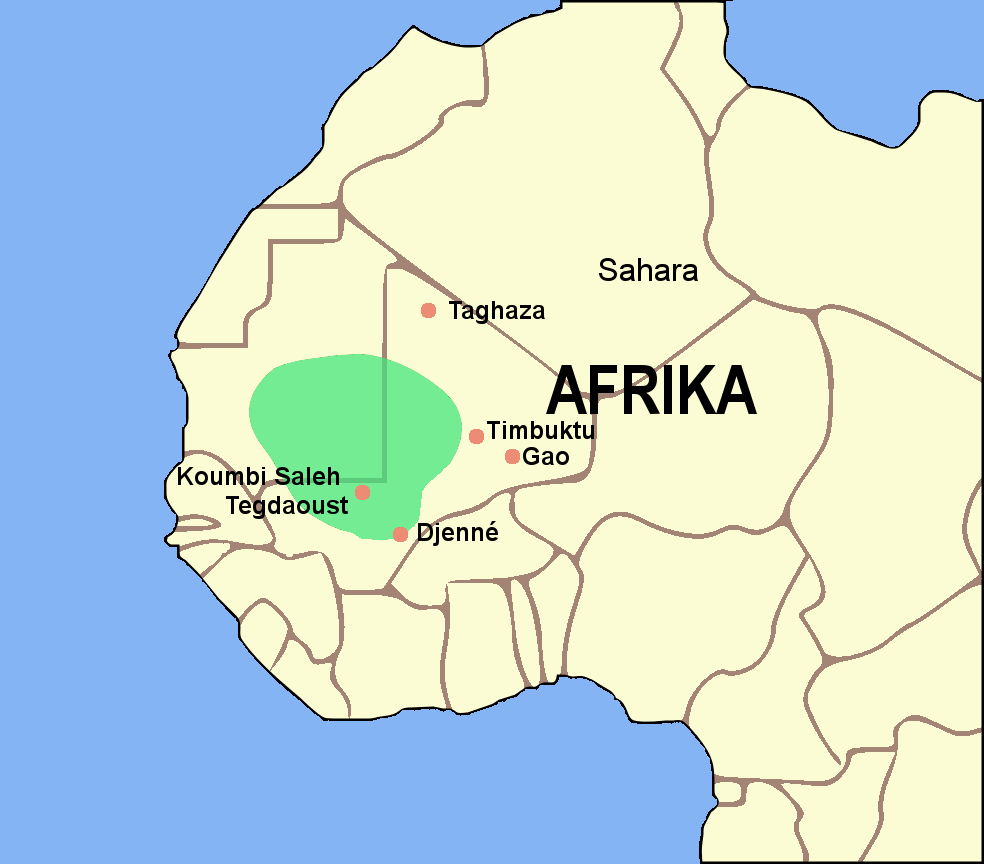
The Ghana Empire (Arabic: غانا), also known as simply Ghana, Ghanata, or Wagadu, was an ancient western-Sahelian empire based in the modern-day southeast of Mauritania and western Mali.
It is uncertain among historians when Ghana's ruling dynasty began. The first identifiable mention of the imperial dynasty in written records was made by Muḥammad ibn Mūsā al-Khwārizmī in 830. Further information about the empire was provided by the accounts of Cordoban scholar al-Bakri when he wrote about the region in the 11th century.
After centuries of prosperity, the empire began its decline in the second millennium, and would finally become a vassal state of the rising Mali Empire at some point in the 13th century. Despite its collapse, the empire's influence can be felt in the establishment of numerous urban centers throughout its former territory. In 1957, the Gold Coast, under the leadership of Kwame Nkrumah named itself Ghana upon independence.
The word Ghana means warrior or war chief, and was the title given to the rulers of the kingdom. Kaya Maghan (king of gold) was another title for these kings. The Soninke name for the polity was Ouagadou. This meant the "place of the Wague", the term current in the 19th century for the local nobility or may have meant 'the land of great herds'.
According to oral traditions, although they vary much amongst themselves, the legendary progenitors of the Soninke was a man named Dinga, who came "from the east" (possibly Aswan, Egypt), after which he migrated to a variety of locations in western Sudan, in each place leaving children by different wives. In order to take power he had to kill a serpent deity (named Bida), and then marry his daughters, who became the ancestors of the clans that were dominant in the region at the time. Some traditions hold he made a deal with Bida to sacrifice one maiden a year in exchange for rainfall, and other versions add a constant supply of gold. Upon Dinga's death, his two sons Khine and Dyabe contested the kingship, and Dyabe was victorious, founding Wagadu.
Bida is stressed as a protective force by narrators; some versions have Bida descending from Dinga, with his children founding Wagadu. Pythons are most at home in grasslands near water, and likely came to be associated with the seasonal rains, with them rarely being seen during the dry periods. As such, snake deities feature prominently in West African traditional religions. The Bida tradition details Wagadu's founding and fall. This tale appears to have been a fragment of what once was a much longer narrative, now lost, however the legend of Wagadu continues to have a deep-rooted significance in Soninke culture and history. The tradition of Gassire's lute mentions Wagadu's fall.
The traditions of the Moors, Hassaniya Arabs and Berbers in Mauritania maintain that the earliest occupants of areas such as the Adrar and Tagant were Black. These regions, part of the core of Wagadu, remained largely Soninke until at least the 16th century.
The earliest discussions of Ghana's origins are found in the Sudanese chronicles of Mahmud Kati (the Tarikh al-Fattash) and Abd al-Rahman as-Sadi (the Tarikh al-Sudan). Addressing the rulers' origin, the Tarikh al-Fattash offers three different theories: that they were Soninke; or Wangara (a Soninke/Mande group), which the author considered improbable; or that they were Sanhaja Berbers, which the author considered most likely. The author concludes that "the nearest to the truth is that they were not black." This interpretation derived from his opinion that the rulers' genealogies linked them to the Berbers. The Tarikh al-Sudan further states that "In origin they were white, though we do not know to whom they trace their origin. Their subjects, however, were Wa'kore [Soninke]." Chronicles by al-Idrisi in the 11th century and Ibn Said in the 13th noted that rulers of Ghana traced their descent from the clan of Muhammad, either through his protector Abi Talib or through his son-in-law Ali.
Hub AI
Ghana Empire AI simulator
(@Ghana Empire_simulator)
Ghana Empire
The Ghana Empire (Arabic: غانا), also known as simply Ghana, Ghanata, or Wagadu, was an ancient western-Sahelian empire based in the modern-day southeast of Mauritania and western Mali.
It is uncertain among historians when Ghana's ruling dynasty began. The first identifiable mention of the imperial dynasty in written records was made by Muḥammad ibn Mūsā al-Khwārizmī in 830. Further information about the empire was provided by the accounts of Cordoban scholar al-Bakri when he wrote about the region in the 11th century.
After centuries of prosperity, the empire began its decline in the second millennium, and would finally become a vassal state of the rising Mali Empire at some point in the 13th century. Despite its collapse, the empire's influence can be felt in the establishment of numerous urban centers throughout its former territory. In 1957, the Gold Coast, under the leadership of Kwame Nkrumah named itself Ghana upon independence.
The word Ghana means warrior or war chief, and was the title given to the rulers of the kingdom. Kaya Maghan (king of gold) was another title for these kings. The Soninke name for the polity was Ouagadou. This meant the "place of the Wague", the term current in the 19th century for the local nobility or may have meant 'the land of great herds'.
According to oral traditions, although they vary much amongst themselves, the legendary progenitors of the Soninke was a man named Dinga, who came "from the east" (possibly Aswan, Egypt), after which he migrated to a variety of locations in western Sudan, in each place leaving children by different wives. In order to take power he had to kill a serpent deity (named Bida), and then marry his daughters, who became the ancestors of the clans that were dominant in the region at the time. Some traditions hold he made a deal with Bida to sacrifice one maiden a year in exchange for rainfall, and other versions add a constant supply of gold. Upon Dinga's death, his two sons Khine and Dyabe contested the kingship, and Dyabe was victorious, founding Wagadu.
Bida is stressed as a protective force by narrators; some versions have Bida descending from Dinga, with his children founding Wagadu. Pythons are most at home in grasslands near water, and likely came to be associated with the seasonal rains, with them rarely being seen during the dry periods. As such, snake deities feature prominently in West African traditional religions. The Bida tradition details Wagadu's founding and fall. This tale appears to have been a fragment of what once was a much longer narrative, now lost, however the legend of Wagadu continues to have a deep-rooted significance in Soninke culture and history. The tradition of Gassire's lute mentions Wagadu's fall.
The traditions of the Moors, Hassaniya Arabs and Berbers in Mauritania maintain that the earliest occupants of areas such as the Adrar and Tagant were Black. These regions, part of the core of Wagadu, remained largely Soninke until at least the 16th century.
The earliest discussions of Ghana's origins are found in the Sudanese chronicles of Mahmud Kati (the Tarikh al-Fattash) and Abd al-Rahman as-Sadi (the Tarikh al-Sudan). Addressing the rulers' origin, the Tarikh al-Fattash offers three different theories: that they were Soninke; or Wangara (a Soninke/Mande group), which the author considered improbable; or that they were Sanhaja Berbers, which the author considered most likely. The author concludes that "the nearest to the truth is that they were not black." This interpretation derived from his opinion that the rulers' genealogies linked them to the Berbers. The Tarikh al-Sudan further states that "In origin they were white, though we do not know to whom they trace their origin. Their subjects, however, were Wa'kore [Soninke]." Chronicles by al-Idrisi in the 11th century and Ibn Said in the 13th noted that rulers of Ghana traced their descent from the clan of Muhammad, either through his protector Abi Talib or through his son-in-law Ali.