
Recent from talks
Walkie-talkie
Knowledge base stats:
Talk channels stats:
Members stats:
Walkie-talkie
A walkie-talkie, more formally known as a handheld transceiver, HT, or handheld radio, is a hand-held, portable, two-way radio transceiver. Its development during the Second World War has been variously credited to Donald Hings, radio engineer Alfred J. Gross, Henryk Magnuski and engineering teams at Motorola. First used for infantry, similar designs were created for field artillery and tank units, and after the war, walkie-talkies spread to public safety and eventually commercial and jobsite work.
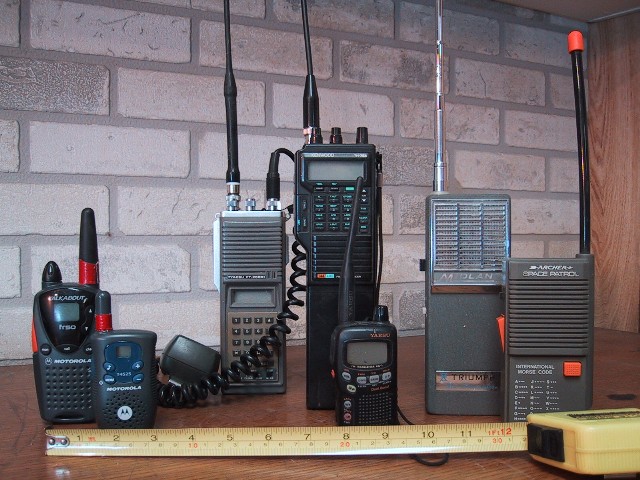
Typical walkie-talkies resemble a telephone handset, with a speaker built into one end and a microphone in the other (in some devices the speaker also is used as the microphone) and an antenna mounted on the top of the unit. They are held up to the face to talk. A walkie-talkie is a half-duplex communication device. Multiple walkie-talkies use a single radio channel, and only one radio on the channel can transmit at a time, although any number can listen. The transceiver is normally in receive mode; when the user wants to talk they must press a "push-to-talk" (PTT) button that turns off the receiver and turns on the transmitter. Some units have additional features such as sending calls, call reception with vibration alarm, keypad locking, and a stopwatch. Smaller walkie-talkies are also very popular among young children.
In accordance with ITU Radio Regulations, article 1.73, a walkie-talkie is classified as radio station/land mobile station.[1]
Handheld two-way radios were developed by the military from backpack radios carried by a soldier in an infantry squad to keep the squad in contact with their commanders. The Canadian inventor Donald Hings was the first to create a portable radio signaling system for his employer CM&S in 1937. He called the system a "packset", although it later became known as a "walkie-talkie". In 2001, Hings received the Order of Canada for the device's significance to the war effort. Hings' model C-58 "Handie-Talkie" was in military service by 1942, the result of a secret R&D effort that began in 1940.
Alfred J. Gross, a radio engineer and one of the developers of the Joan-Eleanor system, also worked on the early technology behind the walkie-talkie between 1938 and 1941, and is sometimes credited with inventing it.
The first device to be widely nicknamed a "walkie-talkie" was developed by the US military during World War II, the backpacked Motorola SCR-300. It was created by an engineering team in 1940 at the Galvin Manufacturing Company (forerunner of Motorola). The team consisted of Marion Bond, Lloyd Morris, Bill Vogel, Dan Noble, who conceived of the design using frequency modulation, and Henryk Magnuski, who was the principal RF engineer.
The first handheld walkie-talkie was the AM SCR-536 transceiver from 1941, also made by Motorola, named the Handie-Talkie (HT). The terms are often confused today, but the original walkie-talkie referred to the back mounted model, while the handie-talkie was the device which could be held entirely in the hand. Both devices used vacuum tubes and were powered by high voltage dry cell batteries.
Following World War II, Raytheon developed the SCR-536's military replacement, the AN/PRC-6. The AN/PRC-6 circuit used 13 vacuum tubes (receiver and transmitter); a second set of thirteen tubes was supplied with the unit as running spares. The unit was factory set with one crystal which could be changed to a different frequency in the field by replacing the crystal and re-tuning the unit. It used a 24-inch whip antenna. There was an optional handset that could be connected to the AN/PRC-6 by a 5-foot cable. An adjustable strap was provided for carrying and support while operating.
Hub AI
Walkie-talkie AI simulator
(@Walkie-talkie_simulator)
Walkie-talkie
A walkie-talkie, more formally known as a handheld transceiver, HT, or handheld radio, is a hand-held, portable, two-way radio transceiver. Its development during the Second World War has been variously credited to Donald Hings, radio engineer Alfred J. Gross, Henryk Magnuski and engineering teams at Motorola. First used for infantry, similar designs were created for field artillery and tank units, and after the war, walkie-talkies spread to public safety and eventually commercial and jobsite work.
Typical walkie-talkies resemble a telephone handset, with a speaker built into one end and a microphone in the other (in some devices the speaker also is used as the microphone) and an antenna mounted on the top of the unit. They are held up to the face to talk. A walkie-talkie is a half-duplex communication device. Multiple walkie-talkies use a single radio channel, and only one radio on the channel can transmit at a time, although any number can listen. The transceiver is normally in receive mode; when the user wants to talk they must press a "push-to-talk" (PTT) button that turns off the receiver and turns on the transmitter. Some units have additional features such as sending calls, call reception with vibration alarm, keypad locking, and a stopwatch. Smaller walkie-talkies are also very popular among young children.
In accordance with ITU Radio Regulations, article 1.73, a walkie-talkie is classified as radio station/land mobile station.[1]
Handheld two-way radios were developed by the military from backpack radios carried by a soldier in an infantry squad to keep the squad in contact with their commanders. The Canadian inventor Donald Hings was the first to create a portable radio signaling system for his employer CM&S in 1937. He called the system a "packset", although it later became known as a "walkie-talkie". In 2001, Hings received the Order of Canada for the device's significance to the war effort. Hings' model C-58 "Handie-Talkie" was in military service by 1942, the result of a secret R&D effort that began in 1940.
Alfred J. Gross, a radio engineer and one of the developers of the Joan-Eleanor system, also worked on the early technology behind the walkie-talkie between 1938 and 1941, and is sometimes credited with inventing it.
The first device to be widely nicknamed a "walkie-talkie" was developed by the US military during World War II, the backpacked Motorola SCR-300. It was created by an engineering team in 1940 at the Galvin Manufacturing Company (forerunner of Motorola). The team consisted of Marion Bond, Lloyd Morris, Bill Vogel, Dan Noble, who conceived of the design using frequency modulation, and Henryk Magnuski, who was the principal RF engineer.
The first handheld walkie-talkie was the AM SCR-536 transceiver from 1941, also made by Motorola, named the Handie-Talkie (HT). The terms are often confused today, but the original walkie-talkie referred to the back mounted model, while the handie-talkie was the device which could be held entirely in the hand. Both devices used vacuum tubes and were powered by high voltage dry cell batteries.
Following World War II, Raytheon developed the SCR-536's military replacement, the AN/PRC-6. The AN/PRC-6 circuit used 13 vacuum tubes (receiver and transmitter); a second set of thirteen tubes was supplied with the unit as running spares. The unit was factory set with one crystal which could be changed to a different frequency in the field by replacing the crystal and re-tuning the unit. It used a 24-inch whip antenna. There was an optional handset that could be connected to the AN/PRC-6 by a 5-foot cable. An adjustable strap was provided for carrying and support while operating.
Recent media