Hubbry Logo
Al Gross (engineer)Al Gross (engineer)Main
Open search
Al Gross (engineer)
Community hub
Al Gross (engineer)
logo
8 pages, 0 posts
0 subscribers
Be the first to start a discussion here.
Al Gross (engineer)
Al Gross (engineer)
from Wikipedia

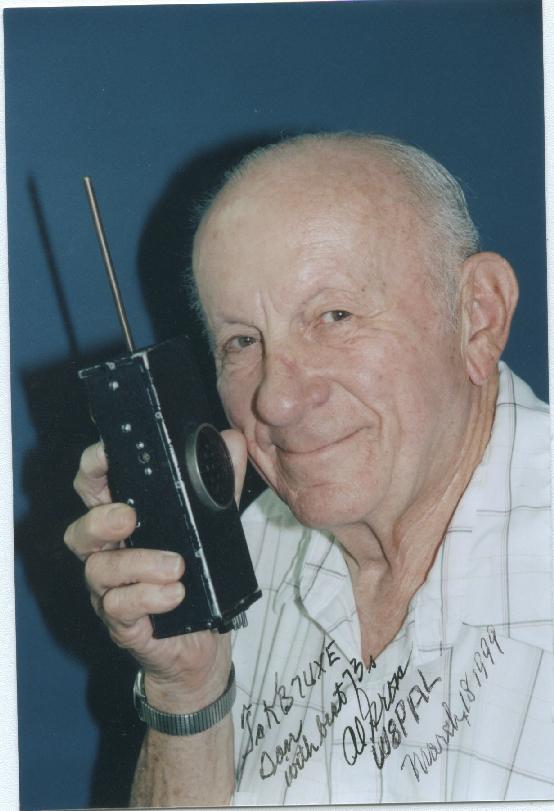
Irving "Al" Gross (/ɡrs/; February 22, 1918 – December 21, 2000) was a pioneer in mobile wireless communication. He created and patented many communications devices, specifically in relation to an early version of the walkie-talkie,[1] Citizens' Band radio,[2] the telephone pager[2] and the cordless telephone.[3]

Key Information

Biography

[edit]
FCC amateur radio license of Al Gross

Gross was born in Toronto, Ontario, Canada in 1918, the son of Romanian-Jewish immigrants, he grew up in Cleveland, Ohio, in the United States.[4]

His lifelong enthusiasm for radio was sparked at age nine, when traveling on Lake Erie by a steamboat.[3] While sneaking around the boat he ended up in the radio transmissions room. The ship's operator let him listen in on transmissions. Later, Gross turned the basement of his house into a radio station, built from scavenged junkyard parts.

At sixteen he earned his amateur radio license, and he used his call sign (W8PAL) his whole life.

The walkie-talkie

[edit]

His interest and knowledge in radio technology had grown considerably by the time he in 1936 entered the BSEE program at Cleveland's Case of Applied Sciences (now a part of Case Western Reserve University). He was determined to investigate the unexplored frequency region above 100 MHz. Between 1938 and 1941, soon after the invention of the "walkie-talkie" in 1937 by Donald Hings, he created and patented his own version of it.

World War II

[edit]

During World War II, Gross had some limited involvement in building a two-way VHF air-to-ground communications system for the U.S. Office of Strategic Services for use in military operations, known as the Joan-Eleanor system. It comprised a hand-held SSTC-502 transceiver ("Joan") and a much larger aircraft-based SSTR-6 transceiver ("Eleanor"). Gross' actual contribution to the project is unclear (he was not an OSS member), but the main developers on the project were Dewitt R. Goddard and Lt. Cmdr. Stephen H. Simpson (Goddard's wife's name was Eleanor, and reportedly Joan was an acquaintance of Simpson).

The system operated at frequencies above 250 MHz, which was at a much higher frequency than the enemy had thought conceivable. This allowed operatives using "Joan" to communicate with high altitude bombers carrying "Eleanor" for times of 10 to 15 minutes without the use of code words, eliminating the need for decryption. It was developed beginning in late 1942, was highly successful and very difficult to detect behind enemy lines at the time. It was marked Top Secret by the U.S. military until it was declassified and made public in 1976.[5]

Citizens' Band (CB)

[edit]

After the war the FCC allocated the first frequencies for personal radio services; the Citizens' Radio Service Frequency Band (1946). Gross formed Gross Electronics Co.[5] to produce two-way communications system to utilize these frequencies, and his company was the first to receive FCC approval in 1948.[2] He sold more than 100 thousand units of his system, mostly to farmers and the U.S. Coast Guard.[2]

Two-way radios

[edit]

Cartoonist Chester Gould asked if he could use Gross' concept of a miniaturized two-way radio in his Dick Tracy comic strip. The result was the Dick Tracy two-way wrist radio.[5]

Telephone pager

[edit]

Another breakthrough came in 1949 when he adapted his two-way radios to one-way for cordless remote telephonic signaling. He had effectively invented the first telephone pager system. His intention for this system was to be used by medical doctors, but was met with skepticism by doctors who were afraid the system would upset patients.[6] This same technology is used in one-way radio signaling devices such as garage door openers.

Later years

[edit]

In 1950 he tried in vain to interest telephone companies in mobile telephony.[2] Bell Telephone was uninterested, and other companies were afraid of Bell's monopoly on transmission lines.

Gross continued inventing, and began working as a specialist in microwave and other communications systems for companies such as Sperry Corporation and General Electric.[5] He continued working until his death at age 82.[7]

Recognition

[edit]

Gross has received much recognition for his work, including, but not limited to:

Awards

[edit]

Honors

[edit]

See also

[edit]

References

[edit]
[edit]
Revisions and contributorsEdit on WikipediaRead on Wikipedia
from Grokipedia
Al Gross (1918–2000) was a Canadian-born American electrical engineer and inventor best known for pioneering key wireless communication technologies, including the , telephone pager, and . Born in , , and raised in , , Gross demonstrated an early passion for radio, building his first receiver at age nine after being inspired by wireless demonstrations on a steamboat trip. He earned a in from the Case School of Applied Sciences (now ), beginning his studies in 1936, and later took advanced courses under at . Gross's inventive career began in his youth, with the development and patenting of the in 1938 at age 20, a two-way voice communicator that he demonstrated to the Office of Strategic Services (OSS) in 1941, earning him a captain's commission during . During the war, he refined the device and contributed to the Joan-Eleanor system, a secure tool praised by the U.S. for saving lives in covert operations. Postwar, Gross founded the Citizens Radio Corporation, becoming the first to obtain a license in 1948 and selling around 100,000 units of his CB radios. His other major innovations included the telephone pager in 1949, initially proposed for doctors but rejected due to concerns over interruptions, and the in 1951, along with a battery-operated in 1958. Later, he worked at firms like Sperry, , and , contributing to aerospace technologies such as missile timing devices and thunder detection systems. Despite earning 12 patents that laid the groundwork for modern cellular telephony, CB radio, and remote controls like garage-door openers, Gross faced significant challenges, including regulatory delays from the FCC and resistance from telephone companies, causing his patents to expire by 1971 before widespread commercial adoption. Often described as the "father of wireless communications," his ideas influenced icons like Dick Tracy's wrist radio and earned him posthumous recognition, including the $500,000 Lemelson-MIT Lifetime Achievement Award in 2000 and a commendation from the FCC. Gross died on , 2000, in , at age 82 after a brief illness.

Early life and education

Childhood and family background

Al Gross was born Alfred J. Gross on February 22, 1918, in , , , to Romanian-Jewish immigrant parents who had recently arrived from . His father worked as a , establishing a small business after the family's relocation. The family moved to Cleveland, , when Gross was an infant, drawn by greater economic prospects in the growing industrial city. Details on Gross's siblings and immediate family dynamics are sparse, but the immigrant household's emphasis on and adaptability likely nurtured his early resourcefulness with tools and materials. This environment indirectly shaped his budding curiosity about , evident in his childhood tinkering with radios. His interest in radio was sparked at age nine during a family trip across , where he was fascinated by the demonstrations, leading him to build his first receiver.

Formal education and early interests

Gross attended public schools in , , after his family relocated there from in the early 1920s, where he displayed an early aptitude for through hands-on experimentation with technology. During the 1930s, amid the , Gross pursued self-taught radio experimentation, transforming his basement into a makeshift workshop using scavenged parts from junkyards to build radios and transmitters. By age 12, he had assembled functional radio sets, and at 16, he earned his (callsign W8PAL). These independent efforts honed his technical skills and fueled his passion for wireless communication. In 1936, Gross enrolled in the program in at the Case School of Applied Science (now part of ) in . He graduated with a BSEE in 1938, building a strong academic foundation in electrical principles that complemented his practical radio experience. The supportive environment nurtured Gross's burgeoning interests in engineering from a young age.

Career and inventions

Development of the walkie-talkie

During his undergraduate studies at the Case School of Applied Sciences in , , where he enrolled in 1936, Al Gross conceived the idea for a portable in 1938. Inspired by his early fascination with that began at age nine, Gross sought to create a lightweight device that would allow users to transmit and receive signals without cumbersome wires or stationary equipment. This personal motivation drove him to design a breakthrough in mobile wireless technology. Gross filed for a patent on his invention in 1938, which was ultimately granted in 1949. The device was a portable two-way radio transceiver that utilized vacuum tubes for amplification and frequency modulation (FM) for clearer signal transmission over unexplored high frequencies above 100 MHz. Battery-powered for portability, the prototype—weighing approximately 5 pounds and roughly the size of a tape recorder—offered a practical range of 1–2 miles in open terrain, making it suitable for outdoor activities or short-distance coordination. In the late 1930s, Gross built and demonstrated working prototypes to showcase their potential for civilian use, such as in , , or emergency services. Despite these efforts, pre-World War II commercialization attempts failed due to limited market interest; manufacturers viewed the technology as niche and unproven, with regulatory hurdles around further discouraging investment. Gross's educational background in provided the essential foundation in radio design principles, enabling him to overcome challenges like and power efficiency inherent to technology.

World War II contributions

Following the ' entry into , Al Gross was recruited by the Office of Strategic Services (OSS), the precursor to the , to develop secure communication technologies for intelligence operations. Commissioned as a , Gross focused on creating portable systems to enable agents behind enemy lines to relay critical information without detection. His work built upon his prewar innovations in handheld radios, adapting them for clandestine military use. Gross's primary contribution was the Joan-Eleanor system, a VHF two-way air-to-ground perfected by 1941 and deployed starting in 1944. The system consisted of a lightweight ground unit called "Joan" (SSTC-502), a handheld weighing about 3.5 pounds with a collapsible antenna, powered by standard B and D batteries, and capable of transmitting over a 30-mile range. The airborne counterpart, "Eleanor" (SSTR-6), was installed in aircraft such as British Mosquito bombers and featured an adjustable external antenna for optimized signal polarization. Operating on frequencies around 260 MHz using super-regenerative circuits, the setup relied on Hertzian radio waves that were difficult to intercept due to their directional nature and high-frequency band, outside typical Axis monitoring capabilities. The Joan-Eleanor system proved vital for OSS operations in Europe, particularly in the Netherlands and Germany, where agents used it to transmit intelligence directly to overhead Allied planes during late-war missions. Classified as top secret until its declassification in 1976, it was later praised by the U.S. for its effectiveness in supporting and contributing to the Allied victory by facilitating real-time that shortened the conflict.

Post-war radio innovations

Following , Al Gross drew on his wartime experience with portable s to advocate for their adaptation into civilian communications tools, filing patents and lobbying the (FCC) for dedicated spectrum to enable short-distance personal and business use without requiring operator licenses. In 1945, he began developing and patenting technologies for compact signaling and systems suitable for non-military applications, laying the groundwork for what would become the Citizens Radio Service. In 1946, Gross founded the Citizens Radio Corporation in Cleveland, Ohio, to design, test, and manufacture these devices, conducting extensive trials over the subsequent two years to demonstrate their reliability for everyday users such as farmers, boaters, and truckers. In 1948, the company achieved a milestone when its handheld transceivers, operating in the 460–470 MHz UHF band, received the first FCC type approval for the newly established Citizens Radio Service on March 22, enabling legal short-range voice communications for the general public. This approval facilitated the launch of the first FCC-sanctioned service, with the formal rules for Part 19 of the FCC regulations (Citizens Radio Service) becoming effective on June 1, 1949. The Citizens Radio Corporation's devices quickly gained traction, selling over 100,000 units primarily to agricultural users and the , marking a significant commercialization of personal radio technology and demonstrating the viability of license-free, low-power systems for hobbyists and professionals. These innovations emphasized portability and simplicity, with transceivers weighing as little as 12 ounces, and operated within power limits to minimize interference while supporting ranges of a few miles in open areas. Gross's efforts helped establish the framework for accessible radio communications, influencing later expansions of the service.

Pager, cordless phone, and cellular precursors

In 1949, Al Gross invented the telephone , a pioneering one-way signaling device designed to alert doctors and other professionals to incoming calls without requiring them to remain near a landline . The , named Royalcall, featured a compact, pocket-sized receiver equipped with discriminating circuitry that selectively responded to coded radio signals transmitted from a central , enabling discreet notifications via vibration or tone; it weighed 12 ounces and used Sylvania vacuum tubes. Early sales included a $1.8 million order from and $500,000 from the U.S. Coast Guard in 1949. Gross's intention was to address the need for mobility in high-demand fields like , where constant accessibility was essential but tethering to phones was impractical. Despite its potential, the invention faced significant skepticism and resistance upon introduction. At a medical conference in that same year, Gross demonstrated the device to physicians, only to encounter criticism that it would disrupt their personal time, such as golf games, leading to perceptions of limited practical utility. This initial rejection extended to broader challenges in securing widespread adoption, as U.S. telephone companies and healthcare institutions showed little interest due to concerns over reliability and necessity. Nevertheless, the technology gained its first real-world use in 1950 at New York City's Jewish Hospital, where it proved effective for summoning staff efficiently. The U.S. (FCC) later approved pager operations in 1958, paving the way for gradual commercialization. Leveraging his expertise in radio communications, Gross advanced the fundamentals of during the early . In 1951, he developed the core principles for phones, which used low-power radio waves to facilitate two-way voice transmission between a portable and a fixed , eliminating the need for a physical cord while maintaining connection to the telephone network. This adaptation of existing technology emphasized short-range, interference-resistant signaling, setting the stage for portable home and office phones that would become commonplace decades later. Throughout the 1950s, Gross pursued conceptual innovations that served as precursors to cellular , envisioning scalable networks well before their mainstream development by entities like . As early as 1950, he pitched comprehensive systems to U.S. companies and demonstrated prototypes to the FCC, proposing frequency reuse and handheld devices for ubiquitous personal communication. These ideas, which included integrating pagers and elements into broader frameworks, were repeatedly rebuffed, largely due to opposition from monopolistic incumbents like Bell , who viewed them as threats to existing . Gross secured several related patents during this period, but they expired in the early 1970s—before cellular technology proliferated—leaving him without financial reward despite his foundational contributions.

Later career and advocacy

Professional roles at major companies

In the latter stages of his career, following his independent inventions, Al Gross contributed his wireless communications expertise to several prominent engineering firms. During the and , he worked at as a specialist in and electronic communications systems, applying his background to advanced and signaling technologies. During his time at and Sperry in the and , Gross contributed to digital timing devices for missiles such as the Titan, Atlas, and Minuteman. Gross also served as a principal at in the 1960s and 1970s, where his efforts centered on integrating wireless technologies into and broader communication infrastructures. In 1990, at age 72, he joined as a senior staff , remaining active until his death in 2000; there, he developed a device to detect the origin and location of thunder. During these corporate roles, Gross continued innovating, filing patents for refinements in remote signaling and portable communication devices that built on his earlier pager concepts, contributing to a career total of 12 patents.

Efforts in personal communications policy

Throughout his career, Al Gross actively advocated for regulatory changes to facilitate the development of personal wireless communications technologies. In the late 1940s, he lobbied the Federal Communications Commission (FCC) to allocate radio spectrum for two-way personal radio services, culminating in the establishment of the Citizens Band (CB) radio service in 1948, which enabled non-commercial, short-distance voice communications for civilians. Gross's efforts extended to testifying and demonstrating technologies before the FCC to secure approvals for emerging devices. In 1950, he presented a system to regulators, securing early authorization for its use in medical settings, though widespread adoption was hindered by regulatory and industry reluctance. By 1958, following persistent advocacy, the FCC approved his company's transceivers for personal use, marking a key step in legitimizing portable signaling devices. Frustrated by the slow pace of regulatory and commercial acceptance of his and early cellular concepts—ideas he proposed as far back as the 1940s—Gross filed multiple petitions over several decades, spanning the 1940s through the 1980s, to expand spectrum availability and reduce barriers to personal mobile services. These sustained efforts highlighted his commitment to overcoming institutional resistance from established telephone monopolies, which viewed personal radio as a threat to wired services. To advance these goals, Gross founded the Citizens Radio Corporation in 1946, which not only produced equipment but also promoted standards and public awareness for personal radio technologies, influencing the trajectory of and mobile systems. His advocacy laid foundational groundwork for the Personal Communications Services (PCS) auctioned by the FCC in the 1990s, which revolutionized consumer wireless access by dedicating spectrum to digital personal networks.

Recognition and legacy

Major awards

In 2000, Al Gross received the Lemelson-MIT Lifetime Achievement Award for Invention and Innovation, recognizing his pioneering role in developing miniaturized portable communications devices that laid the groundwork for modern wireless technologies. This honor highlighted his foundational inventions, such as the and , which advanced personal and mobile radio systems during and after . That same year, the commended Gross for his pioneering contributions to wireless communications. The following year prior, in 1999, Gross was awarded the IEEE Communications Society Edwin Howard Armstrong Achievement Award for his significant contributions to communications , particularly in the evolution of portable radio and signaling technologies. The award underscored his innovations in and systems, which influenced the development of and cellular . Earlier, in 1992, Gross earned the Fred M. Link Award from the Radio Club of America, bestowed for his advancements in aviation communications and radio engineering that enhanced safety and efficiency in aerial operations. This accolade specifically acknowledged his wartime and postwar work on compact radio transceivers used in and ground support.

Honors and lasting impact

Gross's contributions to communication were recognized through his induction into prestigious inventor profiles and halls of honor. Following his , Gross received additional tributes that preserved his legacy. His personal and professional papers, spanning 1909 to 2000, were archived in the Special Collections of Tech's University Libraries, forming the Al Gross Papers collection (Ms2001.011), which includes documentation of his awards, inventions, and correspondence with regulatory bodies like the FCC. This archival effort ensures ongoing access to his work for researchers studying the communications. The enduring impact of Gross's innovations is evident in contemporary wireless systems. His development of the laid groundwork for short-range voice communication features now integral to smartphones and two-way radios used in emergency services. Similarly, the he invented in the 1940s enabled and on-call alerting systems that persist in medical and professional sectors, while his advocacy for personal radio services influenced the regulatory framework for cellular networks, contributing to the evolution toward and technologies. Gross's foresight in wireless portability has been credited with shaping the global mobile communication ecosystem. Gross died on December 21, 2000, in , at the age of 82, after a brief illness. Despite his profound influence, he was often described as an overlooked genius during his lifetime, with major recognition arriving only in his final years.
Add your contribution
Related Hubs
User Avatar
No comments yet.