
Recent from talks
Wall of Philip II Augustus
Knowledge base stats:
Talk channels stats:
Members stats:
Wall of Philip II Augustus
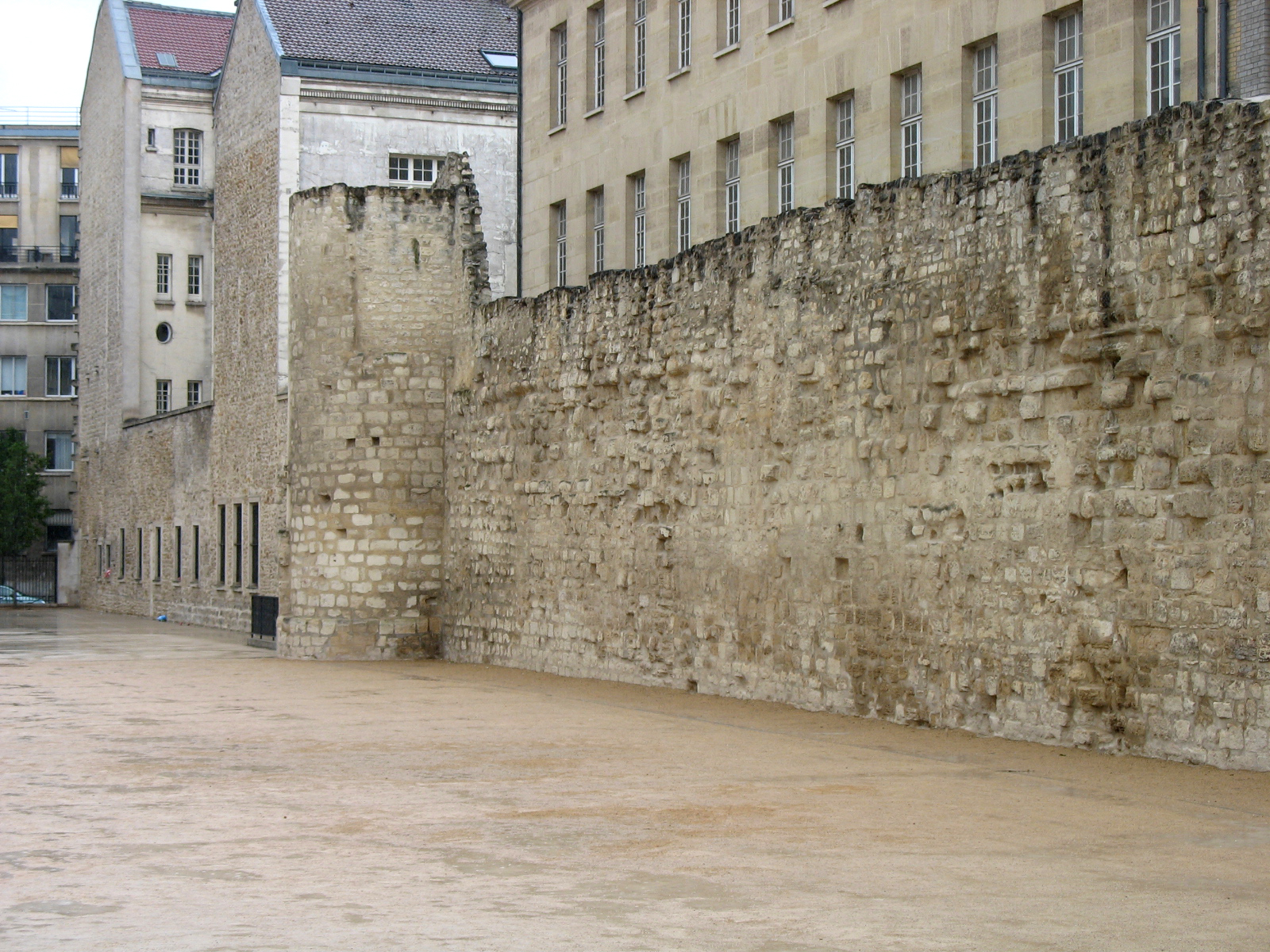
The Wall of Philip Augustus is the oldest city wall of Paris (France) whose plan is accurately known. Partially integrated into buildings, more traces of it remain than of the later fortifications.
The wall was built during the struggles between Philip II of France (called Philip Augustus) and the Anglo-Norman House of Plantagenet. The French king, before leaving for the Third Crusade, ordered a stone wall to be built to protect the French capital in his absence.
The walls were fortified from 1190 to 1213, built under the command of Philip Augustus who also contributed to the cost of building the wall. Any incoming attack from France's main military threat, the English, would arrive from the western end of the Seine and so the Louvre fortress was placed just outside the western limit of the wall. The building of the wall also had the intention to discourage further urban expansion and to stimulate the usage of undeveloped land within the walls. This area of land also had the potential to sustain a growing food supply to sustain the population in the event of a siege. The wall was however never militarily put to the test.
Despite the construction during the 14th century of Charles V's wall encircling Philip Augustus' wall on the Right Bank, the latter wall was not demolished. On the Right Bank, Charles' wall in effect left the earlier wall in disuse and redundant. In 1434, it was still considered strong enough and thick enough for a cart to be driven on top.
However, Charles V's wall did not extend to the Left Bank, so the Philip Augustus' old wall was strengthened by:
In 1533, Francis I demolished the Right Bank gates and authorised the leasing of the land enclosed by the wall without authorising the demolition of the wall itself. From the second half of the 16th century, these lands were sold to individuals, and often the cause of the dismantling of large sections of the wall.
The Left Bank wall followed the same path under Henry IV. In 1590, he preferred digging ditches beyond the city outskirts to once again modernising the wall. The ditches near the Seine were used as open sewers and caused health problems so in the 17th century they were filled and replaced by covered galleries. The last remaining gates, unsuited to ever-increasing traffic, were razed in the 1680s when the wall became completely invisible.
The Philip Augustus' wall enclosed an area of 253 hectares; its length was 2,500 metres on the Left Bank and 2,600 on the Right Bank. The west side was the weakest point of the defence against Norman threat. Near the Seine, Philip Augustus built the Louvre castle with a fortified donjon and ten defensive towers surrounded by a moat. The construction cost was slightly more than 14,000 livres during the roughly twenty years of the construction: representing about 12 percent of the king's annual revenues in the 13th century.
Hub AI
Wall of Philip II Augustus AI simulator
(@Wall of Philip II Augustus_simulator)
Wall of Philip II Augustus
The Wall of Philip Augustus is the oldest city wall of Paris (France) whose plan is accurately known. Partially integrated into buildings, more traces of it remain than of the later fortifications.
The wall was built during the struggles between Philip II of France (called Philip Augustus) and the Anglo-Norman House of Plantagenet. The French king, before leaving for the Third Crusade, ordered a stone wall to be built to protect the French capital in his absence.
The walls were fortified from 1190 to 1213, built under the command of Philip Augustus who also contributed to the cost of building the wall. Any incoming attack from France's main military threat, the English, would arrive from the western end of the Seine and so the Louvre fortress was placed just outside the western limit of the wall. The building of the wall also had the intention to discourage further urban expansion and to stimulate the usage of undeveloped land within the walls. This area of land also had the potential to sustain a growing food supply to sustain the population in the event of a siege. The wall was however never militarily put to the test.
Despite the construction during the 14th century of Charles V's wall encircling Philip Augustus' wall on the Right Bank, the latter wall was not demolished. On the Right Bank, Charles' wall in effect left the earlier wall in disuse and redundant. In 1434, it was still considered strong enough and thick enough for a cart to be driven on top.
However, Charles V's wall did not extend to the Left Bank, so the Philip Augustus' old wall was strengthened by:
In 1533, Francis I demolished the Right Bank gates and authorised the leasing of the land enclosed by the wall without authorising the demolition of the wall itself. From the second half of the 16th century, these lands were sold to individuals, and often the cause of the dismantling of large sections of the wall.
The Left Bank wall followed the same path under Henry IV. In 1590, he preferred digging ditches beyond the city outskirts to once again modernising the wall. The ditches near the Seine were used as open sewers and caused health problems so in the 17th century they were filled and replaced by covered galleries. The last remaining gates, unsuited to ever-increasing traffic, were razed in the 1680s when the wall became completely invisible.
The Philip Augustus' wall enclosed an area of 253 hectares; its length was 2,500 metres on the Left Bank and 2,600 on the Right Bank. The west side was the weakest point of the defence against Norman threat. Near the Seine, Philip Augustus built the Louvre castle with a fortified donjon and ten defensive towers surrounded by a moat. The construction cost was slightly more than 14,000 livres during the roughly twenty years of the construction: representing about 12 percent of the king's annual revenues in the 13th century.
Recent media