


Community hub
Recent from talks
Contribute something
Nothing was collected or created yet.
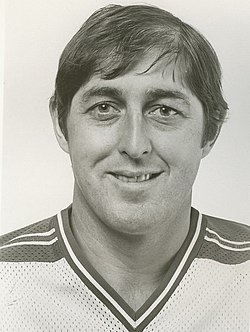
Walt Tkaczuk
View on Wikipedia
Walter Robert Bogdan Tkaczuk (born September 29, 1947) is a Canadian former ice hockey centre who played fourteen seasons for the New York Rangers of the National Hockey League (NHL) between 1967 and 1981. Tkaczuk's family, originally from Ukraine, moved to Timmins, Ontario from West Germany when he was two years old.[1] He was the first player born in Germany to appear in an NHL game.
Key Information


NHL career
[edit]Tkaczuk centred the "Bulldog Line" with Bill Fairbairn and Dave Balon, who was later replaced by Steve Vickers.[2] He could score his fair share of goals, however he was much better at producing assists. Tkaczuk's finest contribution to the game was that of the defensive forward, being among the NHL's elite shadows and faceoff men. This complemented the Rangers' high-scoring GAG line of Jean Ratelle, Rod Gilbert, Vic Hadfield. During his first two seasons with the Rangers, the club and media pronounced his name, "Taychuk" because the Rangers' director of player personnel felt it was easier to say than the correct pronunciation, "Ka-Chook." Prior to the 1969-70 season, the club announced he would henceforth be called by the correct pronunciation.[3]
In the 1972 playoffs, with Ratelle sidelined with a broken ankle and Gilbert hampered by injuries, Tkaczuk played a key role as the Rangers defeated the defending champions Montreal Canadiens, and the previous season's finalists Chicago Black Hawks, to reach the Stanley Cup Finals. While the Rangers lost to the Boston Bruins in six games, Tkaczuk earned much respect for holding the Bruins' Phil Esposito without a goal in the series.
Tkaczuk was asked to play for Team Canada in the 1972 Summit Series but declined the invitation due to his obligation to his summer hockey school. He was replaced by Philadelphia Flyers' centre Bobby Clarke.[4]
In the 1979 playoffs, Tkaczuk was a key contributor as the Rangers upset the first place New York Islanders to reach the Stanley Cup Finals, where they fell to Montreal in five games.
Towards the end of a game on February 2, 1981, Tkaczuk suffered an eye injury when hit by a puck. [5] He never played again. Over his career, Tkaczuk played in 945 NHL games, scoring 227 goals and 451 assists for 678 points. Despite his physical presence, he only accumulated 556 minutes in penalties.
In the 2009 book 100 Ranger Greats, the authors ranked Tkaczuk at No. 14 all-time of the 901 New York Rangers who had played during the team's first 82 seasons.[6]
Post-hockey career
[edit]Tkaczuk is co-owner of River Valley Golf Course and Tube Slide in St. Marys, Ontario.
Career statistics
[edit]Regular season and playoffs
[edit]| Regular season | Playoffs | |||||||||||||
|---|---|---|---|---|---|---|---|---|---|---|---|---|---|---|
| Season | Team | League | GP | G | A | Pts | PIM | GP | G | A | Pts | PIM | ||
| 1963–64 | Kitchener Dutchmen | CJHL | 30 | 25 | 37 | 62 | — | — | — | — | — | — | ||
| 1963–64 | Kitchener Rangers | OHA | 21 | 5 | 5 | 10 | 4 | — | — | — | — | — | ||
| 1964–65 | Kitchener Dutchmen | CJHL | — | — | — | — | — | — | — | — | — | — | ||
| 1964–65 | Kitchener Rangers | OHA | 7 | 1 | 2 | 3 | 6 | — | — | — | — | — | ||
| 1965–66 | Kitchener Rangers | OHA | 47 | 12 | 31 | 43 | 39 | 19 | 7 | 23 | 30 | 13 | ||
| 1966–67 | Kitchener Rangers | OHA | 48 | 23 | 47 | 70 | 85 | 13 | 6 | 8 | 14 | 23 | ||
| 1966–67 | Omaha Knights | CPHL | — | — | — | — | — | 3 | 2 | 0 | 2 | 2 | ||
| 1967–68 | Kitchener Rangers | OHA | 52 | 37 | 56 | 93 | 81 | 19 | 17 | 20 | 37 | 58 | ||
| 1967–68 | New York Rangers | NHL | 2 | 0 | 0 | 0 | 0 | — | — | — | — | — | ||
| 1968–69 | Buffalo Bisons | AHL | 5 | 2 | 7 | 9 | 9 | — | — | — | — | — | ||
| 1968–69 | New York Rangers | NHL | 71 | 12 | 24 | 36 | 28 | 4 | 0 | 1 | 1 | 6 | ||
| 1969–70 | New York Rangers | NHL | 76 | 27 | 50 | 77 | 38 | 6 | 2 | 1 | 3 | 17 | ||
| 1970–71 | New York Rangers | NHL | 77 | 26 | 49 | 75 | 48 | 13 | 1 | 5 | 6 | 14 | ||
| 1971–72 | New York Rangers | NHL | 76 | 24 | 42 | 66 | 65 | 16 | 4 | 6 | 10 | 35 | ||
| 1972–73 | New York Rangers | NHL | 76 | 27 | 39 | 66 | 59 | 10 | 7 | 2 | 9 | 8 | ||
| 1973–74 | New York Rangers | NHL | 71 | 21 | 42 | 63 | 58 | 13 | 0 | 5 | 5 | 22 | ||
| 1974–75 | New York Rangers | NHL | 62 | 11 | 25 | 36 | 34 | 3 | 1 | 2 | 3 | 5 | ||
| 1975–76 | New York Rangers | NHL | 78 | 8 | 28 | 36 | 56 | — | — | — | — | — | ||
| 1976–77 | New York Rangers | NHL | 80 | 12 | 38 | 50 | 38 | — | — | — | — | — | ||
| 1977–78 | New York Rangers | NHL | 80 | 26 | 40 | 66 | 30 | 3 | 0 | 2 | 2 | 0 | ||
| 1978–79 | New York Rangers | NHL | 77 | 15 | 27 | 42 | 38 | 18 | 4 | 7 | 11 | 10 | ||
| 1979–80 | New York Rangers | NHL | 76 | 12 | 25 | 37 | 36 | 7 | 0 | 1 | 1 | 2 | ||
| 1980–81 | New York Rangers | NHL | 43 | 6 | 22 | 28 | 28 | — | — | — | — | — | ||
| NHL totals | 945 | 227 | 451 | 678 | 556 | 93 | 19 | 32 | 51 | 119 | ||||
References
[edit]- ^ Illustrated Digest of Pro Hockey 1972–73 edition, Don Smith and Art Poretz, Stadia Sports Publishing Inc. p. 49.
- ^ "New York Rangers Legends: Walt Tkaczuk".
- ^ "Tkaczuk: He's Always Been a Winner".
- ^ 1981 Canada Cup / Coupe Canada, p.126)
- ^ "Tkaczuk Out for 2 Weeks". The New York Times. February 4, 1981.
- ^ Cohen, Russ; Halligan, John; Raider, Adam (2009). 100 Ranger Greats: Superstars, Unsung Heroes and Colorful Characters. John Wiley & Sons. p. 184. ISBN 978-0470736197.
External links
[edit]- Biographical information and career statistics from NHL.com, or Eliteprospects.com, or Eurohockey.com, or Hockey-Reference.com, or The Internet Hockey Database
Walt Tkaczuk
View on GrokipediaEarly life
Birth and family heritage
Walter Robert Bogdan Tkaczuk was born on September 29, 1947, in Emsdetten, West Germany, to parents of Ukrainian descent.[5][2] His family originated from Ukraine and had been displaced to West Germany in the aftermath of World War II, part of the broader wave of Ukrainian refugees fleeing Soviet control and wartime devastation.[6][2] Despite his Ukrainian heritage, Tkaczuk's birthplace in Germany made him the first NHL player born in that country when he debuted with the New York Rangers in 1967.[6][2] The family emigrated to Timmins, Ontario, Canada, when Tkaczuk was two years old.[6][3]Childhood and introduction to hockey
In 1949, when Walt Tkaczuk was two years old, his family relocated from West Germany to Timmins, Ontario, Canada, where his father, Mike, secured employment as a driller at the Jamieson Copper Mine in the nearby mining community of South Porcupine.[7][6] South Porcupine, a tight-knit settlement centered around mining operations, provided the Tkaczuk family—originally of Ukrainian heritage—with a rugged environment typical of northern Ontario's resource towns during the post-war era.[7] As an immigrant family adapting to Canadian life, they navigated cultural shifts, including the pronunciation of their surname, which is properly rendered as "Ka-Chook" in English.[7] Growing up in this mining hub exposed young Tkaczuk to the demands of the industry during his teenage years, including summer jobs where he assisted as a dynamite man's helper, reaching depths of 3,300 feet.[7] The community's emphasis on physical labor and outdoor activities fostered resilience, while local youth sports programs offered initial outlets for recreation amid the harsh winters.[2] These elements shaped Tkaczuk's formative years, blending immigrant adjustment with the practicalities of small-town Canadian life. Tkaczuk's introduction to hockey came around age 13, when he joined organized play in the Timmins area through local minor hockey leagues and was spotted by a Rangers scout.[2] This marked the beginning of his athletic development in the sport, progressing to competitive youth teams in the region, including stints with the South Porcupine Gold Kings in midget hockey, before moving to Kitchener, Ontario, around age 15 for further development.[5][8] The frozen rinks and community arenas of Timmins became central to his early passion, laying the groundwork for a path toward professional hockey.[7]Professional career
Junior hockey and NHL entry
Tkaczuk honed his skills in junior hockey with the Kitchener Rangers of the Ontario Hockey Association (OHA), playing key seasons from 1964 to 1967. In the 1964–65 season, he appeared in seven OHA games for the Rangers while dominating the Central Ontario Junior Hockey League with the Kitchener Greenshirts, recording 29 goals and 50 assists for 79 points in 29 games.[5] His performance elevated in the OHA the following year, as he posted 12 goals and 31 assists for 43 points in 47 games during 1965–66, contributing significantly to the team's playoff run where he added 30 points in 19 games.[3] By the 1966–67 season, Tkaczuk emerged as a standout, leading the Rangers in scoring with 23 goals and 47 assists for 70 points in 48 regular-season games, alongside 85 penalty minutes that reflected his physical style.[9] He continued his strong play into the 1967–68 OHA season, recording 37 goals and 56 assists for 93 points in 52 games, finishing fourth in league scoring and earning recognition as one of the top amateur prospects in Canada.[5][10] Following his junior career, Tkaczuk signed with the New York Rangers as an undrafted free agent in June 1968, transitioning directly to professional hockey at age 20.[2] He made his NHL debut on January 24, 1968, appearing in two games that season without recording a point. In his first full NHL campaign during 1968–69, Tkaczuk adapted quickly, playing 71 games and tallying 12 goals and 24 assists for 36 points while accumulating 28 penalty minutes.[4] Early in his Rangers tenure, Tkaczuk faced minor adaptation hurdles, including the pronunciation of his surname, initially rendered as "Tay-chuck" by team personnel for simplicity before being corrected to the proper "Ka-chook" ahead of the 1969–70 season.[2] Later, in 1972, he declined an invitation to Team Canada's training camp for the Summit Series against the Soviet Union, citing prior commitments to operating a summer hockey school in which he had invested personally.[11]Bulldog Line and team contributions
In the early 1970s, Walt Tkaczuk centered the New York Rangers' "Bulldog Line," a defensive unit formed in the 1969–70 season alongside left winger Dave Balon and right winger Bill Fairbairn, with Steve Vickers later replacing Balon.[12][2] This line served as a checking counterpoint to the Rangers' high-scoring GAG Line (Goals, Assists, and Glory), featuring Jean Ratelle, Rod Gilbert, and Brad Park, by focusing on shutdown play against opponents' top forwards while contributing offensively.[12] The Bulldogs earned their nickname for their gritty, persistent style, often matching up against elite lines like that of Boston's Phil Esposito, where Tkaczuk's physical presence and positioning limited scoring chances.[2] Tkaczuk's balanced two-way game anchored the line over his 14 NHL seasons, all spent with the Rangers, where he amassed 678 points in 945 regular-season games.[1] He achieved six 60-point seasons, including career highs of 27 goals, 50 assists, and 77 points in 1969–70, his second full NHL year.[1] Renowned as one of the league's top faceoff men and defensive centers, Tkaczuk excelled in penalty killing, helping the Rangers maintain a penalty-kill efficiency above 83.8% during his peak years from 1969–70 to 1972–73.[2][13] His ability to shadow opposing stars and win key draws was instrumental in controlling games, earning him a reputation as the team's most reliable forward.[13][14] Beyond scoring, Tkaczuk provided essential regular-season leadership, leading the Rangers in assists in both 1969–70 (50) and 1970–71 (49), which facilitated transitions and supported the team's overall balance.[1] His consistent production and defensive reliability made him a cornerstone of the Rangers' lineup throughout the 1970s, complementing the offensive firepower while ensuring structural integrity in matchups.[15][1]Playoff performances and captaincy
Tkaczuk's playoff career with the New York Rangers spanned 14 seasons, during which he appeared in 93 games, recording 19 goals and 32 assists for 51 points while accumulating 119 penalty minutes.[1] Known for his defensive prowess and physicality, he often anchored checking lines that neutralized top opponents, contributing to key series advancements through shutdown roles and timely scoring.[2] In the 1972 Stanley Cup Playoffs, Tkaczuk played a pivotal role as the Rangers advanced to the Finals against the Boston Bruins for the first time since 1940.[16] As part of the Bulldog Line, he was primarily tasked with shadowing Bruins star Phil Esposito, who had led the NHL with 66 regular-season goals; Tkaczuk held Esposito scoreless in the seven-game series, limiting him to eight assists despite 41 shots on goal.[2][17] Over 16 playoff games that year, Tkaczuk tallied 4 goals and 6 assists for 10 points, including a clutch goal in Game 6 of the quarterfinals against the Montreal Canadiens that clinched the series 4-2.[1][18] Tkaczuk's leadership shone in the 1979 playoffs, where he helped guide the Rangers to an upset victory over the Presidents' Trophy-winning New York Islanders in the semifinals, winning the best-of-seven series 4-3 before falling to the Montreal Canadiens in the Finals. As a veteran presence alongside Phil Esposito, he provided on-ice stability and contributed offensively with 4 goals and 7 assists for 11 points across 18 games, emphasizing his role in high-pressure defensive assignments against elite lines.[19][1] Tkaczuk was appointed captain of the Rangers for the 1980–81 season, succeeding Dave Maloney and marking the only time he wore the "C" in his career; he assumed the role on December 7, 1980, but held it for just 20 games before an injury sidelined him.[2]Retirement due to injury
On February 2, 1981, during a game against the Los Angeles Kings at Madison Square Garden, Tkaczuk suffered a severe eye injury when a deflected puck struck him above his right eye, causing bleeding around the retina and resulting in significant vision impairment.[20][2] Initially requiring eight stitches to close the wound, the injury sidelined him for the remainder of the 1980–81 season and ultimately proved career-ending, as medical evaluations confirmed he could no longer compete safely at the NHL level.[20][2] Tkaczuk officially retired in the summer of 1981 at the age of 33, concluding a 14-season tenure entirely with the New York Rangers, during which he appeared in 945 regular-season games.[1][2] His loyalty to the organization was evident in his decision to stay with one team throughout his professional career, a rarity in the era's player mobility, despite opportunities elsewhere.[2] The physical demands of his enforcer-style play, which emphasized gritty checking and faceoff prowess over high-scoring, contributed to the toll on his body, as reflected in his career total of 556 penalty minutes across 1,038 games (regular season and playoffs combined).[1][21] Following his retirement, Tkaczuk transitioned into a role as assistant coach for the Rangers, announced in June 1981, marking his immediate shift from player to behind-the-bench contributor within the organization.[22] This move provided continuity amid the challenges of leaving the ice after nearly two decades in professional hockey, though he later reflected on the abrupt end as a bittersweet close to a career defined by team-first dedication.[2]Legacy and post-hockey life
Recognition among Rangers greats
Tkaczuk's contributions to the New York Rangers were formally recognized in 2009 when he was ranked No. 14 on the all-time list in the book 100 Ranger Greats by Russ Cohen, John Halligan, and Adam Raider, placing him among the top players from the team's first 82 seasons based on input from fans and media.[23] This honor underscores his status as one of the franchise's most valued contributors, particularly for his consistent performance over 14 seasons.[1] As the first player born in Germany to appear in an NHL game, Tkaczuk broke new ground in a league dominated by North American talent, helping to broaden the origins of professional hockey players.[2] Born in Emsdetten to Ukrainian émigré parents who relocated to Canada when he was two, his path symbolized the growing international influence in the sport during the late 1960s and 1970s.[24] Tributes to Tkaczuk often highlight his unwavering loyalty to the Rangers, as he spent his entire 945-game NHL career with the team, amassing 678 points while serving as a quintessential two-way forward.[1] His defensive prowess, including excellence on the penalty kill and faceoffs, earned him a reputation as an underrated checking center whose gritty style prefigured modern players in that role.[2][25] Tkaczuk's influence endures as a "heart and soul" figure in Rangers lore, particularly for his pivotal roles in the team's Stanley Cup Final appearances in 1972 and 1979. In 1972, he contributed 10 playoff points while anchoring the penalty kill during the Rangers' first Finals run since 1940; seven years later, he added eleven points in 18 postseason games en route to another Finals berth after upsetting the rival Islanders.[2] These efforts cemented his legacy as a symbol of team resilience and dedication.[2]Business ventures and later years
Following his retirement from professional hockey in 1981 due to an eye injury that caused bleeding around his retina, Walt Tkaczuk transitioned to business ownership in his adopted hometown of St. Marys, Ontario.[2] He co-founded River Valley Golf Course in 1985 with former NHL player Danny Seguin, transforming local land into an 18-hole facility that opened to the public in 1995 and has since served as a recreational hub for golf enthusiasts in Perth County.[26] The course, co-owned by Tkaczuk alongside Seguin and his family, emphasizes community engagement through events and gatherings, with his wife Valerie and children—Sarah, David, and Michael—contributing to daily operations and expertise.[26] Tkaczuk expanded the venture to include the River Valley Snow Tube Slide, a winter adventure park offering tubing activities that complement the summer golf operations and attract families year-round.[26] This addition leverages St. Marys' natural landscape, fostering local tourism and outdoor recreation without drawing significant public attention.[27] Since establishing these businesses, Tkaczuk has maintained a low-profile residence in St. Marys, Ontario, focusing on family and community involvement rather than athletic pursuits or high-visibility endeavors, with no reported public scandals.[28] Now 78 years old, he has recovered sufficiently from the 1981 eye injury to actively contribute to the ongoing success of River Valley as a cherished local destination.[3][2][26]Career statistics
Regular season and playoffs
Tkaczuk played his entire 14-season NHL career exclusively with the New York Rangers, appearing in 945 regular-season games from 1967–68 to 1980–81, during which he recorded 227 goals, 451 assists, 678 points, and 556 penalty minutes.[1]Regular Season
| Season | Team | GP | G | A | Pts | PIM |
|---|---|---|---|---|---|---|
| 1967–68 | NYR | 2 | 0 | 0 | 0 | 0 |
| 1968–69 | NYR | 71 | 12 | 24 | 36 | 28 |
| 1969–70 | NYR | 76 | 27 | 50 | 77 | 38 |
| 1970–71 | NYR | 77 | 26 | 49 | 75 | 48 |
| 1971–72 | NYR | 76 | 24 | 42 | 66 | 65 |
| 1972–73 | NYR | 76 | 27 | 39 | 66 | 59 |
| 1973–74 | NYR | 71 | 21 | 42 | 63 | 58 |
| 1974–75 | NYR | 62 | 11 | 25 | 36 | 34 |
| 1975–76 | NYR | 78 | 8 | 28 | 36 | 56 |
| 1976–77 | NYR | 80 | 12 | 38 | 50 | 38 |
| 1977–78 | NYR | 80 | 26 | 40 | 66 | 30 |
| 1978–79 | NYR | 77 | 15 | 27 | 42 | 38 |
| 1979–80 | NYR | 76 | 12 | 25 | 37 | 36 |
| 1980–81 | NYR | 43 | 6 | 22 | 28 | 28 |
| Total | 945 | 227 | 451 | 678 | 556 |
Playoffs
| Season | Team | GP | G | A | Pts | PIM |
|---|---|---|---|---|---|---|
| 1968–69 | NYR | 4 | 0 | 1 | 1 | 6 |
| 1969–70 | NYR | 6 | 2 | 1 | 3 | 17 |
| 1970–71 | NYR | 13 | 1 | 5 | 6 | 14 |
| 1971–72 | NYR | 16 | 4 | 6 | 10 | 35 |
| 1972–73 | NYR | 10 | 7 | 2 | 9 | 8 |
| 1973–74 | NYR | 13 | 0 | 5 | 5 | 22 |
| 1974–75 | NYR | 3 | 1 | 2 | 3 | 5 |
| 1977–78 | NYR | 3 | 0 | 2 | 2 | 0 |
| 1978–79 | NYR | 18 | 4 | 7 | 11 | 10 |
| 1979–80 | NYR | 7 | 0 | 1 | 1 | 2 |
| Total | 93 | 19 | 32 | 51 | 119 |