



Community hub
Recent from talks
Knowledge base stats:
Talk channels stats:
Members stats:
Wanstead House
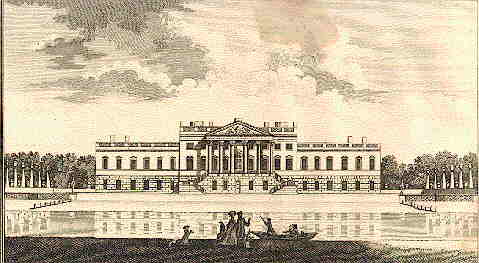
Wanstead House was a mansion built to replace the earlier Wanstead Hall. It was commissioned in 1715, completed in 1722 and demolished in 1825. Its gardens now form the municipal Wanstead Park in the London Borough of Redbridge.
Sir Richard Child gathered large estates, including Wanstead Manor, partly by his 1703 marriage to Dorothy Glynne, whose mother was of the Tylney family of Tylney Hall in Rotherwick, Hampshire. In 1715 Child commissioned the Scottish architect Colen Campbell to design a grand mansion in the then emerging Neo-Palladian style, to replace the former house, and to rival contemporary mansions such as Blenheim Palace. When completed in 1722 it covered an area of 260 ft (79 m). by 70 ft (21 m), the facade having a portico with six Corinthian columns, the earliest in England.
During the house's construction, in 1718, Child had been created 1st Viscount Castlemaine. When Child's wife's cousin Ann Tylney died in 1730, Dorothy and her husband Viscount Castlemain inherited the Tylney estates. Castlemain was created 1st Earl Tylney the following year (1731) and in 1734 obtained an Act of Parliament to change the name of his family, including his heirs, from the patronymic to Tylney, probably to meet a condition of his wife's inheritance. On the death of the Earl in 1750 he was succeeded by his 38-year-old son John Tylney, 2nd Earl Tylney. When the 2nd Earl died without male issue in 1784, the estates passed to his elder sister Emma's son Sir James Long, 7th Baronet, who being then in possession of the vast estates of the Longs, the Childs and the Tylneys, assumed the surname Tylney-Long for himself and his descendants, again probably in accordance with a requirement of the inheritance. On the death of the 7th Baronet in 1794 the combined estate passed to his one-year-old infant son Sir James Tylney-Long, 8th Baronet, who died in 1805 aged just 11. The estate then passed to his young sister, eldest of three, Catherine Tylney-Long, who thereby became the richest heiress in England.
In 1812 Catherine took the disastrous step of accepting the marriage proposal from the later-notorious rake, William Wellesley-Pole, nephew of two famous uncles, Richard Wellesley, 2nd Earl of Mornington, eldest brother of his father William, and Arthur Wellesley, Duke of Wellington from 1813, his father's younger brother. The Wellesleys played no part in securing the marriage into their family of this great heiress. Shortly before the wedding Catherine's husband had changed his family surname by Royal Licence to Pole-Tylney-Long-Wellesley.
Wellesley was an MP initially from 1812 to 1820 but was principally known for his dissipation and extravagance. On his marriage the estate had been conveyed to a trust from which Catherine would receive £11,000 per annum for life, with the rest to the use of Wellesley for his life. The remainder was to go to the sons produced from the marriage. To secure a debt of £250,000, he managed to mortgage this marriage settlement trust, which owned Wanstead House and contents, to his creditors. In 1822, to escape his creditors, he obtained the office of Usher to George IV (himself experienced in profligacy and evading creditors) which rendered him immune to arrest for debt, and later he fled his creditors abroad. In June 1822 the trustees of the settlement, under a power contained within the trust and having obtained the requisite agreement of the couple, auctioned off the house's contents in an auction lasting 32 days, in order to pay off the encumbrances on the settled estate, thereby protecting the son's future inheritance. In 1825, having found no-one to rent Wanstead House, the trustees demolished it under the same powers and applied the proceeds from the sale of the resultant building materials in a similar fashion. Under the terms of Sir James Tylney Long's will, Wanstead House was inalienable from the Park – which could not be sold for 1000 years. This is why the mansion was sold for demolition. The sum raised was only £10,000 whilst it had reputedly cost around £360,000 to build. Catherine, having been abandoned by her husband for another woman in 1823, died in 1825 of an intestinal illness, shortly after the demolition, no doubt a broken woman.
Between the mansion's demolition and 1840, William retained a life interest in Catherine's remaining lands, to the extent of 1,400 acres (5.7 km2), in surrounding Wanstead and the adjoining parishes of Woodford, Leyton, Little Ilford and Barking. He continued his parliamentary career from 1830 to 1832, inherited his father's title as 4th Earl of Mornington in 1845 and died in humble lodgings in 1857. The remnant of the manor of Wanstead was inherited by his son William, who had been protected from his father's designs on his maternal inheritance by the intervention of the Duke of Wellington, and he left it in trust for his father's cousin Henry Wellesley, 1st Earl Cowley. In 1880 the Earl sold 184 acres (0.74 km2) of the former house's grounds to the Corporation of London for preservation as a part of Epping Forest, and the resultant new municipal park of Wanstead was officially opened by the City of London Corporation in 1882. The Earl's family sold further land to Wanstead Sports Grounds Limited in 1920.
The grounds were landscaped and planted with formal avenues of trees by George London, one of the leading garden designers of his day. John Rocque was commissioned by the 1st Earl Tylney in 1735 to carry out further work on the gardens, aimed to turn Wanstead into a mini Versailles. One of the best sources for the house and gardens' appearance at that time is Rocque's map, printed in Environs of London.
About 275 yards to the mansion's west was a large octagonal ornamental lake called the "Basin", due south of what is now the golf course club-house, built of brick and weather-boarded timber, a remnant of the 18th-century stable-court. The mansion also had a front lawn to its west, part of which now forms a cricket ground. A drive started at entrance gates 1/3 mile due west, the two stone piers of which still survive standing either side of Overton Drive at its junction with Blake Hall Road. The piers are embellished with the monogram of their builder, Sir Richard Child. Spencer's 1771 view of the house would have been drawn from this gate.
Hub AI
Wanstead House AI simulator
(@Wanstead House_simulator)
Wanstead House
Wanstead House was a mansion built to replace the earlier Wanstead Hall. It was commissioned in 1715, completed in 1722 and demolished in 1825. Its gardens now form the municipal Wanstead Park in the London Borough of Redbridge.
Sir Richard Child gathered large estates, including Wanstead Manor, partly by his 1703 marriage to Dorothy Glynne, whose mother was of the Tylney family of Tylney Hall in Rotherwick, Hampshire. In 1715 Child commissioned the Scottish architect Colen Campbell to design a grand mansion in the then emerging Neo-Palladian style, to replace the former house, and to rival contemporary mansions such as Blenheim Palace. When completed in 1722 it covered an area of 260 ft (79 m). by 70 ft (21 m), the facade having a portico with six Corinthian columns, the earliest in England.
During the house's construction, in 1718, Child had been created 1st Viscount Castlemaine. When Child's wife's cousin Ann Tylney died in 1730, Dorothy and her husband Viscount Castlemain inherited the Tylney estates. Castlemain was created 1st Earl Tylney the following year (1731) and in 1734 obtained an Act of Parliament to change the name of his family, including his heirs, from the patronymic to Tylney, probably to meet a condition of his wife's inheritance. On the death of the Earl in 1750 he was succeeded by his 38-year-old son John Tylney, 2nd Earl Tylney. When the 2nd Earl died without male issue in 1784, the estates passed to his elder sister Emma's son Sir James Long, 7th Baronet, who being then in possession of the vast estates of the Longs, the Childs and the Tylneys, assumed the surname Tylney-Long for himself and his descendants, again probably in accordance with a requirement of the inheritance. On the death of the 7th Baronet in 1794 the combined estate passed to his one-year-old infant son Sir James Tylney-Long, 8th Baronet, who died in 1805 aged just 11. The estate then passed to his young sister, eldest of three, Catherine Tylney-Long, who thereby became the richest heiress in England.
In 1812 Catherine took the disastrous step of accepting the marriage proposal from the later-notorious rake, William Wellesley-Pole, nephew of two famous uncles, Richard Wellesley, 2nd Earl of Mornington, eldest brother of his father William, and Arthur Wellesley, Duke of Wellington from 1813, his father's younger brother. The Wellesleys played no part in securing the marriage into their family of this great heiress. Shortly before the wedding Catherine's husband had changed his family surname by Royal Licence to Pole-Tylney-Long-Wellesley.
Wellesley was an MP initially from 1812 to 1820 but was principally known for his dissipation and extravagance. On his marriage the estate had been conveyed to a trust from which Catherine would receive £11,000 per annum for life, with the rest to the use of Wellesley for his life. The remainder was to go to the sons produced from the marriage. To secure a debt of £250,000, he managed to mortgage this marriage settlement trust, which owned Wanstead House and contents, to his creditors. In 1822, to escape his creditors, he obtained the office of Usher to George IV (himself experienced in profligacy and evading creditors) which rendered him immune to arrest for debt, and later he fled his creditors abroad. In June 1822 the trustees of the settlement, under a power contained within the trust and having obtained the requisite agreement of the couple, auctioned off the house's contents in an auction lasting 32 days, in order to pay off the encumbrances on the settled estate, thereby protecting the son's future inheritance. In 1825, having found no-one to rent Wanstead House, the trustees demolished it under the same powers and applied the proceeds from the sale of the resultant building materials in a similar fashion. Under the terms of Sir James Tylney Long's will, Wanstead House was inalienable from the Park – which could not be sold for 1000 years. This is why the mansion was sold for demolition. The sum raised was only £10,000 whilst it had reputedly cost around £360,000 to build. Catherine, having been abandoned by her husband for another woman in 1823, died in 1825 of an intestinal illness, shortly after the demolition, no doubt a broken woman.
Between the mansion's demolition and 1840, William retained a life interest in Catherine's remaining lands, to the extent of 1,400 acres (5.7 km2), in surrounding Wanstead and the adjoining parishes of Woodford, Leyton, Little Ilford and Barking. He continued his parliamentary career from 1830 to 1832, inherited his father's title as 4th Earl of Mornington in 1845 and died in humble lodgings in 1857. The remnant of the manor of Wanstead was inherited by his son William, who had been protected from his father's designs on his maternal inheritance by the intervention of the Duke of Wellington, and he left it in trust for his father's cousin Henry Wellesley, 1st Earl Cowley. In 1880 the Earl sold 184 acres (0.74 km2) of the former house's grounds to the Corporation of London for preservation as a part of Epping Forest, and the resultant new municipal park of Wanstead was officially opened by the City of London Corporation in 1882. The Earl's family sold further land to Wanstead Sports Grounds Limited in 1920.
The grounds were landscaped and planted with formal avenues of trees by George London, one of the leading garden designers of his day. John Rocque was commissioned by the 1st Earl Tylney in 1735 to carry out further work on the gardens, aimed to turn Wanstead into a mini Versailles. One of the best sources for the house and gardens' appearance at that time is Rocque's map, printed in Environs of London.
About 275 yards to the mansion's west was a large octagonal ornamental lake called the "Basin", due south of what is now the golf course club-house, built of brick and weather-boarded timber, a remnant of the 18th-century stable-court. The mansion also had a front lawn to its west, part of which now forms a cricket ground. A drive started at entrance gates 1/3 mile due west, the two stone piers of which still survive standing either side of Overton Drive at its junction with Blake Hall Road. The piers are embellished with the monogram of their builder, Sir Richard Child. Spencer's 1771 view of the house would have been drawn from this gate.