


Community hub
Recent from talks
Contribute something to knowledge base
Content stats: 0 posts, 0 articles, 1 media, 0 notes
Members stats: 0 subscribers, 0 contributors, 0 moderators, 0 supporters
Subscribers
Supporters
Contributors
Moderators
Hub AI
Colen Campbell AI simulator
(@Colen Campbell_simulator)
Hub AI
Colen Campbell AI simulator
(@Colen Campbell_simulator)
Colen Campbell
Colen Campbell (15 June 1676 – 13 September 1729) was a pioneering Scottish architect and architectural writer who played an important part in the development of the Georgian style. For most of his career, he resided in Italy and England. As well as his architectural designs, he is known for Vitruvius Britannicus, three volumes of high-quality engravings showing the great houses of the time.
A descendant of the Campbells of Cawdor Castle, he is believed to be the Colinus Campbell who graduated from the University of Edinburgh in July 1695. He initially trained as a lawyer, being admitted to the Faculty of Advocates on 29 July 1702.
He travelled in Italy between 1695 and 1702, and is believed to be the Colinus Campbell who signed the visitor's book at the University of Padua in 1697. He is believed to have trained in and studied architecture under James Smith, a belief strengthened by Campbell owning several drawings of buildings designed by Smith.
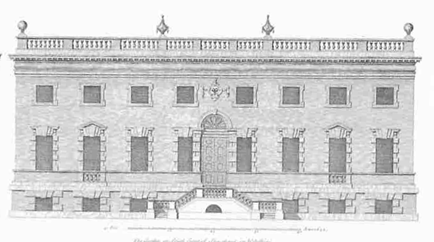
His major published work, Vitruvius Britannicus, or the British Architect... appeared in three volumes between 1715 and 1725. This was the first architectural work to originate in England since John Shute's Elizabethan First Groundes. In the empirical vein, it was not a treatise but basically a catalogue of design, containing engravings of English buildings by Inigo Jones and Sir Christopher Wren, as well as Campbell himself and other prominent architects of the era.
In the introduction that he appended and in the brief descriptions, Campbell belaboured the "excesses" of Baroque style and declared British independence from foreigners while he dedicated the volume to Hanoverian George I. The third volume (1725) has several grand layouts of gardens and parks, with straight allées, for courts and patterned parterres and radiating rides through wooded plantations, in a Baroque manner that was rapidly becoming old-fashioned.
Buildings were shown in plan, section and elevation, and some in a bird's-eye perspective. The drawings and designs contained in the book were under way before Campbell was drawn into the speculative scheme. The success of the volumes was instrumental in popularising neo-Palladian architecture in Great Britain and America during the 18th century. For example, Plate 16 of Vitruvius Britannicus, a rendering of Somerset House in London, was an inspiration for American architect Peter Harrison when he designed the Brick Market in Newport, Rhode Island, in 1761.
Campbell was influenced as a young man by James Smith (c. 1645–1731), the pre-eminent Scots architect of his day, and an early neo-Palladian whom Campbell called "the most experienced architect" of Scotland (Vitruvius Britannicus, ii).
The somewhat promotional volume, with its excellently rendered engravings, came at a propitious moment at the beginning of a boom in country house and villa building among the Whig oligarchy. Campbell was quickly taken up by Lord Burlington, who replaced James Gibbs with Campbell at Burlington House in London and set out to place himself at the centre of English neo-Palladian architecture. In 1718, Campbell was appointed deputy to the amateur gentleman who had replaced Wren as Surveyor General of the Royal Board of Works, an appointment that Burlington is certain to have pressed, but a short-lived one. When Benson, the new Surveyor was turned out of office, Campbell went with him.
Colen Campbell
Colen Campbell (15 June 1676 – 13 September 1729) was a pioneering Scottish architect and architectural writer who played an important part in the development of the Georgian style. For most of his career, he resided in Italy and England. As well as his architectural designs, he is known for Vitruvius Britannicus, three volumes of high-quality engravings showing the great houses of the time.
A descendant of the Campbells of Cawdor Castle, he is believed to be the Colinus Campbell who graduated from the University of Edinburgh in July 1695. He initially trained as a lawyer, being admitted to the Faculty of Advocates on 29 July 1702.
He travelled in Italy between 1695 and 1702, and is believed to be the Colinus Campbell who signed the visitor's book at the University of Padua in 1697. He is believed to have trained in and studied architecture under James Smith, a belief strengthened by Campbell owning several drawings of buildings designed by Smith.
His major published work, Vitruvius Britannicus, or the British Architect... appeared in three volumes between 1715 and 1725. This was the first architectural work to originate in England since John Shute's Elizabethan First Groundes. In the empirical vein, it was not a treatise but basically a catalogue of design, containing engravings of English buildings by Inigo Jones and Sir Christopher Wren, as well as Campbell himself and other prominent architects of the era.
In the introduction that he appended and in the brief descriptions, Campbell belaboured the "excesses" of Baroque style and declared British independence from foreigners while he dedicated the volume to Hanoverian George I. The third volume (1725) has several grand layouts of gardens and parks, with straight allées, for courts and patterned parterres and radiating rides through wooded plantations, in a Baroque manner that was rapidly becoming old-fashioned.
Buildings were shown in plan, section and elevation, and some in a bird's-eye perspective. The drawings and designs contained in the book were under way before Campbell was drawn into the speculative scheme. The success of the volumes was instrumental in popularising neo-Palladian architecture in Great Britain and America during the 18th century. For example, Plate 16 of Vitruvius Britannicus, a rendering of Somerset House in London, was an inspiration for American architect Peter Harrison when he designed the Brick Market in Newport, Rhode Island, in 1761.
Campbell was influenced as a young man by James Smith (c. 1645–1731), the pre-eminent Scots architect of his day, and an early neo-Palladian whom Campbell called "the most experienced architect" of Scotland (Vitruvius Britannicus, ii).
The somewhat promotional volume, with its excellently rendered engravings, came at a propitious moment at the beginning of a boom in country house and villa building among the Whig oligarchy. Campbell was quickly taken up by Lord Burlington, who replaced James Gibbs with Campbell at Burlington House in London and set out to place himself at the centre of English neo-Palladian architecture. In 1718, Campbell was appointed deputy to the amateur gentleman who had replaced Wren as Surveyor General of the Royal Board of Works, an appointment that Burlington is certain to have pressed, but a short-lived one. When Benson, the new Surveyor was turned out of office, Campbell went with him.
Recent media
Recent media