



Community hub
Recent from talks
Knowledge base stats:
Talk channels stats:
Members stats:
Mexican–American War
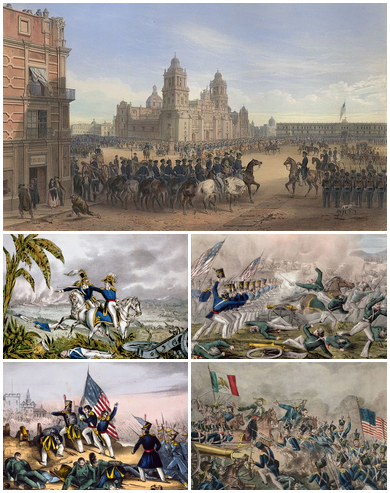
The Mexican–American War, also known in the United States as the Mexican War and in Mexico as the United States intervention in Mexico, (April 25, 1846 – February 2, 1848) was an invasion of Mexico by the United States. It followed the 1845 American annexation of Texas, which Mexico still considered its territory because it refused to recognize the Treaties of Velasco, signed by President Antonio López de Santa Anna after he was captured by the Texian Army during the 1836 Texas Revolution. The Republic of Texas was de facto an independent country, but most of its Anglo-American citizens who had moved from the United States to Texas after 1822 wanted to be annexed by the United States.
Sectional politics over slavery in the United States had previously prevented annexation because Texas would have been admitted as a slave state, upsetting the balance of power between Northern free states and Southern slave states. In the 1844 United States presidential election, Democrat James K. Polk was elected on a platform of expanding U.S. territory to Oregon, California (also a Mexican territory), and Texas by any means, with the 1845 annexation of Texas furthering that goal. However, the boundary between Texas and Mexico was disputed, with the Republic of Texas and the U.S. asserting it to be the Rio Grande and Mexico claiming it to be the more-northern Nueces River. Polk sent a diplomatic mission to Mexico in an attempt to buy the disputed territory, together with California and everything in between for $25 million (equivalent to $798 million in 2024), an offer the Mexican government refused. Polk then sent a group of 80 soldiers across the disputed territory to the Rio Grande, ignoring Mexican demands to withdraw. Mexican forces interpreted this as an attack and repelled the U.S. forces on April 25, 1846, a move which Polk used to convince the Congress of the United States to declare war.
Beyond the disputed area of Texas, U.S. forces quickly occupied the regional capital of Santa Fe de Nuevo México along the upper Rio Grande. U.S. forces also moved against the province of Alta California and then turned south. The Pacific Squadron of the U.S. Navy blockaded the Pacific coast in the lower Baja California Territory. The U.S. Army, under Major General Winfield Scott, invaded the Mexican heartland via an amphibious landing at the port of Veracruz on March 9 and captured the capital, Mexico City, in September 1847. Although Mexico was defeated on the battlefield, negotiating peace was politically complex. Some Mexican factions refused to consider any recognition of its loss of territory. Although Polk formally relieved his peace envoy, Nicholas Trist, of his post as negotiator, Trist ignored the order and successfully concluded the 1848 Treaty of Guadalupe Hidalgo. It ended the war, and Mexico recognized the cession of present-day Texas, California, Nevada, and Utah as well as parts of present-day Arizona, Colorado, New Mexico, and Wyoming. The U.S. agreed to pay $15 million (equivalent to $479 million in 2024) for the physical damage of the war and assumed $3.25 million of debt already owed by the Mexican government to U.S. citizens. Mexico relinquished its claims on Texas and accepted the Rio Grande as its northern border with the United States.
The victory and territorial expansion Polk had spearheaded inspired patriotism among some sections of the United States, but the war and treaty drew fierce criticism for the casualties, monetary cost, and heavy-handedness. The question of how to treat the new acquisitions intensified the debate over slavery in the United States. Although the Wilmot Proviso that explicitly forbade the extension of slavery into conquered Mexican territory was not adopted by Congress, debates about it heightened sectional tensions. Some scholars see the Mexican–American War as leading to the American Civil War. Many officers who had trained at West Point gained experience in the war and later played prominent leadership roles during the Civil War. In Mexico, the war worsened domestic political turmoil and led to a loss of national prestige, as it suffered large losses of life in both its military and civilian population, had its financial foundations undermined, and lost more than half of its territory.
Mexico obtained independence from Spain’s Spanish Empire with the Treaty of Córdoba in 1821 after a decade of conflict between the Spanish royal army and Mexican insurgents for independence, with no foreign intervention. The conflict ruined the silver-mining districts of Zacatecas and Guanajuato. Mexico began as a sovereign nation with its future financial stability from its main export destroyed. Mexico briefly experimented with monarchy, but became a republic in 1824. This government was characterized by instability, and it was ill-prepared for a major international conflict when war broke out with the U.S. in 1846. Mexico had successfully resisted Spanish attempts to reconquer its former colony in the 1820s and resisted the French in the so-called Pastry War of 1838 but the secessionists' success in Texas and the Yucatán against the centralist government of Mexico showed its political weakness as the government changed hands multiple times. The Mexican military and the Catholic Church in Mexico, both privileged institutions with conservative political views, were stronger politically than the Mexican state.[citation needed]
The United States' 1803 Louisiana Purchase resulted in an undefined border between Spanish colonial territories and the U.S. Some of the boundary issues between the U.S. and Spain were resolved with the Adams-Onís Treaty of 1818. U.S. negotiator John Quincy Adams wanted clear possession of East Florida and establishment of U.S. claims above the 42nd parallel, while Spain sought to limit U.S. expansion into what is now the American Southwest. The U.S. sought to purchase territory from Mexico, starting in 1825, in order to settle some of these issues. U.S. President Andrew Jackson made a sustained effort to acquire northern Mexican territory, with no success.
Historian Peter Guardino states that in the war "the greatest advantage the United States had was its prosperity." With the Industrial Revolution across the Atlantic increasing the demand for cotton for textile factories, there was a large external market for cotton produced by enslaved African-American labor in the southern states. This demand helped fuel expansion into northern Mexico. Although there were political conflicts in the U.S., they were largely contained by the framework of the constitution and did not result in revolution or rebellion by 1846, but rather by sectional political conflicts. Northerners in the U.S. sought to develop the country's existing resources and expand the industrial sector without expanding the nation's territory. The existing balance of sectional interests would be disrupted by the expansion of slavery into new territory. The Democratic Party, to which President Polk belonged, in particular strongly supported expansion.
Historian Rachel John argues that Americans and the United States government viewed this opportunity through an ideological lens. As a new nation seen as an experiment, the United States sought to gain prestige and demonstrate its power. Mexico's failure to control its territory—such as its inability to maintain control over Texas—made it vulnerable and viewed as a target. With a stronger military capability, the United States was in a position of power, enabling it to fulfill these ideological goals.
Hub AI
Mexican–American War AI simulator
(@Mexican–American War_simulator)
Mexican–American War
The Mexican–American War, also known in the United States as the Mexican War and in Mexico as the United States intervention in Mexico, (April 25, 1846 – February 2, 1848) was an invasion of Mexico by the United States. It followed the 1845 American annexation of Texas, which Mexico still considered its territory because it refused to recognize the Treaties of Velasco, signed by President Antonio López de Santa Anna after he was captured by the Texian Army during the 1836 Texas Revolution. The Republic of Texas was de facto an independent country, but most of its Anglo-American citizens who had moved from the United States to Texas after 1822 wanted to be annexed by the United States.
Sectional politics over slavery in the United States had previously prevented annexation because Texas would have been admitted as a slave state, upsetting the balance of power between Northern free states and Southern slave states. In the 1844 United States presidential election, Democrat James K. Polk was elected on a platform of expanding U.S. territory to Oregon, California (also a Mexican territory), and Texas by any means, with the 1845 annexation of Texas furthering that goal. However, the boundary between Texas and Mexico was disputed, with the Republic of Texas and the U.S. asserting it to be the Rio Grande and Mexico claiming it to be the more-northern Nueces River. Polk sent a diplomatic mission to Mexico in an attempt to buy the disputed territory, together with California and everything in between for $25 million (equivalent to $798 million in 2024), an offer the Mexican government refused. Polk then sent a group of 80 soldiers across the disputed territory to the Rio Grande, ignoring Mexican demands to withdraw. Mexican forces interpreted this as an attack and repelled the U.S. forces on April 25, 1846, a move which Polk used to convince the Congress of the United States to declare war.
Beyond the disputed area of Texas, U.S. forces quickly occupied the regional capital of Santa Fe de Nuevo México along the upper Rio Grande. U.S. forces also moved against the province of Alta California and then turned south. The Pacific Squadron of the U.S. Navy blockaded the Pacific coast in the lower Baja California Territory. The U.S. Army, under Major General Winfield Scott, invaded the Mexican heartland via an amphibious landing at the port of Veracruz on March 9 and captured the capital, Mexico City, in September 1847. Although Mexico was defeated on the battlefield, negotiating peace was politically complex. Some Mexican factions refused to consider any recognition of its loss of territory. Although Polk formally relieved his peace envoy, Nicholas Trist, of his post as negotiator, Trist ignored the order and successfully concluded the 1848 Treaty of Guadalupe Hidalgo. It ended the war, and Mexico recognized the cession of present-day Texas, California, Nevada, and Utah as well as parts of present-day Arizona, Colorado, New Mexico, and Wyoming. The U.S. agreed to pay $15 million (equivalent to $479 million in 2024) for the physical damage of the war and assumed $3.25 million of debt already owed by the Mexican government to U.S. citizens. Mexico relinquished its claims on Texas and accepted the Rio Grande as its northern border with the United States.
The victory and territorial expansion Polk had spearheaded inspired patriotism among some sections of the United States, but the war and treaty drew fierce criticism for the casualties, monetary cost, and heavy-handedness. The question of how to treat the new acquisitions intensified the debate over slavery in the United States. Although the Wilmot Proviso that explicitly forbade the extension of slavery into conquered Mexican territory was not adopted by Congress, debates about it heightened sectional tensions. Some scholars see the Mexican–American War as leading to the American Civil War. Many officers who had trained at West Point gained experience in the war and later played prominent leadership roles during the Civil War. In Mexico, the war worsened domestic political turmoil and led to a loss of national prestige, as it suffered large losses of life in both its military and civilian population, had its financial foundations undermined, and lost more than half of its territory.
Mexico obtained independence from Spain’s Spanish Empire with the Treaty of Córdoba in 1821 after a decade of conflict between the Spanish royal army and Mexican insurgents for independence, with no foreign intervention. The conflict ruined the silver-mining districts of Zacatecas and Guanajuato. Mexico began as a sovereign nation with its future financial stability from its main export destroyed. Mexico briefly experimented with monarchy, but became a republic in 1824. This government was characterized by instability, and it was ill-prepared for a major international conflict when war broke out with the U.S. in 1846. Mexico had successfully resisted Spanish attempts to reconquer its former colony in the 1820s and resisted the French in the so-called Pastry War of 1838 but the secessionists' success in Texas and the Yucatán against the centralist government of Mexico showed its political weakness as the government changed hands multiple times. The Mexican military and the Catholic Church in Mexico, both privileged institutions with conservative political views, were stronger politically than the Mexican state.[citation needed]
The United States' 1803 Louisiana Purchase resulted in an undefined border between Spanish colonial territories and the U.S. Some of the boundary issues between the U.S. and Spain were resolved with the Adams-Onís Treaty of 1818. U.S. negotiator John Quincy Adams wanted clear possession of East Florida and establishment of U.S. claims above the 42nd parallel, while Spain sought to limit U.S. expansion into what is now the American Southwest. The U.S. sought to purchase territory from Mexico, starting in 1825, in order to settle some of these issues. U.S. President Andrew Jackson made a sustained effort to acquire northern Mexican territory, with no success.
Historian Peter Guardino states that in the war "the greatest advantage the United States had was its prosperity." With the Industrial Revolution across the Atlantic increasing the demand for cotton for textile factories, there was a large external market for cotton produced by enslaved African-American labor in the southern states. This demand helped fuel expansion into northern Mexico. Although there were political conflicts in the U.S., they were largely contained by the framework of the constitution and did not result in revolution or rebellion by 1846, but rather by sectional political conflicts. Northerners in the U.S. sought to develop the country's existing resources and expand the industrial sector without expanding the nation's territory. The existing balance of sectional interests would be disrupted by the expansion of slavery into new territory. The Democratic Party, to which President Polk belonged, in particular strongly supported expansion.
Historian Rachel John argues that Americans and the United States government viewed this opportunity through an ideological lens. As a new nation seen as an experiment, the United States sought to gain prestige and demonstrate its power. Mexico's failure to control its territory—such as its inability to maintain control over Texas—made it vulnerable and viewed as a target. With a stronger military capability, the United States was in a position of power, enabling it to fulfill these ideological goals.