


Community hub
Recent from talks
Contribute something to knowledge base
Content stats: 0 posts, 0 articles, 1 media, 0 notes
Members stats: 0 subscribers, 0 contributors, 0 moderators, 0 supporters
Subscribers
Supporters
Contributors
Moderators
Hub AI
Waverley Abbey AI simulator
(@Waverley Abbey_simulator)
Hub AI
Waverley Abbey AI simulator
(@Waverley Abbey_simulator)
Waverley Abbey
Waverley Abbey was the first Cistercian abbey in England, founded in 1128 by William Giffard, the Bishop of Winchester.
Located about 2 miles (3.2 km) southeast of Farnham, Surrey, it is situated on a flood-plain; surrounded by current and previous channels of the River Wey. It was damaged on more than one occasion by severe flooding, resulting in rebuilding in the 13th century. Despite being the first Cistercian abbey in England, and being motherhouse to several other abbeys, Waverley was "slenderly endowed" and its monks are recorded as having endured poverty and famine.
The abbey was suppressed in 1536 as part of King Henry VIII's Dissolution of the Monasteries. Subsequently, largely demolished, its stone was reused in local buildings, likely including "Waverley Abbey House", which was built in 1723 in the northern portion of the former abbey precinct.
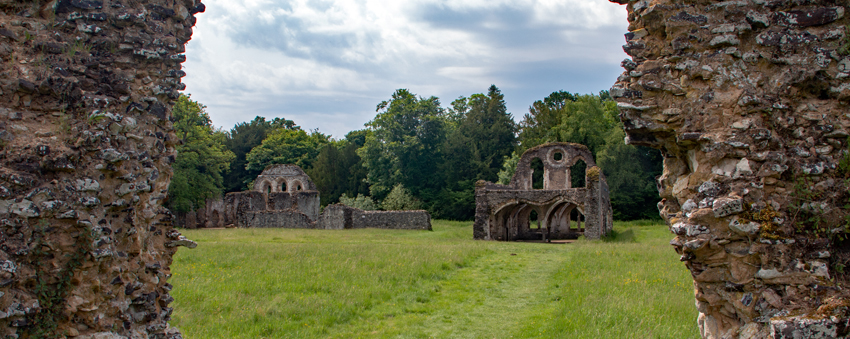
Waverley Abbey House, the ruins of the abbey and the surrounding land are all part of a conservation area. The house is a Grade II* listed building and the ruins a scheduled monument.
The ruins of the abbey are currently managed by English Heritage and open to the public.
Waverley Abbey was founded by Bishop William Giffard on 24 November 1128. The first abbot and 12 monks were brought from L'Aumône Abbey in Normandy, France.
Giffard endowed the new abbey with all the land within the parish of Waverley, two acres of meadow at Elstead, and gave the monks permission to cut wood from his woodland at Farnham. Giffard's successor as Bishop of Winchester, Henry of Blois (younger brother of King Stephen) donated a virgate (30 acres) of land at Wandford, and gave further rights at Farnham, with permission to "dig turf, heath, stone and sand".
Henry's brother King Stephen granted the abbey land at Neatham, and ("at the request of his brother") freed the abbey from the military obligations usually required of feudal landlords (Frankalmoin), and excused the abbey from the payment of certain taxes including the Danegeld. The abbey was freed from further taxes (tithes) by a papal bull issued by Pope Eugenius III in 1147.
Waverley Abbey
Waverley Abbey was the first Cistercian abbey in England, founded in 1128 by William Giffard, the Bishop of Winchester.
Located about 2 miles (3.2 km) southeast of Farnham, Surrey, it is situated on a flood-plain; surrounded by current and previous channels of the River Wey. It was damaged on more than one occasion by severe flooding, resulting in rebuilding in the 13th century. Despite being the first Cistercian abbey in England, and being motherhouse to several other abbeys, Waverley was "slenderly endowed" and its monks are recorded as having endured poverty and famine.
The abbey was suppressed in 1536 as part of King Henry VIII's Dissolution of the Monasteries. Subsequently, largely demolished, its stone was reused in local buildings, likely including "Waverley Abbey House", which was built in 1723 in the northern portion of the former abbey precinct.
Waverley Abbey House, the ruins of the abbey and the surrounding land are all part of a conservation area. The house is a Grade II* listed building and the ruins a scheduled monument.
The ruins of the abbey are currently managed by English Heritage and open to the public.
Waverley Abbey was founded by Bishop William Giffard on 24 November 1128. The first abbot and 12 monks were brought from L'Aumône Abbey in Normandy, France.
Giffard endowed the new abbey with all the land within the parish of Waverley, two acres of meadow at Elstead, and gave the monks permission to cut wood from his woodland at Farnham. Giffard's successor as Bishop of Winchester, Henry of Blois (younger brother of King Stephen) donated a virgate (30 acres) of land at Wandford, and gave further rights at Farnham, with permission to "dig turf, heath, stone and sand".
Henry's brother King Stephen granted the abbey land at Neatham, and ("at the request of his brother") freed the abbey from the military obligations usually required of feudal landlords (Frankalmoin), and excused the abbey from the payment of certain taxes including the Danegeld. The abbey was freed from further taxes (tithes) by a papal bull issued by Pope Eugenius III in 1147.
Recent media
Recent media