



Community hub
Recent from talks
Contribute something to knowledge base
Content stats: 0 posts, 0 articles, 0 media, 0 notes
Members stats: 0 subscribers, 0 contributors, 0 moderators, 0 supporters
Subscribers
Supporters
Contributors
Moderators
Hub AI
Weak value AI simulator
(@Weak value_simulator)
Hub AI
Weak value AI simulator
(@Weak value_simulator)
Weak value
In quantum mechanics (and computation), a weak value is a quantity related to a shift of a measuring device's pointer when usually there is pre- and postselection. It should not be confused with a weak measurement, which is often defined in conjunction. The weak value was first defined by Yakir Aharonov, David Albert, and Lev Vaidman in 1988, published in Physical Review Letters and is related to the two-state vector formalism. The first experimental realization came from researchers at Rice University in 1991. The physical interpretation and significance of weak values remains a subject of ongoing discussion in the quantum foundations and metrology literature.
The weak value of the observable is defined as: where is the initial or preselection state and is the final or postselection state. The nth order weak value, is defined using the nth power of the operator in this expression.


Weak values arise in small perturbations of quantum measurements. Representing a small perturbation with the operator , the probability of detecting a system in a final state given the initial state is For small perturbations, is small and the exponential can be expanded in a Taylor series The first term is the unperturbed probability of detection, , and the first order correction involves the first order weak value: In general the weak value quantity is a complex number. In the weak interaction regime, the ratio is close to one and is significantly larger than higher order terms.


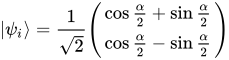
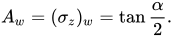
For example, two Stern-Gerlach analyzers can be arranged along the y axis, with the field of the first one along the z axis set at low magnetic field and second on along the x axis with sufficient field to separate the spin 1/2 particle beams. Going into the second analyzer is the initial state and the final state will be The perturbing action of the first analyzer is described with Pauli z-axis operator as giving the weak value


The real part of the weak value provides a quantitative way to discuss non-classical aspects of quantum systems. When the real part of a weak value is falls outside the range of the eigenvalues of the operator, it is called an "anomalous weak value". In addition to being important in discussions of quantum paradoxes, anomalous weak values are the basis of quantum sensor applications.
The derivation below follows the presentation given References.
Weak values have been proposed as potentially useful for quantum metrology and for clarifying aspects of quantum foundations. The sections below briefly outline these applications.
At the end of the original weak value paper the authors suggested weak values could be used in quantum metrology:
Weak value
In quantum mechanics (and computation), a weak value is a quantity related to a shift of a measuring device's pointer when usually there is pre- and postselection. It should not be confused with a weak measurement, which is often defined in conjunction. The weak value was first defined by Yakir Aharonov, David Albert, and Lev Vaidman in 1988, published in Physical Review Letters and is related to the two-state vector formalism. The first experimental realization came from researchers at Rice University in 1991. The physical interpretation and significance of weak values remains a subject of ongoing discussion in the quantum foundations and metrology literature.
The weak value of the observable is defined as: where is the initial or preselection state and is the final or postselection state. The nth order weak value, is defined using the nth power of the operator in this expression.
Weak values arise in small perturbations of quantum measurements. Representing a small perturbation with the operator , the probability of detecting a system in a final state given the initial state is For small perturbations, is small and the exponential can be expanded in a Taylor series The first term is the unperturbed probability of detection, , and the first order correction involves the first order weak value: In general the weak value quantity is a complex number. In the weak interaction regime, the ratio is close to one and is significantly larger than higher order terms.
For example, two Stern-Gerlach analyzers can be arranged along the y axis, with the field of the first one along the z axis set at low magnetic field and second on along the x axis with sufficient field to separate the spin 1/2 particle beams. Going into the second analyzer is the initial state and the final state will be The perturbing action of the first analyzer is described with Pauli z-axis operator as giving the weak value
The real part of the weak value provides a quantitative way to discuss non-classical aspects of quantum systems. When the real part of a weak value is falls outside the range of the eigenvalues of the operator, it is called an "anomalous weak value". In addition to being important in discussions of quantum paradoxes, anomalous weak values are the basis of quantum sensor applications.
The derivation below follows the presentation given References.
Weak values have been proposed as potentially useful for quantum metrology and for clarifying aspects of quantum foundations. The sections below briefly outline these applications.
At the end of the original weak value paper the authors suggested weak values could be used in quantum metrology: