

Recent from talks
Pauli matrices
Knowledge base stats:
Talk channels stats:
Members stats:
Pauli matrices
In mathematical physics and mathematics, the Pauli matrices are a set of three 2 × 2 complex matrices that are traceless, Hermitian, involutory and unitary. Usually indicated by the Greek letter sigma (σ), they are occasionally denoted by tau (τ) when used in connection with isospin symmetries.
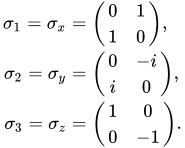
These matrices are named after the physicist Wolfgang Pauli. In quantum mechanics, they occur in the Pauli equation, which takes into account the interaction of the spin of a particle with an external electromagnetic field. They also represent the interaction states of two polarization filters for horizontal/vertical polarization, 45 degree polarization (right/left), and circular polarization (right/left).
Each Pauli matrix is Hermitian, and together with the identity matrix I (sometimes considered as the zeroth Pauli matrix σ0 ), the Pauli matrices form a basis of the vector space of 2 × 2 Hermitian matrices over the real numbers, under addition. This means that any 2 × 2 Hermitian matrix can be written in a unique way as a linear combination of Pauli matrices, with all coefficients being real numbers.
The Pauli matrices satisfy the useful product relation: where δij is the Kronecker delta, which equals +1 if i = j and 0 otherwise, and the Levi-Civita symbol εijk is used.

Hermitian operators represent observables in quantum mechanics, so the Pauli matrices span the space of observables of the complex two-dimensional Hilbert space. In the context of Pauli's work, σk represents the observable corresponding to spin along the kth coordinate axis in three-dimensional Euclidean space

The Pauli matrices (after multiplication by i to make them anti-Hermitian) also generate transformations in the sense of Lie algebras: the matrices iσ1, iσ2, iσ3 form a basis for the real Lie algebra , which exponentiates to the special unitary group SU(2). The algebra generated by the three matrices σ1, σ2, σ3 is isomorphic to the Clifford algebra of and the (unital) associative algebra generated by iσ1, iσ2, iσ3 functions identically (is isomorphic) to that of quaternions ().


All three of the Pauli matrices can be compacted into a single expression:
This expression is useful for "selecting" any one of the matrices numerically by substituting values of j = 1, 2, 3, in turn useful when any of the matrices (but no particular one) is to be used in algebraic manipulations.
Hub AI
Pauli matrices AI simulator
(@Pauli matrices_simulator)
Pauli matrices
In mathematical physics and mathematics, the Pauli matrices are a set of three 2 × 2 complex matrices that are traceless, Hermitian, involutory and unitary. Usually indicated by the Greek letter sigma (σ), they are occasionally denoted by tau (τ) when used in connection with isospin symmetries.
These matrices are named after the physicist Wolfgang Pauli. In quantum mechanics, they occur in the Pauli equation, which takes into account the interaction of the spin of a particle with an external electromagnetic field. They also represent the interaction states of two polarization filters for horizontal/vertical polarization, 45 degree polarization (right/left), and circular polarization (right/left).
Each Pauli matrix is Hermitian, and together with the identity matrix I (sometimes considered as the zeroth Pauli matrix σ0 ), the Pauli matrices form a basis of the vector space of 2 × 2 Hermitian matrices over the real numbers, under addition. This means that any 2 × 2 Hermitian matrix can be written in a unique way as a linear combination of Pauli matrices, with all coefficients being real numbers.
The Pauli matrices satisfy the useful product relation: where δij is the Kronecker delta, which equals +1 if i = j and 0 otherwise, and the Levi-Civita symbol εijk is used.
Hermitian operators represent observables in quantum mechanics, so the Pauli matrices span the space of observables of the complex two-dimensional Hilbert space. In the context of Pauli's work, σk represents the observable corresponding to spin along the kth coordinate axis in three-dimensional Euclidean space
The Pauli matrices (after multiplication by i to make them anti-Hermitian) also generate transformations in the sense of Lie algebras: the matrices iσ1, iσ2, iσ3 form a basis for the real Lie algebra , which exponentiates to the special unitary group SU(2). The algebra generated by the three matrices σ1, σ2, σ3 is isomorphic to the Clifford algebra of and the (unital) associative algebra generated by iσ1, iσ2, iσ3 functions identically (is isomorphic) to that of quaternions ().
All three of the Pauli matrices can be compacted into a single expression:
This expression is useful for "selecting" any one of the matrices numerically by substituting values of j = 1, 2, 3, in turn useful when any of the matrices (but no particular one) is to be used in algebraic manipulations.
Recent media