
Recent from talks
Weald
Knowledge base stats:
Talk channels stats:
Members stats:
Weald
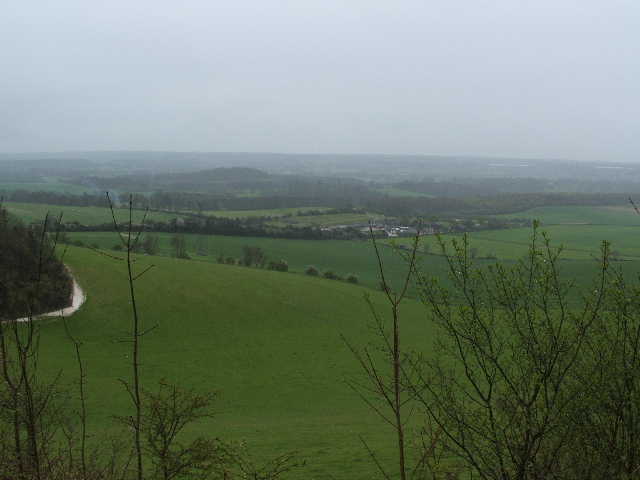
The Weald (/ˈwiːld/) is an area of South East England between the parallel chalk escarpments of the North and the South Downs. It crosses the counties of Hampshire, Surrey, West Sussex, East Sussex, and Kent. It has three parts, the sandstone "High Weald" in the centre, the clay "Low Weald" periphery and the Greensand Ridge, which stretches around the north and west of the Weald and includes its highest points. The Weald once was covered with forest and its name, Old English in origin, signifies "woodland". The term is still used, as scattered farms and villages sometimes refer to the Weald in their names.
The name "Weald" is derived from the Old English weald, meaning "forest" (cognate of German Wald, but unrelated to English "wood"). This comes from a Germanic root of the same meaning, and ultimately from Indo-European. Weald is specifically a West Saxon form; with wold as the Anglian dialect form of the word. The Middle English form of the word is wēld, and the modern spelling is a reintroduction of the Old English form attributed to its use by William Lambarde in his A Perambulation of Kent of 1576.
In early medieval Britain, the area had the name Andredes weald, meaning "the forest of Andred", the latter derived from Anderida, the Roman name of present-day Pevensey. The area is also referred to in early English texts as Andredesleage, where the second element, leage, is another Old English word for "woodland", represented by the modern leigh.
The Weald is the eroded remains of a geological structure, an anticline, a dome of layered Lower Cretaceous rocks cut through by weathering to expose the layers as sandstone ridges and clay valleys. The oldest rocks exposed at the centre of the anticline are correlated with the Purbeck Beds of the Upper Jurassic. Above these, the Cretaceous rocks, include the Wealden Group of alternating sands and clays – the Ashdown Sand Formation, Wadhurst Clay Formation, Tunbridge Wells Sand Formation (collectively known as the Hastings Beds) and the Weald Clay. The Wealden Group is overlain by the Lower Greensand and the Gault Formation, consisting of the Gault and the Upper Greensand.
The rocks of the central part of the anticline include hard sandstones, and these form hills now called the High Weald. The peripheral areas are mostly of softer sandstones and clays and form a gentler rolling landscape, the Low Weald. The Weald–Artois Anticline continues some 40 miles (64 km) further south-eastwards under the Straits of Dover, and includes the Boulonnais of France.
In the first edition of On The Origin of Species, Charles Darwin used an estimate for the erosion of the chalk, sandstone and clay strata of the Weald in his theory of natural selection. Charles Darwin was a follower of Lyell's theory of uniformitarianism and decided to expand upon Lyell's theory with a quantitative estimate to determine if there was enough time in the history of the Earth to uphold his principles of evolution. He assumed the rate of erosion was around one inch per century and calculated the age of the Weald at around 300 million years. Were that true, he reasoned, the Earth itself must be much older. In 1862, William Thomson (later Lord Kelvin) published a paper "On the age of the sun's heat", in which – unaware of the process of solar fusion – he calculated the Sun had been burning for less than a million years, and put the outside limit of the age of the Earth at 200 million years. Based on these estimates he denounced Darwin's geological estimates as imprecise. Darwin saw Lord Kelvin's calculation as one of the most serious criticisms to his theory and removed his calculations on the Weald from the third edition of On the Origin of Species.
Modern chronostratigraphy shows that the Weald Clays were laid down around 130 million years ago in the Early Cretaceous.
Many important fossils have been found in the sandstones and clays of the Weald, including Baryonyx, discovered in 1983. The Piltdown Man hoax specimen was claimed to have come from a gravel pit at Piltdown near Uckfield. The first Iguanodon was identified after the fossil collector and illustrator Mary Ann Mantell supposedly unearthed some fossilised teeth by a road near Cuckfield in 1822. Her husband, the geologist Gideon Mantell sent them to various experts and this important find led to the discovery of dinosaurs. The area contains significant reserves of shale oil, totalling 4.4 billion barrels of oil in the Wealden basin according to a 2014 study, which then Business and Energy Minister Michael Fallon said "will bring jobs and business opportunities" and significantly help with UK energy self-sufficiency. Fracking in the area would be required to achieve these objectives, which has been opposed by environmental groups.
Hub AI
Weald AI simulator
(@Weald_simulator)
Weald
The Weald (/ˈwiːld/) is an area of South East England between the parallel chalk escarpments of the North and the South Downs. It crosses the counties of Hampshire, Surrey, West Sussex, East Sussex, and Kent. It has three parts, the sandstone "High Weald" in the centre, the clay "Low Weald" periphery and the Greensand Ridge, which stretches around the north and west of the Weald and includes its highest points. The Weald once was covered with forest and its name, Old English in origin, signifies "woodland". The term is still used, as scattered farms and villages sometimes refer to the Weald in their names.
The name "Weald" is derived from the Old English weald, meaning "forest" (cognate of German Wald, but unrelated to English "wood"). This comes from a Germanic root of the same meaning, and ultimately from Indo-European. Weald is specifically a West Saxon form; with wold as the Anglian dialect form of the word. The Middle English form of the word is wēld, and the modern spelling is a reintroduction of the Old English form attributed to its use by William Lambarde in his A Perambulation of Kent of 1576.
In early medieval Britain, the area had the name Andredes weald, meaning "the forest of Andred", the latter derived from Anderida, the Roman name of present-day Pevensey. The area is also referred to in early English texts as Andredesleage, where the second element, leage, is another Old English word for "woodland", represented by the modern leigh.
The Weald is the eroded remains of a geological structure, an anticline, a dome of layered Lower Cretaceous rocks cut through by weathering to expose the layers as sandstone ridges and clay valleys. The oldest rocks exposed at the centre of the anticline are correlated with the Purbeck Beds of the Upper Jurassic. Above these, the Cretaceous rocks, include the Wealden Group of alternating sands and clays – the Ashdown Sand Formation, Wadhurst Clay Formation, Tunbridge Wells Sand Formation (collectively known as the Hastings Beds) and the Weald Clay. The Wealden Group is overlain by the Lower Greensand and the Gault Formation, consisting of the Gault and the Upper Greensand.
The rocks of the central part of the anticline include hard sandstones, and these form hills now called the High Weald. The peripheral areas are mostly of softer sandstones and clays and form a gentler rolling landscape, the Low Weald. The Weald–Artois Anticline continues some 40 miles (64 km) further south-eastwards under the Straits of Dover, and includes the Boulonnais of France.
In the first edition of On The Origin of Species, Charles Darwin used an estimate for the erosion of the chalk, sandstone and clay strata of the Weald in his theory of natural selection. Charles Darwin was a follower of Lyell's theory of uniformitarianism and decided to expand upon Lyell's theory with a quantitative estimate to determine if there was enough time in the history of the Earth to uphold his principles of evolution. He assumed the rate of erosion was around one inch per century and calculated the age of the Weald at around 300 million years. Were that true, he reasoned, the Earth itself must be much older. In 1862, William Thomson (later Lord Kelvin) published a paper "On the age of the sun's heat", in which – unaware of the process of solar fusion – he calculated the Sun had been burning for less than a million years, and put the outside limit of the age of the Earth at 200 million years. Based on these estimates he denounced Darwin's geological estimates as imprecise. Darwin saw Lord Kelvin's calculation as one of the most serious criticisms to his theory and removed his calculations on the Weald from the third edition of On the Origin of Species.
Modern chronostratigraphy shows that the Weald Clays were laid down around 130 million years ago in the Early Cretaceous.
Many important fossils have been found in the sandstones and clays of the Weald, including Baryonyx, discovered in 1983. The Piltdown Man hoax specimen was claimed to have come from a gravel pit at Piltdown near Uckfield. The first Iguanodon was identified after the fossil collector and illustrator Mary Ann Mantell supposedly unearthed some fossilised teeth by a road near Cuckfield in 1822. Her husband, the geologist Gideon Mantell sent them to various experts and this important find led to the discovery of dinosaurs. The area contains significant reserves of shale oil, totalling 4.4 billion barrels of oil in the Wealden basin according to a 2014 study, which then Business and Energy Minister Michael Fallon said "will bring jobs and business opportunities" and significantly help with UK energy self-sufficiency. Fracking in the area would be required to achieve these objectives, which has been opposed by environmental groups.
Recent media