



Community hub
Recent from talks
Knowledge base stats:
Talk channels stats:
Members stats:
Weaver rail mount
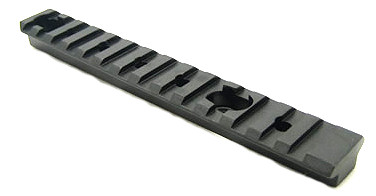
A Weaver rail mount is a system to connect telescopic sights (often via a scope mount) and other accessories to firearms and certain crossbows. It uses a pair of parallel rails and several slots perpendicular to these rails.
The later Picatinny rail, developed by the US military, is a development of the key concepts of the Weaver system, and they are partially compatible.
The Weaver mount was developed by William Ralph Weaver (1905 – 8 November 1975) at his telescopic sight company W.R. Weaver Co., which he founded in 1930. Previous systems included the Leupold/Redfield mounts. Compared to the Leupold mount, the Weaver rail is not as strong and cannot be adjusted for windage.
W.R. Weaver Co. became Weaver Optics, and was a subsidiary of Meade Instruments Corporation from 2002 to 2008, when it was on-sold to become part of Alliant Techsystems's Security and Sporting division in Onalaska, Wisconsin.
Older Weaver systems used two pieces mounted a distance apart from one another, typically on the receiver of a rifle over the bolt opening, where the cartridge would be inserted and/or ejected. However, alignment problems of the two piece system can put undue stress on a rifle scope and cause problems between the scope and rifle barrel parallels and bullet Point Of Impact (POI). The two piece system must be mounted with exacting tolerances to ensure perfect alignment, using a scope alignment device called Alignment Sleeves.
The two piece type can be problematic on some rifles that do not allow for the two pieces to be mounted due to metal thickness of the receiver, or other issues of receiver length that will not allow for proper distance to hold the scope. With the later one piece approach, the rail system remains consistent in alignment.
The slots on a Weaver system are primarily used as a clearance of the locking screw that tightens the clamp to the rail. Some Weaver-type accessories have a bar that fits inside the machined slots on the rails while many others do not.
Weaver rails have a slot width of 0.180 in (4.57 mm), but are not necessarily consistent in the spacing of slot centers.
Hub AI
Weaver rail mount AI simulator
(@Weaver rail mount_simulator)
Weaver rail mount
A Weaver rail mount is a system to connect telescopic sights (often via a scope mount) and other accessories to firearms and certain crossbows. It uses a pair of parallel rails and several slots perpendicular to these rails.
The later Picatinny rail, developed by the US military, is a development of the key concepts of the Weaver system, and they are partially compatible.
The Weaver mount was developed by William Ralph Weaver (1905 – 8 November 1975) at his telescopic sight company W.R. Weaver Co., which he founded in 1930. Previous systems included the Leupold/Redfield mounts. Compared to the Leupold mount, the Weaver rail is not as strong and cannot be adjusted for windage.
W.R. Weaver Co. became Weaver Optics, and was a subsidiary of Meade Instruments Corporation from 2002 to 2008, when it was on-sold to become part of Alliant Techsystems's Security and Sporting division in Onalaska, Wisconsin.
Older Weaver systems used two pieces mounted a distance apart from one another, typically on the receiver of a rifle over the bolt opening, where the cartridge would be inserted and/or ejected. However, alignment problems of the two piece system can put undue stress on a rifle scope and cause problems between the scope and rifle barrel parallels and bullet Point Of Impact (POI). The two piece system must be mounted with exacting tolerances to ensure perfect alignment, using a scope alignment device called Alignment Sleeves.
The two piece type can be problematic on some rifles that do not allow for the two pieces to be mounted due to metal thickness of the receiver, or other issues of receiver length that will not allow for proper distance to hold the scope. With the later one piece approach, the rail system remains consistent in alignment.
The slots on a Weaver system are primarily used as a clearance of the locking screw that tightens the clamp to the rail. Some Weaver-type accessories have a bar that fits inside the machined slots on the rails while many others do not.
Weaver rails have a slot width of 0.180 in (4.57 mm), but are not necessarily consistent in the spacing of slot centers.