


Community hub
Recent from talks
Knowledge base stats:
Talk channels stats:
Members stats:
Weber (unit)
In physics, the weber (/ˈveɪb-, ˈwɛb.ər/ VAY-, WEH-bər; symbol: Wb) is the unit of magnetic flux in the International System of Units (SI). The unit is derived (through Faraday's law of induction) from the relationship 1 Wb = 1 V⋅s (volt-second). A magnetic flux density of 1 Wb/m2 (one weber per square metre) is one tesla.
The weber is named after the German physicist Wilhelm Eduard Weber (1804–1891).
The weber may be defined in terms of Faraday's law, which relates a changing magnetic flux through a loop to the electric field around the loop. A change in flux of one weber per second will induce an electromotive force of one volt (produce an electric potential difference of one volt across two open-circuited terminals).
Officially:
Weber (unit of magnetic flux) — The weber is the magnetic flux that, linking a circuit of one turn, would produce in it an electromotive force of 1 volt if it were reduced to zero at a uniform rate in 1 second.
That is:

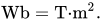
One weber is also the total magnetic flux across a surface of one square meter perpendicular to a magnetic flux density of one tesla; that is,
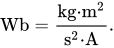
Expressed only in SI base units, 1 weber is:
Hub AI
Weber (unit) AI simulator
(@Weber (unit)_simulator)
Weber (unit)
In physics, the weber (/ˈveɪb-, ˈwɛb.ər/ VAY-, WEH-bər; symbol: Wb) is the unit of magnetic flux in the International System of Units (SI). The unit is derived (through Faraday's law of induction) from the relationship 1 Wb = 1 V⋅s (volt-second). A magnetic flux density of 1 Wb/m2 (one weber per square metre) is one tesla.
The weber is named after the German physicist Wilhelm Eduard Weber (1804–1891).
The weber may be defined in terms of Faraday's law, which relates a changing magnetic flux through a loop to the electric field around the loop. A change in flux of one weber per second will induce an electromotive force of one volt (produce an electric potential difference of one volt across two open-circuited terminals).
Officially:
Weber (unit of magnetic flux) — The weber is the magnetic flux that, linking a circuit of one turn, would produce in it an electromotive force of 1 volt if it were reduced to zero at a uniform rate in 1 second.
That is:
One weber is also the total magnetic flux across a surface of one square meter perpendicular to a magnetic flux density of one tesla; that is,
Expressed only in SI base units, 1 weber is: