


Community hub
Weber (unit)
View on Wikipedia| weber | |
|---|---|
| Unit system | SI |
| Unit of | magnetic flux |
| Symbol | Wb |
| Named after | Wilhelm Eduard Weber |
| Conversions | |
| 1 Wb in ... | ... is equal to ... |
| SI base units | 1 kg⋅m2⋅s−2⋅A−1 |
| Gaussian units | 1×10⁸ Mx |
In physics, the weber (/ˈveɪb-, ˈwɛb.ər/ VAY-, WEH-bər;[1][2] symbol: Wb) is the unit of magnetic flux in the International System of Units (SI). The unit is derived (through Faraday's law of induction) from the relationship 1 Wb = 1 V⋅s (volt-second). A magnetic flux density of 1 Wb/m2 (one weber per square metre) is one tesla.
The weber is named after the German physicist Wilhelm Eduard Weber (1804–1891).
Definition
[edit]The weber may be defined in terms of Faraday's law, which relates a changing magnetic flux through a loop to the electric field around the loop. A change in flux of one weber per second will induce an electromotive force of one volt (produce an electric potential difference of one volt across two open-circuited terminals).
Officially:
Weber (unit of magnetic flux) — The weber is the magnetic flux that, linking a circuit of one turn, would produce in it an electromotive force of 1 volt if it were reduced to zero at a uniform rate in 1 second.[3]
That is:

One weber is also the total magnetic flux across a surface of one square meter perpendicular to a magnetic flux density of one tesla; that is,
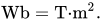
Expressed only in SI base units, 1 weber is:
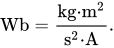
The weber is used in the definition of the henry as 1 weber per ampere, and consequently can be expressed as the product of those units:

The weber is commonly expressed in a multitude of other units[citation needed]:
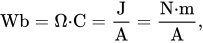
where Ω is ohm, C is coulomb, J is joule, and N is newton.
The weber is named after Wilhelm Eduard Weber. As with every SI unit named after a person, its symbol starts with an upper case letter (Wb), but when written in full, it follows the rules for capitalisation of a common noun; i.e., weber becomes capitalised at the beginning of a sentence and in titles but is otherwise in lower case.
History
[edit]In 1861, the British Association for the Advancement of Science (known as "The BA"[4]) established a committee under William Thomson (later Lord Kelvin) to study electrical units.[5] In a February 1902 manuscript, with handwritten notes of Oliver Heaviside, Giovanni Giorgi proposed a set of rational units of electromagnetism including the weber, noting that "the product of the volt into the second has been called the weber by the B. A."[6]
The International Electrotechnical Commission began work on terminology in 1909 and established Technical Committee 1 in 1911, its oldest established committee,[7] "to sanction the terms and definitions used in the different electrotechnical fields and to determine the equivalence of the terms used in the different languages."[8]
It was not until 1927 that TC1 dealt with the study of various outstanding problems concerning electrical and magnetic quantities and units. Discussions of a theoretical nature were opened at which eminent electrical engineers and physicists considered whether magnetic field strength and magnetic flux density were in fact quantities of the same nature. As disagreement continued, the IEC decided on an effort to remedy the situation. It instructed a task force to study the question in readiness for the next meeting.[9]
In 1930, TC1 decided that the magnetic field strength (H) is of a different nature from the magnetic flux density (B),[9] and took up the question of naming the units for these fields and related quantities, among them the integral of magnetic flux density.[citation needed]
In 1935, TC 1 recommended names for several electrical units, including the weber for the practical unit of magnetic flux (and the maxwell for the CGS unit).[9][10]
It was decided to extend the existing series of practical units into a complete comprehensive system of physical units, the recommendation being adopted in 1935 "that the system with four fundamental units proposed by Professor Giorgi be adopted subject to the fourth fundamental unit being eventually selected". This system was given the designation of "Giorgi system".[11]
Also in 1935, TC1 passed responsibility for "electric and magnetic magnitudes and units" to the new TC24. This "led eventually to the universal adoption of the Giorgi system, which unified electromagnetic units with the MKS dimensional system of units, the whole now known simply as the SI system (Système International d'unités)."[12]
In 1938, TC24 "recommended as a connecting link [from mechanical to electrical units] the permeability of free space with the value of μ0 = 4π×10−7 H/m". This group also recognized that any one of the practical units already in use (ohm, ampere, volt, henry, farad, coulomb, and weber), could equally serve as the fourth fundamental unit.[9] "After consultation, the ampere was adopted as the fourth unit of the Giorgi system in Paris in 1950."[11]
Multiples
[edit]Like other SI units, the weber can be modified by adding a prefix that multiplies it by a power of 10.
| Submultiples | Multiples | ||||
|---|---|---|---|---|---|
| Value | SI symbol | Name | Value | SI symbol | Name |
| 10−1 Wb | dWb | deciweber | 101 Wb | daWb | decaweber |
| 10−2 Wb | cWb | centiweber | 102 Wb | hWb | hectoweber |
| 10−3 Wb | mWb | milliweber | 103 Wb | kWb | kiloweber |
| 10−6 Wb | μWb | microweber | 106 Wb | MWb | megaweber |
| 10−9 Wb | nWb | nanoweber | 109 Wb | GWb | gigaweber |
| 10−12 Wb | pWb | picoweber | 1012 Wb | TWb | teraweber |
| 10−15 Wb | fWb | femtoweber | 1015 Wb | PWb | petaweber |
| 10−18 Wb | aWb | attoweber | 1018 Wb | EWb | exaweber |
| 10−21 Wb | zWb | zeptoweber | 1021 Wb | ZWb | zettaweber |
| 10−24 Wb | yWb | yoctoweber | 1024 Wb | YWb | yottaweber |
| 10−27 Wb | rWb | rontoweber | 1027 Wb | RWb | ronnaweber |
| 10−30 Wb | qWb | quectoweber | 1030 Wb | QWb | quettaweber |
| Common multiples are in bold face. | |||||
Conversions
[edit]Notes and references
[edit]- ^ Wells, John (3 April 2008). Longman Pronunciation Dictionary (3rd ed.). Pearson Longman. ISBN 978-1-4058-8118-0.
- ^ "weber (main entry is American English, Collins World English (further down) is British)". Dictionary.com.
- ^ "CIPM, 1946: Resolution 2 / Definitions of Electrical Units". International Committee for Weights and Measures (CIPM) Resolutions. International Bureau of Weights and Measures (BIPM). 1946. Archived from the original on 2020-11-25. Retrieved 2008-04-29.
- ^ "The BA (British Association for the Advancement of Science)".
- ^ Frary, Mark. "In the beginning...The world of electricity: 1820-1904". International Electrotechnical Commission. Archived from the original on 2018-04-18. Retrieved 2018-04-19.
- ^ Giorgi, Giovanni (February 1902). "Rational Units of Electromagnetism". p. 9. Archived from the original (Manuscript with handwritten notes by Oliver Heaviside) on 2019-10-29. Retrieved 2014-02-21.
- ^ "Strategic Policy Statement, IEC Technical Committee on Terminology" (PDF). International Electrotechnical Commission. Archived from the original (PDF) on 2006-09-04. Retrieved 2008-04-29.
- ^ "IEC Technical Committee 1". International Electrotechnical Commission. Retrieved 2018-04-19.
- ^ a b c d "The role of the IEC / Work on quantities and units". History of the SI. International Electrotechnical Commission. Archived from the original on 11 June 2007. Retrieved 2018-04-19.
- ^ "Summary: Electrical Units". IEC History. International Electrotechnical Commission. Archived from the original on 2018-04-20. Retrieved 2018-04-19.
- This page incorrectly states that the units were established in 1930, since that year, TC 1 decided "that the question of names to be allocated to magnetic units should not be considered until general agreement had been reached on their definitions" [1] Archived 2007-06-11 at the Wayback Machine
- ^ a b Ruppert, Louis (1956). Brief History of the International Electrotechnical Commission (PDF). International Electrotechnical Commission. p. 5. Archived from the original (PDF) on 2016-12-24. Retrieved 2018-04-19.
- ^ Raeburn, Anthony. "Overview: IEC technical committee creation: the first half-century (1906-1949)". International Electrotechnical Commission. Retrieved 2018-04-19.[permanent dead link]

Weber (unit)
View on GrokipediaDefinition and Fundamentals
Formal Definition
The weber (symbol: Wb) is the SI unit of magnetic flux, defined as the magnetic flux that, linking a circuit of one turn, produces in it an electromotive force of 1 volt as the flux is reduced to zero at a uniform rate in 1 second.[2] This operational definition derives from Faraday's law of electromagnetic induction, which states that the induced electromotive force in a closed loop is equal to the negative rate of change of magnetic flux through the loop:Setting V and s for a uniform change yields Wb.[2] The weber was formally adopted as a derived unit in the metre-kilogram-second-ampere (MKSA) system by the 9th General Conference on Weights and Measures (CGPM) in 1948, ratifying the definitions of electrical units proposed by the International Committee for Weights and Measures (CIPM) in 1946. The unit was retained in the SI upon its establishment in 1960.[2]
Physical Interpretation
The weber measures magnetic flux, the total amount of magnetic field passing through a given surface. Physically, magnetic flux through a surface is the surface integral of the magnetic flux density over the area:where the dot product accounts for the orientation of the surface relative to the field. For a uniform field perpendicular to a flat surface of area , this simplifies to . Thus, 1 Wb corresponds to a magnetic flux density of 1 tesla over an area of 1 square meter.[3]
Historical Development
Contributions of Wilhelm Weber
Wilhelm Eduard Weber (1804–1891) was a German physicist renowned for his foundational contributions to acoustics and electromagnetism. Born in Wittenberg on October 24, 1804, he earned his doctorate from the University of Halle in 1826 and later held professorships in physics at institutions including the University of Göttingen, where he collaborated extensively with leading scientists. In 1837, Weber was dismissed from Göttingen as part of the "Göttingen Seven" protest against the repeal of the Hanover constitution but was reinstated in 1843. His early work in acoustics, co-authored with his brother Ernst Heinrich Weber, advanced wave theory through experimental studies of sound propagation.[4] A pivotal aspect of Weber's career was his collaboration with Carl Friedrich Gauss, beginning around 1831, which focused on terrestrial magnetism and led to the development of absolute units for magnetic measurements.[4] Together, they constructed the world's first practical electromagnetic telegraph in 1833, spanning over a mile between Göttingen Observatory buildings, enabling remote electrical signaling for scientific communication.[4][3] This work established an absolute system of electromagnetic units based on mechanical dimensions—length, mass, and time—allowing precise, reproducible measurements of magnetic intensity and currents without reliance on arbitrary standards.[5] Weber's experimental validations, including the first absolute current measurements in 1841 using a specialized tangent galvanometer, laid groundwork for modern electromagnetism.[5] Weber invented several key instruments that enhanced electromagnetic research, including the electrodynamometer for measuring magnetic fields and currents and an improved galvanometer, which supported his studies in acoustics and wave motion.[4] His 1846 publication Die Galvanische Kette provided a mathematical framework for galvanic circuits, elucidating the interactions between electric currents and magnetic fields through Ampère's laws and induction effects.[6] This treatise unified electrostatic and electrodynamic phenomena, proposing a generalized force law that incorporated velocity-dependent terms, influencing later theories of electromagnetism.[7] In recognition of these advancements in quantifying electromagnetic relationships, the unit of magnetic flux was named the weber during discussions by the International Committee for Weights and Measures (CIPM) in 1946, as part of standardizing practical electrical units.[8][3] This honor, formalized in the SI system, underscores Weber's role in establishing precise measurements essential for technologies like electric generators and transformers.[3]Adoption in the SI System
In 1935, the International Electrotechnical Commission (IEC) proposed the adoption of the Giorgi system, an extension of the meter-kilogram-second (MKS) framework to electromagnetism, which included a unit for magnetic flux linkage to support practical electrical measurements.[9] This proposal aimed to establish coherent units for electromagnetic quantities, addressing the limitations of earlier systems like the centimeter-gram-second electromagnetic units (CGS emu).[10] The name "weber" for this unit of magnetic flux was officially adopted by the Comité International des Poids et Mesures (CIPM) in 1946 via Resolution 2 of its 41st meeting, defining the weber as the magnetic flux that, linking a circuit of one turn, produces an electromotive force of 1 volt as it is reduced uniformly to zero in 1 second.[1] The 9th General Conference on Weights and Measures (CGPM) in 1948, through Resolution 6, directed the CIPM to develop a unified international system of measurement based on the MKS system and one electrical unit, advancing the standardization of units including the weber beyond provisional MKS conventions.[11] The weber achieved full integration as a coherent derived unit within the International System of Units (SI) at the 11th CGPM in 1960, via Resolution 12, which formally established the SI based on six base units and specified the weber (symbol Wb) as equivalent to the volt-second (V·s).[12] This marked the definitive transition from non-coherent absolute units in systems like CGS emu—where magnetic flux was quantified in maxwells (1 Wb = 10^8 Mx)—to the SI's rationalized framework, ensuring consistency across electrical and magnetic measurements.[13] In English, the weber is pronounced /ˈveɪbər/ (VAY-ber), as clarified in a 2024 National Institute of Standards and Technology (NIST) publication.[3]Unit Equivalences
Dimensional Expression
The weber, as the SI unit of magnetic flux denoted by the symbol Φ, has the dimensional formula [Φ] = [M L² T⁻² I⁻¹], where M represents mass in kilograms (kg), L length in meters (m), T time in seconds (s), and I electric current in amperes (A). This derived unit arises from the definition of the weber as equivalent to one volt-second (V·s), ensuring its integration within the coherent SI system. The volt itself is expressed dimensionally as [V] = [M L² T⁻³ I⁻¹], or in base units as kg·m²·s⁻³·A⁻¹. Multiplying by the second yields the weber's expression:Alternative Representations
The weber, as the SI unit of magnetic flux, can be equivalently expressed using other derived SI units that arise from its physical relationships in electromagnetism. The primary equivalent is the volt-second, where 1 Wb = 1 V·s, reflecting the definition of magnetic flux in terms of the electromotive force induced by a changing flux according to Faraday's law.[2] Another fundamental representation links the weber to magnetic flux density and area: 1 Wb = 1 T·m², where the tesla (T) measures flux density and the square meter (m²) accounts for the surface area through which the flux passes. This equivalence holds for uniform magnetic fields perpendicular to the area, as described by the relationSI Prefixes and Multiples
Standard Prefixes
The weber (Wb), as the SI unit of magnetic flux, employs the standard decimal prefixes defined by the International Bureau of Weights and Measures (BIPM) to denote multiples and submultiples, facilitating the expression of flux values over an extensive scale from extremely small to extraordinarily large magnitudes. These prefixes follow powers of 10, ensuring consistency across SI units.[14] The complete set of SI prefixes extends from the yoctoweber (yWb = 10^{-24} Wb) for the smallest submultiples to the yottaweber (YWb = 10^{24} Wb) for the largest multiples, covering 48 orders of magnitude in total. However, practical measurements of magnetic flux in engineering and scientific contexts predominantly utilize prefixes within the range of 10^{-6} Wb to 10^3 Wb, aligning with typical scales in electronics, sensors, and power systems where fluxes rarely exceed kilowbers.[14] Among these, the microweber (µWb = 10^{-6} Wb) is commonly applied to quantify small magnetic fluxes in electronic components, such as micro-inductors, where values on the order of 10 µWb represent significant dc flux offsets in hybrid core designs for high-saturation applications. Similarly, the megweber (MWb = 10^6 Wb) accommodates large-scale fluxes, though such magnitudes are exceptional and more relevant to theoretical or geophysical contexts rather than routine power grid operations. For everyday use, intermediate prefixes like milliweber (mWb) and kiloweber (kWb) bridge smaller sensor-level measurements to modest industrial scales.| Prefix | Symbol | Factor | Weber Unit | Example Application |
|---|---|---|---|---|
| Micro- | µ | 10^{-6} | Microweber (µWb) | Flux in micro-inductor cores, e.g., on the order of 10 µWb for dc offset in high-density designs. |
| Milli- | m | 10^{-3} | Milliweber (mWb) | Leakage flux in small transformers, e.g., tens of mWb in residual magnetization. |
| - | - | 10^{0} | Weber (Wb) | Core flux in power transformers, e.g., around 0.3 Wb at peak during inrush conditions. |
| Kilo- | k | 10^{3} | Kiloweber (kWb) | Hypothetical large-scale flux aggregation in extended systems, e.g., 1000 Wb change in electromagnetic induction scenarios.[15] |
| Mega- | M | 10^{6} | Megweber (MWb) | Rare extreme fluxes, such as in theoretical models of massive electromagnetic fields.[14] |
Practical Usage
In inductors, the magnetic flux linkage Φ is related to the inductance L and current I by the equation Φ = L · I, where Φ is measured in webers, allowing engineers to quantify the stored magnetic energy in circuits. This relationship is particularly useful for designing components where flux values are typically expressed in milliwbers (mWb) to manage electromagnetic interference and efficiency. In transformers, the weber quantifies the magnetic flux that links primary and secondary windings, enabling the calculation of voltage ratios and core saturation limits during power transmission.[16] A practical example of microscale flux measurement is the Earth's magnetic field, which has an average strength of about 50 microteslas (µT); the flux through a 1 m² loop perpendicular to this field is approximately 50 microwebers (µWb).[17] In medical imaging, MRI machines generate fields of 1.5 to 7 teslas, resulting in flux values of up to about 1 Wb over typical imaging cross-sections, such as those encompassing human limbs or organs.[18] Fluxmeters and search coils are key instruments calibrated directly in webers or subunits like microwebers for non-destructive testing applications, such as detecting flaws in metallic structures by measuring changes in magnetic flux leakage.[19] These devices integrate the flux over time to assess material integrity without physical alteration, commonly used in infrastructure inspections like bridges and pipelines.[20]Conversions to Non-SI Units
CGS System Equivalents
The weber (Wb), the SI unit of magnetic flux, is equivalent to maxwells (Mx) in the centimeter-gram-second electromagnetic (CGS emu) system, where the maxwell serves as the corresponding unit of magnetic flux.[21] This conversion factor stems from the fundamental differences in unit scales between SI and CGS emu, particularly in the definitions of electric potential and length, with 1 Mx defined as the flux that induces an electromotive force of 1 abvolt when changing at a rate of 1 Mx per second.[22] In the CGS emu system, the maxwell relates directly to other electromagnetic units, such as the gauss (G) for magnetic flux density and the oersted (Oe) for magnetic field strength, through the expression 1 Mx = 1 G·cm², representing the flux through a square centimeter area under a field of 1 gauss.[23] The gilbert (Gb), the emu unit of magnetomotive force, connects indirectly via the magnetic circuit analogy, where flux in maxwells equals magnetomotive force in gilberts divided by reluctance, though the primary flux measure remains tied to the gauss-centimeter product in practical applications.[13] Historically, the CGS emu unit of magnetic flux originated as 1 abvolt-second, reflecting Faraday's law of induction in the absolute electromagnetic system, but it was standardized as the maxwell in the late 19th century to honor James Clerk Maxwell's contributions to electromagnetism.[24] The scaling factor between the weber and maxwell arises from the SI-CGS emu dimensional alignments, implicitly incorporating the speed of light ( m/s) in the rationalization of electrostatic and electromagnetic units, though the emu system sets the permeability of vacuum to unity without explicit factors in flux definitions.[25]Other Historical Units
In the Gaussian system of units, a variant of the CGS framework commonly employed in theoretical electromagnetism, magnetic flux is measured in maxwells (Mx), equivalent to the CGS electromagnetic units (emu) counterpart, with 1 Wb = 10^8 Mx. The system's integration of electrostatic units (esu) and emu introduces complexity, as conversions between electric and magnetic quantities incorporate the speed of light $ c \approx 2.9979 \times 10^{10} $ cm/s to maintain consistency in Maxwell's equations. Specifically, the esu unit for magnetic flux, the statweber (statWb), relates through $ 1 $ Wb $ = \frac{10^8}{c} $ statWb, yielding approximately 3.336 × 10^{-3} statWb due to the dimensional scaling between the systems.[26][27] Less common historical units include the concept of "lines of force," an older terminology for magnetic flux lines originating from 19th-century visualizations by Michael Faraday, where 1 Wb corresponds to 10^8 lines of force, reflecting the same scaling as the maxwell. This unit was rarely used in quantitative work but provided a conceptual bridge to modern definitions.[28] In specialized contexts like superconductivity, magnetic flux is quantized in units of the superconducting flux quantum $ \Phi_0 = \frac{h}{2e} \approx 2.068 \times 10^{-15} $ Wb, where $ h $ is Planck's constant and $ e $ is the elementary charge; thus, 1 Wb encompasses approximately 4.84 × 10^{14} such quanta, highlighting the scale of quantum effects in macroscopic magnetic phenomena.[29][30] The following table summarizes key conversion factors from the weber to these historical and specialized units:| Unit System | Unit Name | Conversion Factor | Notes |
|---|---|---|---|
| Gaussian/emu | Maxwell (Mx) | 1 Wb = 10^8 Mx | Primary unit for magnetic flux; identical in Gaussian and CGS emu. |
| esu | Statweber (statWb) | 1 Wb ≈ 3.336 × 10^{-3} statWb | Involves $ c $ due to esu-emu linkage; rarely applied in practice. |
| Historical | Line of force | 1 Wb = 10^8 lines | Conceptual unit from early electromagnetism; non-quantitative. |
| Superconductivity | Flux quantum (Φ₀) | 1 Wb ≈ 4.84 × 10^{14} Φ₀ | Quantized unit; establishes scale in quantum magnetic contexts. |