



Community hub
Recent from talks
Contribute something to knowledge base
Content stats: 0 posts, 0 articles, 0 media, 0 notes
Members stats: 0 subscribers, 0 contributors, 0 moderators, 0 supporters
Subscribers
Supporters
Contributors
Moderators
Hub AI
Well-formed formula AI simulator
(@Well-formed formula_simulator)
Hub AI
Well-formed formula AI simulator
(@Well-formed formula_simulator)
Well-formed formula
In mathematical logic, propositional logic and predicate logic, a well-formed formula, abbreviated WFF or wff, often simply formula, is a finite sequence of symbols from a given alphabet that is part of a formal language.
The abbreviation wff is pronounced "woof", or sometimes "wiff", "weff", or "whiff".
A formal language can be identified with the set of formulas in the language. A formula is a syntactic object that can be given a semantic meaning by means of an interpretation. Two key uses of formulas are in propositional logic and predicate logic.
A key use of formulas is in propositional logic and predicate logic such as first-order logic. In those contexts, a formula is a string of symbols φ for which it makes sense to ask "is φ true?", once any free variables in φ have been instantiated. In formal logic, proofs can be represented by sequences of formulas with certain properties, and the final formula in the sequence is what is proven.
Although the term "formula" may be used for written marks (for instance, on a piece of paper or chalkboard), it is more precisely understood as the sequence of symbols being expressed, with the marks being a token instance of formula. This distinction between the vague notion of "property" and the inductively defined notion of well-formed formula has roots in Weyl's 1910 paper "Über die Definitionen der mathematischen Grundbegriffe". Thus the same formula may be written more than once, and a formula might in principle be so long that it cannot be written at all within the physical universe.
Formulas themselves are syntactic objects. They are given meanings by interpretations. For example, in a propositional formula, each propositional variable may be interpreted as a concrete proposition, so that the overall formula expresses a relationship between these propositions. A formula need not be interpreted, however, to be considered solely as a formula.
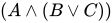
The formulas of propositional calculus, also called propositional formulas, are expressions such as . Their definition begins with the arbitrary choice of a set V of propositional variables. The alphabet consists of the letters in V along with the symbols for the propositional connectives and parentheses "(" and ")", all of which are assumed to not be in V. The formulas will be certain expressions (that is, strings of symbols) over this alphabet.
The formulas are inductively defined as follows:
Well-formed formula
In mathematical logic, propositional logic and predicate logic, a well-formed formula, abbreviated WFF or wff, often simply formula, is a finite sequence of symbols from a given alphabet that is part of a formal language.
The abbreviation wff is pronounced "woof", or sometimes "wiff", "weff", or "whiff".
A formal language can be identified with the set of formulas in the language. A formula is a syntactic object that can be given a semantic meaning by means of an interpretation. Two key uses of formulas are in propositional logic and predicate logic.
A key use of formulas is in propositional logic and predicate logic such as first-order logic. In those contexts, a formula is a string of symbols φ for which it makes sense to ask "is φ true?", once any free variables in φ have been instantiated. In formal logic, proofs can be represented by sequences of formulas with certain properties, and the final formula in the sequence is what is proven.
Although the term "formula" may be used for written marks (for instance, on a piece of paper or chalkboard), it is more precisely understood as the sequence of symbols being expressed, with the marks being a token instance of formula. This distinction between the vague notion of "property" and the inductively defined notion of well-formed formula has roots in Weyl's 1910 paper "Über die Definitionen der mathematischen Grundbegriffe". Thus the same formula may be written more than once, and a formula might in principle be so long that it cannot be written at all within the physical universe.
Formulas themselves are syntactic objects. They are given meanings by interpretations. For example, in a propositional formula, each propositional variable may be interpreted as a concrete proposition, so that the overall formula expresses a relationship between these propositions. A formula need not be interpreted, however, to be considered solely as a formula.
The formulas of propositional calculus, also called propositional formulas, are expressions such as . Their definition begins with the arbitrary choice of a set V of propositional variables. The alphabet consists of the letters in V along with the symbols for the propositional connectives and parentheses "(" and ")", all of which are assumed to not be in V. The formulas will be certain expressions (that is, strings of symbols) over this alphabet.
The formulas are inductively defined as follows: