



Community hub
Recent from talks
Contribute something to knowledge base
Content stats: 0 posts, 0 articles, 1 media, 0 notes
Members stats: 0 subscribers, 0 contributors, 0 moderators, 0 supporters
Subscribers
Supporters
Contributors
Moderators
Hub AI
West Falkland AI simulator
(@West Falkland_simulator)
Hub AI
West Falkland AI simulator
(@West Falkland_simulator)
West Falkland
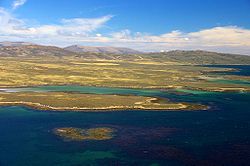
West Falkland (Spanish: Isla Gran Malvina) is the second largest of the Falkland Islands in the South Atlantic. It is a hilly island, separated from East Falkland by the Falkland Sound. Its area is 4,532 square kilometres (1,750 square miles), 37% of the total area of the islands. Its coastline is 1,258.7 kilometres (782.1 miles) long.
The island has fewer than 200 people, scattered around the coastline. The largest settlement is Port Howard on the east coast, which has an airstrip. Other settlements include Albemarle, Chartres, Dunnose Head, Fox Bay, Fox Bay West, Hill Cove, Port Stephens, and Roy Cove, most of which are linked by road and also have airstrips and harbours. In 1986, the population was 265, in 2001, it had fallen to 144 and rose to 160 in 2016.
Because West Falkland is outside Stanley or RAF Mount Pleasant on East Falkland it is considered part of the "camp", a Falklander term for the area outside the main settlement.
West Falkland is hillier on the side closest to East Falkland. The principal mountain range, the Hornby Hills, runs parallel with Falkland Sound. Mount Adam, the highest hill in the islands, is 700 metres (2,300 ft) above sea level. Formerly it was thought that Mount Robinson at 695 metres (2,280 ft) above sea level was the highest point. However, a later survey found that Mount Adam was higher. At this, the Argentines transferred the name Monte Independencia from Mount Robinson to Mount Adam. The major industry on the island is sheep farming, while it is also known for its penguin and cormorant colonies. Fishing is also popular in the two main rivers, the Warrah and the Chartres.
In the 19th century as today, indigenous land fauna was very scanty. A small wolf, the warrah, the loup-renard of Louis Antoine de Bougainville, is extinct, the last having been seen about 1875 on West Falkland. It is commemorated in the name of one of the island's rivers – the Warrah River – and the settlement of Fox Bay. Some herds of cattle and horses ran wild; but these were introduced by settlers as were the wild hogs, the numerous rabbits and the less common hares. All these have greatly declined in numbers, being profitably replaced by sheep.
The southernmost point of West Falkland is Cape Meredith, and the most south-westerly point is Calm Head. On the southerly side lie high cliffs with an abundance of seabirds. To the west are some white sandy beaches with clean water and rolling sand dunes with tall grass. Set just back from the top of the cliffs is a single wooden hut locally referred to as Uncle Tom's Cabin. The beaches are a habitat for elephant seals and are unpolluted save for the occasional piece of wreckage.
Most of the layers of West Falkland and its surrounding islands are slightly inclined from the horizontal. This inclination shows different types of rocks in different places. The quartzites of Port Stephens and Stanley are more resistant than the arenaceous sediments of the formation at Fox Bay. The Hornby Mountains, near Falkland Sound have experienced tectonic forces of uplift and folding which has inclined the quartzite beds of Stanley to the vertical.
In West Falkland there are several dykes that cut the rocks of the western islands, but these dykes, unlike the previous ones, are chemically more unstable and have been eroded. The only indications of their existence are the aligned linear depressions. In the margins of these depressions there is evidence of contact baking or hornfels formation adjacent to the once molten basalt dyke.
West Falkland
West Falkland (Spanish: Isla Gran Malvina) is the second largest of the Falkland Islands in the South Atlantic. It is a hilly island, separated from East Falkland by the Falkland Sound. Its area is 4,532 square kilometres (1,750 square miles), 37% of the total area of the islands. Its coastline is 1,258.7 kilometres (782.1 miles) long.
The island has fewer than 200 people, scattered around the coastline. The largest settlement is Port Howard on the east coast, which has an airstrip. Other settlements include Albemarle, Chartres, Dunnose Head, Fox Bay, Fox Bay West, Hill Cove, Port Stephens, and Roy Cove, most of which are linked by road and also have airstrips and harbours. In 1986, the population was 265, in 2001, it had fallen to 144 and rose to 160 in 2016.
Because West Falkland is outside Stanley or RAF Mount Pleasant on East Falkland it is considered part of the "camp", a Falklander term for the area outside the main settlement.
West Falkland is hillier on the side closest to East Falkland. The principal mountain range, the Hornby Hills, runs parallel with Falkland Sound. Mount Adam, the highest hill in the islands, is 700 metres (2,300 ft) above sea level. Formerly it was thought that Mount Robinson at 695 metres (2,280 ft) above sea level was the highest point. However, a later survey found that Mount Adam was higher. At this, the Argentines transferred the name Monte Independencia from Mount Robinson to Mount Adam. The major industry on the island is sheep farming, while it is also known for its penguin and cormorant colonies. Fishing is also popular in the two main rivers, the Warrah and the Chartres.
In the 19th century as today, indigenous land fauna was very scanty. A small wolf, the warrah, the loup-renard of Louis Antoine de Bougainville, is extinct, the last having been seen about 1875 on West Falkland. It is commemorated in the name of one of the island's rivers – the Warrah River – and the settlement of Fox Bay. Some herds of cattle and horses ran wild; but these were introduced by settlers as were the wild hogs, the numerous rabbits and the less common hares. All these have greatly declined in numbers, being profitably replaced by sheep.
The southernmost point of West Falkland is Cape Meredith, and the most south-westerly point is Calm Head. On the southerly side lie high cliffs with an abundance of seabirds. To the west are some white sandy beaches with clean water and rolling sand dunes with tall grass. Set just back from the top of the cliffs is a single wooden hut locally referred to as Uncle Tom's Cabin. The beaches are a habitat for elephant seals and are unpolluted save for the occasional piece of wreckage.
Most of the layers of West Falkland and its surrounding islands are slightly inclined from the horizontal. This inclination shows different types of rocks in different places. The quartzites of Port Stephens and Stanley are more resistant than the arenaceous sediments of the formation at Fox Bay. The Hornby Mountains, near Falkland Sound have experienced tectonic forces of uplift and folding which has inclined the quartzite beds of Stanley to the vertical.
In West Falkland there are several dykes that cut the rocks of the western islands, but these dykes, unlike the previous ones, are chemically more unstable and have been eroded. The only indications of their existence are the aligned linear depressions. In the margins of these depressions there is evidence of contact baking or hornfels formation adjacent to the once molten basalt dyke.
Recent media
Recent media