


Community hub
Recent from talks
Contribute something to knowledge base
Content stats: 0 posts, 0 articles, 1 media, 0 notes
Members stats: 0 subscribers, 0 contributors, 0 moderators, 0 supporters
Subscribers
Supporters
Contributors
Moderators
Hub AI
West Ham Stadium AI simulator
(@West Ham Stadium_simulator)
Hub AI
West Ham Stadium AI simulator
(@West Ham Stadium_simulator)
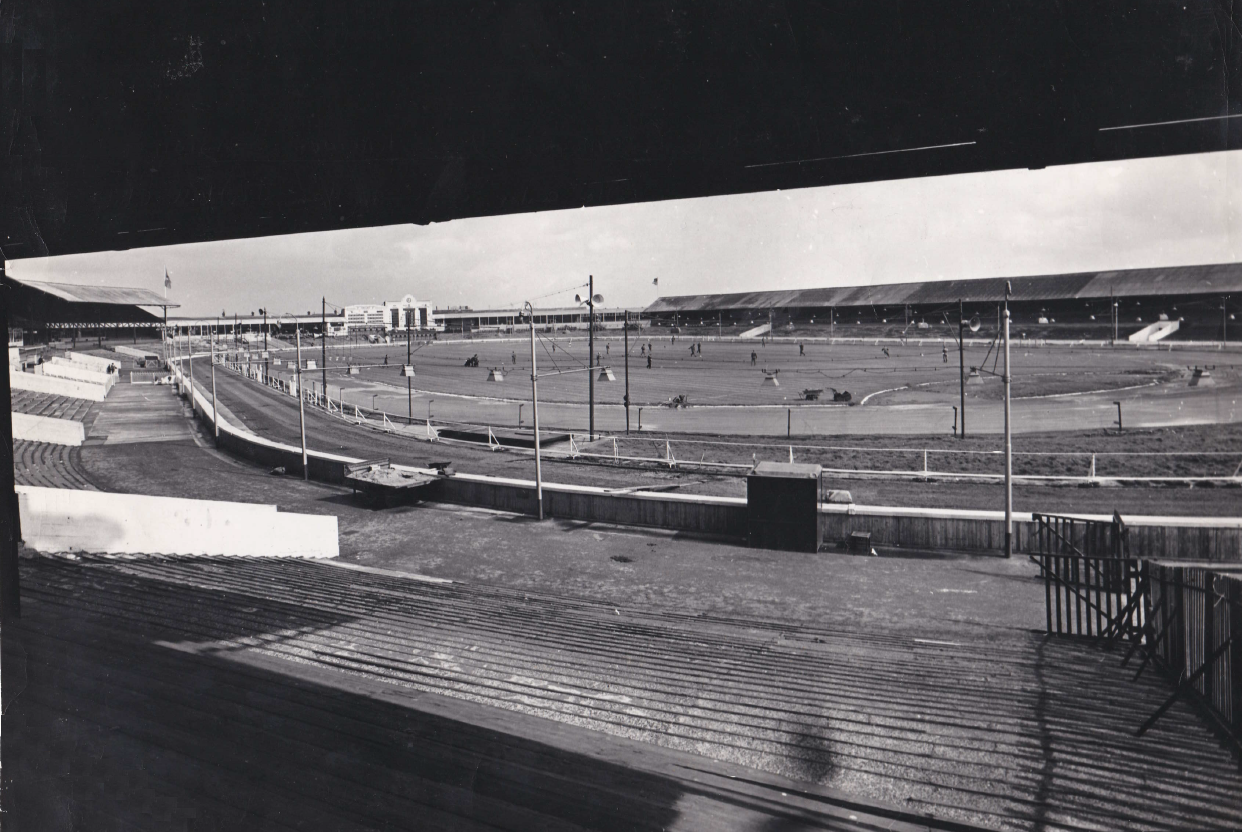
West Ham Stadium
West Ham Stadium existed between 1928 and 1972 in Custom House, east London, England, on Prince Regent Lane, near the present-day Prince Regent DLR station.
The venue was used for greyhound racing and speedway on weekdays and had no connection with West Ham United football club, who played at the nearby Boleyn Ground, Upton Park from 1904 until 2016.
Plans for a very large stadium in a rural area near Plaistow Marsh, east of Canning Town were unveiled in the late 1920s and work began on the structure where an old sports ground (built in 1855) was situated that had belonged to the workers of the custom house of Royal Victoria Dock.
The stadium was designed by Archibald Leitch, responsible for most of the major football stadia at the time including Goodison Park and Highbury. There was a large two tier stand accommodating 80,000 spectators with a smaller stand able to hold a further 20,000 bringing the capacity for the stadium up to 100,000. The track was the largest in Great Britain with a circumference of 562 yards and 123-yard straights. The standard trip of 550 yards did not even require a greyhound to complete a full lap. The track was lit by 70 x 750 watt lamps and used a special monorail train weighing 500lbs to carry the hare. There was also a very unusual design regarding the track surface which used turf laid on a wooden foundation which had been raised twelve inches above ground level which would consequently result in a very fast track. It was described as a well-sprung dance floor matted with a special fibrous substance.
The kennels consisted of six ranges totalling over 200 kennels within the two acres of the stadium grounds.
The first meeting took place on 4 August 1928. The stadium management brought in a race called the Cesarewitch, which gained classic status; the race started over the distance of 600 yards but become a competition for marathon greyhounds.
Early successful trainers were Ken Appleton and Stan Biss, both of whom had owned greyhounds on Wembley's opening night and subsequently taken out trainers' licences at Wimbledon Stadium before joining West Ham. Biss trained a famous bitch called Bradshaw Fold when she finished runner up to Mick the Miller in the 1930 English Greyhound Derby. Two weeks later Mick the Miller won the Cesarewitch winning by seven lengths in his heat and on the same day winning the first prize of £200 in the final.
West Ham won the Derby in 1931 with the Wally Green trained Seldom Led and one year later Future Cutlet recorded a second successive Cesarewitch victory setting a new world record of 33.78 sec in his semi-final. In 1936 the track introduced the Cambridgeshire which would stand as the tracks second major competition. One year later in 1937 the track opened a veterinary hospital on site. The Second World War forced the racing to be suspended on more than one occasion and the Canning Town area suffered terrible bombing damage due to the fact that the docks were seen as a primary target. The stadium was lucky to miss the destruction that many buildings suffered in the immediate area but there were continual closures until 1946. The West Ham operation was largely moved to Dagenham Greyhound Stadium from March 1944 until 1946.
West Ham Stadium
West Ham Stadium existed between 1928 and 1972 in Custom House, east London, England, on Prince Regent Lane, near the present-day Prince Regent DLR station.
The venue was used for greyhound racing and speedway on weekdays and had no connection with West Ham United football club, who played at the nearby Boleyn Ground, Upton Park from 1904 until 2016.
Plans for a very large stadium in a rural area near Plaistow Marsh, east of Canning Town were unveiled in the late 1920s and work began on the structure where an old sports ground (built in 1855) was situated that had belonged to the workers of the custom house of Royal Victoria Dock.
The stadium was designed by Archibald Leitch, responsible for most of the major football stadia at the time including Goodison Park and Highbury. There was a large two tier stand accommodating 80,000 spectators with a smaller stand able to hold a further 20,000 bringing the capacity for the stadium up to 100,000. The track was the largest in Great Britain with a circumference of 562 yards and 123-yard straights. The standard trip of 550 yards did not even require a greyhound to complete a full lap. The track was lit by 70 x 750 watt lamps and used a special monorail train weighing 500lbs to carry the hare. There was also a very unusual design regarding the track surface which used turf laid on a wooden foundation which had been raised twelve inches above ground level which would consequently result in a very fast track. It was described as a well-sprung dance floor matted with a special fibrous substance.
The kennels consisted of six ranges totalling over 200 kennels within the two acres of the stadium grounds.
The first meeting took place on 4 August 1928. The stadium management brought in a race called the Cesarewitch, which gained classic status; the race started over the distance of 600 yards but become a competition for marathon greyhounds.
Early successful trainers were Ken Appleton and Stan Biss, both of whom had owned greyhounds on Wembley's opening night and subsequently taken out trainers' licences at Wimbledon Stadium before joining West Ham. Biss trained a famous bitch called Bradshaw Fold when she finished runner up to Mick the Miller in the 1930 English Greyhound Derby. Two weeks later Mick the Miller won the Cesarewitch winning by seven lengths in his heat and on the same day winning the first prize of £200 in the final.
West Ham won the Derby in 1931 with the Wally Green trained Seldom Led and one year later Future Cutlet recorded a second successive Cesarewitch victory setting a new world record of 33.78 sec in his semi-final. In 1936 the track introduced the Cambridgeshire which would stand as the tracks second major competition. One year later in 1937 the track opened a veterinary hospital on site. The Second World War forced the racing to be suspended on more than one occasion and the Canning Town area suffered terrible bombing damage due to the fact that the docks were seen as a primary target. The stadium was lucky to miss the destruction that many buildings suffered in the immediate area but there were continual closures until 1946. The West Ham operation was largely moved to Dagenham Greyhound Stadium from March 1944 until 1946.
Recent media
Recent media