Recent from talks
Nothing was collected or created yet.
Arsenal Stadium
View on Wikipedia
Arsenal Stadium was a football stadium in Highbury, London, which was the home of Arsenal Football Club between 6 September 1913 and 7 May 2006. It was popularly known as "Highbury" from the name of the district in which it was located, and was given the affectionate nickname of "The Home of Football".[1]
Key Information
It was originally built in 1913 on the site of a local college's recreation ground, and was significantly redeveloped twice. The first reconstruction came in the 1930s, from which the Art Deco East and West Stands date. There was a second development; the first phase, which added executive boxes to the Clock End, was completed in 1989, and afterward in 1993 a new North Bank Stand was constructed. These latter developments both followed the recommendations of the Taylor Report by replacing the terraces to make the stadium an all-seater with four stands. However, further attempts to expand the stadium were blocked by the community, resulting in a reduction in capacity and matchday revenue. This led to Arsenal opting to build a new stadium, the Emirates Stadium. After the club moved to its new stadium upon the conclusion of the 2005–06 season, Highbury was redeveloped as a residential development known as Highbury Square, with the Clock End and North Bank stands being demolished; parts of the East and West Stands remained and were incorporated into the new development due to their listed status.
The stadium also hosted international matches – both for England and in the 1948 Summer Olympics – and FA Cup semi-finals, as well as boxing, baseball and cricket matches.[4] Its presence also led to the local London Underground station being renamed as Arsenal in 1932, making it the only station on the Underground network to be named after a football club.
In addition to its architecture, the stadium was known for its small but immaculate pitch[5] and for the clock that had been positioned in the southern side of the ground since its introduction in 1930.[6]
History
[edit]
The original stadium was built in 1913 after Woolwich Arsenal chairman Henry Norris moved the club from the Manor Ground in Plumstead, South East London to Highbury, leasing the recreation fields of St John's College of Divinity for 21 years for £20,000.[7] The move was initially opposed by Islington Borough Council, residents and nearby clubs, Tottenham Hotspur and Clapton Orient.[8][9] The lease agreement, signed by the Archbishop of Canterbury Randall Davidson, allowed no matches to be played on "holy days" and that no "intoxicating liquor" would be sold at the stadium; however, these stipulations were later dropped.[10][9] One advantage of the site was its close proximity to Gillespie Road tube station.[9]
The stadium, designed by Archibald Leitch, architect of many other football grounds of that era, was hurriedly built over the summer of 1913. It featured a single stand on the eastern side and the other three sides had banked terracing and cost £125,000.[7] It opened on 6 September 1913 whilst not fully complete, for Arsenal's first match of the 1913–14 season, a 2–1 Second Division win against Leicester Fosse. Leicester's Tommy Benfield scored the first goal at the new ground while George Jobey was the first Arsenal player to do so.[11]
Highbury hosted its first England match in 1920. The Australian rugby league team suffered the first loss of their 1921–22 Kangaroo tour of Great Britain at Highbury to an English side 4 points to 5 before approximately 12,000 spectators.[12]
In 1925, Arsenal purchased the stadium site outright for the sum of £64,000.[7]
No significant portion of Leitch's original stadium remains today following a series of bold redevelopments during the 1930s. The idea was to create a ground for London that could capture the grandeur of Villa Park, home of Birmingham club Aston Villa. The Highbury project was ambitious in its scale and reach, the first stand completed being the West Stand, designed by Claude Waterlow Ferrier and William Binnie in the Art Deco style which opened in 1932.[7] On 5 November the same year, the local Tube station was renamed from Gillespie Road to Arsenal following successful persuasion by manager Herbert Chapman. The stadium's name was also changed from Highbury to Arsenal Stadium.[8][9] Chapman next decided to install a 45-minute clock on the North Bank despite the Football Association's concern that it would undermine the referee's authority.[9] The North Bank terrace was given a roof in 1935 and the clock was moved to the front of the southern terrace, giving it the name the Clock End.[9] Leitch's main stand was demolished to make way for a new East Stand, matching the West, in 1936. The West Stand cost £45,000, while the East Stand went far over budget and the final cost was £130,000, this was mainly due to the expense of the facade.[13]

During the 1948 Summer Olympics, the stadium hosted the football preliminaries. For the next 50 years, the stadium changed little, although during the Second World War the North Bank terrace was bombed and had to be rebuilt; the roof was not restored until 1956.[14]
Chapman had demonstrated floodlit football at Highbury in November 1932, however, the Football Association had banned its members from taking part in a floodlit match.[8][9] Following the lifting of the ban in December 1950, in 1951 Arsenal became the first team in Division One to fit floodlights, with the first floodlit match being a friendly against Hapoel Tel Aviv on 19 September of that year.[15][8][9] The floodlights that adorn Dalymount Park, once stood at the Arsenal stadium. They were shipped to Dublin in 1962. The inaugural floodlit match saw Arsenal beat Bohemians 3–8.[16] Undersoil heating was added in 1964. Unlike at many other grounds, Arsenal refused to install perimeter fencing, even at the height of hooliganism in the 1980s, which made it ineligible for use as an FA Cup semi-final venue.[17]
Before the Taylor report in January 1990 on the Hillsborough disaster was published, which recommended that football stadia become all-seater, both the North Bank and Clock End consisted of terracing, and the stadium often saw crowds of up to 60,000 or more; its largest attendance was 73,295 on 9 March 1935 when Arsenal played Sunderland in the First Division; the game finished 0–0.[18] When the ground was initially constructed, it was to "accommodate 90,000 spectators".[19]
The Clock End was redeveloped in 1988–89 with the addition of a roof and 48 executive boxes,[20] while seating was fitted into the remaining standing area in 1993.[21]

The North Bank, which had become home of Arsenal's most passionate supporters, was demolished at the end of the 1991–92 season. During redevelopment, a giant mural of fans was placed behind the goal at that end, to give the illusion that the players were kicking towards a crowd rather than a construction site. The mural initially attracted criticism for its absence of black fans, which was quickly rectified. The lengthy process of rebuilding the North Bank meant that Highbury was three-sided for the entire 1992–93 season, which was also the first season of the new FA Premier League. Although a lack of goals meant that Arsenal only finished 10th in the new league, they won both of the domestic cup competitions that season.[22] Populous (then LOBB Partnership) designed all-seater two-tier North Bank Stand, the last area of Highbury to be refurbished, which was opened in August 1993 at a cost of £20 million amid strong opposition from local residents. The new North Bank Stand contained a museum and a concourse with video arcades, bars, confectionery counters, souvenir shops and fast-food stands.[23][24] While the all-seater North Bank was "never the same as the old-fashioned Archibald Leitch stand" that it replaced, it was "much more like the future of Arsenal than the past" with its added amenities and "Gone were the days of pushing a petrified child through a packed crowd and placing them on a barrier from which they could only see a small section of the pitch".[25] The old stand had received a fitting send off with a 5–1 defeat of Southampton, though the new stand had a less auspicious start, the first game being a surprise 0–3 defeat to Coventry City with all three goals coming from striker Micky Quinn. The first victory came 10 days later against Leeds United.[26]
Arsenal did not always play their home matches at Highbury in the 93 years they were based there. During the Second World War the stadium was used as an ARP station and was bombed; Arsenal played their matches at White Hart Lane, home of North London rivals Tottenham Hotspur, until Highbury re-opened in 1946. More recently, Arsenal's home UEFA Champions League matches in the 1998–99 and 1999–00 seasons were played at Wembley Stadium, as Highbury's already limited capacity had to be reduced to accommodate advertising hoardings.[27] Arsenal's record at Wembley (P6 W2 D1 L3) was relatively poor, and after two seasons the club switched back to playing at Highbury, not least because since Wembley closed for rebuilding in October 2000, it would not have been able to host their 2000–01 campaign. The club set a record attendance at Wembley, with 73,707 against RC Lens on 25 November 1998.[28]
Structure
[edit]
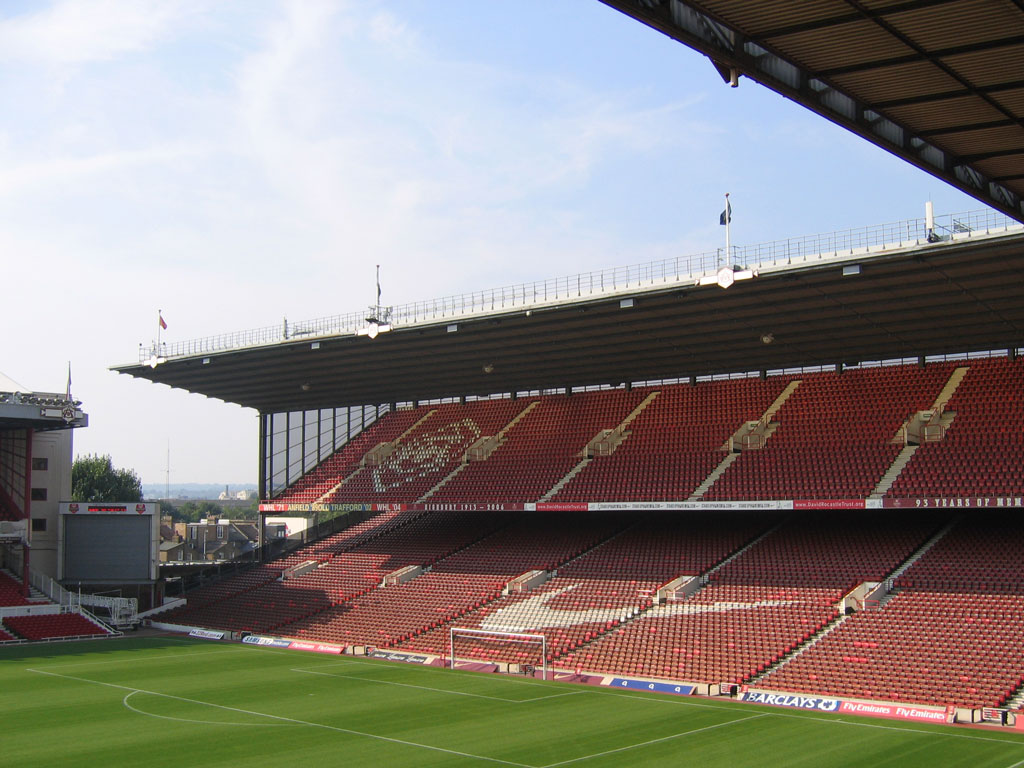
At the time of its closure, the stadium consisted of four separate all-seater stands; the pitch was aligned north–south, with the North Bank Stand (formerly the Laundry End) and South Stand (popularly known as the Clock End) at the ends of the field. The East and West Stands ran alongside the pitch and are two of the few examples of British football stands designed in the Art Deco style. The East Stand incorporated the club's offices and was well known for its marble halls (though the floors were actually terrazzo) which are often cited in media depictions of the stadium,[29] and the facade that faces onto Avenell Road. The East Stand is considered architecturally significant enough to have been designated a Grade II listed building.[7]
The stadium's main entrances were on Gillespie Road, Avenell Road and Highbury Hill. When it closed, Highbury had a capacity of 38,419[30] (approximately 12,500 in the North Bank, 11,000 in the West Stand, 9,000 in the East Stand and 6,000 in the Clock End), all seated, and had Jumbotron screens in the south-east and north-west corners.
Arsenal Stadium was well known for its very small immaculately-kept pitch, which measured only 109×73 yards (100×67 metres).[3] Arsenal's groundsmen, Steve Braddock and his successor Paul Burgess, won the FA Premier League's Groundsman of the Year award several times for their work on the stadium.[31]
Closure and redevelopment
[edit]

The post-Taylor capacity of Highbury was limited to 38,419, while Arsenal's success during the 1990s and 2000s meant that virtually every home match was filled to near capacity.[32] Restrictions, such as the East Stand's status as a listed building and the fact the stadium was surrounded on all sides by a residential area, made any future expansion of Highbury difficult and expensive, although the club's directors would have liked to have kept Arsenal at a modernised and expanded Highbury.[33] In October 1998, just after Arsenal started playing Champions League games at Wembley, the club made an unsuccessful bid to buy the stadium and make it their permanent home to share with the England national football team.[34]
In November 1999, Arsenal decided to leave Highbury and construct a new 60,000-seat stadium in nearby Ashburton Grove.[35] It was confirmed in October 2004 that the new stadium would be called the Emirates Stadium as part of a sponsorship deal with Emirates Airlines.[36] The stadium opened in July 2006; Arsenal's offices were moved to a new building, Highbury House, which was named in commemoration of the former stadium.[37]
For their final season at Highbury (2005–06) Arsenal ran a series of promotions honouring the stadium's legacy. A commemorative logo was designed featuring the club's traditional Art Deco crest from the 1930s,[38] and the club's history at Highbury was celebrated through a series of themed matchdays. On the field, Arsenal temporarily set aside their traditional red shirts with white sleeves for the season and adopted a solid redcurrant shirt, the colour they wore during their first season at Highbury in 1913–14.
Arsenal's final game at the stadium was their FA Premier League match on 7 May 2006 against Wigan Athletic, the last game of the season. The team needed to better the result of neighbours Tottenham Hotspur to again secure qualification for the Champions League. Having been 2–1 behind, a hat trick by captain and all-time leading goal scorer Thierry Henry secured qualification, with Henry kneeling down to kiss the turf on scoring what proved to be the final goal seen at the stadium.[39] The last goal scored in a regulation game at the stadium came in a Football Aid charity match when lifelong fan Alan Alger scored a penalty in the final minute of a fixture played on Thursday 8 June 2006 (exactly one month and one day after Henry's goal).[40] After the stadium's closure, Arsenal held an auction to sell off many of the stadium's parts, including pieces of the pitch, the goalposts and former manager George Graham's desk.[41] Sale of the stadium's seats had to be cancelled after it was found they contained trace amounts of the toxic metal cadmium.[42]
As of 2010[update], The former Arsenal Stadium was redeveloped and converted into flats in a project known as "Highbury Square", a scheme that had 711 properties built on the site.[43] The North Bank and Clock End stands were demolished.[44] The exteriors of the listed Art Deco East Stand and the matching West Stand were preserved and incorporated into the new developments, while the rest of the stands' structures were removed, and the pitch became a communal garden. In October 2005 the proposed flats went on sale; as of May 2006 all properties in the North, East and West Stands had been taken.[45]
Arsenal's clock was moved from Highbury to the outer side of the new stadium, with a new larger version of the feature added inside the ground in August 2010. At the same time as the unveiling of the new clock, the south stands at the venue were also renamed Clock End in line with the same name previously used at Highbury.[46][47]
Arsenal's record of results
[edit]Arsenal's complete competitive record at Highbury is as follows:[48]
| Competition | P | W | D | L | F | A | Win % |
|---|---|---|---|---|---|---|---|
| League[a] | 1689 | 981 | 412 | 296 | 3372 | 1692 | 58% |
| FA Cup[b] | 142 | 92 | 32 | 18 | 305 | 123 | 64.5% |
| League Cup | 98 | 69 | 14 | 15 | 195 | 74 | 70% |
| Europe[c] | 76 | 50 | 17 | 9 | 153 | 60 | 66% |
| Charity Shield | 5 | 4 | 0 | 1 | 13 | 6 | 80% |
| Total | 2010 | 1196 | 475 | 339 | 4038 | 1955 | 60% |
Record scorelines
[edit]Arsenal's biggest win at Highbury came on 9 January 1932, with an 11–1 victory over Darwen in the FA Cup. Their biggest defeats were 0–5 losses to Huddersfield Town in the First Division on 14 February 1925 and against Chelsea in the League Cup on 11 November 1998.[49]
Other events
[edit]International football
[edit]As well as being home to Arsenal, the stadium also hosted games for England matches; 12 internationals were played at Highbury from 1920 to 1961, most of them being friendlies. These included both England's first full home international against opposition outside of Great Britain and Ireland (Belgium in 1923), and the "Battle of Highbury", England's 3–2 win over World Champions Italy in 1934, where a record seven Arsenal players started the match, the most players from a single club to play in an England fixture.[50][51]
England's record at Highbury is as follows:[52]
| Competition | P | W | D | L | F | A | Win % |
|---|---|---|---|---|---|---|---|
| World Cup Qualifiers | 1 | 1 | 0 | 0 | 4 | 1 | 100% |
| British Home Championship | 1 | 0 | 0 | 1 | 1 | 2 | 0% |
| Friendly matches[d] | 10 | 8 | 2 | 0 | 42 | 12 | 80% |
| Total | 12 | 9 | 2 | 1 | 47 | 15 | 75% |
In May 1963, England played The Football League XI at the stadium to celebrate the 100th anniversary of the Football Association and the 75th anniversary of the Football League.[8][54]
The stadium was also used as a football venue for two matches in the 1948 London Olympics – a first-round match and a quarter-final.[55] It was also provisionally named as one of London's two host stadiums for the 1966 FIFA World Cup (along with Wembley), but was eventually dropped with White City Stadium taking the role instead.[56] By the time of Euro 96, the pitch had been ruled too small for international football and the stadium would have been ineligible.
FA Cup semi-finals
[edit]Highbury was the venue for twelve FA Cup semi-finals as a neutral ground; the first in 1929 and the last in 1997. Between 1984 and 1992 the stadium was not included in the FA's list of approved venues after Arsenal refused to install perimeter fencing following a pitch invasion by Everton fans during their semi-final against Southampton.[17] FA Cup semi-finals held at Highbury are listed below. Teams in bold went on to win the competition that year
| # | Date | Winner | Score | Loser |
|---|---|---|---|---|
| 1 | 1929 | Portsmouth | 1–0 | Aston Villa |
| 2 | 1937 | Preston North End | 4–1 | West Bromwich Albion |
| 3 | 1939 | Portsmouth | 2–1 | Huddersfield Town |
| 4 | 1949 | Leicester City | 3–1 | Portsmouth |
| 5 | 1958 | Manchester United | 5–3 | Fulham |
| 6 | 1978 | Ipswich Town | 3–1 | West Bromwich Albion |
| 7 | 1981 | Tottenham Hotspur | 3–0 | Wolverhampton Wanderers |
| 8 | 1982 | Queens Park Rangers | 1–0 | West Bromwich Albion |
| 9 | 1983 | Brighton & Hove Albion | 2–1 | Sheffield Wednesday |
| 10 | 1984 | Everton | 1–0 aet | Southampton |
| 11 | 1992 | Liverpool | 1–1 | Portsmouth |
| 12 | 1997 | Chelsea | 3–0 | Wimbledon |
FA Amateur Cup finals
[edit]Arsenal Stadium was the venue for three FA Amateur Cup finals until it moved permanently to Wembley Stadium in 1949.
| # | Date | Winner | Score | Runner-up |
|---|---|---|---|---|
| 1 | 1929 | Ilford | 3–1 | Leyton |
| 2 | 1931 | Wycombe Wanderers | 1–0 | Hayes |
| 3 | 1947 | Leytonstone | 2–1 | Wimbledon |
1955-58 Inter-Cities Fairs Cup
[edit]The stadium also hosted the London XI's home leg against Lausanne Sports in the 1955–58 Inter-Cities Fairs Cup semi-finals; London won 2–0 on the night and 3–2 on aggregate.[57]
Other sporting events
[edit]The stadium also hosted several cricket games and also baseball matches involving American servicemen between 1916 and 1919.[58] It was the venue for the 1966 World Heavyweight boxing title bout between Henry Cooper and Muhammad Ali, which Ali won.[59]
Highbury also played host to an international rugby league match on 10 October 1921 as part of the Australian rugby league team's 1921–22 Kangaroo tour of Great Britain. The match saw England defeat Australia 5–4 in front of 12,000 fans.[60]
Broadcasting milestones
[edit]On 22 January 1927, Arsenal's game against Sheffield United was the first radio broadcast of a football match. On 16 September 1937, a practice match between Arsenal and their reserves was the first trial televised game.[8][9][61]
Appearance in films
[edit]The stadium has been the backdrop for at least three films: The Arsenal Stadium Mystery (1939), and Fever Pitch (1997).[62][63]
A floodlight match in the stadium, against unknown opposition, is the setting for the climax of the 1960 film Jackpot.
Notes
[edit]- ^ Includes Premier League, First Division and Second Division.
- ^ One of these matches, a 5–1 win over Farnborough Town in 2003, was officially an "away" match, but after the draw the venue was switched to Highbury at Farnborough's request.
- ^ Includes Champions League, Cup Winners' Cup, UEFA Cup and European Super Cup.
- ^ One of these matches was a 3–0 win against a "Rest of Europe" side in 1938; although caps were awarded at the time, FIFA have since struck it from their records as an official international. The Football Association continues to recognise it as an official match.[53]
References
[edit]- ^ a b "Old Highbury". Flickr. 9 June 2005. Retrieved 23 January 2007.
- ^ "Arsenal property deals send profits to record high". BBC News. 24 September 2010.
- ^ a b "Key Facts". Arsenal F.C. Retrieved 23 January 2007.
- ^ 1948 Summer Olympics official report. pp. 45–46.
- ^ "Emirates Stadium: New goal for the Gunners". The Independent. London. 4 December 2006. Archived from the original on 27 February 2009.
- ^ "The Arsenal Clock | Arsenal's Heritage | History". Arsenal F.C. 1 July 2008.
- ^ a b c d e "A Conservation Plan for Highbury Stadium, London" (PDF). Islington Council. p. 7. Archived from the original (PDF) on 20 June 2007. Retrieved 23 January 2007.
- ^ a b c d e f Ballard, John; Suff, Paul (1999). World Soccer The Dictionary of Football. Boxtree Ltd. pp. 296–297. ISBN 0-7522-2434-4.
- ^ a b c d e f g h i Inglis, Simon (1990). The Football Grounds of Great Britain (2nd ed.). London: Willow Books. pp. 238–243. ISBN 0-00-218249-1.
- ^ Spurling, Jon (2007). Highbury The Story of Arsenal in N.5. London: Orion Books Ltd. p. 12. ISBN 978-0-7528-7639-9.
- ^ "Arsenal's First Game at Highbury". Arsenal F.C. Retrieved 23 January 2007.
- ^ Fagan, Sean (2006). Kangaroo Tour: 1921–1922. Australia: rl1908.com. Archived from the original on 2 January 2011. Retrieved 20 February 2011.
- ^ Soar, Phil & Tyler, Martin (2005). The Official Illustrated History of Arsenal. Hamlyn. pp. 75–76. ISBN 0-600-61344-5.
- ^ "Highbury – A history". Arsenal F.C. Archived from the original on 18 August 2008. Retrieved 18 August 2008.
- ^ "Arsenal v Hapoel Tel Aviv 1951". Footysphere.tumblr.com. Archived from the original on 17 July 2011. Retrieved 20 February 2011.
- ^ Come Here to Me! Dublin's Other History www.comeheretome.com
- ^ a b Hornby, Nick (1992). Fever Pitch. Indigo. pp. 142–3. ISBN 978-0-575-40015-3.
- ^ "Club Records: Appearances/Attendances". Arsenal F.C. Archived from the original on 18 August 2008. Retrieved 18 August 2008.
- ^ "Woolwich To Have New Ground at Highburg-- English Football News". The Daily Telegraph and Daily Witness. Montreal. 19 August 1913. Retrieved 9 December 2012.
- ^ "Highbury - A history | Arsenal Stadium, Highbury | History | Arsenal.com". Archived from the original on 12 August 2008.
- ^ "Arsenal Stadium Highbury, Arsenal FC". Old Football Grounds. Archived from the original on 26 January 2010.
- ^ Gleiber, Steve. "Arsenal Football Club – The Glorious History, 1987 to today". Archived from the original on 5 February 2007. Retrieved 23 January 2007.
- ^ Murray, Callum (11 August 1993). "Architecture: A grand stand for football: At Arsenal, new safety standards and innovative design are being used to turn the game into family entertainment. Callum Murray applauds". The Independent. London. Retrieved 17 February 2012.
- ^ "Tims 92". Tims92.blogspot.ca.
- ^ "The Life and Times of Arsenal's North Bank | wearethenorthbank.com | wearethenorthbank.com". Archived from the original on 25 October 2016. Retrieved 24 October 2016.
- ^ "Quinn spoils North Bank party | News Archive". Arsenal F.C. 14 July 2007.
- ^ Soar & Tyler (2005). The Official Illustrated History of Arsenal. p. 197.
- ^ Anderson, John (2019). Football Yearbook 2019-2020. Headline Publishing Group. p. 34. ISBN 978-1-4722-6111-3.
- ^ Garrett, Alexander (24 September 2006). "Pool, gym, garden, marble halls..." The Observer. London. Retrieved 23 January 2007.
- ^ "Arsenal Stadium, Highbury". Arsenal F.C. Archived from the original on 11 January 2008. Retrieved 23 January 2007.
- ^ "Super Surface at Emirates". Arsenal F.C. Retrieved 23 January 2007.
- ^ "Arsenal Football Club plc". The Political Economy of Football. Archived from the original on 2 October 2008. Retrieved 17 August 2008.
- ^ Garner, Clare (18 August 1997). "Arsenal consider leaving hallowed marble halls". The Independent. Retrieved 9 December 2012.
- ^ "BBC News | Sport | Wembley Stadium sold to highest bidder". News.bbc.co.uk.
- ^ "Where is Arsenal". Goonernow.co.uk.
- ^ "Arsenal name new ground". News.bbc.co.uk. 5 October 2004.
- ^ "New Stadium Secrets". Arsenal F.C.
- ^ "Highbury farewell photos". BBC Sport. 7 May 2006. Retrieved 29 March 2013.
- ^ Wallace, Sam (8 May 2006). "Arsenal 4 Wigan Athletic 2: Highbury story ends with last act of sublime skill from Henry". The Independent. London. Archived from the original on 3 November 2012.
- ^ "Arsenal Game 2 2006". Football Aid. London. 8 June 2006.
- ^ "The Highbury Auction – Arsenal under the hammer". Pocket Lint. 19 April 2006. Retrieved 22 February 2014.
- ^ "Toxic fears hit Highbury auction". BBC Sport. 10 May 2006. Archived from the original on 20 December 2006. Retrieved 23 January 2007.
- ^ "Highbury Square Development (Revised Scheme)". Islington Council. Archived from the original on 2 August 2009. Retrieved 18 August 2008.
- ^ "The Arsenal Clock". Arsenal F.C. 21 August 2010. Retrieved 5 January 2011.
- ^ "Buy a home at The Stadium, Highbury Square!". Arsenal F.C. Retrieved 22 February 2014.
- ^ "The Arsenal Clock | The Club". Arsenal F.C.
- ^ "Emirates Stadium's new Clock – Pictures | News Archive". Arsenal F.C. 23 August 2010.
- ^ "Arsenal at Highbury – a complete record". Arsenal F.C. Retrieved 23 January 2007.
- ^ "Record Scorelines | History". Arsenal F.C. 8 July 2008.
- ^ "GGM 39: Seven Gunners selected for England | History". Arsenal F.C. 25 July 2007.
- ^ "Most Players from a Single Club in an England Team". Englandfootballonline.com. Archived from the original on 28 September 2007.
- ^ "England's Matches at London Grounds". England Football Online. Retrieved 23 January 2007.
- ^ "England's Official Internationals: The Disputed Matches". England Football Online. Archived from the original on 20 February 2007. Retrieved 23 January 2007.
- ^ "Draw at Highbury". The Glasgow Herald. Glasgow. 25 May 1963. p. 8. Retrieved 27 July 2024.
- ^ "XIV. Olympiad London 1948 Football Tournament". Rec.Sport.Soccer Statistics Foundation. Archived from the original on 4 January 2007. Retrieved 23 January 2007.
- ^ "English Grounds For World Cup". The Guardian. November 1962. Quoted in Belam, Martin (18 November 2009). ""1966 and all that..." – Contrasting England's 1966 and 2018 World Cup bids".
- ^ "Inter-Cities Fairs Cup 1955–58 Results". FootballSite.co.uk. Archived from the original on 18 December 2006. Retrieved 23 January 2007.
- ^ "Football takes a back seat at Highbury | News Archive". Arsenal F.C. 7 July 2007.
- ^ "1966: Cooper loses to world champ Clay". BBC News. 21 May 1966.
- ^ "Kangaroos Tour 1921 Series - Game 8 - Rugby League Project". Archived from the original on 9 August 2017. Retrieved 10 June 2017.
- ^ "Happened on this day - 16 September". BBC.co.uk. 16 September 2002. Retrieved 28 July 2024.
- ^ "BFI Screenonline: Arsenal Stadium Mystery, The (1939)". Screenonline.org.uk.
- ^ "The Football Oscars: The Damned United, Escape To Victory, Goal, Gregory's Girl, The Football Factory, There's Only One Jimmy Grimble, Fever Pitch, Shaolin Soccer, Goal 2, Loo". Mirrorfootball.co.uk.
Further reading
[edit]- Glanville, Brian (2006). Arsenal Stadium History: The Official Illustrated History of Highbury Stadium. Hamlyn. ISBN 0-600-61217-1.
- Smith, Bruce (2005). Highbury: The Story of Arsenal Stadium. Mainstream. ISBN 1-84596-012-2.
- Spurling, Jon (2006). Highbury: The Story of Arsenal in N5. Orion. ISBN 075287344X.
External links
[edit]- Highbury Square Official website of the redevelopment project
Arsenal Stadium
View on GrokipediaHistory
Origins and Construction
In 1913, Arsenal's chairman Henry Norris secured a site in Highbury from St John's College for a 21-year lease at a cost of £20,000, motivated by severe overcrowding at the club's previous home, the Manor Ground in Plumstead, and ongoing financial difficulties that limited attendance and revenue.[1] In 1925, the club purchased the site outright for £64,000.[1] This move to North London was intended to attract a larger local fanbase and secure the club's future in professional football.[1] Construction of the new stadium, initially referred to as the Arsenal Stadium but commonly known as Highbury, began in 1913 under the architectural design of renowned Scottish stadium architect Archibald Leitch, who incorporated a main covered East Stand capable of holding around 9,000 spectators, while the other three sides featured open terracing.[1] The project was completed in time for the opening on 6 September 1913 at a total cost of £125,000, transforming the former college recreation ground into a purpose-built football venue with an initial capacity of 50,000.[1] Highbury officially opened on 6 September 1913, with Arsenal securing a 2-1 victory over Leicester Fosse (the predecessor to Leicester City) in a Second Division match attended by over 20,000 fans.[1] The stadium's development played a pivotal role in Arsenal's resurgence, contributing to their election to the First Division in 1919 following a strong post-war performance.[1] Early operations at Highbury were disrupted by the outbreak of World War I, which led to the suspension of official league football from 1915 to 1919, during which the ground was occasionally used for military training and wartime matches but saw no regular competitive play.[1] This period tested the club's resilience, yet Highbury's establishment marked a foundational shift that elevated Arsenal's status in English football.[1]Expansions and Renovations
The major expansions at Arsenal Stadium began in the interwar period to meet rising attendance demands. Between 1925 and 1936, the North Bank terrace was significantly developed under designs influenced by architect Archibald Leitch, who had shaped the stadium's original layout; this addition boosted overall capacity to around 70,000 by providing extensive standing room for supporters.[10] A roof was added to the North Bank in 1935, offering better shelter, though it was destroyed during World War II and rebuilt as an exact replica in 1956 under the supervision of club architect William Binnie.[10] Simultaneously, the East Stand was constructed from 1932 to 1936 in an Art Deco style by architects Claude Waterlow Ferrier and William Binnie, featuring opulent marble halls, a prominent clock tower, and seating for 8,000; the project cost £130,000, making it one of Britain's most expensive grandstands at the time.[11][10] This stand complemented the earlier West Stand (completed in 1932 for £45,000) and elevated the stadium's aesthetic and functional prestige, with the East Stand's facade later earning Grade II listed status for its architectural significance.[12] In the post-war era, further upgrades focused on functionality. Floodlights were installed in 1951, enabling the first illuminated match on September 19 against Hapoel Tel Aviv and extending playable hours into evenings.[13] Roofs were extended over additional stands in the 1950s and 1960s to shield fans from weather, while undersoil heating was added in 1964 for pitch maintenance. From 1969 to 1973, the West Stand underwent partial enclosure with the installation of 5,200 seats in its lower tier, improving comfort and sightlines without fully replacing terracing.[1][7] The most transformative renovations occurred in response to the 1990 Taylor Report, which mandated all-seater stadiums for safety following the Hillsborough disaster. Between 1991 and 1993, Arsenal converted the venue at a cost of around £22 million, demolishing terraces and building new two-tier stands: the North Bank in 1992 and the Clock End in 1993.[1][14] This reduced capacity from 57,000 to 38,500 but enhanced security and accessibility, with the enclosed North Bank stand notably improving acoustics and intensifying the vocal matchday atmosphere for remaining fans.[10]Pre-War and Post-War Developments
During the pre-war period, Arsenal Stadium, known as Highbury, emerged as a pivotal venue in the club's golden era of the 1930s, underpinning their dominance with four First Division titles won between 1930 and 1938. The ground hosted key matches that drew massive crowds, reflecting the era's football fervor, including a record attendance of 73,295 for a 0-0 draw against title rivals Sunderland on March 9, 1935.[15][16] Highbury also served as a neutral venue for significant cup ties, such as the 1929 FA Cup semi-final where Portsmouth defeated Aston Villa 1-0 before a packed terrace.[17] The outbreak of World War II profoundly altered Highbury's role, as the stadium was requisitioned from 1940 to 1945 and transformed into an Air Raid Precautions (ARP) center, complete with shelters under the West Stand for local residents. Arsenal played limited friendly matches there but relocated most wartime fixtures to Tottenham Hotspur's White Hart Lane due to the restrictions. In 1941, the ground sustained bomb damage during the Blitz, with the North Bank terrace completely wrecked by fire and portions of the South Stand terracing also affected, necessitating extensive repairs before football could resume.[18][19][20] Post-war recovery saw Highbury return to league action on September 4, 1946, with Arsenal hosting Stoke City in their first competitive match at the venue since 1939, though the club struggled initially amid financial strains from war damage repairs. The stadium hosted football events for the 1948 Summer Olympics, including group stage matches as one of London's auxiliary venues. In the 1950s, repairs incorporated concrete reinforcements to the damaged terracing, enhancing structural integrity, while the installation of floodlights in 1951—first used in a major fixture against Hapoel Tel Aviv on September 19—paved the way for evening games, including Arsenal's inaugural European ties at Highbury, such as the 1963 Inter-Cities Fairs Cup clash with Esbjerg fB. By the 1980s, amid rising hooliganism across English football, Highbury implemented safety measures like increased stewarding, though it notably avoided installing perimeter fencing, a decision that distinguished it from many contemporaries until the post-Hillsborough era.[21][22][19][13][23][24]Architecture and Facilities
Layout and Stands
Arsenal Stadium, commonly known as Highbury, was configured around a central pitch oriented north-south, with the East Stand positioned on the eastern side, allowing it to catch the morning sun. The playing surface measured 100 meters in length by 67 meters in width, contributing to its reputation for intense, close-quarters action.[25] This layout formed a compact, bowl-like enclosure that enhanced the stadium's acoustic properties, famously amplifying the "Highbury roar"—a thunderous supporter chant that reverberated off the enclosed stands and created an intimidating atmosphere for visiting teams.[26] The four principal stands encircled the pitch, each with distinct characteristics that defined Highbury's identity. The North Bank, located at the northern end, was originally a terraced standing area renowned as the vocal heart of the stadium, where passionate fans generated much of the noise and energy during matches.[1] Opposite it, the South Bank—later renamed the Clock End after the large timepiece installed above it in 1933—served as another key supporter zone, transitioning from terracing to all-seating in the 1990s following safety regulations.[27] The Clock End's design included executive boxes added in a late-1980s redevelopment, blending functionality with its historic role in crowd dynamics.[1] Flanking the sidelines were the East and West Stands, which provided a more architectural contrast. The East Stand, completed in 1936, stood as an Art Deco masterpiece with a striking marble facade, grand staircase known as the Marble Halls, and decorative elements including statues that evoked classical grandeur; it was designated a Grade II listed building for its architectural significance.[28] The West Stand, opened in 1932, offered a two-tier structure with partial covering for protection from the elements and was often allocated for family seating, emphasizing comfort amid its functional design.[1] This end-to-end and side-to-side arrangement drew inspiration from the grandeur of Villa Park, aiming to elevate London's football venues to match the elegance of established midlands grounds.[29]Pitch and Technical Features
The playing pitch at Arsenal Stadium, known as Highbury, measured 100 metres in length by 67 metres in width, making it one of the smaller surfaces in English top-flight football during its later years.[30] This natural grass field was initially laid with basic turf upon the stadium's opening in 1913, but underwent significant enhancements for durability and playability.[1] In the 1930s, during major renovations including the construction of the East and West Stands, the pitch was relevelled and standardized to facilitate consistent gameplay, addressing earlier irregularities from the site's conversion from residential gardens.[7] To combat harsh winter conditions, under-soil heating was pioneered at Highbury with an electric system installed in 1964, marking one of the earliest such implementations in English football and allowing matches to proceed despite frost.[31] This was upgraded to a more efficient hot-water system in 1970, which also incorporated improved subsurface drainage to prevent waterlogging and maintain pitch integrity during heavy rain.[31] Prior to these innovations, ground staff employed straw coverings and other protective measures to shield the turf from freezing temperatures, as evidenced by postponed fixtures like the 1935 Arsenal vs. Bolton match due to ice-covered conditions.[32] Floodlighting was introduced in 1951 with four pylon-style masts, enabling Highbury's first illuminated match on 19 September against Hapoel Tel Aviv, a 6–1 victory that showcased Herbert Chapman's forward-thinking approach to stadium technology.[13] These original installations were replaced and upgraded multiple times, culminating in modern high-intensity systems by the early 2000s to meet Premier League standards for evening fixtures and broadcasts.[33] Scoreboards evolved from manual half-time displays in the corners to electronic versions installed during the 1992–93 renovations, providing real-time updates visible across the ground.[34] The dressing rooms and player facilities were housed beneath the East Stand, with the tunnel positioned centrally along the stand's pitchside facade, flanked by dugouts that offered direct oversight of the field.[35] Adjacent to the pitch, medical and treatment areas were integrated into this lower level, supporting immediate player care during matches and training sessions conducted on-site before the club's move to a dedicated facility.[36]Capacity and Safety Upgrades
Upon its opening in 1913, Arsenal Stadium had an initial capacity of approximately 50,000 spectators, though the ground was not fully completed at the time.[37] Early attendances were relatively modest, averaging around 23,000 per match in the first season, reflecting the club's mid-table status in the Second Division and the challenges of drawing crowds from South London.[38] By the 1930s, however, Arsenal's success under manager Herbert Chapman led to frequent sell-outs, with the stadium reaching its peak capacity of 73,295 during a 0-0 draw against Sunderland on March 9, 1935.[2] Safety regulations began shaping the stadium's operations with the passage of the Safety of Sports Grounds Act in 1971, which mandated safety certificates and regular inspections for venues accommodating over 10,000 people, including Highbury.[39] This legislation prompted ongoing assessments to ensure compliance with minimum safety standards, such as adequate exits and structural integrity. Following the Heysel Stadium disaster in 1985, where 39 fans died during crowd unrest, UK football authorities required the installation of perimeter fencing at major grounds to prevent pitch invasions; Highbury received such barriers as part of this widespread response.[40] The most transformative changes came after the 1989 Hillsborough disaster, which claimed 97 lives and led to the Taylor Report's recommendation for all-seater stadiums to enhance crowd safety.[1] In response, Arsenal initiated conversions starting in 1991, replacing terraces with seating and completing the process by 1993 with a new two-tier North Bank stand, reducing the overall capacity from over 57,000 to 38,500.[2] These upgrades, costing around £20 million, also included expanded CCTV surveillance and increased stewarding in the 1990s to monitor and manage crowds more effectively.[41] By the final 2005-06 season, average home attendance stood at 38,184, nearly filling the reduced all-seater venue amid the club's competitive success.[42]Arsenal's Tenure
Home Fixtures and Attendance Records
Arsenal hosted more than 2,000 competitive home fixtures at Highbury from its opening in 1913 until the final match in 2006, encompassing league, cup, and European competitions. Of these, the majority were league games, with the club playing in the top flight for most of its tenure there, typically scheduling 21 home matches per season in the Football League era. Seasonal fixture patterns followed English football traditions, including frequent Boxing Day home games, which became a hallmark of the holiday schedule and drew large crowds to the stadium.[43] Attendance at Highbury reached peaks during the pre-war era, particularly in the 1930s amid Arsenal's dominance, when average home league crowds exceeded 37,000 per match, culminating in a record 73,295 spectators for a 0-0 draw against Sunderland on 9 March 1935.[44][2] Post-war, figures declined due to economic challenges and the growing popularity of television broadcasts, with averages dropping to around 25,000-30,000 in the 1970s and 1980s as overall English football attendances bottomed out.[45][46] The launch of the Premier League in 1992 sparked a resurgence in turnout, fueled by increased commercial appeal and Arsenal's on-pitch success, pushing average home attendances above 36,000 by the mid-1990s and maintaining near-capacity crowds at the all-seater stadium's 38,500 limit.[47] Efforts to foster fan loyalty, including early membership initiatives under manager Herbert Chapman in the 1930s, contributed to sustained support by prioritizing season ticket sales and reserved seating.[27] In the final 2005-06 season, all home league fixtures sold out, reflecting the emotional farewell to the venue with capacities consistently filled at 38,000-plus.[48] Over its history, Arsenal amassed significant statistical aggregates at Highbury, scoring more than 3,000 goals in league home matches alone, with standout seasons like 1930-31 yielding 66 goals from 21 games to underline the stadium's role in the club's attacking prowess.[49]Notable Matches and Achievements
Highbury was the site of several pivotal moments in Arsenal's history, including multiple league title clinches that underscored the stadium's role in the club's golden eras. In the 1930-31 season, Arsenal secured their first-ever First Division title with a 3-1 victory over Liverpool on April 18, 1931, before a capacity crowd, marking the beginning of a dominant decade under manager Herbert Chapman.[50] Similarly, the 1952-53 campaign ended with a tense 3-0 win against Burnley on May 2, 1953, clinching the club's seventh league championship by a mere 0.099 goal average over Preston North End, a record narrow margin at the time.[51] These triumphs highlighted Highbury's electric atmosphere, where fans' support often propelled the team to glory in title-deciding fixtures. The post-war period brought further accolades, with the 1997-98 Premier League title confirmed in emphatic fashion via a 4-0 thrashing of Everton on May 3, 1998, ending an 18-year wait for domestic supremacy and signaling the start of Arsène Wenger's trophy-laden tenure.[52] The 2002-03 season saw another home clinch, as a 1-0 victory over Everton on April 25, 2003, sealed the title two games early, with Sylvain Wiltord's goal proving decisive in a campaign defined by flair and resilience.[53] Highbury also hosted the season finale of Arsenal's unbeaten "Invincibles" run in 2003-04, a 2-1 comeback win against Leicester City on May 15, 2004, where Thierry Henry and Patrick Vieira scored late to preserve the historic 26-game league streak without defeat.[54] European nights at Highbury added to its legacy, exemplified by the 2-0 defeat of Juventus in the 2005-06 UEFA Champions League quarter-final first leg on March 28, 2006. Cesc Fàbregas opened the scoring with a composed finish, followed by Henry's trademark curling effort, propelling Arsenal to the semi-finals and showcasing the stadium's intimidating presence against continental giants.[55] Thierry Henry, Arsenal's all-time leading scorer, etched his name into Highbury folklore by netting 114 Premier League goals there—a record for any player at a single stadium in the competition—many of which came in high-stakes matches that defined eras of success.[56] Player milestones further elevated Highbury's status, including Tony Adams' emotional testimonial match on May 13, 2002, against Celtic, which ended in a 1-1 draw before a 38,500-strong crowd chanting for "one more year" as the club captain bid farewell after 19 years of service.[57] These events, from title triumphs to individual honors, cemented Highbury as a fortress of Arsenal's achievements, where dramatic victories and unbreakable spirits intertwined to create enduring club lore.Record Scorelines and Statistics
Arsenal's record scorelines at Highbury reflect the stadium's role as a fortress during the club's most dominant eras. The largest league victory occurred on 28 January 1931, when Arsenal defeated Grimsby Town 9-1 in the First Division, with David Jack scoring four goals and Jack Lambert adding a hat-trick. [58] The biggest overall home win came in the FA Cup on 9 January 1932, an 11-1 thrashing of Darwen, where Ray Bowden and Alex James each netted braces, marking the highest goal tally in a single match at the venue with 12 goals total. [58] On the defensive end, Arsenal suffered their heaviest home defeat at Highbury on 14 February 1925, losing 0-5 to Huddersfield Town in the First Division, a result that underscored the challenges of the early years at the stadium. [58] Goalkeeping records highlight periods of exceptional solidity, including Jens Lehmann's 10 consecutive clean sheets during the 2003-04 season run-in, contributing to the Invincibles' unbeaten campaign. [58] The longest unbeaten home run in the Premier League era spanned 32 matches from December 1997 to March 2000 under Arsène Wenger, transforming Highbury into an impregnable venue. During the 2003-04 season, Arsenal extended an unbeaten home streak to 29 games across competitions, culminating in their historic Invincibles title. [59] Seasonal home win streaks exemplify Arsenal's dominance at Highbury, notably a 14-game league winning sequence in 1930-31 that propelled the club to their first top-flight title. [49]| Top 5 Highest Attendances at Highbury (Arsenal Home Games) |
|---|
| Date |
| 9 March 1935 |
| 24 February 1926 |
| 20 October 1930 |
| 2 March 1935 |
| 9 November 1935 |
| Top Arsenal Goalscorers at Highbury (Overall Home Goals) |
|---|
| Player |
| Cliff Bastin |
| Thierry Henry |
| Ian Wright |
| John Radford |
| Ted Drake |
Other Events Hosted
International Football and Cup Finals
Highbury hosted numerous international football matches, serving as a venue for England's national team on 12 occasions between 1920 and 1962. These fixtures included British Home Championship games and friendlies, often drawing significant crowds due to the stadium's central London location and reputation. One of the most notable was the 14 November 1934 friendly against Italy, dubbed the "Battle of Highbury," where England secured a 2-0 victory amid intense physical play, with goals from Eric Brook and George Bower; the match is remembered for its controversial nature and as England's response to Italy's 1934 World Cup triumph. Other key England games at the stadium included the 15 March 1920 British Home Championship clash with Wales (England 1-2 loss) and the 28 September 1961 World Cup qualifier against Luxembourg (England 4-1 win), highlighting Highbury's role in major competitive fixtures.[63][64] The stadium also featured in the 1948 Summer Olympics football tournament, hosting one match for the Great Britain team as part of the event's widespread use of London venues. On 31 July 1948, Great Britain defeated the Netherlands 4-3 after extra time in a first-round match, with goals from Bob Hardisty, George McBain, Thomas Hopper, and Archie McIlvenny; this thrilling encounter advanced Great Britain to the quarter-finals. Highbury's selection underscored its status as a premier football facility capable of accommodating international Olympic standards.[65]FA Cup Semi-Finals
Highbury served as a neutral venue for 12 FA Cup semi-finals between 1927 and 1991, providing a balanced setting for high-stakes domestic knockout ties outside the finalists' home grounds. The stadium's compact layout and atmosphere made it ideal for these matches, which often featured dramatic encounters and large attendances. The first semi-final hosted was on 26 March 1927, where Cardiff City defeated Arsenal 2-0 with goals from Harry Perrin and Joe Nicholson, marking Cardiff's path to the final. Subsequent fixtures included the 23 March 1929 tie between Portsmouth and Aston Villa, won 1-0 by Portsmouth via Jack Tinn's goal, and the 1939 match where Portsmouth prevailed 2-1 over Huddersfield Town. Later examples encompassed the 1981 Tottenham Hotspur vs Ipswich Town (3-1 win for Tottenham) and the 1991 replay between Tottenham and Arsenal (3-1 to Tottenham), the latter drawing over 37,000 spectators despite its controversial outcome. These games contributed to Highbury's legacy as a key site for English cup football progression.[66][17][67]| Date | Winner | Score | Loser | Attendance |
|---|---|---|---|---|
| 26 March 1927 | Cardiff City | 2-0 | Arsenal | 55,000 |
| 23 March 1929 | Portsmouth | 1-0 | Aston Villa | 55,796 |
| 10 April 1937 | Preston North End | 3-1 | Sunderland | 56,206 |
| 25 March 1939 | Portsmouth | 2-1 | Huddersfield Town | 60,053 |
| 18 April 1981 | Tottenham Hotspur | 3-1 | Ipswich Town | 45,678 |
| 14 April 1984 | Everton | 1-0 | Sheffield Wednesday | 38,174 |
| 14 April 1991 (replay) | Tottenham Hotspur | 3-1 | Arsenal | 37,995 |
FA Amateur Cup Finals
Highbury hosted three FA Amateur Cup finals in the interwar and post-war periods, before the event permanently moved to Wembley Stadium in 1949, showcasing the stadium's versatility for amateur-level national competitions. These finals featured teams from non-professional leagues, emphasizing community and regional football talent. Examples included the 1929 final where Ilford beat Leyton 3-1, the 1931 match won 6-2 by Wycombe Wanderers over Hayes, and the 1947 final with Leytonstone defeating Wimbledon 2-1 before a crowd of around 26,000. These events highlighted Highbury's early role in promoting amateur football's prestige.[70]| Year | Winner | Score | Runner-up |
|---|---|---|---|
| 1929 | Ilford | 3-1 | Leyton |
| 1931 | Wycombe Wanderers | 6-2 | Hayes |
| 1947 | Leytonstone | 2-1 | Wimbledon |

