



Community hub
Recent from talks
Contribute something to knowledge base
Content stats: 0 posts, 0 articles, 1 media, 0 notes
Members stats: 0 subscribers, 0 contributors, 0 moderators, 0 supporters
Subscribers
Supporters
Contributors
Moderators
Hub AI
Western Harbour Crossing AI simulator
(@Western Harbour Crossing_simulator)
Hub AI
Western Harbour Crossing AI simulator
(@Western Harbour Crossing_simulator)
Western Harbour Crossing
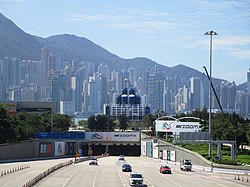
The Western Harbour Crossing (WHC) is a dual three-lane immersed tube tunnel in Hong Kong. It is the third road tunnel to cross Victoria Harbour, linking reclaimed land in Yau Ma Tei in West Kowloon with Sai Ying Pun on Hong Kong Island. It was constructed by the Western Harbour Tunnel Company Limited (WHTCL), which also operated the tunnel from 1993 to 2023 under a build-operate-transfer (BOT) model on a 30-year franchise contract with the Hong Kong government.
The tunnel was the first three-lane road tunnel in Asia to be constructed using submerged pipe. It was built as part of the Airport Core Programme, which included other infrastructure projects to support the Hong Kong International Airport at Chek Lap Kok. The tunnel carries on the Route 3 designation from the West Kowloon Highway and connects to Route 4 on Hong Kong Island.
By the early 1980s, commuters made 120,000 trips at the Cross-Harbour Tunnel (CHT) every day, beyond its designed capacity of 80,000 daily trips. Population growth was also projected to reach 6.34 million in 2001 from 5.125 million in 1981. The Hong Kong government launched the Second Comprehensive Transport Study in the late 1980s, which said cross-harbour trips would increase greatly – person-trips would increase by 86% from 1.4m to 2.6m, and goods-vehicle-trips by 129% from 34,000 to 78,000 by 2001.
Also, with the development of the Hong Kong International Airport, it was to be an important component of the strategic Airport Core Programme linking it to the Kwai Tsing Container Terminals and Hong Kong Island. There are 10 km of associated roads (40 km of lanes) and 17 bridges.
The Government announced in 1990 that the tunnel project would be financed as a private venture, with bidding initially scheduled to be called in April 1991. As the project was to span the change in sovereignty of Hong Kong, the support of both the British and Chinese was necessary. In September 1991, the British and Chinese governments signed the Memorandum of Understanding committing their firm support for building the new airport at Chek Lap Kok and its connecting infrastructure. Since mid-1991, private sector companies interested in the project started looking for partners to form consortia. The formal tendering exercise was launched in March 1992 and ended in early July 1992.
In early 1992, two consortia appeared to be vying for the contract. However, one week before the closing date for tenders, Cross Harbour Tunnel Company and CITIC decided to merge their bids. Cross Harbour Tunnel Company, with Wharf Holdings as its major shareholder, dissolved its own consortium in favour of joining with CITIC group; the contractors of the CHT team were dropped. At the close of the tender, the Government was disappointed that there was only one bidder. Upon this news, two new consortia of construction companies proposed to build the project for the Government if the Government decided to pull the tender and run the project itself.
In 1993, the Western Harbour Crossing Ordinance (Cap. 436) was enacted to govern the construction and operation of tunnel. Having decided to rely on the private sector, the government opted for a build–operate–transfer (BOT) model, for 30 years. Tenders for the project were invited, and was won by the Western Harbour Tunnel Company (WHTCL). The franchise was awarded for 30 years, ending August 2023. The Western Harbour Crossing Bill was also passed to award the franchise to the Western Harbour Tunnel Company to build and operate WHC.
WHTCL's largest shareholder is The Cross-Harbour (Holdings) Limited (CHHL), which has a 50% stake. Its other shareholders are CITIC Limited and Kerry Properties Limited, which hold 35% and 15% effective interests in WHTCL respectively through a joint venture company.
Western Harbour Crossing
The Western Harbour Crossing (WHC) is a dual three-lane immersed tube tunnel in Hong Kong. It is the third road tunnel to cross Victoria Harbour, linking reclaimed land in Yau Ma Tei in West Kowloon with Sai Ying Pun on Hong Kong Island. It was constructed by the Western Harbour Tunnel Company Limited (WHTCL), which also operated the tunnel from 1993 to 2023 under a build-operate-transfer (BOT) model on a 30-year franchise contract with the Hong Kong government.
The tunnel was the first three-lane road tunnel in Asia to be constructed using submerged pipe. It was built as part of the Airport Core Programme, which included other infrastructure projects to support the Hong Kong International Airport at Chek Lap Kok. The tunnel carries on the Route 3 designation from the West Kowloon Highway and connects to Route 4 on Hong Kong Island.
By the early 1980s, commuters made 120,000 trips at the Cross-Harbour Tunnel (CHT) every day, beyond its designed capacity of 80,000 daily trips. Population growth was also projected to reach 6.34 million in 2001 from 5.125 million in 1981. The Hong Kong government launched the Second Comprehensive Transport Study in the late 1980s, which said cross-harbour trips would increase greatly – person-trips would increase by 86% from 1.4m to 2.6m, and goods-vehicle-trips by 129% from 34,000 to 78,000 by 2001.
Also, with the development of the Hong Kong International Airport, it was to be an important component of the strategic Airport Core Programme linking it to the Kwai Tsing Container Terminals and Hong Kong Island. There are 10 km of associated roads (40 km of lanes) and 17 bridges.
The Government announced in 1990 that the tunnel project would be financed as a private venture, with bidding initially scheduled to be called in April 1991. As the project was to span the change in sovereignty of Hong Kong, the support of both the British and Chinese was necessary. In September 1991, the British and Chinese governments signed the Memorandum of Understanding committing their firm support for building the new airport at Chek Lap Kok and its connecting infrastructure. Since mid-1991, private sector companies interested in the project started looking for partners to form consortia. The formal tendering exercise was launched in March 1992 and ended in early July 1992.
In early 1992, two consortia appeared to be vying for the contract. However, one week before the closing date for tenders, Cross Harbour Tunnel Company and CITIC decided to merge their bids. Cross Harbour Tunnel Company, with Wharf Holdings as its major shareholder, dissolved its own consortium in favour of joining with CITIC group; the contractors of the CHT team were dropped. At the close of the tender, the Government was disappointed that there was only one bidder. Upon this news, two new consortia of construction companies proposed to build the project for the Government if the Government decided to pull the tender and run the project itself.
In 1993, the Western Harbour Crossing Ordinance (Cap. 436) was enacted to govern the construction and operation of tunnel. Having decided to rely on the private sector, the government opted for a build–operate–transfer (BOT) model, for 30 years. Tenders for the project were invited, and was won by the Western Harbour Tunnel Company (WHTCL). The franchise was awarded for 30 years, ending August 2023. The Western Harbour Crossing Bill was also passed to award the franchise to the Western Harbour Tunnel Company to build and operate WHC.
WHTCL's largest shareholder is The Cross-Harbour (Holdings) Limited (CHHL), which has a 50% stake. Its other shareholders are CITIC Limited and Kerry Properties Limited, which hold 35% and 15% effective interests in WHTCL respectively through a joint venture company.
Recent media
Recent media