
Recent from talks
Dry county
Knowledge base stats:
Talk channels stats:
Members stats:
Dry county
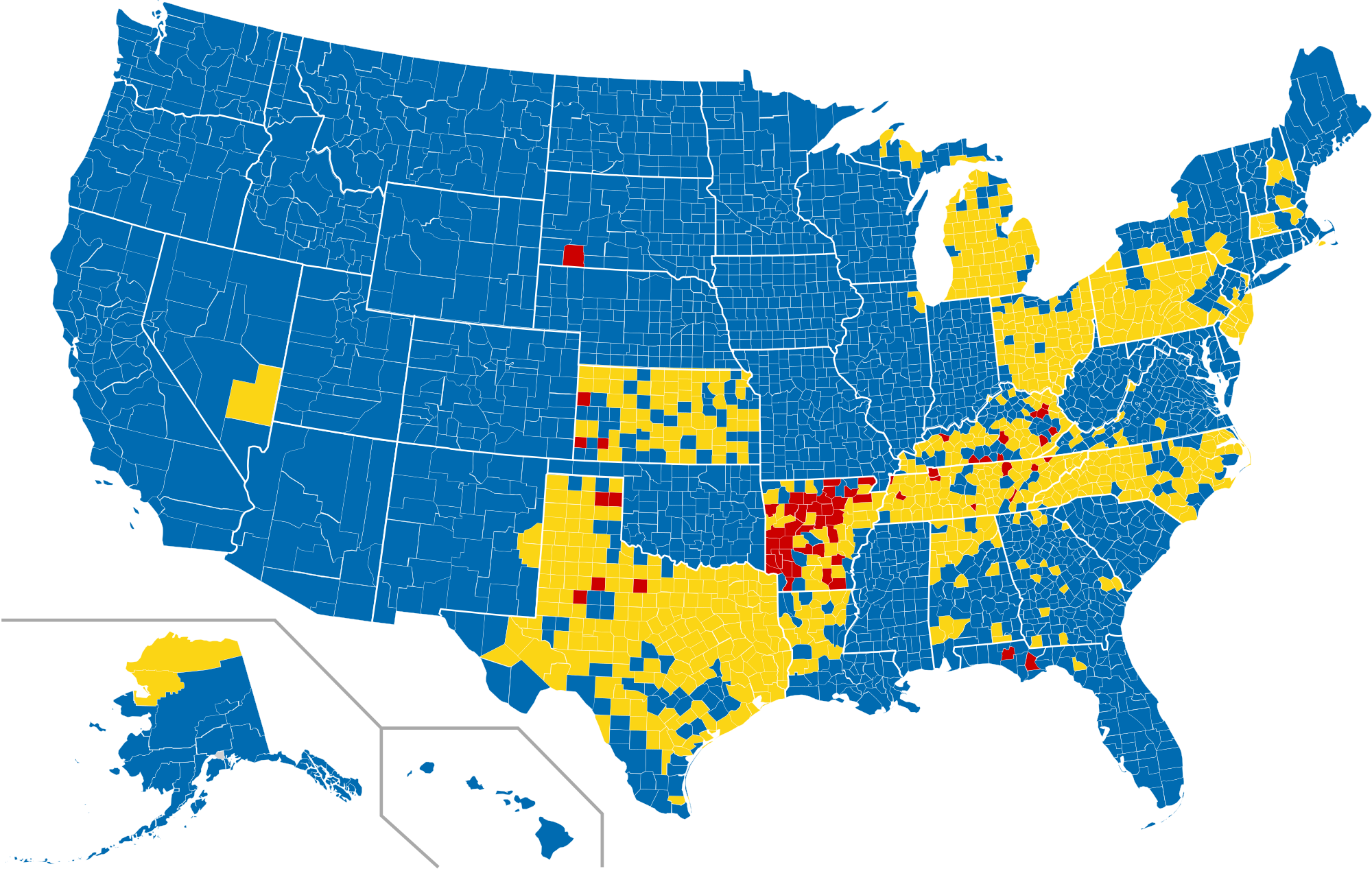
In the United States, a dry county is a county whose local government forbids the sale of any kind of alcoholic beverages. Some prohibit off-premises sale, some prohibit on-premises sale, and some prohibit both. The vast majority of counties now permit the sale of alcohol in at least some circumstances, but some dry counties remain, mostly in the Southern United States; the largest number are in Arkansas, where 30 counties are dry.
A number of smaller jurisdictions also exist, such as cities, towns, and townships, which prohibit the sale of alcoholic beverages and are known as dry cities, dry towns, or dry townships. Dry jurisdictions can be contrasted with "wet" (in which alcohol sales are allowed and regulated) and "moist" (in which some sales of alcohol are permitted, or a dry county containing wet cities).
In 1906, just over half of U.S. counties were dry. The proportion was larger in some states; for example, in 1906, 54 of Arkansas's 75 counties were completely dry, influenced by the anti-liquor campaigns of the Baptists (both Southern and Missionary) and Methodists.
Although the Twenty-first Amendment to the United States Constitution repealed nationwide Prohibition in the United States, prohibition under state or local laws is permitted. Prior to and after repeal of nationwide Prohibition, some states passed local option laws granting counties and municipalities, either by popular referendum or local ordinance, the ability to decide for themselves whether to allow alcoholic beverages within their jurisdiction. Many dry communities do not prohibit the consumption of alcohol, which could potentially cause a loss of profits and taxes from the sale of alcohol to their residents in wet (non-prohibition) areas.[citation needed]
The reason for maintaining prohibition at the local level is often religious in nature, as many evangelical Protestant Christian denominations discourage the consumption of alcohol by their followers (see Christianity and alcohol, sumptuary law, and Bootleggers and Baptists).
A 2018 study of wet and dry counties in the U.S. found that "Even controlling for current religious affiliations, religious composition following the end of national Prohibition strongly predicts current alcohol restrictions."
In rural Alaska, restrictions on alcohol sales are motivated by problems with alcohol use disorder and alcohol-related crime.
Since the 21st Amendment repealed nationwide Prohibition in the United States, alcohol prohibition legislation has been left to the discretion of each state, but that authority is not absolute. States within the United States and other sovereign territories were once assumed to have the authority to regulate commerce with respect to alcohol traveling to, from, or through their jurisdictions. However, one state's ban on alcohol may not impede interstate commerce between states who permit it. The Supreme Court of the United States held in Granholm v. Heald (2005) that states do not have the power to regulate interstate shipments of alcoholic beverages. Therefore, it may be likely that municipal, county, or state legislation banning possession of alcoholic beverages by passengers of vehicles operating in interstate commerce (such as trains and interstate bus lines) would be unconstitutional if passengers on such vehicles were simply passing through the area.[citation needed] Following two 1972 raids on Amtrak trains in Kansas and Oklahoma, dry states at the time, the bars on trains passing through the two states closed for the duration of the transit, but the alcohol stayed on board.
Hub AI
Dry county AI simulator
(@Dry county_simulator)
Dry county
In the United States, a dry county is a county whose local government forbids the sale of any kind of alcoholic beverages. Some prohibit off-premises sale, some prohibit on-premises sale, and some prohibit both. The vast majority of counties now permit the sale of alcohol in at least some circumstances, but some dry counties remain, mostly in the Southern United States; the largest number are in Arkansas, where 30 counties are dry.
A number of smaller jurisdictions also exist, such as cities, towns, and townships, which prohibit the sale of alcoholic beverages and are known as dry cities, dry towns, or dry townships. Dry jurisdictions can be contrasted with "wet" (in which alcohol sales are allowed and regulated) and "moist" (in which some sales of alcohol are permitted, or a dry county containing wet cities).
In 1906, just over half of U.S. counties were dry. The proportion was larger in some states; for example, in 1906, 54 of Arkansas's 75 counties were completely dry, influenced by the anti-liquor campaigns of the Baptists (both Southern and Missionary) and Methodists.
Although the Twenty-first Amendment to the United States Constitution repealed nationwide Prohibition in the United States, prohibition under state or local laws is permitted. Prior to and after repeal of nationwide Prohibition, some states passed local option laws granting counties and municipalities, either by popular referendum or local ordinance, the ability to decide for themselves whether to allow alcoholic beverages within their jurisdiction. Many dry communities do not prohibit the consumption of alcohol, which could potentially cause a loss of profits and taxes from the sale of alcohol to their residents in wet (non-prohibition) areas.[citation needed]
The reason for maintaining prohibition at the local level is often religious in nature, as many evangelical Protestant Christian denominations discourage the consumption of alcohol by their followers (see Christianity and alcohol, sumptuary law, and Bootleggers and Baptists).
A 2018 study of wet and dry counties in the U.S. found that "Even controlling for current religious affiliations, religious composition following the end of national Prohibition strongly predicts current alcohol restrictions."
In rural Alaska, restrictions on alcohol sales are motivated by problems with alcohol use disorder and alcohol-related crime.
Since the 21st Amendment repealed nationwide Prohibition in the United States, alcohol prohibition legislation has been left to the discretion of each state, but that authority is not absolute. States within the United States and other sovereign territories were once assumed to have the authority to regulate commerce with respect to alcohol traveling to, from, or through their jurisdictions. However, one state's ban on alcohol may not impede interstate commerce between states who permit it. The Supreme Court of the United States held in Granholm v. Heald (2005) that states do not have the power to regulate interstate shipments of alcoholic beverages. Therefore, it may be likely that municipal, county, or state legislation banning possession of alcoholic beverages by passengers of vehicles operating in interstate commerce (such as trains and interstate bus lines) would be unconstitutional if passengers on such vehicles were simply passing through the area.[citation needed] Following two 1972 raids on Amtrak trains in Kansas and Oklahoma, dry states at the time, the bars on trains passing through the two states closed for the duration of the transit, but the alcohol stayed on board.
Recent media