Hubbry Logo
Dry countyDry countyMain
Open search
Dry county
Community hub
Dry county
logo
8 pages, 0 posts
0 subscribers
Be the first to start a discussion here.
Dry county
Dry county
from Wikipedia

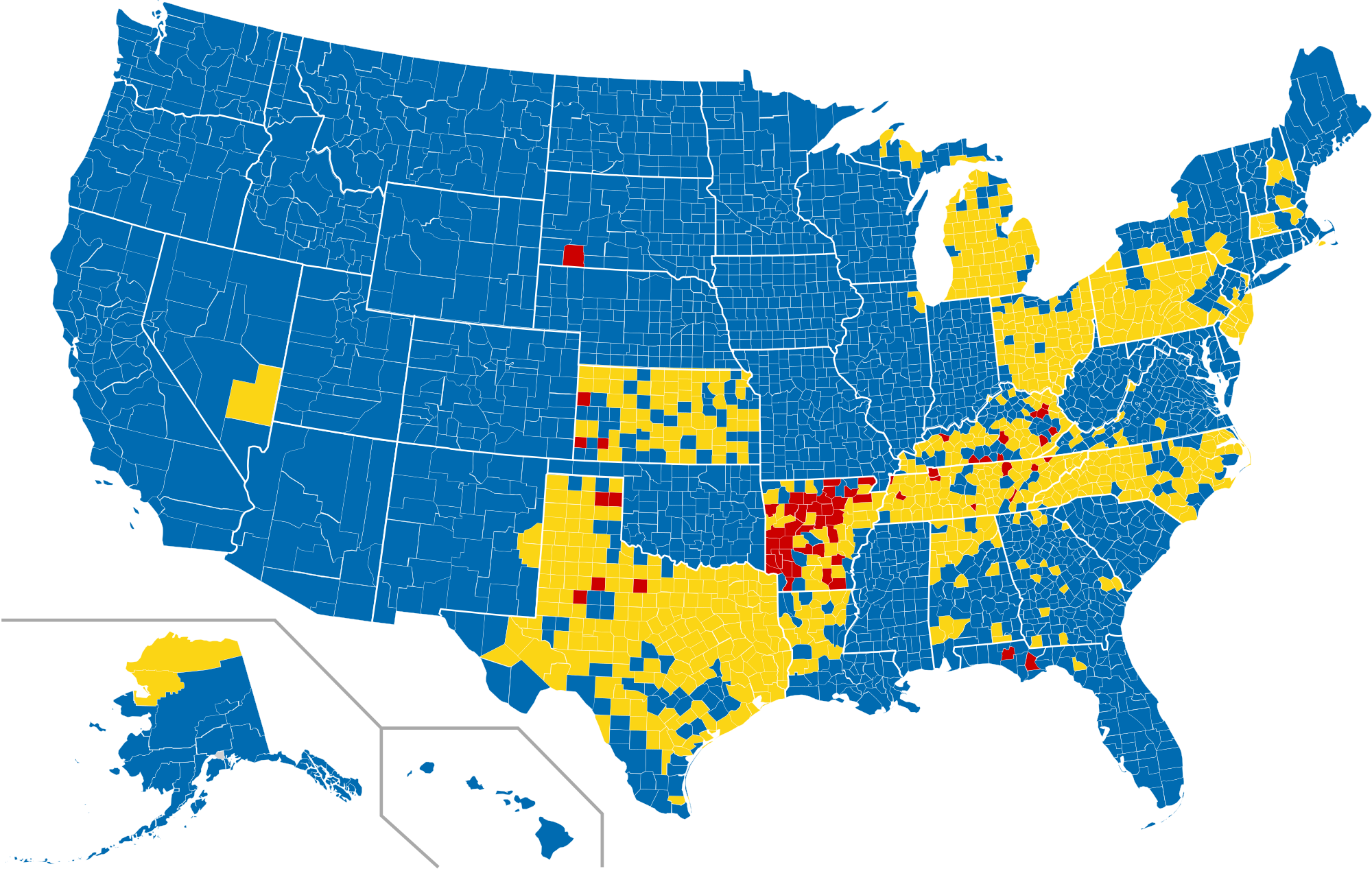
Map of alcohol control laws in the United States:
Red = dry counties, where selling alcohol is prohibited
Yellow = semi-dry ("moist") counties, where some restrictions apply
Blue = no restrictions

In the United States, a dry county is a county whose local government forbids the sale of any kind of alcoholic beverages. Some prohibit off-premises sale, some prohibit on-premises sale, and some prohibit both. The vast majority of counties now permit the sale of alcohol in at least some circumstances, but some dry counties remain, mostly in the Southern United States; the largest number are in Arkansas, where 30 counties are dry.

A number of smaller jurisdictions also exist, such as cities, towns, and townships, which prohibit the sale of alcoholic beverages and are known as dry cities, dry towns, or dry townships. Dry jurisdictions can be contrasted with "wet" (in which alcohol sales are allowed and regulated) and "moist" (in which some sales of alcohol are permitted, or a dry county containing wet cities).

Background

[edit]

History

[edit]
Animated map of alcohol prohibition in the United States 1880 – 2025

In 1906, just over half of U.S. counties were dry. The proportion was larger in some states; for example, in 1906, 54 of Arkansas's 75 counties were completely dry, influenced by the anti-liquor campaigns of the Baptists (both Southern and Missionary) and Methodists.[1]

Although the Twenty-first Amendment to the United States Constitution repealed nationwide Prohibition in the United States, prohibition under state or local laws is permitted.[2] Prior to and after repeal of nationwide Prohibition, some states passed local option laws granting counties and municipalities, either by popular referendum or local ordinance, the ability to decide for themselves whether to allow alcoholic beverages within their jurisdiction.[3] Many dry communities do not prohibit the consumption of alcohol, which could potentially cause a loss of profits and taxes from the sale of alcohol to their residents in wet (non-prohibition) areas.[citation needed]

The reason for maintaining prohibition at the local level is often religious in nature, as many evangelical Protestant Christian denominations discourage the consumption of alcohol by their followers (see Christianity and alcohol, sumptuary law, and Bootleggers and Baptists).

A 2018 study of wet and dry counties in the U.S. found that "Even controlling for current religious affiliations, religious composition following the end of national Prohibition strongly predicts current alcohol restrictions."[4]

In rural Alaska, restrictions on alcohol sales are motivated by problems with alcohol use disorder and alcohol-related crime.[5]

Transport

[edit]

Since the 21st Amendment repealed nationwide Prohibition in the United States, alcohol prohibition legislation has been left to the discretion of each state, but that authority is not absolute. States within the United States and other sovereign territories were once assumed to have the authority to regulate commerce with respect to alcohol traveling to, from, or through their jurisdictions.[6] However, one state's ban on alcohol may not impede interstate commerce between states who permit it.[6] The Supreme Court of the United States held in Granholm v. Heald (2005)[6] that states do not have the power to regulate interstate shipments of alcoholic beverages. Therefore, it may be likely that municipal, county, or state legislation banning possession of alcoholic beverages by passengers of vehicles operating in interstate commerce (such as trains and interstate bus lines) would be unconstitutional if passengers on such vehicles were simply passing through the area.[citation needed] Following two 1972 raids on Amtrak trains in Kansas and Oklahoma, dry states at the time, the bars on trains passing through the two states closed for the duration of the transit, but the alcohol stayed on board.[7][8]

Prevalence

[edit]

A 2004 survey by the National Alcohol Beverage Control Association found that more than 500 municipalities in the United States are dry, including 83 in Alaska.[citation needed] Of Arkansas's 75 counties, 30 are dry.[9][10] 36 of the 82 counties in Mississippi were dry or moist[11] by the time that state repealed its alcoholic prohibition on January 1, 2021, the date it came into force, making all its counties "wet" by default and allowing alcohol sales unless they vote to become dry again through a referendum.[12] In Florida, three of its 67 counties are dry,[13] all of which are located in the northern part of the state, an area that has cultural ties to the Deep South.

Moore County, Tennessee, the home county of Jack Daniel's, a major American producer of whiskey,[14] is a dry county and so the product is not available at stores or restaurants within the county. The distillery, however, sells commemorative bottles of whiskey on site.[15]

Traveling to purchase alcohol

[edit]

A study in Kentucky suggested that residents of dry counties have to drive farther from their homes to consume alcohol, thus increasing impaired driving exposure,[16] although it found that a similar proportion of crashes in wet and dry counties are alcohol-related.

Other researchers have pointed to the same phenomenon. Winn and Giacopassi observed that residents of wet counties most likely have "shorter distances (to travel) between home and drinking establishments".[17] From their study, Schulte and colleagues postulate that "it may be counter productive in that individuals are driving farther under the influence of alcohol, thus, increasing their exposure to crashes in dry counties".[16]

Data from the National Highway Traffic and Safety Administration (NHTSA) showed that in Texas, the fatality rate in alcohol-related accidents in dry counties was 6.8 per 10,000 people over a five-year period. That was three times the rate in wet counties: 1.9 per 10,000.[18][19] A study in Arkansas came to a similar conclusion - that accident rates were higher in dry counties than in wet.[20]

Another study in Arkansas noted that wet and dry counties are often adjacent and that alcoholic beverage sales outlets are often located immediately across county or even on state lines.[21]

Tax revenue

[edit]

Another issue a dry city or county may face is the loss of tax revenue because drinkers are willing to drive across city, county or state lines to obtain alcohol. Counties in Texas have experienced this problem, which led to some of its residents to vote towards going wet to see their towns come back to life commercially. Although the idea of bringing more revenue and possibly new jobs to a town may be appealing from an economic standpoint, moral opposition remains present.[22]

Crime

[edit]

One study finds that the shift from bans on alcohol to legalization causes an increase in crime.[23] The study finds that "a 10% increase in drinking establishments is associated with a 3 to 5% increase in violent crime. The estimated relationship between drinking establishments and property crime is also positive, although smaller in magnitude".[23]

Dry and moist counties in Kentucky had a higher rate of meth lab seizures than wet counties; a 2018 study of Kentucky counties concluded that "meth lab seizures in Kentucky would decrease by 35% if all counties became wet."[4]

See also

[edit]

References

[edit]
Revisions and contributorsEdit on WikipediaRead on Wikipedia
from Grokipedia
A dry is a in in which local ordinances prohibit the sale of alcoholic beverages, either completely or with substantial limitations such as bans on off-premises retail or on-site consumption, while typically permitting private possession and consumption by residents. These areas trace their origins to the 19th-century and persisted after the 1933 repeal of national through state-enacted local option laws that devolve alcohol regulation to county voters, allowing prohibitions to endure in regions with strong religious or cultural opposition to alcohol. Predominantly located in the Southern "Bible Belt" states including , , , , and Georgia—where counties default to dry status unless affirmatively voted wet—dry counties numbered over 80 as of 2025, though exact counts vary due to ongoing referendums shifting some to partial or full legalization for economic reasons like tax revenue and tourism. Empirical studies indicate mixed outcomes, with lower per capita alcohol consumption but elevated rates of , alcohol-related traffic fatalities, and mortality in dry counties compared to wet counterparts, suggesting that proximity to borders encourages riskier cross-county consumption patterns rather than outright abstinence.

Definition of Dry County

A dry county is a county in the United States where local ordinances prohibit the sale of any alcoholic beverages within its boundaries, encompassing both on-premises consumption at bars and restaurants and off-premises retail sales. This restriction arises from state-enacted local option laws, which empower to independently regulate alcohol sales rather than defaulting to statewide permissions. As of , such represented jurisdictions with complete bans, distinguishing them from "moist" areas that permit limited sales, like or wine only. While sales are forbidden, personal possession, transportation, and private consumption of alcohol—typically purchased from adjacent wet jurisdictions—are generally legal, subject to state-specific rules on or open containers. varies by locality, but violations of sales prohibitions can result in fines, denials for businesses, or criminal penalties under municipal codes. These dry status designations persist primarily in Southern and states, reflecting voter referendums or legislative holdovers from Prohibition-era sentiments. ![Alcohol control map of the United States][float-right] The term "dry" contrasts with "wet" counties, where full alcohol sales are authorized, and underscores decentralized control over vice regulation post-1933 repeal of the 18th Amendment. Dry counties do not equate to total abstinence mandates; residents often cross borders for purchases, potentially influencing local economies through lost from alcohol sales. Legal challenges to dry laws occasionally arise under arguments, but courts have upheld local options as valid exercises of police power. The Twenty-first Amendment to the Constitution, ratified on December 5, 1933, provides the primary constitutional basis for dry counties by repealing the Eighteenth Amendment's national and delegating regulatory authority over alcoholic beverages to the states. Section 2 of the amendment states: "The transportation or importation into any State, Territory, or possession of the for delivery or use therein of intoxicating liquors, in violation of the laws thereof, is hereby prohibited," thereby empowering states to enforce prohibitions on alcohol importation and sales without interference from federal doctrines. This provision establishes states' over intrastate alcohol regulation, including the ability to authorize local dry jurisdictions, as affirmed in subsequent interpretations that prioritize state autonomy in this area over federal preemption. Under this constitutional framework, state legislatures have codified local option laws that permit counties and municipalities to enact dry status through mechanisms such as voter referendums or county ordinances. These statutes typically allow jurisdictions to prohibit the sale, distribution, or public consumption of alcoholic beverages, though possession for personal use is often permitted unless state law specifies otherwise. In 17 states, including and , localities may proactively vote to impose dry restrictions via opt-out referendums, while in , , and , areas remain dry by default unless voters approve sales through opt-in elections. State variations in these laws reflect differing approaches to delegation: some, like , enable local elections on specific alcohol types (e.g., , wine, or ) or sales venues (on-premises versus off-premises), as outlined in statutes such as the Texas Alcoholic Beverage Code. Federal courts have consistently upheld such state and local prohibitions against challenges under the Equal Protection or Clauses of the Fourteenth Amendment, recognizing the Twenty-first Amendment's intent to return alcohol policy to subnational control. This legal structure ensures that dry counties operate as valid exercises of state-conferred authority, with no overriding federal mandate for uniform alcohol availability.

Historical Origins

Temperance Movement and Early Local Options

The arose in the early amid high per capita alcohol consumption, which reached approximately 7 gallons of pure alcohol annually by the 1830s, correlating with observed increases in social disruptions such as family breakdowns, workplace , and . Rooted in Protestant , the movement initially emphasized personal abstinence through societies like the , founded in 1826, which by 1833 claimed over 1.5 million members promoting moral reform over distilled spirits as a primary target due to their higher potency and association with habitual drunkenness. Advocates argued from first-hand accounts and that alcohol causally exacerbated and , shifting from voluntary pledges to demands for regulatory intervention when individual restraint proved insufficient against widespread saloon culture. Local option laws emerged as a pragmatic legislative response, granting municipalities or counties the authority to vote on banning alcohol sales, thereby tailoring prohibitions to community-specific conditions without imposing statewide mandates. enacted the first such law in , permitting towns to prohibit traffic via , a mechanism that empowered rural and religious enclaves to enforce dry status amid resistance from urban commercial interests. By the late , at least 12 states and territories, including , , and New York, had authorized similar provisions, often restricting sales to quantities under 15 gallons to curb bulk purchases for public drinking while allowing private use. These early local options facilitated the creation of dry counties by decentralizing control, reflecting a causal logic that uniform state laws ignored heterogeneous local harms from alcohol, such as in agrarian areas where distilleries competed with farm productivity. Enforcement challenges persisted, including evasion through out-of-jurisdiction purchases, yet the framework proliferated, with states like passing county-level bills by the 1850s that enabled votes like Adams County's 1855 dry declaration. By 1913, 31 states incorporated local options alongside nine statewide prohibitions, establishing dry counties as enduring features of American alcohol rooted in empirical local experimentation rather than centralized fiat.

National Prohibition and Its Aftermath

The Eighteenth Amendment to the United States Constitution, ratified on January 16, 1919, and taking effect on January 17, 1920, instituted a nationwide ban on the manufacture, sale, and transportation of intoxicating liquors, extending the dry policies already in place across numerous counties and states through prior local option laws. This federal measure, enforced via the , aimed to eliminate alcohol-related social ills but encountered widespread noncompliance, including speakeasies, bootlegging operations, and rising syndicates that undermined its objectives. By the early 1930s, economic pressures from the and recognition of Prohibition's enforcement failures—such as increased government costs and corruption—fueled repeal efforts, leading to the ratification of the Twenty-first Amendment on December 5, 1933, which nullified the Eighteenth Amendment. Unlike a blanket return to pre-1920 conditions, the new amendment devolved alcohol regulation to the states, stipulating that "the transportation or importation into any State, Territory, or Possession of the for delivery or use therein of intoxicating liquors, in violation of the laws thereof, is hereby prohibited." This shift empowered states to implement varied controls, including local option mechanisms that permitted counties and municipalities to vote on retaining dry status via referendums, thereby preserving or establishing alcohol sales bans in areas where temperance views remained dominant. In the immediate aftermath, particularly in Southern and rural regions, numerous counties elected to stay dry, reflecting entrenched moral and religious opposition to alcohol rather than a uniform national . Such local prohibitions, often rooted in Baptist and Methodist influences, created a regulatory landscape that endured beyond the federal experiment, with dry counties numbering in the hundreds by the mid-20th century as states like and upheld partial bans into the 1960s and later.

Current Prevalence by State

As of 2024, dry counties—where the sale of alcoholic beverages is entirely prohibited—exist in nine states, totaling over 80 such jurisdictions nationwide. These restrictions are most prevalent in the , reflecting historical temperance influences. Arkansas maintains the highest number with 34 dry counties out of 75, representing 45% of its territory. has 15 dry counties, comprising 11% of its 120 counties. features dry areas across 13% of its 82 counties, primarily rural precincts enforcing total bans. Alabama sustains 23 dry counties out of 67, concentrated in the northern and eastern regions. Other states with dry counties include Georgia, (with Wallace County remaining dry despite recent wettings in Haskell and Stanton in 2023), , , , and , though numbers vary and often involve partial prohibitions in smaller units like precincts rather than entire counties. No dry counties are reported in the remaining 41 states, indicating a national trend toward since the 2000s, with fewer than 300 fully dry municipalities overall.

Historical and Recent Shifts

The number of dry counties in the United States has declined substantially since the mid-20th century, reflecting a broader trend toward of local alcohol policies following the repeal of National Prohibition in 1933. In 1970, there were 582 dry counties nationwide, which decreased to 263 by 2008, driven by referendums prioritizing economic development, convenience, and reduced cross-border alcohol purchases. This shift was particularly pronounced in Southern and Midwestern states with historical temperance strongholds, where local option laws allowed communities to vote on alcohol sales, often resulting in piecemeal transitions from fully dry to partially wet or moist statuses permitting limited or wine sales. In the , the decline has continued, albeit at a slower pace, with fewer than 100 fully dry counties remaining as of 2025, concentrated in nine states including (over 30) and . exemplifies recent reversals, with 22 counties and over 200 cities or towns voting to allow alcohol sales in the decade leading up to 2014, motivated by revenue gains and . Similar changes occurred in 's Adair County (2016) and Alabama's Ashland and Lineville (2016), eliminating the latter's last dry areas, while 's Polk County transitioned to wet status around 2024. These shifts often stem from in referendums highlighting fiscal benefits, though dry status persists in rural, religiously conservative regions resistant to change.

Motivations for Maintaining Dry Status

Moral and Religious Rationales

The moral and religious rationales for dry counties originate in the Protestant of the 19th and early 20th centuries, which framed alcohol as a catalyst for personal , family dissolution, and societal vice, drawing on biblical injunctions against drunkenness such as Proverbs 20:1 and Ephesians 5:18. Proponents argued that alcohol impaired moral judgment and spiritual vitality, leading to poverty, violence, and moral decay, with evangelical leaders viewing saloons as dens of iniquity that undermined Christian piety and community ethics. This perspective, rooted in Pietistic Protestantism, motivated local prohibitions as acts of collective moral guardianship, prioritizing to foster and godly living over permissive access. In persisting dry counties, particularly in the U.S. South and , these rationales endure through strong Evangelical demographics, where higher proportions of and other conservative Protestants correlate with opposition to alcohol sales. Statistical analyses of county-level data reveal that dry jurisdictions contain more Evangelicals and fewer Catholics or mainline Protestants than wet areas, with religious adherence explaining much of the variance in prohibition's longevity beyond mere tradition. Southern , representing a core influence, have codified alcohol as incompatible with faithful living; their 2006 resolution explicitly deemed consumption sinful, reinforcing local bans to safeguard communal moral standards against perceived spiritual erosion. Morally, advocates contend that dry status upholds virtues of temperance and responsibility, averting alcohol's causal links to domestic abuse, , and health harms, as observed in temperance-era campaigns that linked to ethical lapses and social disorder. These views persist as traditions in rural, faith-centered localities, where prohibiting sales is seen not as but as a bulwark for preserving , family , and public virtue amid broader cultural shifts toward .

Community Self-Governance Perspectives

Proponents of maintaining dry county status emphasize its role in upholding local , where communities exercise direct democratic control over alcohol policy through referendums authorized by state local option laws. These mechanisms, established post-Prohibition under the 21st Amendment, delegate regulatory authority to counties and municipalities, allowing residents to vote on prohibiting alcohol sales to align governance with prevailing local values, often rooted in religious or cultural preferences. For instance, in , counties retain autonomy via periodic local-option elections to classify as dry, wet, or partially restricted, enabling rural areas to preserve distinct social norms without state-level override. This framework reflects principles, permitting heterogeneous policies that mirror demographic variations, such as drier outcomes in Protestant-majority counties versus wetter ones in Catholic areas, thereby fostering cohesion by letting majorities enforce standards they deem protective of morals and order. Advocates argue that imposing uniform statewide policies would undermine this granular , potentially eroding the ability of smaller jurisdictions to resist external economic pressures from alcohol industries or urban interests. In practice, dry persistence in states like and —where over 30 counties remain fully dry as of recent elections—demonstrates sustained voter preference for self-imposed restrictions as an expression of collective agency rather than top-down mandates. Critics of centralization, including some policy analysts, contend that local option prevents a "one-size-fits-all" approach, preserving the causal link between community choices and outcomes like social stability, even if empirical effects vary. This perspective prioritizes procedural legitimacy—voter-driven decisions—over uniform outcomes, viewing dry status as a bulwark against homogenization that could dilute minority cultural enclaves within states. Historical precedents, such as Virginia's local option adoption, underscore this as a longstanding tool for localized in vice regulation.

Debates and Criticisms

Arguments for Personal Liberty and

Advocates for personal liberty argue that dry county laws infringe on adults' rights to engage in voluntary transactions for alcohol, a federally legal , without evidence of direct harm to others. Such prohibitions extend the logic of national , which the has characterized as a policy failure that expanded government overreach and failed to curb consumption effectively. Libertarian perspectives, as articulated in historical analyses, emphasize that local bans prioritize moral paternalism over individual , compelling residents to travel outside county lines for purchases or forgo choices altogether, thereby undermining the principle of minimal state interference in non-coercive personal decisions. From an economic freedom standpoint, dry counties restrict property owners' abilities to operate businesses involving alcohol sales, limiting entrepreneurial opportunities in and retail sectors. This constraint hampers job creation and local commerce, as evidenced by input-output models projecting gains in food service establishments and upon in previously dry areas. For example, in Little River County, , studies estimate that permitting retail liquor sales would generate additional economic output through multiplier effects on related industries. Dry status also results in forgone , as residents purchase alcohol in neighboring wet jurisdictions, exporting economic activity. In , where 34 of 75 counties remain dry as of 2020, this cross-border travel deprives local governments of sales taxes that could fund public services. A case occurred in Winona, , where transitioning from dry to wet in 2009 boosted monthly alcohol-related tax collections from $2,000 to $11,000, illustrating untapped fiscal potential stifled by . Critics further note that such policies deter tourism-dependent businesses, reducing overall economic vitality in rural areas reliant on visitor spending.

Claims of Ineffectiveness and Unintended Consequences

Critics argue that dry county policies fail to substantially reduce alcohol consumption or related harms, as residents often obtain alcohol from neighboring wet areas or through informal channels, leading to comparable or elevated risks. Studies in states like have found alcohol-related accident rates to be 40% higher and DUI arrest rates 35% higher in dry counties compared to wet ones, attributing this to cross-border travel for purchases followed by impaired driving home. Similarly, analyses in indicate no significant difference in prevalence between dry and wet counties, suggesting prohibitions do not deter heavy episodic drinking but may encourage stockpiling or clandestine sourcing. Unintended consequences include heightened illicit activities, such as black-market alcohol sales and substitution toward other substances. Economic research on U.S. counties demonstrates a positive correlation between dry status and increased production and use of controlled drugs, including opioids and methamphetamine, as prohibitions on legal alcohol create voids filled by unregulated alternatives. This shift is posited to exacerbate public health issues, with dry areas reporting elevated opioid problems despite lower reported alcohol incidents. Additionally, dry policies contribute to lost local revenue from alcohol taxes and tourism, depriving communities of economic benefits observed in wet jurisdictions, such as boosted hospitality sectors. Enforcement challenges amplify these effects, fostering underground economies that undermine the moral intent of dry laws. While some older studies claim benefits like improved highway safety from reduced outlets, more recent empirical data highlights persistent consumption patterns and amplified risks from travel, questioning the overall efficacy in curbing alcohol's societal toll.

Empirical Impacts

Effects on Public Health and Alcohol Consumption

Residence in dry counties is associated with reduced alcohol consumption, attributable to the elevated implicit costs of acquisition, such as travel to wet jurisdictions or reliance on informal sources. An econometric study of U.S. data found that a 10% increase in the population share living in dry counties corresponds to a 4 decline in the probability of any . Additional analysis from the Centers for Disease Control and Prevention indicates lower rates of spirits consumption among residents of dry areas compared to wet ones. These effects stem from restricted local availability, though consumption persists via cross-border purchases, potentially altering patterns toward less frequent but higher-volume intake. Public health outcomes in dry counties show mixed empirical results, with evidence of both benefits and unintended risks. A 1980 analysis of counties, controlling for socioeconomic variables, documented lower alcohol-related social harms in dry areas: rates at 0.9 per 1,000 residents versus 2.9 in wet counties, property crimes at 14.9 versus 29.9, and driving while intoxicated arrests at 7.2 versus 11.2 (all differences significant at p<0.01). This suggests dry status may curb certain acute alcohol-attributable disorders by limiting immediate access. Historical data from the era reinforce potential long-term gains, with a 2023 study estimating a 1.7-year average extension in lifespan for individuals born in counties that sustained prohibition, linked to sustained reductions in alcohol-related mortality like . However, displacement effects pose countervailing health concerns. Residents traveling to wet areas for alcohol may face heightened risks of impaired driving over longer distances, contributing to elevated traffic fatalities. Observational studies in and dry counties report higher alcohol-related crash deaths than in wet counterparts, hypothesizing that the journey exacerbates intoxication-related hazards. Furthermore, restricted legal alcohol access correlates with substitution toward illicit drugs, including increased production—e.g., 0.2-0.5 more incidents per 1,000 residents in dry counties of , , and —potentially worsening substance-related health burdens through toxic exposures. Overall, while dry policies demonstrably lower baseline consumption and select harms, they do not eradicate use and may shift risks to other domains, underscoring the limits of localized in addressing causal drivers of alcohol misuse.

Crime Rates and Social Order

Dry counties in the United States exhibit lower rates of compared to wet counties, with empirical analyses indicating that levels are approximately three times higher in wet jurisdictions. This pattern holds in state-specific examinations, such as in , where aggregated data from the FBI revealed stark disparities after controlling for basic demographic factors. Property crime rates also demonstrate a similar trend, averaging twice as high in wet counties, potentially linked to increased alcohol availability facilitating opportunistic offenses. Alcohol-related offenses, including driving while intoxicated (DWI) arrests, are reduced in dry areas, with rates about 1.5 times lower than in wet counties based on comparative arrest data. In , studies of dry versus wet counties found DWI arrest rates 35% higher and alcohol-related accident rates 40% higher in wet jurisdictions, attributing this to greater access to alcohol outlets. of alcohol sales in previously dry areas has been associated with a 10% rise in , as observed in analyses of county-level shifts toward wet status. These findings align with broader research on alcohol availability, where expansions in outlets correlate with elevated violent and property crimes, though rural demographics and enforcement variations in dry counties may confound direct causality. Regarding social order, dry counties report fewer incidents of public intoxication and alcohol-fueled disturbances, contributing to perceptions of enhanced community stability. Containment theory posits that alcohol restrictions strengthen informal social controls, reducing deviance spillover from drinking establishments, a dynamic evidenced by lower overall crime in prohibited areas. However, some data suggest potential substitutions, such as elevated illicit alcohol production or drug use in dry counties, which could undermine order through underground economies, though these effects appear secondary to the net reduction in alcohol-linked crimes. Comprehensive assessments emphasize that while dry status correlates with improved metrics of social cohesion—fewer bar-related assaults and DUIs—ongoing illegal sales pose enforcement challenges without proportionally increasing reported crime.

Economic Revenue and Development

Dry counties forgo substantial direct tax revenue from alcohol sales, including excise taxes, sales taxes, and licensing fees, which are captured by adjacent wet jurisdictions when residents cross borders to purchase alcohol. A 2012 study on , estimated that legalizing retail alcohol sales could generate over $10 million annually in additional state and local tax revenue, primarily from sales and income taxes on new economic activity. Similarly, a 2015 analysis projected that if a dry county had legalized sales in 2010, it would have realized nearly $78 million in extra retail sales, translating to millions in foregone taxes diverted to neighboring areas. These losses compound over time, as dry status deters investment in alcohol-related like distilleries or breweries, further limiting local fiscal capacity for public services and . Beyond direct taxes, dry counties experience constrained economic development in hospitality, retail, and tourism sectors, where alcohol availability drives consumer spending and business formation. A 2017 University of Kentucky thesis examining alcohol legalization in dry counties found that transitioning to wet status correlates with new food service establishments, job creation in retail and service industries, and reduced leakage of local spending to wet neighbors. For instance, University of Arkansas projections for Little River County indicated that legalization would spur 50-100 new jobs and increase property values through expanded commercial development, as alcohol sales enable fuller restaurant operations and event hosting. Empirical data from counties that have repealed dry laws, such as those in Arkansas and Kentucky, show measurable upticks in gross domestic product contributions from beverage and food services post-legalization, often exceeding initial projections due to multiplier effects on supply chains and visitor economies. While proponents of dry status occasionally claim intangible benefits like preserved community cohesion aiding long-term stability, available economic analyses prioritize quantifiable metrics and consistently demonstrate net developmental lags in dry areas. A 2020 University of Central Arkansas report on Faulkner County highlighted how sustained prohibition leaves counties "thirsty for revenue," stifling diversification into modern entertainment and retail economies reliant on alcohol as a complementary good. Cross-state comparisons reinforce this: wet counties in the same regions exhibit higher per capita retail sales and business densities, attributing disparities to dry neighbors' inability to retain or attract alcohol-fueled commerce. No peer-reviewed studies identify systemic revenue gains from dry policies; instead, they underscore opportunity costs, with dry counties averaging lower fiscal autonomy and growth rates in alcohol-proximate industries.

Practical Implications

Alcohol Access and Cross-Border Travel

In dry counties, where the sale of alcohol is prohibited, residents legally access alcoholic beverages by traveling to neighboring wet counties or municipalities that permit sales. This cross-border purchasing is facilitated by the fact that possession and consumption of alcohol, once obtained, are generally allowed within dry jurisdictions, except in rare cases of full . Such travel often involves driving distances that can span tens of miles, depending on proximity to wet areas. Studies indicate that these extended trips contribute to elevated risks of alcohol-impaired driving. In , analysis of dry counties revealed that greater distances to alcohol outlets correlate with higher rates of alcohol-related crashes, as individuals procure beverages in wet areas and return home under the influence. Similarly, dry county residents face increased involvement in driving while intoxicated incidents compared to those in wet counties, with data from showing 6.8 alcohol-related traffic fatalities per 10,000 people in dry areas versus 1.9 in wet ones over a five-year period. A broader examination across Southern states confirms that the necessity to travel further for alcohol procurement heightens the likelihood of impaired returns, exacerbating highway concerns. Economically, dry counties forfeit potential tax revenue from alcohol sales, which instead accrues to adjacent wet jurisdictions benefiting from inbound purchases. This dynamic has prompted referendums in several dry areas, such as those in Arkansas and Kentucky, where voters have approved limited sales to reduce travel burdens and capture local economic activity. While illegal bootlegging occurs in some instances, legal cross-border travel remains the predominant method, underscoring the practical limitations of county-level prohibitions in a mobile society.

Enforcement Challenges

Enforcing alcohol sales prohibitions in dry counties encounters substantial hurdles, including the enduring prevalence of illegal production and distribution networks. Moonshining, involving the unlicensed distillation of high-proof spirits, persists in rural dry areas of the American South, facilitated by remote terrains like Appalachian hollows that hinder detection and raids by under-resourced local sheriffs' offices. In regions such as Franklin County, Virginia—historically dubbed the "Moonshine Capital"—federal sting operations in the 1980s and beyond uncovered vast bootlegging empires producing thousands of gallons annually, underscoring the scale and sophistication of underground operations that evade routine patrols. Resource constraints exacerbate these issues, as small, rural counties typically maintain limited personnel focused on higher-priority crimes like violent offenses rather than alcohol violations. This selective enforcement fosters community tolerance for discreet sales at private residences or "blind tigers"—unlicensed speakeasies—where transactions occur informally among acquaintances, evading public scrutiny. In Kentucky's remaining dry counties, which numbered 10 as of 2022, officials report sporadic busts of illegal vendors but acknowledge widespread circumvention through home production or informal networks, reflecting a cultural disconnect between formal bans and practical behaviors. Borderline procurement from adjacent "wet" areas further strains , as residents routinely cross county lines for purchases, leading to frequent violations of transport restrictions—such as Mississippi's outright ban on conveying alcohol through dry jurisdictions. Policing these movements requires constant roadside checks, yet data show dry counties experience DUI crash rates up to four times higher than wet counterparts, diverting officers to response and investigations over proactive . This dynamic not only undermines the prohibitions' intent but also elevates risks from unregulated, adulterated illicit alcohol, which lacks quality controls and contributes to health incidents that indirectly burden .

References

Add your contribution
Related Hubs
User Avatar
No comments yet.