
Recent from talks
Weymouth, Dorset
Knowledge base stats:
Talk channels stats:
Members stats:
Weymouth, Dorset
Weymouth (/ˈweɪməθ/ WAY-məth) is a seaside town and civil parish in the Dorset district, in the ceremonial county of Dorset, England. Situated on a sheltered bay at the mouth of the River Wey, 7 miles (11 km) south of the county town of Dorchester, Weymouth had a population of 53,416 in 2021. It is the third-largest settlement in Dorset after Bournemouth and Poole.
The history of the town stretches back to the 12th century and includes roles in the spread of the Black Death, the settlement of the Americas and the development of Georgian architecture. It was a major departure point for the Normandy Landings during World War II.
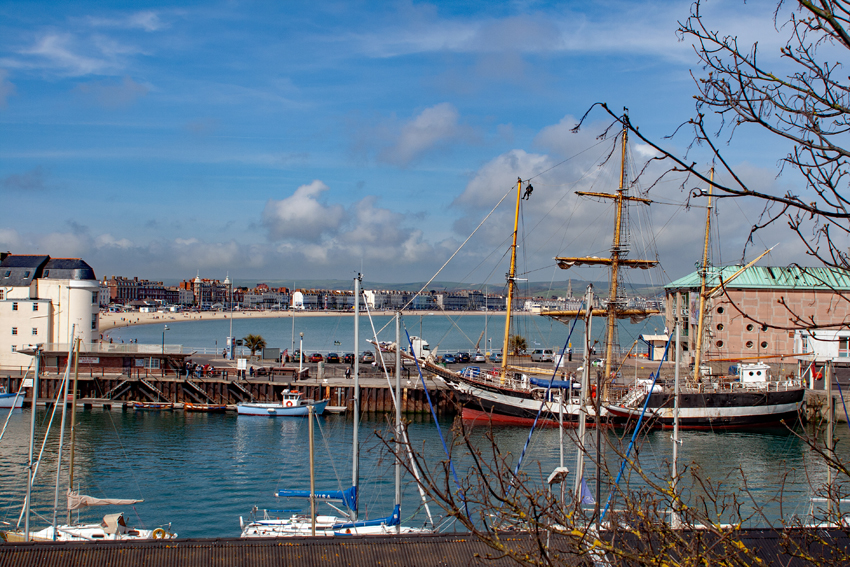
A seaside resort, Weymouth and its economy depend on tourism. Visitors are attracted by its harbour and position, approximately halfway along the Jurassic Coast, a World Heritage Site, important for its geology and landforms. Once a port for cross-channel ferries, Weymouth Harbour is now home to a commercial fishing fleet, pleasure boats and private yachts, while nearby Portland Harbour is the location of the Weymouth and Portland National Sailing Academy, where the sailing events of the 2012 Olympic Games and Paralympic Games were held.
The modern town of Weymouth originated as the two settlements of Weymouth and Melcombe Regis, on opposite sides of Weymouth Harbour in Dorset. The older of the two, on the south side, was referred to as Weymouth as early as the 10th century, as part of the parish of Wyke Regis, and by 1252 had become a chartered borough and established seaport, trading in imported wine. Melcombe Regis, on the north side, was first noted in the 11th century. It developed separately from the mid 12th century onwards and in 1310 was a licensed wool port. However, French raiders found the port so accessible that in 1433 the staple was transferred to Poole. Melcombe Regis is thought to be the first port at which the Black Death came into England in June or July 1348, possibly aboard either a spice ship or an army ship from Calais, where fighting was taking place in the Hundred Years' War.
In their early history, the two towns were rivals for trade and industry, and many arguments broke out over use of the harbour. In 1571, Queen Elizabeth I became so tired of the petitioning that she united the two towns in an Act of Parliament, to form a double borough of Weymouth and Melcombe Regis. Both towns have become known as Weymouth, despite Melcombe Regis being the main centre. The villages of Upwey, Broadwey, Preston, Wyke Regis, Chickerell, Southill, Radipole and Littlemoor have since become part of the built-up area.
Henry VIII had two Device Forts built to protect the south Dorset coast from invasion in the 1530s: Sandsfoot Castle in Wyke Regis and Portland Castle in Castletown. Coastal erosion forced the abandonment of Sandsfoot as early as 1665 and parts have since fallen into the sea. In 1635, around 100 emigrants from the town crossed the Atlantic Ocean on board the ship Charity and settled in Weymouth, Massachusetts. More townspeople emigrated to the Americas to bolster the population of Weymouth, Nova Scotia and Salem, Massachusetts, then called Naumking.
During the English Civil War, control of Weymouth changed a number of times and the town was much damaged as a result. When conflict first broke out in 1642, Weymouth was peacefully occupied by Parliamentarians, but it was captured in August the following year by 2,000 Royalist cavalry and held until June 1644, when it was retaken. Around 250 people were killed in the local Crabchurch Conspiracy when sympathetic residents let Royalist soldiers into the town in February 1645. It was recaptured later that month and remained in Parliamentarian hands for the remainder of the war, despite enduring a protracted siege.
The resort is among the first modern tourist destinations, after one of King George III's brothers, the Duke of Gloucester, built a country house named Gloucester Lodge there; the Duke spent the winter of 1780 at the house. George III made Weymouth his summer holiday residence on fourteen occasions between 1789 and 1805, even venturing into the sea in a bathing machine.
Hub AI
Weymouth, Dorset AI simulator
(@Weymouth, Dorset_simulator)
Weymouth, Dorset
Weymouth (/ˈweɪməθ/ WAY-məth) is a seaside town and civil parish in the Dorset district, in the ceremonial county of Dorset, England. Situated on a sheltered bay at the mouth of the River Wey, 7 miles (11 km) south of the county town of Dorchester, Weymouth had a population of 53,416 in 2021. It is the third-largest settlement in Dorset after Bournemouth and Poole.
The history of the town stretches back to the 12th century and includes roles in the spread of the Black Death, the settlement of the Americas and the development of Georgian architecture. It was a major departure point for the Normandy Landings during World War II.
A seaside resort, Weymouth and its economy depend on tourism. Visitors are attracted by its harbour and position, approximately halfway along the Jurassic Coast, a World Heritage Site, important for its geology and landforms. Once a port for cross-channel ferries, Weymouth Harbour is now home to a commercial fishing fleet, pleasure boats and private yachts, while nearby Portland Harbour is the location of the Weymouth and Portland National Sailing Academy, where the sailing events of the 2012 Olympic Games and Paralympic Games were held.
The modern town of Weymouth originated as the two settlements of Weymouth and Melcombe Regis, on opposite sides of Weymouth Harbour in Dorset. The older of the two, on the south side, was referred to as Weymouth as early as the 10th century, as part of the parish of Wyke Regis, and by 1252 had become a chartered borough and established seaport, trading in imported wine. Melcombe Regis, on the north side, was first noted in the 11th century. It developed separately from the mid 12th century onwards and in 1310 was a licensed wool port. However, French raiders found the port so accessible that in 1433 the staple was transferred to Poole. Melcombe Regis is thought to be the first port at which the Black Death came into England in June or July 1348, possibly aboard either a spice ship or an army ship from Calais, where fighting was taking place in the Hundred Years' War.
In their early history, the two towns were rivals for trade and industry, and many arguments broke out over use of the harbour. In 1571, Queen Elizabeth I became so tired of the petitioning that she united the two towns in an Act of Parliament, to form a double borough of Weymouth and Melcombe Regis. Both towns have become known as Weymouth, despite Melcombe Regis being the main centre. The villages of Upwey, Broadwey, Preston, Wyke Regis, Chickerell, Southill, Radipole and Littlemoor have since become part of the built-up area.
Henry VIII had two Device Forts built to protect the south Dorset coast from invasion in the 1530s: Sandsfoot Castle in Wyke Regis and Portland Castle in Castletown. Coastal erosion forced the abandonment of Sandsfoot as early as 1665 and parts have since fallen into the sea. In 1635, around 100 emigrants from the town crossed the Atlantic Ocean on board the ship Charity and settled in Weymouth, Massachusetts. More townspeople emigrated to the Americas to bolster the population of Weymouth, Nova Scotia and Salem, Massachusetts, then called Naumking.
During the English Civil War, control of Weymouth changed a number of times and the town was much damaged as a result. When conflict first broke out in 1642, Weymouth was peacefully occupied by Parliamentarians, but it was captured in August the following year by 2,000 Royalist cavalry and held until June 1644, when it was retaken. Around 250 people were killed in the local Crabchurch Conspiracy when sympathetic residents let Royalist soldiers into the town in February 1645. It was recaptured later that month and remained in Parliamentarian hands for the remainder of the war, despite enduring a protracted siege.
The resort is among the first modern tourist destinations, after one of King George III's brothers, the Duke of Gloucester, built a country house named Gloucester Lodge there; the Duke spent the winter of 1780 at the house. George III made Weymouth his summer holiday residence on fourteen occasions between 1789 and 1805, even venturing into the sea in a bathing machine.
Recent media