Hubbry Logo
Device FortsDevice FortsMain
Open search
Device Forts
Community hub
Device Forts
logo
8 pages, 0 posts
0 subscribers
Be the first to start a discussion here.
Device Forts
Device Forts
from Wikipedia

The Device Forts, also known as Henrician castles and blockhouses, were a series of artillery fortifications built to defend the coast of England and Wales by Henry VIII.[a] Traditionally, the Crown had left coastal defences in the hands of local lords and communities but the threat of French and Spanish invasion led the King to issue an order, called a "device", for a major programme of work between 1539 and 1547. The fortifications ranged from large stone castles positioned to protect the Downs anchorage in Kent, to small blockhouses overlooking the entrance to Milford Haven in Pembrokeshire, and earthwork bulwarks along the Essex coast. Some forts operated independently, others were designed to be mutually reinforcing. The Device programme was hugely expensive, costing a total of £376,000 (estimated as between £2 and £82 billion in today's money);[b] much of this was raised from the proceeds of the Dissolution of the Monasteries a few years before.

Key Information

These utilitarian fortifications were armed with artillery, intended to be used against enemy ships before they could land forces or attack ships lying in harbour. The first wave of work between 1539 and 1543 was characterised by the use of circular bastions and multi-tiered defences, combined with many traditional medieval features. These designs contained serious military flaws, however, and the second period of construction until 1547 saw the introduction of angular bastions and other innovations probably inspired by contemporary thinking in mainland Europe. The castles were commanded by captains appointed by the Crown, overseeing small garrisons of professional gunners and soldiers, who would be supplemented by the local militia in an emergency.

Despite a French raid against the Isle of Wight in 1545, the Device Forts saw almost no action before peace was declared in 1546. Some of the defences were left to deteriorate and were decommissioned only a few years after their construction. After war broke out with Spain in 1569, Elizabeth I improved many of the remaining fortifications, including during the attack of the Spanish Armada of 1588. By the end of the century, the defences were badly out of date and for the first few decades of the 17th century many of the forts were left to decay. Most of the fortifications saw service in the First and Second English Civil Wars during the 1640s and were garrisoned during the Interregnum, continuing to form the backbone of England's coastal defences against the Dutch after Charles II was restored to the throne in 1660. Again left to fall in ruin during the 18th century, many of the Device Forts were modernised and rearmed during the Napoleonic Wars, until peace was declared in 1815.

Fears over a possible French invasion resurfaced several times in the 19th century, combined with rapid changes in technology, such as the development of steamships and shell guns in the 1840s, rifled cannon and iron-clad warships in the 1850s, and torpedo boats in the 1880s. This spurred fresh investment in those Device Forts still thought to be militarily valuable, and encouraged the decommissioning of others. By 1900, however, developments in guns and armour had made most of the Device Forts that remained in service simply too small to be practical in modern coastal defence. Despite being brought back into use during the First and Second World Wars, by the 1950s the fortifications were finally considered redundant and decommissioned for good. Coastal erosion over the centuries had taken its toll and some sites had been extensively damaged or completely destroyed. Many were restored, however, and opened to the public as tourist attractions.

Early history and design

[edit]

Device programme

[edit]

Background

[edit]
Map of Southern England showing the locations of the Device Forts
Device Forts
Device Forts
Device Forts
Device Forts
Device Forts
Device Forts
Device Forts
Device Forts
Device Forts
Device Forts
Device Forts
Device Forts
Device Forts
Device Forts
Device Forts
Device Forts
Device Forts
Device Forts
Device Forts
Device Forts
Device Forts
Device Forts
Device Forts
Device Forts
Device Forts
Device Forts
Device Forts
Device Forts
Device Forts
Device Forts
Device Forts
Device Forts
Device Forts
Device Forts
Device Forts
Device Forts
Device Forts
Device Forts
Device Forts
Device Forts
Map of Southern England and Wales showing the locations of the Device Forts: Henrician castles Henrician blockhouses and bulwarks[3]

The Device Forts emerged as a result of changes in English military architecture and foreign policy in the early 16th century.[4] During the late medieval period, the English use of castles as military fortifications had declined in importance.[citation needed] The introduction of gunpowder in warfare had initially favoured the defender, but soon traditional stone walls could easily be destroyed by early artillery.[5] The few new castles that were built during this time still incorporated the older features of gatehouses and crenellated walls, but intended them more as martial symbols than as practical military defences.[6] Many older castles were simply abandoned or left to fall in disrepair.[7]

Although fortifications could still be valuable in times of war, they had played only a limited role during the Wars of the Roses and, when Henry VII invaded and seized the throne in 1485, he had not needed to besiege any castles or towns during the campaign.[8] Henry rapidly consolidated his rule at home and had few reasons to fear an external invasion from the continent; he invested little in coastal defences over the course of his reign.[9] Modest fortifications existed along the coasts, based around simple blockhouses and towers, primarily in the south-west and along the Sussex coast, with a few more impressive works in the north of England, but they were very limited in scale.[10]

His son, Henry VIII inherited the throne in 1509 and took a more interventionist approach in European affairs, fighting one war with France between 1512 and 1514, and then another between 1522 and 1525, this time allying himself with Spain and the Holy Roman Empire.[11] While France and the Empire were in conflict with one another, raids along the English coast might still be common, but a full-scale invasion seemed unlikely.[12] Indeed, traditionally the Crown had left coastal defences to local lords and communities, only taking a modest role in building and maintaining fortifications.[12] Initially, therefore, Henry took little interest in his coastal defences; he declared reviews of the fortifications in both 1513 and 1533, but not much investment took place as a result.[13]

In 1533 Henry broke with Pope Clement VII in order to annul the long-standing marriage to his wife, Catherine of Aragon, and remarry.[14] Catherine was the aunt of King Charles V of Spain, who took the annulment as a personal insult.[15] As a consequence, France and the Empire declared an alliance against Henry in 1538, and the Pope encouraged the two countries to attack England.[16] An invasion of England now appeared certain; that summer Henry made a personal inspection of some of his coastal defences, which had recently been mapped and surveyed: he appeared determined to make substantial, urgent improvements.[17]

Initial phase, 1539–1543

[edit]
Deal Castle in 2011, and in a draft 1539 plan probably shown to Henry VIII[18]

Henry VIII gave instructions through Parliament in 1539 that new defences were to be built along the coasts of England, beginning a major programme of work that would continue until 1547.[19] The order was known as a "device", which meant a documented plan, instruction or schema, leading to the fortifications later becoming known as the "Device Forts".[20] The initial instructions for the "defence of the realm in time of invasion" concerned building forts along the southern coastline of England, as well as making improvements to the defences of the towns of Calais and Guisnes in France, then controlled by Henry's forces.[20] Commissioners were also to be sent out across south-west and south-east England to inspect the current defences and to propose sites for new ones.[21]

The initial result was the construction of 30 new fortifications of various sizes during 1539.[22] The stone castles of Deal, Sandown and Walmer were constructed to protect the Downs in east Kent, an anchorage which gave access to Deal Beach and on which an invasion force of enemy soldiers could easily be landed.[23] These defences, known as the castles of the Downs, were supported by a line of four earthwork forts, known as the Great Turf Bulwark, the Little Turf Bulwark, the Great White Bulwark of Clay and the Walmer Bulwark, and a 2.5-mile (4.0 km) long defensive ditch and bank.[24] The route inland through a gap in the Kentish cliffs was guarded by Sandgate Castle.[25] In many cases temporary bulwarks for artillery batteries were built in during the initial stages of the work, ahead of the main stonework being completed.[26]

The Thames estuary leading out of London, through which 80 percent of England's exports passed, was protected with a mutually reinforcing network of blockhouses at Gravesend, Milton, and Higham on the south side of the river, and West Tilbury and East Tilbury on the opposite bank.[27] Camber Castle was built to protect the anchorage outside the ports of Rye and Winchelsea, defences were built in the port of Harwich and three earth bulwarks were built around Dover.[28] Work was also begun on Calshot Castle in Fawley and the blockhouses of East and West Cowes on the Isle of Wight to protect the Solent, which led into the trading port of Southampton.[29] The Portland Roads anchorage in Dorset was protected with new castles at Portland and Sandsfoot, and work began on two blockhouses to protect the Milford Haven Waterway in Pembrokeshire.[30]

In 1540 additional work was ordered to defend Cornwall.[31] Carrick Roads was an important anchorage at the mouth of the River Fal and the original plans involved constructing five new fortifications to protect it, although only two castles, Pendennis and St Mawes, were actually built, on opposite sides of the estuary.[32] Work began on further fortifications to protect the Solent in 1541, with the construction of Hurst Castle, overlooking the Needles Passage, and Netley Castle just outside Southampton itself.[33] Following a royal visit to the north of England, the coastal fortifications around the town of Hull were upgraded in 1542 with a castle and two large blockhouses.[34] Further work was carried out in Essex in 1543, with a total of seven fortifications constructed, three in Harwich itself, three protecting the estuary leading to the town, and two protecting the estuary linking into Colchester.[35] St Andrew's Castle was begun to further protect the Solent.[36]

The work was undertaken rapidly, and 24 sites were completed and garrisoned by the end of 1540, with almost all of the rest finished by the end of 1543.[37] By the time they were completed, however, the alliance between Charles and Francis had collapsed and the threat of imminent invasion was over.[38]

Second phase, 1544–1547

[edit]
Southsea Castle in 2011, and depicted in the Cowdray engraving of the Battle of the Solent in 1545

Henry moved back onto the offensive in Europe in 1543, allying himself with Spain against France once again.[39] Despite Henry's initial successes around Boulogne in northern France, King Charles and Francis made peace in 1544, leaving England exposed to an invasion by France, backed by her allies in Scotland.[40] In response Henry issued another device in 1544 to improve the country's defences, particularly along the south coast.[41] Work began on Southsea Castle in 1544 on Portsea Island to further protect the Solent, and on Sandown Castle the following year on the neighbouring Isle of Wight.[42] Brownsea Castle in Dorset was begun in 1545, and Sharpenrode Bulwark was built opposite Hurst Castle from 1545 onwards.[43]

The French invasion emerged in 1545, when Admiral Claude d'Annebault crossed the Channel and arrived off the Solent with 200 ships on 19 July.[44] Henry's fleet made a brief sortie, before retreating safely behind the protective fortifications.[45] Annebault landed a force near Newhaven, during which Camber Castle may have fired on the French fleet, and on 23 July they landed four detachments on the Isle of Wight, including a party that took the site of Sandown Castle, which was still under construction.[46] The French expedition moved further on along the coast on 25 July, bringing an end to the immediate invasion threat.[47] Meanwhile, on 22 July the French had carried out a raid at Seaford, and Camber Castle may have seen action against the French fleet.[48] A peace treaty was agreed in June 1546, bringing an end to the war.[49] By the time that Henry died the following year, in total the huge sum of £376,000 had been spent on the Device projects.[50][b]

Architects and engineers

[edit]
Yarmouth Castle in 2009, and its 1559 plan showing its Italianate, arrow-head bastion

Some of the Device Forts were designed and built by teams of English engineers.[51] The master mason John Rogers was brought back from his work in France and worked on the Hull defences, while Sir Richard Lee, another of the King's engineers from his French campaigns, may have been involved in the construction of Sandown and Southsea; the pair were paid the substantial sums of £30 and £36 a year respectively.[52][b] Sir Richard Morris, the Master of Ordnance, and James Nedeham, the Surveyor of the King's Works, led on the defences along the Thames.[51] The efforts of the Hampton Court Palace architectural team, under the leadership of the Augustinian canon, Richard Benese, contributed to the high-quality construction and detailing seen in many of Henry's Device projects.[53]

Henry himself took a close interest in the design of the fortifications, sometimes overruling his technical advisers on particular details.[54] Southsea Castle, for example, was described by the courtier Sir Edmund Knyvet as being "of his Majesty's own device", which typically indicated that the King had taken a personal role in its design.[55] The historian Andrew Saunders suspects that Henry was "probably the leading and unifying influence behind the fortifications".[51]

England also had a tradition of drawing on expert foreign engineers for military engineering; Italians were particularly sought after, as their home country was felt to be generally more technically advanced, particularly in the field of fortifications.[56] One of these foreign engineers, Stefan von Haschenperg from Moravia, worked on Camber, Pendennis, Sandgate and St Mawes, apparently attempting to reproduce Italian designs, although his lack of personal knowledge of such fortifications impacted poorly on the end results.[57] Technical treatises from mainland Europe also influenced the designers of the Device Forts, including Albrecht Dürer's Befestigung der Stett, Schlosz und Felcken which described contemporary methods of fortification in Germany, published in 1527 and translated into Latin in 1535, and Niccolò Machiavelli's Libro dell'art della guerra, published in 1521, which also described new Italian forms of military defences.[58]

Architecture

[edit]
18th-century engraving of a 1588 map showing the mutually reinforcing defences along the River Thames, including Milton and Gravesend blockhouses (top), and East Tilbury and West Tilbury blockhouses (bottom)[c]

The Device Forts represented a major, radical programme of work; the historian Marcus Merriman describes it as "one of the largest construction programmes in Britain since the Romans", Brian St John O'Neil as the only "scheme of comprehensive coastal defence ever attempted in England before modern times", while Cathcart King likened it to the Edwardian castle building programme in North Wales.[59]

Although some of the fortifications are titled as castles, historians typically distinguish between the character of the Device Forts and those of the earlier medieval castles.[60] Medieval castles were private dwellings as well as defensive sites, and usually played a role in managing local estates; Henry's forts were organs of the state, placed in key military locations, typically divorced from the surrounding patterns of land ownership or settlements.[60] Unlike earlier medieval castles, they were spartan, utilitarian constructions.[61] Some historians such as King have disagreed with this interpretation, highlighting the similarities between the two periods, with the historian Christopher Duffy terming the Device Forts the "reinforced-castle fortification".[62]

The forts were positioned to defend harbours and anchorages, and designed both to focus artillery fire on enemy ships, and to protect the gunnery teams from attack by those vessels.[63] Some, including the major castles, including the castles of the Downs in Kent, were intended to be self-contained and able to defend themselves against attack from the land, while the smaller blockhouses were primarily focused on the maritime threat.[64] Although there were extensive variations between the individual designs, they had common features and were often built in a consistent style.[65]

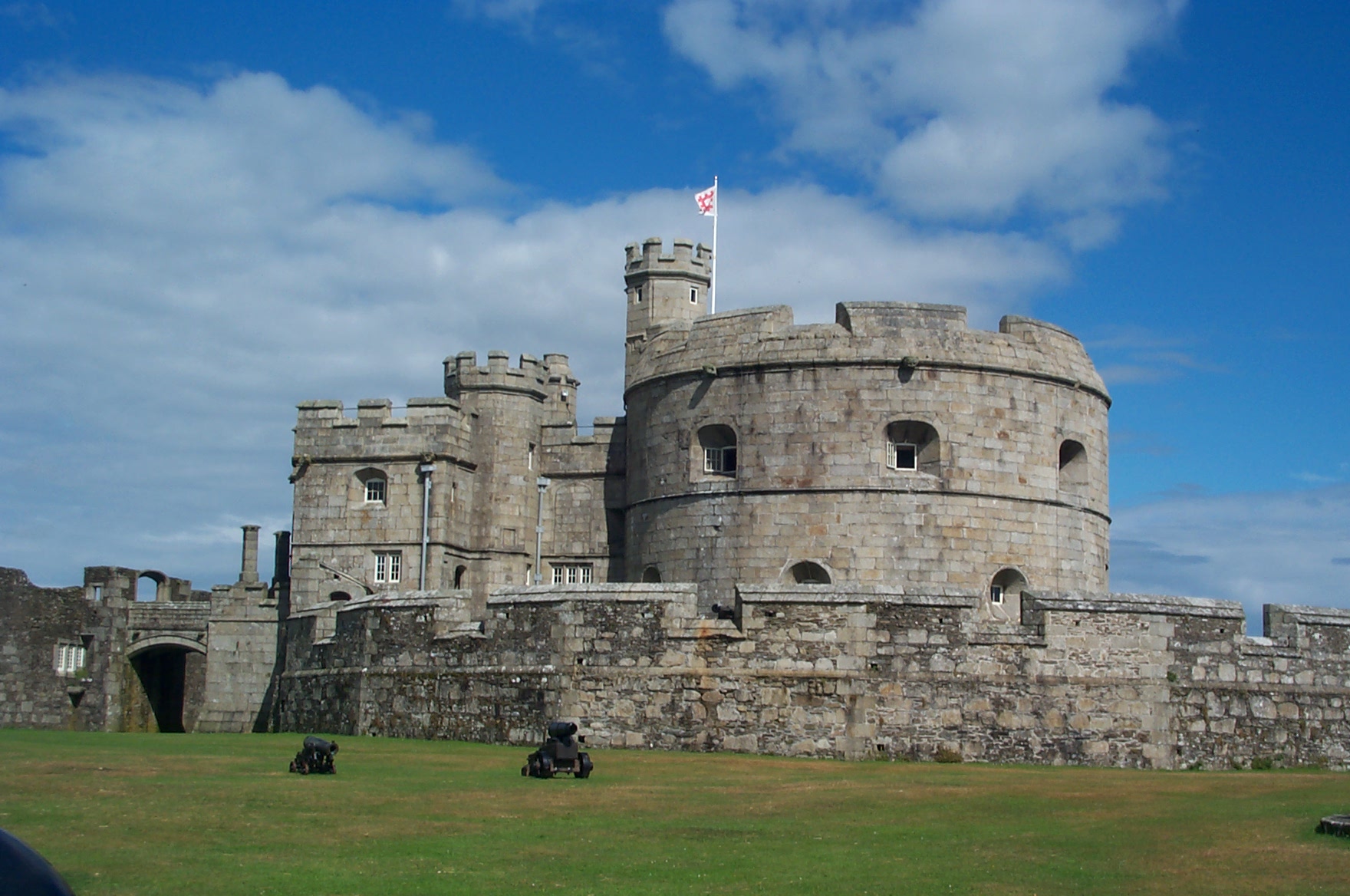
The larger sites, such as Deal or Camber, were typically squat, with low parapets and massively thick walls to protect against incoming fire.[66] They usually had a central keep, echoing earlier medieval designs, with curved, concentric bastions spreading out from the centre.[67] The main guns were positioned over multiple tiers to enable them to engage targets at different ranges. There were far more gunports than there were guns held by the individual fortification.[68] The bastion walls were pierced with splayed gun embrasures, giving the artillery space to traverse and enabling easy fire control, with overlapping angles of fire.[69] The interiors had sufficient space for gunnery operations, with specially designed vents to remove the black powder smoke generated by the guns.[70] Moats often surrounded the sites, to protect against any attack from land, and they were further protected by what the historian Beric Morley describes as the "defensive paraphernalia developed in the Middle Ages": portcullises, murder holes and reinforced doors.[71] The smaller blockhouses took various forms, including D-shapes, octagonal and square designs.[72] The Thames blockhouses were typically protected on either side by additional earthworks and guns.[73]

These new fortifications were the most advanced in England at the time, an improvement over earlier medieval designs, and were effective in terms of concentrating firepower on enemy ships.[74] They contained numerous flaws, however, and were primitive in comparison to their counterparts in mainland Europe.[75] The multiple tiers of guns gave the forts a relatively high profile, exposing them to enemy attack, and the curved surfaces of the hollow bastions were vulnerable to artillery.[76] The concentric bastion design prevented overlapping fields of fire in the event of an attack from the land, and the tiers of guns meant that, as an enemy approached, the number of guns the fort could bring to bear diminished.[77]

Some of these issues were addressed during the second Device programme from 1544 onwards. Italian ideas began to be brought in, although the impact of Henry's foreign engineers seems to have been limited, and the designs themselves lagged behind those used in his French territories.[78] The emerging continental approach used angled, "arrow-head" bastions, linked in a line called a trace italienne, to provide supporting fire against any attacker.[79] Sandown Castle on the Isle of Wight, constructed in 1545, was a hybrid of traditional English and continental ideas, with angular bastions combined with a circular bastion overlooking the sea.[80] Southsea Castle and Sharpenode Fort had similar, angular bastions.[81] Yarmouth Castle, finished by 1547, was the first fortification in England to adopt the new arrow-headed bastion design, which had further advantages over a simple angular bastion.[82] Not all the forts in the second wave of work embraced the Italian approach however, and some, such as Brownsea Castle, retained the existing, updated architectural style.[80]

Logistics

[edit]
Calshot Castle in 2012 (left) and in a 1539 plan (right); the castle reused materials from the dissolution of nearby Beaulieu Abbey

The costs of building the fortifications varied with their size.[83] A small blockhouse cost around £500 to build, whereas a medium-sized castle, such as Sandgate, Pendennis or Portland, would come to approximately £5,000.[83] The defensive line of Deal, Sandown and Walmer castles cost a total £27,092, while the work at Hull Castle and its two blockhouses came to £21,056.[84][b] Various officials were appointed to run each of the projects, including a paymaster, a comptroller, an overseer and commissioners from the local gentry.[85] A few fortifications were built by local individuals and families; St Catherine's Castle, for example, was reportedly paid for by the town and local gentry, and the Edgcumbe family built Devil's Point Artillery Tower to protect Plymouth Harbour.[86]

Much of the expenditure was on the construction teams, called "crews", who built the forts.[50] The numbers of workers varied during the course of the project, driven in part by seasonal variation, but the teams were substantial: Sandgate Castle, for example, saw an average of 640 men on the site daily during June 1540, and the work at Hull required a team of 420.[87] A skilled worker was paid between 7 and 8 pence a day, a labourer between 5 and 6 pence, with trades including stonemasons, carpenters, carters, lime burners, sawyers, plumbers, scavelmen, dikers and bricklayers.[88][d] Finding enough workers proved difficult, and in some cases men had to be pressed into service unwillingly.[89] Labour disputes broke out, with strikes over low pay at Deal in 1539 and at Guisnes in 1541; both were quickly suppressed by royal officials.[90]

Large amounts of raw materials were also needed for the work, including stone, timber and lead and many other supplies. Camber, for example, probably required over 500,000 bricks, Sandgate needed 44,000 tiles, while constructing a small blockhouse along the Thames was estimated by contemporaries to require 200 tonnes (200 long tons; 220 short tons) of chalk just to enable the manufacture of the lime mortar.[91] Some materials could be sourced locally, but coal was shipped from the north of England and prefabricated items were brought in from London.[92]

Most of the money for the first phase of Device works came from Henry's dissolution of the monasteries a few years before, and the revenues that flowed in from the Court of Augmentations and First Fruits and Tenths as a result.[93] In addition, the dissolution had released ample supplies of building materials as the monastic buildings were pulled down, and much of this was recycled.[94] Netley Castle, for example, was based on an old abbey and reused many of its stones, East Tilbury Blockhouse reused parts of St Margaret's Chantry, Calshot Castle took the lead from nearby Beaulieu Abbey, East and West Cowes castles stone from Beaulieu and Quarr, and Sandwich had the stone from the local Carmelite friary.[95] Milton Blockhouse was constructed on land that had recently been confiscated from Milton Chantry.[96] By the second phase of the programme, however, most of the money from the dissolution had been spent, and Henry instead had to borrow funds; government officials noted that at least £100,000 was needed for the work.[39][b]

Garrisons

[edit]
Reconstruction of life amongst the 16th-century garrison at St Mawes Castle

The garrisons of the Device Forts comprised relatively small teams of men who typically lived and worked in the fortifications.[97] The garrisons would maintain and care for the buildings and their artillery during the long periods of peacetime and, in a crisis, would be supplemented by additional soldiers and the local militia.[97] The size of the garrisons varied according to the fortification; Camber Castle had a garrison of 29, Walmer Castle 18, while the West Tilbury Blockhouse only held 9 men.[98] The ordinary soldiers would have lived in relatively basic conditions, typically on the ground floor, with the captains of the fortifications occupying more elaborate quarters, often in the upper levels of the keeps.[99] The soldiers ate meat and fish, some of which might have been hunted or caught by the garrison.[100]

The garrisons were well organised, and a strict code of discipline was issued in 1539; the historian Peter Harrington suggests that life in the forts would have usually been "tedious" and "isolated".[101] Soldiers were expected to provide handguns at their own expense, and could be fined if they failed to produce them.[102] There were only around 200 gunners across England during the 1540s; they were important military specialists, and the historians Audrey Howes and Martin Foreman observe that "an air of mystery and danger" surrounded them.[103]

The rates of pay across the defences were recorded in 1540, showing that the typical pay of the garrisons was 1 or 2 shillings a day for a captain; his deputy, 8 pence; porters, 8 pence; with soldiers and gunners receiving 6 pence each.[104][b] In total, 2,220 men were recorded as receiving pay that year, at a cost to the Crown of £2,208.[105] Although most garrisons were paid for by the Crown, in some cases the local community also had a role; at Brownsea, the local town was responsible for providing a garrison of 6 men, and at Sandsfoot the village took up the responsibility for supporting the castle garrison, in exchange for an exemption from paying taxes and carrying out militia service.[106]

Armament

[edit]
Reconstruction of a 16th-century cannon and gun crew at Pendennis Castle

The artillery guns in the Device forts were the property of the Crown and were centrally managed by the authorities in the Tower of London.[105] The Tower moved them between the various fortifications as they felt necessary, often resulting in complaints from the local captains.[105] Various surviving records record the armaments held by individual forts on particular dates, and between 1547 and 1548 a complete inventory was made of the Crown's possessions, detailing the weapons held by all of the forts.[107] The number of guns varied considerably from site to site; in the late 1540s, heavily armed forts such as Hurst and Calshot held 26 and 36 guns respectively; Portland, however, had only 11 pieces.[108] Some forts had more guns than the level of their regular, peacetime garrison; for example, despite only having an establishment of 13 men, Milton Blockhouse had 30 artillery pieces.[109]

A variety of artillery guns were deployed, including heavier weapons, such as cannons, culverins and demi-cannons, and smaller pieces such as sakers, minions and falcons.[110] Some older guns, for example slings and bases, were also deployed, but were less effective than newer weapons such as the culverin.[110] With sites equipped with several tiers of weapons, the heaviest guns would typically be placed higher up in the fortification, with the smaller weapons closer to the ground.[70] It is uncertain how far the guns of the period would have reached; analysis carried out in the 16th and 17th century on the ranges of artillery suggested that the largest weapons, such as a culverin, could hit a target up to between 1,600 and 2,743 metres (5,249–8,999 ft) away.[111]

The forts were typically equipped with a mixture of brass and iron artillery guns.[112] Guns made of brass could fire more quickly—up to eight times an hour—and were safer to use than their iron equivalents, but were expensive and required imported copper (tin could be sourced from Cornwall and Devon).[113] In the 1530s Henry had established a new English gun-making industry in the Weald of Kent and London, staffed by specialists from mainland Europe.[114] This could make cast-iron weapons, but probably initially lacked the capacity to supply all of the artillery required for the Device forts, particularly since Henry also required more guns for his new navy.[115] A technical breakthrough in 1543, however, led to the introduction of vertical casting and a massive increase in Henry's ability to manufacture iron cannons.[116] Few guns from this period have survived, but during excavations in 1997 an iron portpiece was discovered on the site of the South Blockhouse in Kingston on Hull.[117] The weapon, now known as "Henry's Gun", is one of only four such guns in the world to have survived and is displayed at the Hull and East Riding Museum.[117]

In addition to artillery, the Device Forts were equipped with infantry weapons.[107] Handguns, typically an early form of matchlock arquebus, would have been used for close defence; these were 6-foot (1.8 m) long and supported on tripods.[107] Many forts also held supplies of bows, arrows and polearms, such as bills, pikes and halberds.[118] Longbows were still in military use among English armies in the 1540s, although they later declined quickly in popularity, and these, along with the polearms, would have been used by the local militia when they were called out in a crisis.[119]

Later history

[edit]

16th century

[edit]
Walmer Castle in 2011 (left) and a 1539 plan for either Walmer or Sandown Castle (right)[120]

After Henry's death there was a pause in the conflict with France, during which many of the new fortifications were allowed to deteriorate.[121] There was little money available for repairs and the garrisons were reduced in size.[122] East Cowes was abandoned around 1547 and fell into ruin, while the bulwarks along the Downs were defaced and their guns removed; they were formally removed from service in 1550.[123] In 1552 the Essex fortifications were decommissioned, and several were subsequently pulled down.[124] The expense of maintaining the fortifications in Hull led the Crown to agree a deal with the town authorities to take over management of them.[125] Milton and Higham were demolished between 1557 and 1558.[126] Mersea Fort was temporarily decommissioned, before being brought back into active service.[124]

The strategic importance of south-east England declined after peace was declared with France in 1558.[127] Military attention instead shifted towards the Spanish threat to the increasingly prosperous south-west of the country; tensions grew and war finally broke out in 1569.[127] The new threat led to improvements being made to Pendennis and St Mawes castles in Cornwall, and repairs to Calshot, Camber and Portland along the south coast.[128] In 1588 the Spanish Armada sailed for England and the Device Forts were mobilised in response.[129] As part of this work, West Tilbury was brought back into service and supported by a hastily raised army, which was visited by Queen Elizabeth I, and further enlargement followed under the direction of the Italian engineer, Federigo Giambelli.[130] Gravesend was improved and several of the Essex fortifications were temporarily brought back into use; there were discussions about enhancing the defences at Hull and Milford Haven, but no work was actually carried out.[131]

Despite the destruction of the Armada, the Spanish threat continued;[132] the castles in Kent were kept ready for action throughout the rest of Elizabeth's reign.[133] In 1596 a Spanish invasion fleet reportedly carrying 20,000 soldiers set out for Pendennis, which was then garrisoned with only 500 men.[134] The fleet was forced to turn back due to bad weather, but Elizabeth reviewed the defences and significantly expanded Henry's original fortifications with more up-to-date bastions, designed by the engineer Paul Ive.[135] By the end of the century, however, most of the Device Forts were typically out of date by European standards.[136]

17th century

[edit]

James I came to the English throne in 1603, resulting peace with both France and Spain.[137] His government took little interest in the coastal defences and many of the Device Forts were neglected and fell into disrepair, with their garrisons' wages left unpaid.[138] Castles such as Deal and blockhouses like Gravesend were all assessed as needing extensive repairs, with Sandgate reported to be in such a poor condition that it was "neither habitable or defensible against any assault, nor any way fit to command the roads".[139] Lacking ammunition and powder, and with only a handful of its guns in adequate repair, Hurst was unable to prevent Flemish ships from passing along the Solent.[140] Pendennis's garrison's pay was two years in arrears, reportedly forcing them to gather limpets from the shoreline for food.[141] Some of the forts fell out of use; Camber Castle, whose original function of protecting the local anchorage had by now been made redundant by the changing shoreline, was decommissioned by King Charles I in 1637, while Sharpenrode Bulwark lay in ruins by the 1620s.[142]

First English Civil War

[edit]
Sketch of the Gravesend Blockhouse, by Cornelis Bol, mid-17th century

Civil war broke out across England in 1642 between the supporters of King Charles I and Parliament. Fortifications and artillery played an important role in the conflict, and most of the Device Forts saw service.[143] The south and east of England were soon largely controlled by Parliament.[144] The blockhouses at Gravesend and Tilbury were garrisoned by Parliament and used to control access to London.[145] The castles along the Sussex and Kentish coastline were seized by Parliament in the opening phase of the war, Camber Castle then being decommissioned to prevent it being used by the enemy, the remainder continuing to be garrisoned.[146] The royal fleet, which had been positioned in the Downs anchorage, sided with Parliament.[147]

The Device Forts along the Solent also fell into Parliamentary hands early in the conflict. Calshot was garrisoned throughout, as was Brownsea, which was strengthened and equipped with additional guns.[148] West Cowes was rapidly taken after firing on a nearby Parliamentary ship, and the Royalist commander at Yarmouth quickly negotiated a surrender of his tiny garrison.[149] The heavily outnumbered garrison at Southsea Castle was stormed by Parliamentary forces in a night attack.[150] Like Camber, St Andrew's and Netley were rapidly occupied and then decommissioned by Parliament.[151] In the north-east, Hull also sided with Parliament, and its castle and blockhouses were used as part of the town's defences during multiple sieges.[152]

Much of the south-west sided with the King; Device Forts such as St Catherine's were held by the Royalists from the beginning of the conflict.[153] The Royalists invaded Parliamentary-controlled Dorset in 1643, taking Portland and Sandsfoot.[154] The flow of the war turned against the King, and the Dorset forts were besieged in 1644 and 1645, with Sandsfoot falling to Parliament.[155] By March 1646, Thomas Fairfax had entered Cornwall with a substantial army.[156] The captain of the castle was invited to retreat to the stronger fortress of Pendennis, but he surrendered immediately without putting up resistance.[157] Pendennis was bombarded from the land and blockaded by a flotilla of ships.[158] The captain, Sir John Arundell, agreed to an honourable surrender on 15 August, and around 900 survivors left the fort, some terminally ill from malnutrition.[159] Pendennis was the penultimate Royalist fortification to hold out in the war, followed by Portland Castle which finally surrendered in April 1646.[160]

Second English Civil War

[edit]
Little Dennis Blockhouse in 2008

After a few years of unsteady peace, in 1648 the Second English Civil War broke out, this time with Charles' Royalist supporters joined by Scottish forces. The Parliamentary navy was based in the Downs, protected by the nearby Henrician castles, but by May a Royalist insurrection was underway across Kent.[161] Sandown Castle declared for the King, and the soldier and former naval captain Major Keme then convinced the garrisons at Deal and Walmer to surrender.[162] Sandgate Castle probably joined the Royalists as well.[163] With both the coastal fortresses and the navy now under Royalist control, Parliament feared that foreign forces might be landed along the coast, or military aid sent to the Scots.[164]

Essex also rose in rebellion in June and the town of Colchester was taken by the Royalists.[165] Sir Thomas Fairfax placed it under siege, and Mersea Fort was taken by Parliamentary forces and used to cut off any assistance reaching the town by river.[165] Meanwhile, Parliament defeated the Kentish insurgency at the Battle of Maidstone at the start of June and then sent a force under the command of Colonel Rich to deal with the castles of the Downs.[166]

Walmer Castle was the first to be besieged and surrendered on 12 July.[167] An earthwork fort was then built between Sandown and Deal, who each may have been defended by around 150 men each.[167] Deal, which had been resupplied by the Royalists from the sea, was besieged in July.[168] A Royalist fleet bombarded the Parliamentary positions and temporarily landed a force of 1,500 Flemish mercenaries in support of the revolt, but a shortage of money forced their return to the Continent.[169] The fleet, under the command of Prince Charles, attempted to landed a fresh force in August, but despite three attempts the operation failed and suffered heavy losses.[170] Deal surrendered on 25 August, followed by Sandown on 5 September.[171]

Interregnum and the Restoration

[edit]
The South Blockhouse (centre) and Castle (right) at Hull, viewed from the sea, by Wenceslas Hollar, mid-17th century

Unlike many castles, the Device Forts avoided being slighted – deliberately damaged or destroyed – by Parliament during the years of the Interregnum.[172] Many of the forts remained garrisoned with substantial numbers of men due to fears of a Royalist invasion, overseen by newly appointed governors; Netley was brought back into service due to the threat.[173] Many were used to hold prisoners of war or political detainees, including Hull, Mersea, Portland, Southsea and West Cowes.[174] During the First Anglo-Dutch War between 1652 and 1654, castles such as Deal were reinforced with earthworks and soldiers.[175] Portland saw action during a three-day long naval battle between English and Dutch forces in the Portland Roads.[176] Some sites fell out of use: Little Dennis Blockhouse – part of the complex of defences at Pendennis – and Mersea were decommissioned between 1654 and 1655, and Brownsea Castle was sold off into private hands.[177]

Charles II was restored to the throne in 1660 and reduced both the size and the wages of the garrisons across the kingdom.[178] The Device Forts initially remained at the heart of the defences along the south coast, but their design was by now badly antiquated.[179] Deal continued to play an important role in defending the Downs during the Second and Third Dutch Wars, supported by local trained bands, and castles such as Hurst, Portland and Sandgate remained garrisoned.[180] Others, however, were decommissioned with Sandsfoot closing in 1665 following a dispute over the control of the defences, and Netley being abandoned to fall into ruin.[181]

Concerns about the Dutch threat were intensified after an unexpected naval raid along the Thames in 1667, during which Gravesend and Tilbury prevented the attack reaching the capital itself.[182] In response, Charles made extensive improvements to his coastal defences.[183] As part of this investments were made to Pendennis, Southsea and Yarmouth, while Tilbury was hugely expanded with an updated system of ramparts, bastions and moats at considerable cost.[184] In the final phases of Charles's work, the castle and southern blockhouse at Hull were incorporated into a massive new fortification called the Citadel during the 1680s.[185]

Some of the Device Forts played a role in the Glorious Revolution of 1688 against Charles' brother, King James II. The townsfolk of Deal seized their local castle in support of William of Orange, and took steps to defend the Downs against a feared Irish invasion which never materialised.[186] Southsea Castle was held by the King's illegitimate son, James FitzJames, the Duke of Berwick, who was pressurised into surrendering as his father's cause collapsed.[187] Yarmouth was controlled by Robert Holmes, a supporter of James, but was prevented from actively supporting the loyalist cause by the local inhabitants and his garrison, who sided with William.[188]

18th–19th centuries

[edit]

1700–1791

[edit]
St Mawes Castle (centre) and Pendennis (left) depicted by J. M. W. Turner in 1823

The military significance of the Device Forts declined during the 18th century.[172] Some of the fortifications were redesigned to provide more comfortable housing for their occupants. Cowes Castle was partially rebuilt in 1716 to modernise its accommodation, demolishing much of the keep and adding residential wings and gardens over the landward defences, and Brownsea Castle began to be converted into a country house from the 1720s onwards.[189] Walmer became the official residence of the Lord Warden of the Cinque Ports, and Lionel Sackville, the Duke of Dorset, carried out extensive work there after 1708.[190] There was probably some rivalry between Sackville and the naval officer Sir John Norris, who redeveloped nearby Deal Castle during the same period, creating comfortable wood-panelled quarters for himself there overlooking the sea.[190]

Criticisms were levelled at the defences of the Device Forts, which often had minimal garrisons and had been left to fall into disrepair.[172] Southsea Castle, for example, was only garrisoned by "an old sergeant and three or four men who sell cakes and ale" according to one contemporary account, and proposals were put forward to abandon the site altogether.[191] Portland suffered badly from coastal erosion and, protected only by a caretaker garrison, was reportedly not repaired for many years, and a 1714 survey found the long-neglected Pendennis Castle to be "in a very ruinous condition".[192] The French military dismissed Deal, Walmer and Sandown as being highly vulnerable to any potential attack, describing them in 1767 as "very old and little more than gun platforms".[193] Mersea Fort and East Tilbury fell into ruin and were abandoned, the latter being submerged by the Thames.[194] Some limited investments were made in the fortifications, however, with the defences of Pendennis Castle being modernised in the 1730s, and those of Calshot in the 1770s.[195]

1792–1849

[edit]
The Duke of Wellington's room in Walmer Castle; the Duke was captain there between 1829 and 1852

The Revolutionary and Napoleonic Wars at the turn of the 18th and 19th centuries led to some of the castles being re-garrisoned and improved, as part of the development of a range of gun batteries around key locations.[196] Some of the fortifications such as Sandgate, Southsea, Hurst and Pendennis, protected strategic locations and these were extensively modernised.[197] Hurst, for example, was redesigned with batteries of heavier 36-pounder (16 kg) weapons, and Pendennis was equipped with up to 48 guns.[198] Sandgate's keep was rebuilt to form a Martello tower as part of a wider programme of work along the south coast.[199] New gun batteries were constructed at Deal, Sandown in Kent and Tilbury, while Fort Mersea was brought back into service complete with a new battery as well.[200] Calshot Castle was renovated, and Southsea's defences were extensively modernised, as were those in Hull, with the castle and the south blockhouse being refitted.[201]

Some of the Device Forts worked in conjunction with the volunteer units raised during the wars to counter the threat of a French invasion.[202] Walmer Castle was used by its captain William Pitt the Younger – then both prime minister and Lord Warden of the Cinque Ports – as the base for volunteer cavalry unit and a fleet of 35 armed fishing boats called luggers.[203] Nearby Deal also had units of infantry and cavalry, called fencibles and in 1802 units of bombardiers recruited by Pitt carried out military exercises at the castle.[204] Calshot was used to store munitions for nearby Sea Fencibles.[205] Pendennis held a new volunteer artillery unit, which was used to train other garrisons across Cornwall.[206]

The government coastguard used some of the fortifications as bases to combat smuggling.[207] Calshot was a good location for interception vessels to lie in wait and, by the middle of the century, two officers and forty-two men were stationed there; Sandown Castle in Kent was also used by the coastguard for anti-smuggling operations.[208] In the coming decades some forts were declared obsolete and put to new uses; Portland was disarmed after the war and converted into a private house.[209] Gravesend was superseded by the New Tavern Fort and demolished in 1844.[210] Meanwhile, the ruins of Netley Castle were transformed into a Gothic-styled house from 1826 onwards.[211]

1850–1899

[edit]
Hurst Castle seen from the east, showing the 16th-century defences (centre) flanked by extensive mid-19th century additions

From the mid-19th century onwards, changes in military technology repeatedly challenged the value and composition of Britain's coastal defences. The introduction of shell guns and steam ships created a new risk that the French might successfully attack along the south coast, and fears grew of a conflict in the early 1850s.[212][e] Southsea Castle and St Mawes were extended with new gun batteries, Pendennis was re-equipped with heavier guns, and Hurst was extensively redeveloped.[214] There were discussions about rearming Calshot, but these were rejected, in part due to concerns about the suitability of the 16th-century walls in modern warfare.[215][f] The Crimean War sparked a fresh invasion scare and in 1855 the south coast of England was refortified.[216] New guns were installed at St Catherine's and Yarmouth in 1855.[217] The remains of the West Blockhouse were destroyed by a new fortification, the West Blockhouse Fort, designed to deal with the French threat.[218]

Fresh worries about France, combined with the development of rifled cannon and iron-clad warships, led to the Royal Commission on the Defence of the United Kingdom being established in 1859, and expressing fears about the security of the south coast.[219] In response, Sandgate was re-equipped with heavier guns in 1859, and extensive work was carried out on Southsea.[220] Hurst was fitted with two huge batteries of heavy rifled breech-loading guns, protected by iron armour plate, intended for use against fast-moving enemy warships.[221] Tilbury Blockhouse was demolished to make way for heavier guns at the fort after 1868.[222] Portland was readopted by the army as a garrison base in 1869 in response to fears of an invasion, but it was not rearmed.[223]

A fresh wave of concerns about France followed in the 1880s, accompanied by the introduction of still more powerful naval artillery and fast warships and torpedo boats, resulting in a fresh wave of modernisation.[224] An electronically operated minefield was laid across Carrick Roads in 1885, jointly controlled from St Mawes and Pendennis.[225] New, quick-firing guns were installed at Hurst to enable the castle to engage the newer vessels.[226] Calshot was brought back into service as a coastal fort, with a new battery of quick-firing guns protecting a boom across the estuary.[227] The original 16th-century parts of fortifications such as Southsea and Calshot were too small and unsuitable for modern weapons, however, and were instead used for mounting searchlights, range and direction finding; in some cases their fabric was left to slowly decline.[228]

Some other sites were no longer considered viable at all. West Cowes was decommissioned in 1854 and became the club house of the Royal Yacht Squadron.[229] Sandown Castle in Kent, suffering badly from coastal erosion, began to be demolished from 1863 onwards; Hull Citadel and its 16th-century fortifications were demolished in 1864 to make way for docks; Yarmouth was decommissioned in 1885, becoming a coastguard signalling station; and Sandgate, also suffering from coastal erosion, was sold off to the South Eastern Railway company in 1888.[230]

20th–21st centuries

[edit]

1900–1945

[edit]
6-inch (152 mm) Mark 24 gun in the Half Moon Battery at Pendennis Castle, dating from the Second World War

By the start of the 20th century, developments in guns and armour had made most of the Device Forts that remained in service too small to be useful. Modern weapons systems and their supporting logistics facilities such as munitions stores could not fit within the 16th-century designs.[231] A 1905 review of the Falmouth defences concluded that the naval artillery at St Mawes had become superfluous, as the necessary guns could be mounted at a combination of Pendennis and newer sites along the coast, and the castle was disarmed.[232] A review in 1913 concluded that keeping naval artillery at Calshot was also unnecessary, and the site was turned into an experimental seaplane station instead.[233]

Meanwhile, concerns had been growing about the unsympathetic treatment of historic military buildings by the War Office; for its part, the War Office was concerned that it might find itself financially supporting these properties from its own budget.[234] Yarmouth Castle was passed to the Commissioners of Woods and Forests in 1901, with parts of it being leased to the neighbouring hotel.[235] The War Office concluded that Walmer and Deal had no remaining military value and agreed to transfer the castles to the Office of Works in 1904, who opened both former fortifications to visitors.[236] Portland Castle was placed onto what was known as the Schedule C list, which meant that the Army would continue to use and manage the historic property, but would receive advice on the suitability of repairs from the Office of Works.[237]

With the outbreak of the First World War, naval operations were mainly focused along the south-east and southern coasts.[238] The defences of Pendennis were reinforced, while Southsea, with the addition of anti-Zeppelin guns, formed part of the Fortress Portsmouth plan for defending the Solent.[239] Calshot formed a base for anti-submarine warfare, and the remaining castles of the Downs were used to support the activities of the Dover Patrol.[240] St Mawes and Portland were used as barracks, and Walmer became a weekend retreat for the Prime Minister, Asquith, exploiting its good communication links with the front line in France.[241]

During the Second World War, Britain's coastal defences depended on extensive barriers constructed along the shores, combined with large numbers of small defensive artillery positions supported by air cover.[242] Several of the Device Forts were brought back into service in this way. Pendennis, St Catherine's, St Mawes and Walmer were equipped with naval gun batteries, Calshot and Hurst were rearmed with naval guns and anti-aircraft defences, and Sandsfoot was used as an anti-aircraft battery.[243] Southsea continued in service, and was involved in Operation Grasp, which seized the French fleet in 1940.[244] Others were used as support facilities; Yarmouth was requisitioned for military use; Portland was used for accommodation, offices and as an ordnance store, and West Cowes used as a naval headquarters for part of the D-Day landings.[245] Camber was used as an early warning and decoy site to distract raids from nearby Rye.[246] Early in the war a German bomber destroyed much of the captain's quarters at Deal, forcing William Birdwood to move to Hampton Court Palace.[247] The Prime Minister, Winston Churchill, was appointed as the captain of Walmer Castle during the war, but declined to use it as a residence, noting that it was too expensive for him to maintain, and that it lay within the range of German artillery.[248]

1946 – 21st century

[edit]
Sandgate Castle, damaged by coastal erosion and converted into a private house during the 1970s

After the war, coastal defences became increasingly irrelevant as nuclear weapons came to dominate the battlefield.[249] The remaining Device Forts still in military use were initially garrisoned with reservist units and then closed as military establishments.[250] St Catherine's and Portland were decommissioned in the late 1940s, Hurst, Pendennis and Yarmouth in the 1950s, Southsea in 1960 and, after, the closure of its air base, Calshot followed in 1961.[251]

Widespread restoration work was then carried out; at Calshot, Deal, Hurst, Pendennis, Portland, St Catherine's and Southsea, the more modern additions to the fortifications were destroyed in an attempt to recreate the appearance of the castles at earlier periods of their history, ranging from the 16th to the 19th centuries.[252] There was extensive research into the forts during this period, commencing in 1951 with a long-running research project commissioned by the Ministry of Works into the Device Forts, which in turn led to heightened academic interest in their histories during the 1980s.[253]

A range of the fortifications were opened to the public in the post-war years.[254] Deal, Hurst, Pendennis and Portland opened in the 1950s, and Southsea in 1967.[255] Calshot followed in the 1980s, Camber after a long period of restoration work in 1994, and Sandsfoot reopened following repair work in 2012.[256] Visitor numbers vary across the sites; Southsea Castle, for example, received over 90,000 visitors in 2011–12.[257] Other forts were put to different uses: Netley was first used a nursing home, and then converted into private flats; Brownsea became a corporate hotel for the employees of the John Lewis Partnership; and Sandgate was restored in the 1970s to form a private home.[258]

By the 21st century many of the Device Forts had been damaged by, or in some cases lost entirely, to coastal erosion; the problem had existed at some locations since the 16th century and still persists, for example at Hurst.[259] East Cowes Castle and East Tilbury Fort have been entirely lost, while the East Blockhouse, Mersea and Sandsfoot have been badly damaged, a third of Sandgate and most of St Andrews have been washed away.[260] Other sites were demolished, built upon or simply eroded over time; almost no trace remains of the bulwarks along the Downs, for example.[261] The remaining sites are protected by UK conservation law, either as scheduled monuments or listed buildings.[262]

See also

[edit]

Notes

[edit]

References

[edit]

Bibliography

[edit]
Revisions and contributorsEdit on WikipediaRead on Wikipedia
from Grokipedia
The Device Forts, also known as Henrician castles and blockhouses, comprised a chain of over 30 coastal artillery fortifications erected by King of primarily between 1539 and 1547 to safeguard vulnerable coastal regions against potential invasions by Catholic powers such as and the . These structures formed part of a broader "device programme" of national defense measures initiated amid heightened tensions following Henry's schism with and the excommunication that rendered a target for continental aggression. Concentrated along the south and east coasts from to , the forts targeted key ports, anchorages, and landing sites, with notable examples including Deal and Walmer Castles in —the former Tudor rose-shaped with a central keep and curved bastions— and St Mawes Castles in guarding Falmouth Harbour, and Yarmouth Castle on of . Construction emphasized low-profile, symmetrical designs optimized for gunpowder artillery, featuring thick walls, gun batteries, and bastion-like platforms to maximize defensive firepower while minimizing vulnerability to siege engines. Funded through a combination of royal revenues and local contributions, the project reflected pragmatic resource allocation under fiscal strain, yielding cost-effective bulwarks that deterred immediate threats without the expense of medieval-style castles. Though few saw combat during Henry's reign, the Device Forts exemplified an early shift toward purpose-built defenses, influencing subsequent Tudor and Stuart fortifications and enduring as symbols of strategic adaptation to emerging naval warfare dynamics. Several, like , later withstood sieges in the , underscoring their robust engineering despite initial criticisms of overexpenditure.

Historical Context and Strategic Necessity

Geopolitical Threats Facing Tudor England

Tudor England under Henry VIII confronted acute geopolitical vulnerabilities in the late 1530s, primarily from France and the Holy Roman Empire (encompassing Spanish territories), exacerbated by the kingdom's schism with the Roman Catholic Church. The Act of Supremacy in 1534, affirming Henry's headship over the Church of England, culminated in his excommunication by Pope Paul III on 17 December 1538, isolating England diplomatically and inviting potential crusades from Catholic powers. This religious rupture transformed longstanding continental rivalries into existential threats, as France under Francis I and the Habsburg domains under Charles V viewed the Protestant-leaning regime as heretical and ripe for intervention. The Truce of Nice in June 1538, reconciling Francis I and Charles V after their Italian War, heightened invasion alarms by freeing these powers from mutual conflict and enabling coordinated action against . Intelligence reports indicated French naval mobilizations, including preparations for a fleet capable of transporting 30,000 troops, while Spanish forces were rumored to support amphibious assaults on southern ports. These fears prompted Henry to initiate emergency coastal defenses in 1539, focusing on forts to deter landings along exposed southeastern and waterways, where pre-existing medieval structures proved inadequate against gunpowder-era shipping. Northern threats from , allied to France via the , compounded maritime risks but were secondary to direct Channel crossings by French or combined fleets; Scottish incursions typically involved land raids rather than large-scale naval invasions. By mid-1539, Henry's "Great Armament" mobilized over 30,000 men and bolstered the navy, yet the perceived imminence of attack—averted only by renewed Franco-Imperial tensions—underscored England's strategic isolation, with over £376,000 expended on fortifications by 1547 to safeguard key harbors like and Dover.

Pre-Existing Coastal Defenses and Their Limitations

Prior to the initiation of the Device Forts programme in 1539, England's coastal defenses primarily consisted of medieval castles, walled towns, and rudimentary blockhouses inherited from Norman and earlier periods. These structures, often adapted from Roman fortifications or built in the 11th to 13th centuries, focused on repelling land-based invasions through high stone walls, keeps, and earthworks rather than systematic naval threats. Key examples included , with its massive Norman keep measuring approximately 98 by 96 feet and walls up to 24 feet thick, constructed under Henry II between 1154 and 1189 to command the Straits of Dover; , an elliptical Roman castrum refortified by the Normans post-1066; and , featuring baileys suited for local defense. Walled ports like Sandwich, protected by earth ramparts, moats, and gates such as the Fisher Gate, supplemented these, while modest blockhouses and towers appeared sporadically in areas like and the south-west, typically small-scale and earthwork-supported. These fortifications emphasized elevated positions for observation and passive resistance, such as cliff-top sites at or riverine placements near Rochester, but lacked integration into a national defensive network. Under Henry VII, limited harbor defenses were erected, including early gun-armed works at , yet investment remained minimal, leaving many structures in disrepair by the early as castles transitioned from military to symbolic roles. The primary limitations of these pre-existing defenses stemmed from their obsolescence against gunpowder artillery, which had proliferated since the late . High masonry walls, effective against medieval siege engines, proved vulnerable to cannon bombardment, as demonstrated by the ineffectiveness of Yarmouth's walls against early gun fire; traditional keeps offered little protection for gunners or platforms for seaward enfilade fire on approaching fleets. Scattered and uncoordinated, they failed to cover vulnerable anchorages and landing sites comprehensively, allowing enemies to bypass them via naval superiority without close engagement. Moreover, without dedicated anti-ship armament or mutual support, they could not deter large-scale invasions by or , whose ships could shell from offshore distances, rendering passive earthworks and towers inadequate for the era's mobile, artillery-equipped threats.

Construction Programme

Initiation Under Henry VIII

In 1538, confronted acute invasion threats after the issued a excommunicating him and inciting Catholic monarchs to depose him, compounded by the Truce of Nice that aligned under Francis I and the under Charles V against . These powers, harboring resentment over Henry's schism from and annexation of monastic lands, posed risks of coordinated naval incursions targeting 's southern and eastern coasts. To counter this, Henry initiated a defensive program leveraging artillery forts, redirecting funds plundered from dissolved monasteries to finance rapid construction between 1538 and 1547. The program commenced formally in 1539 with a royal "device"—a strategic directive for fortifying coastal vulnerabilities against invasion—prioritizing sites exposed to Channel crossings and key harbors. This marked England's first centralized, state-driven coastal defense effort, departing from ad hoc medieval arrangements reliant on local levies and obsolete towers. Initial works focused on , , and Cornish approaches, incorporating low-lying bastions optimized for fire to deter landing forces and shipping. Among the earliest commissions were Calshot Castle (1539–1540) guarding and the Kent trio of Deal, Walmer, and Castles (begun 1539), designed with angular bastions and gun batteries to enfilade approaching vessels. These prototypes emphasized thick walls, central keeps for command, and multi-tiered emplacements, influenced by continental treatises on gunpowder fortifications while adapting to England's fiscal and material constraints. By 1540, the initiative had expanded to include upgrades like Camber Castle and blockhouses along the , establishing a networked deterrent amid ongoing diplomatic tensions.

Phases of Building and Expansion

The construction of the Device Forts unfolded in two main phases between 1539 and 1547, driven by escalating invasion threats from continental powers. The initial phase, from 1539 to 1543, was triggered by the 1538 alliance between France and Spain against England following Henry VIII's break with Rome, necessitating rapid fortification of vulnerable coastal areas. This effort resulted in approximately 30 fortifications, primarily along the southern coastline, including stone castles in Kent such as Deal, Sandown, and Walmer Castles, earthwork forts like the Great Turf Bulwark, and blockhouses at sites including Gravesend and Milton. By 1540, 24 sites had been completed, with the remainder finished by the end of 1543 as the immediate threat subsided. A second phase of expansion began in 1544 amid renewed French aggression after their peace with , focusing reinforcements on the Solent and Dorset regions to counter potential naval incursions. Key additions included , Sandown Castle on the Isle of Wight, the Sharpenrode bulwark, and Yarmouth Castle, incorporating advanced features like angular "arrow-head" bastions inspired by Italian designs. This phase continued until Henry VIII's death in 1547, with the overall program costing around £376,000, largely funded through revenues from the . The forts were distributed across the coasts of , emphasizing strategic anchorages like the Downs, , , Portland Roads, and in . While subsequent monarchs maintained and modified these structures, the core building and expansion occurred during Henry's reign to address the era's geopolitical pressures.

Funding, Logistics, and Socioeconomic Impacts

The construction of the Device Forts required substantial financial outlay, with total royal expenditure estimated at £376,500 between 1539 and 1547. Funding primarily derived from revenues generated by the , initiated in 1536 and continuing through 1541, which provided the crown with seized monastic lands, buildings, and assets repurposed for defense. Later phases of building necessitated borrowing approximately £100,000 to sustain the program amid ongoing fiscal pressures. Individual costs varied by scale: small blockhouses approximated £500, medium-sized forts such as Sandgate or around £5,000, and the cluster of Deal, , and Walmer castles totaled £27,092. Logistical challenges involved coordinating vast quantities of materials and labor across dispersed coastal sites. Stone, timber, lead, bricks, and tiles were sourced locally where possible, with reuse of monastic structures accelerating supply; for instance, over 500,000 bricks were produced for Camber Castle, 44,000 tiles for Sandgate, and 200 tons of chalk for the Thames . Labor forces fluctuated seasonally, peaking at hundreds per site—such as 640 men daily at Sandgate in June 1540 or 420 at Hull—comprising skilled masons paid 7–8 pence per day and unskilled laborers at 5–6 pence, though workers were occasionally pressed into service, leading to strikes at Deal in 1539 and Guisnes in 1541. Oversight fell to royal appointees, with materials like coal shipped from to southern worksites. Socioeconomic effects included localized economic stimulation through employment but also disruptions from coerced labor and resource extraction, straining rural communities already recovering from monastic closures. Some forts received partial funding from nearby towns or , as with St Catherine's Castle, while garrisons were maintained via local taxes or exemptions, fostering dependency on directives. Overall, the program diverted significant resources from other expenditures, contributing to Tudor England's mounting debts without immediate reciprocal benefits to broader agrarian or trade economies.

Architectural and Engineering Innovations

Core Design Principles

The Device Forts, constructed under Henry VIII in the 1530s–1540s, marked the shift to advanced fortifications incorporating gunpowder artillery in England, signifying the end of the medieval era in fortification design. They were built with a primary emphasis on defense against naval incursions, shifting from medieval reliance on high walls and active defense to static positions optimized for weapons that could deliver concentrated fire on approaching ships while minimizing exposure to enemy . This utilitarian approach prioritized functionality over aesthetic or residential elements, positioning forts to guard harbors and anchorages with overlapping fields of fire to deter landings or protect anchored fleets. Central to their design were low, sloped profiles and massively thick walls—often 10 to 15 feet thick at the base—crafted from stone, brick, or faced earthworks to deflect or absorb cannon shot, a stark departure from the tall, thin curtain walls of earlier castles vulnerable to breaching. Gun emplacements featured multiple tiers for varying engagement ranges, with splayed embrasures enabling enfilade fire and traverse across sea approaches, supplemented by vents to clear gunpowder smoke and more ports than mounted guns for tactical flexibility. Rounded turrets or concentric bastions in early examples (built from 1539) facilitated all-around defense, while later iterations from 1545 introduced angular bastions, such as arrow-head projections, drawing on emerging Italianate principles to enhance flanking coverage and counter land assaults. Defensive strategies incorporated mutual support through intervisible positions, moats or tidal positions for natural barriers, and landward features like portcullises, murder holes, and low parapets to repel , ensuring self-sufficiency against combined sea and land threats without depending on field armies. These innovations reflected empirical adaptations to observed tactics, including lessons from continental conflicts, though early designs retained some medieval flaws like exposed bases until refined in subsequent phases.

Key Fort Types and Variations

The Device Forts encompassed a spectrum of designs, from rudimentary blockhouses and artillery towers to elaborate bastioned fortifications, reflecting adaptations to specific coastal vulnerabilities, available resources, and evolving artillery tactics during their construction between 1539 and 1547. Early examples prioritized simplicity and rapid erection, often featuring low-profile structures with thick stone walls to withstand cannon fire, multi-tiered gun emplacements for enfilading fire, and integration with natural barriers like moats or earthworks. These variations arose from the program's phased implementation, with initial builds focusing on Thames and Solent defenses, while later ones incorporated continental influences for enhanced gun coverage. Blockhouses represented the simplest type, typically small and paired for mutual support, as seen in the D-shaped or octagonal structures at , Milton, and erected in 1539–1540 to guard the . These featured basic gun platforms, often two stories high, with embrasures for overlapping fields of fire and surrounding earthworks for additional protection, emphasizing cost-effective defense against riverine incursions rather than standalone fortitude. Artillery towers, prevalent in pre-existing modest coastal setups and expanded in the southwest and , were isolated, circular or angular sentinels with limited garrisons, designed primarily for visual signaling and light armament against opportunistic raids. More advanced bastioned forts, constructed mainly in the 1540s, introduced centralized keeps surrounded by 3 to 6 curved or low bastions providing 360-degree gun platforms, as exemplified by Deal, Walmer, Sandown, Camber, , and Hurst castles. These included innovations like portcullises, murder holes, and tiered gunports for variable elevation, with walls up to 13 feet thick in some cases to resist . A second-phase variation from 1544–1547 adopted Italianate "arrow-head" bastions for better angling against siege artillery, evident at Yarmouth and on the Isle of Wight, blending English concentric traditions with trace italienne principles to counter French invasion threats. Earthwork bulwarks, used at sites like and Brownsea, offered temporary, low-cost alternatives with ramparts for mobile guns, particularly where stone was scarce or urgency demanded speed. Overall, approximately 30 forts were completed by across 24 sites, with further expansions prioritizing strategic anchorages like the Downs.

Armament, Garrisons, and Operational Setup

The Device Forts were equipped with a mix of and iron optimized for anti-ship , including heavy pieces such as cannons, culverins, and demi-cannons, alongside lighter sakers, minions, and falcons; guns allowed for faster firing rates of up to eight rounds per hour compared to iron equivalents. Older bombards like slings and bases were also present in some installations. was centrally managed and distributed from the , with culverins capable of ranges exceeding 1,600 meters. Garrison personnel supplemented these with handheld firearms such as hagbuts, alongside traditional weapons including longbows, bills, pikes, and halberds. Gun inventories varied by fort size and strategic role; examples include 36 guns at Calshot Castle, 26 at , 30 at Milton Blockhouse, and 11 at Portland Castle.
FortNumber of GunsGarrison Size (Men)
Calshot Castle36-
Hurst Castle26-
Milton Blockhouse3013
Portland Castle11-
Camber Castle-29
Walmer Castle-18
West Tilbury-9
Garrisons comprised small permanent detachments of professional soldiers and specialist gunners—totaling around 200 gunners across —who resided within the forts, maintaining armaments, stores, and structures during peacetime. Overall strength across the network reached approximately 2,220 men by 1540, at an annual maintenance cost of £2,208. Pay scales reflected : captains received 1–2 shillings daily, deputies and porters 8 pence, and rank-and-file soldiers or gunners 6 pence, with captains occupying superior quarters while ordinary troops endured basic conditions. Operationally, each fort fell under a captain appointed directly by the Crown or, in regions like the , by figures such as the Lord Warden, who directed military administration, discipline, and readiness. Permanent crews focused on routine upkeep and alert status, with forces expandable via local musters during threats; a 1539 royal code enforced strict discipline, mandating soldiers to furnish their own handguns. This setup prioritized rapid artillery response to naval incursions over large infantry holdings, aligning with the forts' role in denying enemy landings.

Military Role in the 16th Century

Defensive Operations During Henry's Reign

The Device Forts were equipped with permanent garrisons of professional soldiers and gunners, typically numbering a few dozen per site, under captains appointed by , to maintain vigilance and operational readiness along vulnerable coastal stretches. These detachments focused on artillery maintenance, patrol coordination, and signaling via beacons to alert inland forces of approaching threats, supplementing larger mobilizations during heightened alerts. The most notable defensive episode occurred in July 1545 during the , when a French armada of roughly 200–235 ships ferrying up to 30,000 troops assembled off the Isle of Wight with intentions to land and seize . English countermeasures included manning the Solent-area forts, such as guarding , where approximately 20 personnel—including 12 gunners—positioned cannons to threaten incoming vessels, while King Henry VIII observed proceedings from the battlements. Although the French conducted a limited raid on the Isle of Wight, inflicting minor damage before withdrawing, the Device Forts engaged in no or repulse actions, as the invaders avoided amphibious assaults in the face of coverage and concurrent naval clashes that saw the sinking of Henry's flagship . Local defenses, bolstered by reinforcements to existing garrisons, emphasized deterrence through demonstrated firepower potential rather than kinetic confrontation. This standoff validated the forts' strategic emphasis on preventing landings via enfilading gun positions over harbors and beaches, contributing to the French fleet's dispersal without territorial gains. No further invasions materialized before the Treaty of Ardres in 1546 ended hostilities, leaving the Device Forts' operational record during Henry's reign one of sustained preparedness amid unrealized threats.

Maintenance and Challenges After 1547

Following Henry VIII's death in 1547, the Device Forts faced immediate fiscal constraints under , with reduced garrisons and limited funds for upkeep leading to the abandonment of sites such as East Cowes Castle around that year, which subsequently fell into ruin. Maintenance efforts were minimal amid the regime's religious reforms and economic strains, resulting in widespread deterioration from exposure to coastal elements. Under Mary I (1553–1558), renewed invasion threats from prompted sporadic repairs, but resources remained scarce, with forts like sustained only on a shoestring budget. By the early , surveys revealed operational deficiencies, including at Deal where just 17 guns—most unserviceable—remained by 1570, hampering defensive readiness despite preparations against the . Elizabeth I's government allocated funds for essential armaments and garrisons, yet chronic understaffing persisted due to high costs relative to perceived threats post-1588. Persistent environmental challenges exacerbated decay, as salt spray accelerated iron rusting and wood rotting in gun platforms and fittings, while storms and tidal action eroded foundations and walls. At , outer defenses suffered storm damage by 1615, with a survey estimating initial repairs at £396, a figure that escalated to £1,243 by 1634 amid funding delays and material shortages. Similar erosion undermined sites like Sandown Castle in , where coastal undermining required ongoing interventions, though many forts proved vulnerable to long-term battering without comprehensive overhauls. These issues reflected broader tensions between deterrence value and escalating maintenance expenses in an era of evolving naval priorities.

Engagements in Later Conflicts

Participation in the English Civil Wars

During the English Civil Wars (1642–1651), Device Forts served as vital garrisons and defensive outposts, their coastal positions enabling control over ports and deterring naval support for opposing forces, though direct combat was often limited to localized seizures and sieges aligned with regional allegiances. In the First Civil War, secured forts in the south-east, such as the and blockhouses to protect access to , and seized and sites like Camber Castle, which was subsequently decommissioned to deny it to Royalists. In the Solent area, Parliament garrisoned and Brownsea Castles, augmenting Brownsea's armament, while rapidly capturing West Cowes after it fired on a Parliamentary vessel, Yarmouth Castle through swift surrender, and via a nocturnal ; St Andrew's and Netley Castles were occupied and dismantled. remained under Parliamentarian control without facing attack, later briefly imprisoning King Charles I in December 1648 en route to his trial. Royalist forces dominated south-western forts initially: St Catherine's Oratory held firm, while Portland and Sandsfoot Castles were taken in 1643 and besieged during 1644–1645, with Sandsfoot yielding to and Portland capitulating in April 1646 after withstanding assaults. endured a five-month and starting in March 1646 under Sir John Arundell's command, sheltering around 1,000 soldiers and dependents as the final bastion in western ; malnutrition forced surrender on 15 August, with roughly 900 survivors. The Second Civil War saw renewed action in , where , Deal, and Walmer Castles defected to in June 1648 amid the uprising; 's Colonel Nathaniel Rich besieged them, capturing Walmer on 12 July, Deal on 25 August following mortar fire and a repulsed attempt on 15 August, and on 5 September despite Royalist naval and mercenary reinforcements. In , seized Mersea Fort to blockade during its siege. These engagements underscored the forts' enduring defensive capabilities, originally designed for artillery against shipping, now repurposed against land assaults.

Limited Uses in the 17th and 18th Centuries

After the English Civil Wars, most Device Forts saw reduced military activity, with many falling into disrepair or serving primarily as symbolic deterrents rather than active defenses. Surviving royalist strongholds like were retained under Crown control following their surrender in 1646, but systematic slighting was avoided to preserve coastal artillery capabilities against potential naval threats from the and . Garrisons were minimal, often consisting of a captain and a handful of gunners tasked with basic maintenance and occasional drills, reflecting the forts' diminished strategic priority amid shifting continental alliances and the Royal Navy's growing dominance. In the late 17th century, select forts underwent modest updates to counter emerging threats, such as the addition of batteries at to guard against smuggling and minor raids, though no major engagements occurred. Fort, originally a Henrician , was significantly expanded after 1670 into a star-shaped fortress to protect the Thames approaches to , incorporating advanced trace italienne designs that overshadowed the original 16th-century structure. However, the broader network of Device Forts largely transitioned to auxiliary roles, with armaments limited to outdated culverins and sakers, insufficient for confronting modern warships. By the , military utility further waned as advancements and linear theories rendered the low-lying, circular Henrician designs obsolete for warfare. Yarmouth Castle, for instance, maintained a of one master gunner and five subordinates for most of the period, focused on harbor vigilance rather than active combat, with no recorded defensive actions. received 11 guns in 1728 to bolster Downs anchorage defenses, yet its role remained passive amid the absence of invasion attempts. Walmer Castle's defensive function declined early in the century, evolving into the residence of the Lord Warden of the by mid-century, prioritizing administrative over martial duties. Pendennis saw outer battery enhancements and barracks adaptations for infantry, functioning as a training depot until the prompted more substantial Victorian overhauls. Overall, these forts provided localized deterrence and revenue collection from pilots and traders, but their limited armament and isolation precluded significant contributions to Britain's imperial defenses.

Decline, Adaptation, and Modern Preservation

Obsolescence and Repurposing from the

By the mid-19th century, the Device Forts were rendered obsolete by rapid advancements in , including the introduction of shell-firing guns, rifled , steam-powered warships, and ironclad vessels, which exposed the forts' limitations in scale, elevation, and firepower. Their compact designs, optimized for 16th-century smoothbore cannons, proved inadequate against longer-range, more accurate ordnance and faster naval threats that could bypass or overwhelm fixed coastal positions. This obsolescence accelerated the construction of newer fortifications, such as the in the 1860s, while contributing to further degraded sites like Sandown Castle in , which was partially demolished starting in 1863; these developments reflected a broader shift in English defensive strategy, with Henry VIII's Device Forts representing the last major programme of traditional royal castle commissions for military purposes, as subsequent monarchs relied on adaptations of existing sites or new forms such as trace italienne star forts rather than initiating comparable new castle constructions. Decommissioning led to diverse repurposing for non-military functions, often leveraging the forts' strategic coastal locations. Portland Castle, disarmed after the , was converted into a private residence in the early , with renovations by Rev. John Manning beginning around 1825. Similarly, the ruins of Netley Castle were rebuilt as a Gothic-style house from 1826 onward. West Cowes Castle, decommissioned in 1854, became the clubhouse for the Royal Yacht Squadron. Several forts were adapted for coastguard operations to combat smuggling, capitalizing on their vantage points for surveillance and interception. Calshot Castle served as a base for revenue vessels by the mid-19th century, accommodating two officers and 42 men, with munitions storage supporting anti-smuggling patrols. Sandown Castle in similarly housed coastguard personnel for smuggling prevention efforts. Yarmouth Castle, after decommissioning in 1885, functioned as a coastguard signalling station before being leased as a in 1901. Sandgate Castle was sold to the South Eastern Railway in for potential reuse, though it later transitioned to private residential purposes. Where repurposing was impractical, demolitions cleared space for modern infrastructure or defenses. Gravesend Blockhouse was razed in 1844 to accommodate the New Tavern Fort, reflecting the shift to larger gun emplacements. Tilbury Blockhouse faced destruction after 1868 to install heavier artillery, while Hull Citadel was demolished in 1864 to expand dock facilities. These actions underscored the forts' transition from active defense to historical relics by the late .

20th-21st Century Archaeological Insights and Conservation

Archaeological excavations at Camber Castle, conducted primarily in the 1960s and 1970s, yielded significant insights into Henrician construction methods and material use. Investigators recovered 633 loose architectural stones and fragments, the majority composed of Kentish ragstone and , which informed reconstructions of the fort's bastioned and refurbishments under . Metalwork analysis revealed that weaponry accounted for 15% of finds, predominantly 16th- and 17th-century artifacts including gun fittings and tools, underscoring the forts' prolonged military role beyond initial deployment. Associated organic remains, such as and wood adhering to , provided evidence of environmental conditions and artifact preservation, analyzed through specialist reports. Research at other sites, including , emphasized architectural phasing and ancillary features. Studies documented the evolution from Henry VIII's low-lying gun platforms to later Victorian and 20th-century modifications, with focus on the adjacent civilian settlement's growth and decline, derived from documentary and standing structure analysis rather than large-scale digs. Limited geophysical and standing building surveys across Device Forts have clarified emplacement layouts and angles optimized for all-round fire, confirming design adaptations to contemporary siege warfare. Conservation efforts intensified in the late as forts passed into public guardianship, with assuming management of key sites like by 1984. A 2000 conservation plan for outlined strategies for structural stabilization and interpretation, prioritizing original Tudor elements amid later accretions. At , 2023 geotechnical investigations assessed shingle spit erosion threats, informing reinforcement measures to prevent subsidence. Ongoing projects include cannon restoration at Pendennis in 2018, employing non-invasive cleaning to preserve 16th-century armaments, while broader initiatives address climate-induced coastal risks to multiple Device Forts through monitoring and fundraising. These efforts balance accessibility for over 70,000 annual visitors with fabric preservation, guided by scheduling.

Assessments of Effectiveness and Legacy

Strategic Achievements and Deterrence Success

The Device Forts fulfilled their primary strategic objective by securing England's vulnerable southern and eastern coasts against naval incursions, particularly from , following the 1538 alliance between and the . Rapidly constructed from 1539 onward using revenues from dissolved monasteries, totaling around £376,000, the approximately 30 fortifications—including major castles like Deal, Walmer, and —were strategically emplaced to dominate approaches to key harbors such as , Plymouth, and the Downs, thereby protecting naval assets and supply lines essential for England's . Their deterrence value was demonstrated most acutely during the French invasion attempt of 1545, when a fleet exceeding 200 vessels carrying over 30,000 troops targeted region. Forts like shielded from direct assault, allowing the English fleet—despite the loss of the —to maintain operational integrity and contest the Channel. Meanwhile, at on the Isle of Wight, French troops assaulted the recently completed Device Fort but suffered heavy losses, including the deaths of multiple commanders, prompting a disorganized retreat that fragmented the invasion force. This coordinated resistance, bolstered by the forts' platforms designed for overlapping fields of fire against shipping, compelled the French to confine operations to peripheral raids rather than committing to a full amphibious against defended positions. By 22 July 1545, supply shortages, adverse weather, and mounting defensive pressure had eroded French resolve, leading to withdrawal without capturing any strategic ports or enabling a . Overall, the Device Forts' network achieved deterrence success by elevating the prospective costs of invasion, as evidenced by the absence of successful enemy landings on fortified sectors during Henry VIII's reign and the subsequent Treaty of Ardres in 1546, which restored peace without territorial losses. Their low, angular designs, influenced by contemporary European trace italienne principles, optimized gun deployment for coastal enfilade, proving resilient to naval gunfire and setting a for integrated land-sea defense that outlasted immediate threats.

Criticisms Regarding Cost, Design Flaws, and Long-Term Utility

The Device Forts program imposed a heavy financial burden on the Tudor crown, with total construction costs reaching approximately £376,000 between 1539 and 1547, equivalent to a significant portion of annual royal revenue and funded largely through proceeds from the Dissolution of the Monasteries. Individual expenditures varied widely, from around £500 for modest blockhouses to £27,092 for the interconnected trio of Deal, Sandown, and Walmer Castles, reflecting the scale of materials, labor, and armament required for artillery-focused defenses. Historians have noted that this outlay strained England's post-war economy, especially as the forts' primary threats—French and Spanish invasions—did not fully materialize, raising questions about the proportionality of the investment relative to the achieved deterrence. Early iterations of the forts, constructed amid urgent 1539–1540 threats, exhibited notable design flaws, including circular or cloverleaf bastion layouts that created dead angles vulnerable to enfilading fire and limited mutual support between structures. These primitive forms, influenced by English traditions rather than fully adopting continental trace italienne principles, lacked the angular bastions and low, sloped profiles optimized for prolonged artillery exchanges seen in Italian or Low Countries fortifications. Subsequent builds from 1544 onward incorporated angular bastions and enhanced gun emplacements to mitigate these weaknesses, but the rushed initial phase—driven by limited domestic expertise and Henry's personal oversight—resulted in inconsistencies that compromised overall defensive geometry. Moreover, the forts' emphasis on centralized, low-profile gun platforms proved inadequate against evolving siege tactics, as high-angle mortar fire and improved breaching could exploit thin walls and exposed flanks. In terms of long-term utility, the Device Forts demonstrated limited adaptability beyond Henry VIII's reign, with many structures neglected after 1547 due to unpaid garrisons and shifting priorities under and subsequent monarchs, leading to widespread disrepair by the late . Advances in naval gunnery and ship design rendered their fixed coastal positions obsolete by the , as vessels could engage from standoff ranges beyond the forts' effective , while rifled artillery and explosive shells outpaced the static defenses' capabilities. Although some saw repurposing—such as Portland Castle as a private residence—their specialized anti-invasion role offered scant value in later eras of mobile warfare and naval dominance, underscoring criticisms that the program's focus on immediate threats overlooked enduring technological and strategic evolution.

References

Add your contribution
Related Hubs
User Avatar
No comments yet.