
Recent from talks
Whale shark
Knowledge base stats:
Talk channels stats:
Members stats:
Whale shark
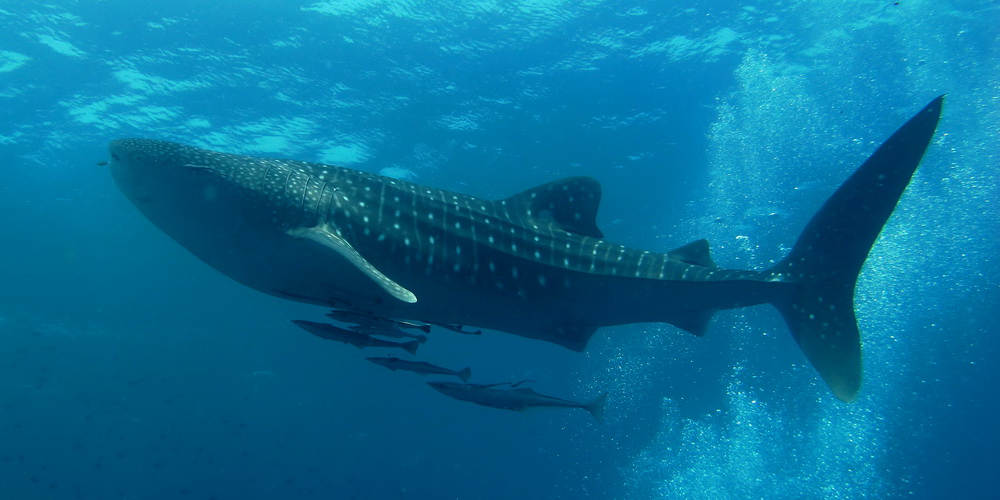
The whale shark (Rhincodon typus) is a slow-moving, filter-feeding carpet shark and the largest known extant fish species. An individual with a length of 18.8 m (61.7 ft) has been considered the largest reliably recorded. The whale shark holds many records for size in the animal kingdom, most notably being by far the largest living non-cetacean animal. It is the only living species of the genus Rhincodon and the only extant member of the family Rhincodontidae, which belongs to the subclass Elasmobranchii in the class Chondrichthyes. Before 1984, it was classified as Rhiniodon into Rhinodontidae. An extinct species, Rhincodon ferriolensis, was described in Europe (probably in Spain), in the Late Burdigalian stage.
The whale shark is an active filter feeder, primarily consuming plankton, krill, fish eggs, and small schooling fish such as sardines and anchovies. The shark can process over 6,000 liters of water per hour through its specialized sieve-like gill pads. Highly migratory, the whale shark travels thousands of miles across tropical oceans to exploit seasonal food sources, with large, predictable feeding aggregations occurring at coastal sites such as Ningaloo Reef in Western Australia, the Yucatan Peninsula in Mexico, and off the coast of Gujarat and Kerala in India. Despite its immense size, the whale shark is docile and poses no significant threat to humans. It is currently listed as an Endangered species on the IUCN Red List owing to a population decline of more than 50% over the last 75 years, primarily as a result of targeted fishing, bycatch in other fisheries, and collisions with large ships.
Whale sharks inhabit the open waters of all tropical oceans. They are rarely found in water below 21 °C (70 °F). The lifespan of a whale shark is estimated to be between 80 and 130 years, based on studies of their vertebral growth bands and the growth rates of free-swimming sharks.
The species was distinguished in April 1828 after the harpooning of a 4.6 m (15 ft) specimen in Table Bay, South Africa. Andrew Smith, a military doctor associated with British troops stationed in Cape Town, described it the following year. The name "whale shark" refers to the animal's appearance and large size; it is a fish, not a mammal, and, like all sharks, is not closely related to whales.
The whale shark is one of the most ancient shark species still extant today, with the earliest fossil teeth known from the Late Oligocene of South Carolina, US. Their teeth become more geographically widespread from the Early Miocene onwards, where they are known from other parts of the eastern United States, southern France, and Costa Rica.
Whale sharks possess a broad, flattened head with a large mouth and two small eyes located at the front corners. Unlike many other sharks, whale shark mouths are located at the front of the head rather than on the underside of the head. Their mouths can be exceptionally wide; a 12.1 m (39.7 ft) individual was reported to have a mouth measuring 1.55 m (5.1 ft) across. Whale shark mouths can contain over 300 rows of tiny teeth and 20 filter pads which it uses to filter feed. The spiracles are located just behind the eyes. Whale sharks have five large pairs of gills. Their skin is dark grey with a white belly marked with an arrangement of pale grey or white spots and stripes that is unique to each individual. The skin can be up to 15 cm (5.9 in) thick and is very hard and rough to the touch. The whale shark has three prominent ridges along its sides, which start above and behind the head and end at the caudal peduncle. The shark has two dorsal fins set relatively far back on the body, a pair of pectoral fins, a pair of pelvic fins and a single medial anal fin. The caudal fin has a larger upper lobe than the lower lobe (heterocercal).
Whale sharks have been found to possess dermal denticles on the surface of their eyeballs that are structured differently from their body denticles. The dermal denticles, as well as the whale shark's ability to retract its eyes deep into their sockets, serve to protect the eyes from damage.
Evidence suggests that whale sharks can recover from major injuries and may be able to regenerate small sections of their fins. Their spot markings have been shown to reform over a previously wounded area.
Hub AI
Whale shark AI simulator
(@Whale shark_simulator)
Whale shark
The whale shark (Rhincodon typus) is a slow-moving, filter-feeding carpet shark and the largest known extant fish species. An individual with a length of 18.8 m (61.7 ft) has been considered the largest reliably recorded. The whale shark holds many records for size in the animal kingdom, most notably being by far the largest living non-cetacean animal. It is the only living species of the genus Rhincodon and the only extant member of the family Rhincodontidae, which belongs to the subclass Elasmobranchii in the class Chondrichthyes. Before 1984, it was classified as Rhiniodon into Rhinodontidae. An extinct species, Rhincodon ferriolensis, was described in Europe (probably in Spain), in the Late Burdigalian stage.
The whale shark is an active filter feeder, primarily consuming plankton, krill, fish eggs, and small schooling fish such as sardines and anchovies. The shark can process over 6,000 liters of water per hour through its specialized sieve-like gill pads. Highly migratory, the whale shark travels thousands of miles across tropical oceans to exploit seasonal food sources, with large, predictable feeding aggregations occurring at coastal sites such as Ningaloo Reef in Western Australia, the Yucatan Peninsula in Mexico, and off the coast of Gujarat and Kerala in India. Despite its immense size, the whale shark is docile and poses no significant threat to humans. It is currently listed as an Endangered species on the IUCN Red List owing to a population decline of more than 50% over the last 75 years, primarily as a result of targeted fishing, bycatch in other fisheries, and collisions with large ships.
Whale sharks inhabit the open waters of all tropical oceans. They are rarely found in water below 21 °C (70 °F). The lifespan of a whale shark is estimated to be between 80 and 130 years, based on studies of their vertebral growth bands and the growth rates of free-swimming sharks.
The species was distinguished in April 1828 after the harpooning of a 4.6 m (15 ft) specimen in Table Bay, South Africa. Andrew Smith, a military doctor associated with British troops stationed in Cape Town, described it the following year. The name "whale shark" refers to the animal's appearance and large size; it is a fish, not a mammal, and, like all sharks, is not closely related to whales.
The whale shark is one of the most ancient shark species still extant today, with the earliest fossil teeth known from the Late Oligocene of South Carolina, US. Their teeth become more geographically widespread from the Early Miocene onwards, where they are known from other parts of the eastern United States, southern France, and Costa Rica.
Whale sharks possess a broad, flattened head with a large mouth and two small eyes located at the front corners. Unlike many other sharks, whale shark mouths are located at the front of the head rather than on the underside of the head. Their mouths can be exceptionally wide; a 12.1 m (39.7 ft) individual was reported to have a mouth measuring 1.55 m (5.1 ft) across. Whale shark mouths can contain over 300 rows of tiny teeth and 20 filter pads which it uses to filter feed. The spiracles are located just behind the eyes. Whale sharks have five large pairs of gills. Their skin is dark grey with a white belly marked with an arrangement of pale grey or white spots and stripes that is unique to each individual. The skin can be up to 15 cm (5.9 in) thick and is very hard and rough to the touch. The whale shark has three prominent ridges along its sides, which start above and behind the head and end at the caudal peduncle. The shark has two dorsal fins set relatively far back on the body, a pair of pectoral fins, a pair of pelvic fins and a single medial anal fin. The caudal fin has a larger upper lobe than the lower lobe (heterocercal).
Whale sharks have been found to possess dermal denticles on the surface of their eyeballs that are structured differently from their body denticles. The dermal denticles, as well as the whale shark's ability to retract its eyes deep into their sockets, serve to protect the eyes from damage.
Evidence suggests that whale sharks can recover from major injuries and may be able to regenerate small sections of their fins. Their spot markings have been shown to reform over a previously wounded area.
Recent media