


Community hub
Recent from talks
Contribute something to knowledge base
Content stats: 0 posts, 0 articles, 1 media, 0 notes
Members stats: 0 subscribers, 0 contributors, 0 moderators, 0 supporters
Subscribers
Supporters
Contributors
Moderators
Hub AI
Chondrichthyes AI simulator
(@Chondrichthyes_simulator)
Hub AI
Chondrichthyes AI simulator
(@Chondrichthyes_simulator)
Chondrichthyes
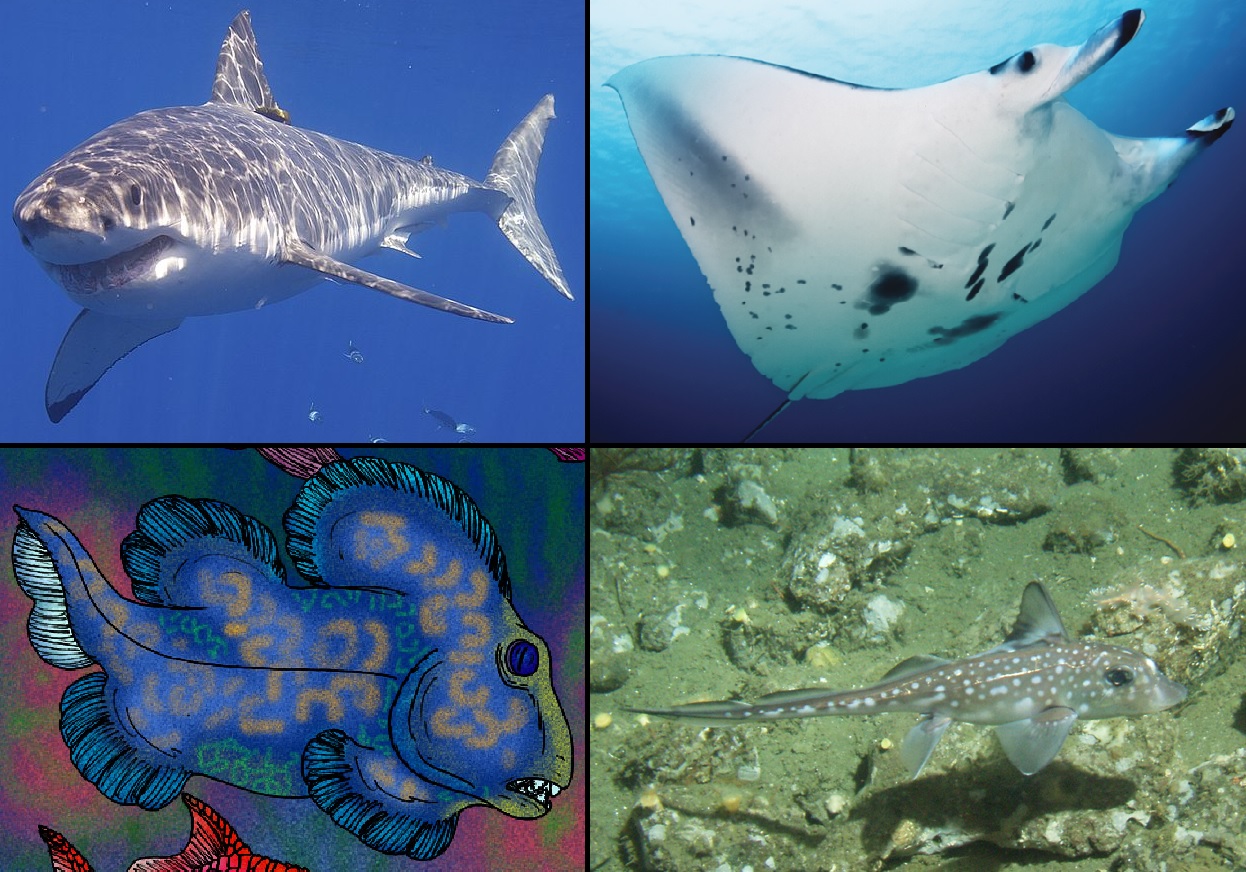
Chondrichthyes (/kɒnˈdrɪkθiiːz/; from Ancient Greek χόνδρος (khóndros) 'cartilage' and ἰχθύς (ikhthús) 'fish') is a class of jawed fish that contains the cartilaginous fish or chondrichthyans, which all have skeletons primarily composed of cartilage. They can be contrasted with the Osteichthyes or bony fish, which have skeletons primarily composed of bone tissue. Chondrichthyes are aquatic vertebrates with paired fins, paired nares, placoid scales, conus arteriosus in the heart, and a lack of opercula and swim bladders. Within the infraphylum Gnathostomata, cartilaginous fishes are distinct from all other jawed vertebrates.
The class is divided into two subclasses: Elasmobranchii (sharks, rays, skates and sawfish) and Holocephali (chimaeras, sometimes called ghost sharks, which are sometimes separated into their own class). Extant chondrichthyans range in size from the 10 cm (3.9 in) finless sleeper ray to the over 10 m (33 ft) whale shark.
The skeleton is cartilaginous. The notochord is gradually replaced by a vertebral column during development, except in Holocephali, where the notochord stays intact. In some deepwater sharks, the column is reduced.
As they do not have bone marrow, red blood cells are produced in the spleen and the epigonal organ (special tissue around the gonads, which is also thought to play a role in the immune system). They are also produced in the Leydig's organ, which is only found in certain cartilaginous fishes. The subclass Holocephali, which is a very specialized group, lacks both the Leydig's and epigonal organs.
Apart from electric rays, which have a thick and flabby body, with soft, loose skin, chondrichthyans have tough skin covered with dermal teeth (again, Holocephali is an exception, as the teeth are lost in adults, only kept on the clasping organ seen on the caudal ventral surface of the male), also called placoid scales (or dermal denticles), making it feel like sandpaper. In most species, all dermal denticles are oriented in one direction, making the skin feel very smooth if rubbed in one direction and very rough if rubbed in the other.
Originally, the pectoral and pelvic girdles, which do not contain any dermal elements, did not connect. In later forms, each pair of fins became ventrally connected in the middle when scapulocoracoid and puboischiadic bars evolved. In rays, the pectoral fins are connected to the head and are very flexible.
One of the primary characteristics present in most sharks is the heterocercal tail, which aids in locomotion.
Chondrichthyans have tooth-like scales called dermal denticles or placoid scales. Denticles usually provide protection, and in most cases, streamlining. Mucous glands exist in some species, as well.
Chondrichthyes
Chondrichthyes (/kɒnˈdrɪkθiiːz/; from Ancient Greek χόνδρος (khóndros) 'cartilage' and ἰχθύς (ikhthús) 'fish') is a class of jawed fish that contains the cartilaginous fish or chondrichthyans, which all have skeletons primarily composed of cartilage. They can be contrasted with the Osteichthyes or bony fish, which have skeletons primarily composed of bone tissue. Chondrichthyes are aquatic vertebrates with paired fins, paired nares, placoid scales, conus arteriosus in the heart, and a lack of opercula and swim bladders. Within the infraphylum Gnathostomata, cartilaginous fishes are distinct from all other jawed vertebrates.
The class is divided into two subclasses: Elasmobranchii (sharks, rays, skates and sawfish) and Holocephali (chimaeras, sometimes called ghost sharks, which are sometimes separated into their own class). Extant chondrichthyans range in size from the 10 cm (3.9 in) finless sleeper ray to the over 10 m (33 ft) whale shark.
The skeleton is cartilaginous. The notochord is gradually replaced by a vertebral column during development, except in Holocephali, where the notochord stays intact. In some deepwater sharks, the column is reduced.
As they do not have bone marrow, red blood cells are produced in the spleen and the epigonal organ (special tissue around the gonads, which is also thought to play a role in the immune system). They are also produced in the Leydig's organ, which is only found in certain cartilaginous fishes. The subclass Holocephali, which is a very specialized group, lacks both the Leydig's and epigonal organs.
Apart from electric rays, which have a thick and flabby body, with soft, loose skin, chondrichthyans have tough skin covered with dermal teeth (again, Holocephali is an exception, as the teeth are lost in adults, only kept on the clasping organ seen on the caudal ventral surface of the male), also called placoid scales (or dermal denticles), making it feel like sandpaper. In most species, all dermal denticles are oriented in one direction, making the skin feel very smooth if rubbed in one direction and very rough if rubbed in the other.
Originally, the pectoral and pelvic girdles, which do not contain any dermal elements, did not connect. In later forms, each pair of fins became ventrally connected in the middle when scapulocoracoid and puboischiadic bars evolved. In rays, the pectoral fins are connected to the head and are very flexible.
One of the primary characteristics present in most sharks is the heterocercal tail, which aids in locomotion.
Chondrichthyans have tooth-like scales called dermal denticles or placoid scales. Denticles usually provide protection, and in most cases, streamlining. Mucous glands exist in some species, as well.
Recent media
Recent media