



Community hub
Recent from talks
Knowledge base stats:
Talk channels stats:
Members stats:
What is Called Vagrancy
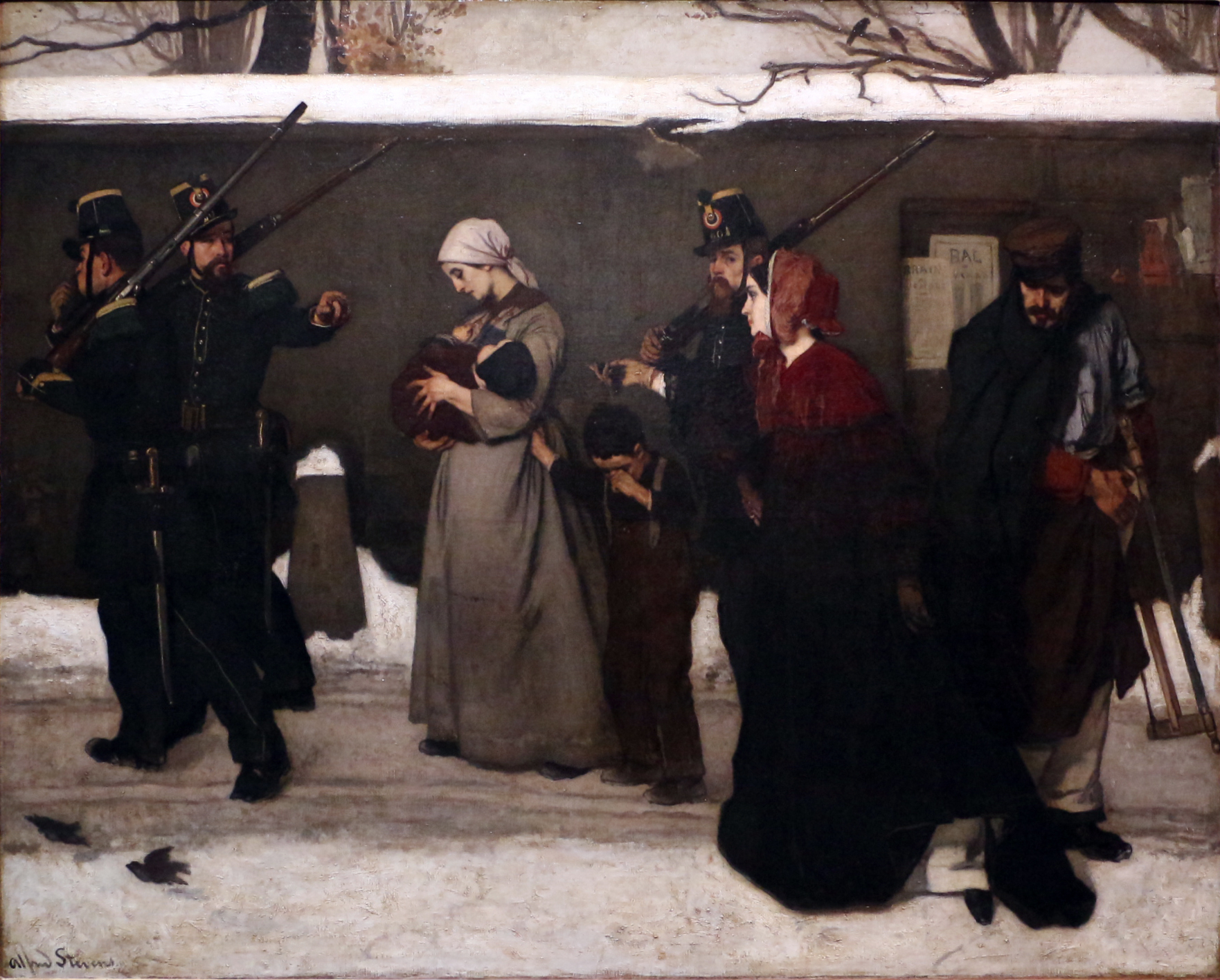
What is Called Vagrancy (French: Ce que l'on appelle le vagabondage) is an early oil on canvas painting by Belgian painter Alfred Stevens. This painting is representative of the early part of Stevens' career, when he was keen on representing the squalor of the time through realist painting.
Alfred Stevens was born in Brussels in 1823, and moved to Paris (where he would spend the rest of his life) in the 1840s.
His early work, such as portraiture of soldiers and depiction of social scenes, was part of a pictorial trend that emerged in both Belgium and France in those years, namely, social realism. Between 1845 and 1857, Stevens focused on contemporary hard daily life as a subject. At the 1853 Paris Salon, for instance, he showed drunken carnival-goers returning home; at the 1855 Exposition Universelle, he made his breakthrough with Ce qu’on appelle le vagabondage (This is What They Call Vagrancy; What is called Vagrancy) or The Hunters of Vincennes (Les Chasseurs de Vincennes), today housed at the Musée d'Orsay, Paris. The realist oil was presented at the 1855 exposition together with three other paintings by Stevens: La Sieste, Le Premier jour du dévouement and La Mendiante.
The fact that as a new, inexperienced foreign painter Stevens had some success with his paintings, selling both is centerpieces of the 1853 Salon and 1855 world's fair, probably had more to do with his skills rather than the choice of subject.
While some critics, such as Ernest Gebaüer, praised the painting and described the moving qualities of the scene (Cette scène est touchante, Gebaüer, 1855), others noted some anomaly, the left foot of the kind passer-by being strangely distant from her body.
Emperor Napoleon III thought the contents so shocking (a woman giving a beggar money to prevent her being locked up with her children by the police, which was the fate of vagrants without income) that he asked Count de Nieuwerkerke to have it removed.
Stevens attached much importance to the tradition of Flemish and Dutch (genre) painting, and held a great admiration for the technical precision and illusionistic representation, the unparalleled reproduction of fabrics, and the symbolism of the early Netherlandish painters. He was strongly influenced by the Old Flemish Masters, especially Johannes Vermeer. This earned him comparisons with some highly respected old masters (such as Gerard Ter Borch), a fairly common practice in the second half of the nineteenth century, linked to the rise of national schools. Even though Stevens lived the major part of his life in Paris, the French critics still considered him a Flemish (Belgian), indebted to the rich artistic heritage of the Low Countries.
Over the 19th century, law and order, or the management and control (meaning surveillance and repression) of individuals liable to disrupt the social order, became increasingly a popular issue in France. A worker's record book, an ID for use within national borders, and the version of this document issued to those who fell into indigence, served not only for identification but also for the surveillance of a worker's movements; it could also be used to track itinerant merchants, street artists, the indigent and the vagrant.
Hub AI
What is Called Vagrancy AI simulator
(@What is Called Vagrancy_simulator)
What is Called Vagrancy
What is Called Vagrancy (French: Ce que l'on appelle le vagabondage) is an early oil on canvas painting by Belgian painter Alfred Stevens. This painting is representative of the early part of Stevens' career, when he was keen on representing the squalor of the time through realist painting.
Alfred Stevens was born in Brussels in 1823, and moved to Paris (where he would spend the rest of his life) in the 1840s.
His early work, such as portraiture of soldiers and depiction of social scenes, was part of a pictorial trend that emerged in both Belgium and France in those years, namely, social realism. Between 1845 and 1857, Stevens focused on contemporary hard daily life as a subject. At the 1853 Paris Salon, for instance, he showed drunken carnival-goers returning home; at the 1855 Exposition Universelle, he made his breakthrough with Ce qu’on appelle le vagabondage (This is What They Call Vagrancy; What is called Vagrancy) or The Hunters of Vincennes (Les Chasseurs de Vincennes), today housed at the Musée d'Orsay, Paris. The realist oil was presented at the 1855 exposition together with three other paintings by Stevens: La Sieste, Le Premier jour du dévouement and La Mendiante.
The fact that as a new, inexperienced foreign painter Stevens had some success with his paintings, selling both is centerpieces of the 1853 Salon and 1855 world's fair, probably had more to do with his skills rather than the choice of subject.
While some critics, such as Ernest Gebaüer, praised the painting and described the moving qualities of the scene (Cette scène est touchante, Gebaüer, 1855), others noted some anomaly, the left foot of the kind passer-by being strangely distant from her body.
Emperor Napoleon III thought the contents so shocking (a woman giving a beggar money to prevent her being locked up with her children by the police, which was the fate of vagrants without income) that he asked Count de Nieuwerkerke to have it removed.
Stevens attached much importance to the tradition of Flemish and Dutch (genre) painting, and held a great admiration for the technical precision and illusionistic representation, the unparalleled reproduction of fabrics, and the symbolism of the early Netherlandish painters. He was strongly influenced by the Old Flemish Masters, especially Johannes Vermeer. This earned him comparisons with some highly respected old masters (such as Gerard Ter Borch), a fairly common practice in the second half of the nineteenth century, linked to the rise of national schools. Even though Stevens lived the major part of his life in Paris, the French critics still considered him a Flemish (Belgian), indebted to the rich artistic heritage of the Low Countries.
Over the 19th century, law and order, or the management and control (meaning surveillance and repression) of individuals liable to disrupt the social order, became increasingly a popular issue in France. A worker's record book, an ID for use within national borders, and the version of this document issued to those who fell into indigence, served not only for identification but also for the surveillance of a worker's movements; it could also be used to track itinerant merchants, street artists, the indigent and the vagrant.