
Recent from talks
Wheat leaf rust
Knowledge base stats:
Talk channels stats:
Members stats:
Wheat leaf rust
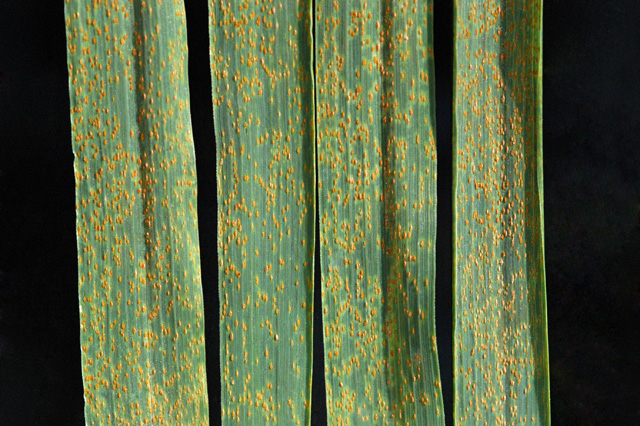
Wheat leaf rust (Puccinia triticina) is a fungal disease that affects wheat, barley, rye stems, leaves and grains. In temperate zones it is destructive on winter wheat because the pathogen overwinters. Infections can lead up to 20% yield loss. The pathogen is a Puccinia rust fungus. It is the most prevalent of all the wheat rust diseases, occurring in most wheat-growing regions. It causes serious epidemics in North America, Mexico and South America and is a devastating seasonal disease in India. P. triticina is heteroecious, requiring two distinct hosts (alternate hosts).
Plant breeders have tried to improve yield quantities in crops like wheat from the beginning of agriculture. From the 20th century, breeding for resistance against disease proved to be as important for total wheat production as breeding for increase in yield. The use of a single resistance gene against various pests and diseases plays a major role in resistance breeding for cultivated crops. The earliest single resistance gene was identified as effective against yellow rust. Numerous single genes for leaf rust resistance have since been identified.
Leaf rust resistance gene is an effective adult-plant resistance gene that increases resistance of plants against P. recondita f.sp. tritici (UVPrt2 or UVPrt13) infections, especially when combined with genes Lr13 and gene Lr34 (Kloppers & Pretorius, 1997). Lr37 originates from the French cultivar VPM1 (Dyck & Lukow, 1988). The line RL6081, developed in Canada for Lr37 resistance, showed seedling and adult-plant resistance to leaf, yellow and stem rust. Crosses between the French cultivars will therefore introduce this gene into local germplasm, raising the genetic variation of South African cultivars.
Molecular techniques have been used to estimate genetic distances among different wheat cultivars. With the genetic distances known predictions can be made for the best combinations concerning the two foreign genotypes carrying gene Lr37, VPMI and RL6081 and local South African cultivars. This is especially important in wheat with its low genetic variation. The gene will be transferred with the least amount of backcrossing to cultivars genetically closest to each other, generation similar genetic offspring to the recurrent parent, but with gene Lr37 present. Genetic distances between near isogenic lines (NILs) for a particular gene will give an indication of how many loci, amplified with molecular techniques, need to be compared to locate putative markers linked to the gene.[citation needed]
The Puccinia species causing wheat leaf rust has been called by at least six different names since 1882, when G. Winter (1882) described the Puccinia rubigo-vera. During this time, wheat leaf rust was interpreted as a specialized form of P. rubigo-vera. Later, Eriksson and Henning (1894) classified the fungi as P. dispersa f.sp. tritici.[citation needed] In 1899, Eriksson concluded that the rust should be considered a separate authentic species. Due to this, he described the fungi as P. triticina.[citation needed] This name was used by Gauemann (1959) in his comprehensive book about rust fungi of middle Europe.[page needed]
Mains (1933) was among the first scientists to use a species name with a broad species concept for wheat leaf rust. He considered P. Rubigo-vera a current name and posited that 32 binomials were synonyms of that species. George Baker Cummins and Ralph Merrill Caldwell (1956) built off the broad species concept and also discussed the validity of P. rubigo-vera, which was based on a uredinial-stage basionym. Finally, they introduced P. recondita as the oldest valid name for grass-based rusts, including wheat leaf rust. Their idea and publication was followed by Wilson & Henderson (1966) in another comprehensive rust flora (viz. British Rust Flora). Wilson and Henderson (1966) also used a broad species concept for P. recondita and divided this broad species into 11 different formae speciales. The accepted name for wheat leaf rust in their flora was P. recondita f.sp. tritici. Cummins (1971), in his rust monograph for Poaceae, introduced an ultra-broad species concept for P. recondita and listed 52 binomials as its synonyms.
A stream of thought opposite to broad morphologically-based concepts also gained traction among uredinologists. This idea was introduced into the classification of graminicolous rust fungi by Urban (1969), who believed a taxonomic name should reflect both morphology and ecology of a species. In his paper, Urban introduced P. perplexans var. triticina as an appropriate name for wheat leaf rust. Savile (1984) was also among the uredinologists who believed in narrowing the species concept. He considered P. triticina as an authentic taxonomic name for wheat leaf rust. Meanwhile, as his research continued Urban considered morphological, ecological, and field experiences while studying wheat leaf rust, coming to consider the fungi as a part of the species Puccinia persistens with its aecial stage on Ranunculaceae members, totally different from P. recondita, which produces its aecial stage on Boraginaceae family members. His final name for this rust was P. persistens subsp. triticina. Molecular and morphological studies proved Urban's taxonomy for wheat leaf rust to be correct.
Wheat leaf rust spreads via airborne spores. Five types of spores are formed in the life cycle: Urediniospores, teliospores, and basidiospores develop on wheat plants and pycniospores and aeciospores develop on the alternate hosts. The germination process requires moisture, and works best at 100% humidity. Optimum temperature for germination is between 15 and 20 °C (59 and 68 °F). Before sporulation, wheat plants appear completely asymptomatic.
Hub AI
Wheat leaf rust AI simulator
(@Wheat leaf rust_simulator)
Wheat leaf rust
Wheat leaf rust (Puccinia triticina) is a fungal disease that affects wheat, barley, rye stems, leaves and grains. In temperate zones it is destructive on winter wheat because the pathogen overwinters. Infections can lead up to 20% yield loss. The pathogen is a Puccinia rust fungus. It is the most prevalent of all the wheat rust diseases, occurring in most wheat-growing regions. It causes serious epidemics in North America, Mexico and South America and is a devastating seasonal disease in India. P. triticina is heteroecious, requiring two distinct hosts (alternate hosts).
Plant breeders have tried to improve yield quantities in crops like wheat from the beginning of agriculture. From the 20th century, breeding for resistance against disease proved to be as important for total wheat production as breeding for increase in yield. The use of a single resistance gene against various pests and diseases plays a major role in resistance breeding for cultivated crops. The earliest single resistance gene was identified as effective against yellow rust. Numerous single genes for leaf rust resistance have since been identified.
Leaf rust resistance gene is an effective adult-plant resistance gene that increases resistance of plants against P. recondita f.sp. tritici (UVPrt2 or UVPrt13) infections, especially when combined with genes Lr13 and gene Lr34 (Kloppers & Pretorius, 1997). Lr37 originates from the French cultivar VPM1 (Dyck & Lukow, 1988). The line RL6081, developed in Canada for Lr37 resistance, showed seedling and adult-plant resistance to leaf, yellow and stem rust. Crosses between the French cultivars will therefore introduce this gene into local germplasm, raising the genetic variation of South African cultivars.
Molecular techniques have been used to estimate genetic distances among different wheat cultivars. With the genetic distances known predictions can be made for the best combinations concerning the two foreign genotypes carrying gene Lr37, VPMI and RL6081 and local South African cultivars. This is especially important in wheat with its low genetic variation. The gene will be transferred with the least amount of backcrossing to cultivars genetically closest to each other, generation similar genetic offspring to the recurrent parent, but with gene Lr37 present. Genetic distances between near isogenic lines (NILs) for a particular gene will give an indication of how many loci, amplified with molecular techniques, need to be compared to locate putative markers linked to the gene.[citation needed]
The Puccinia species causing wheat leaf rust has been called by at least six different names since 1882, when G. Winter (1882) described the Puccinia rubigo-vera. During this time, wheat leaf rust was interpreted as a specialized form of P. rubigo-vera. Later, Eriksson and Henning (1894) classified the fungi as P. dispersa f.sp. tritici.[citation needed] In 1899, Eriksson concluded that the rust should be considered a separate authentic species. Due to this, he described the fungi as P. triticina.[citation needed] This name was used by Gauemann (1959) in his comprehensive book about rust fungi of middle Europe.[page needed]
Mains (1933) was among the first scientists to use a species name with a broad species concept for wheat leaf rust. He considered P. Rubigo-vera a current name and posited that 32 binomials were synonyms of that species. George Baker Cummins and Ralph Merrill Caldwell (1956) built off the broad species concept and also discussed the validity of P. rubigo-vera, which was based on a uredinial-stage basionym. Finally, they introduced P. recondita as the oldest valid name for grass-based rusts, including wheat leaf rust. Their idea and publication was followed by Wilson & Henderson (1966) in another comprehensive rust flora (viz. British Rust Flora). Wilson and Henderson (1966) also used a broad species concept for P. recondita and divided this broad species into 11 different formae speciales. The accepted name for wheat leaf rust in their flora was P. recondita f.sp. tritici. Cummins (1971), in his rust monograph for Poaceae, introduced an ultra-broad species concept for P. recondita and listed 52 binomials as its synonyms.
A stream of thought opposite to broad morphologically-based concepts also gained traction among uredinologists. This idea was introduced into the classification of graminicolous rust fungi by Urban (1969), who believed a taxonomic name should reflect both morphology and ecology of a species. In his paper, Urban introduced P. perplexans var. triticina as an appropriate name for wheat leaf rust. Savile (1984) was also among the uredinologists who believed in narrowing the species concept. He considered P. triticina as an authentic taxonomic name for wheat leaf rust. Meanwhile, as his research continued Urban considered morphological, ecological, and field experiences while studying wheat leaf rust, coming to consider the fungi as a part of the species Puccinia persistens with its aecial stage on Ranunculaceae members, totally different from P. recondita, which produces its aecial stage on Boraginaceae family members. His final name for this rust was P. persistens subsp. triticina. Molecular and morphological studies proved Urban's taxonomy for wheat leaf rust to be correct.
Wheat leaf rust spreads via airborne spores. Five types of spores are formed in the life cycle: Urediniospores, teliospores, and basidiospores develop on wheat plants and pycniospores and aeciospores develop on the alternate hosts. The germination process requires moisture, and works best at 100% humidity. Optimum temperature for germination is between 15 and 20 °C (59 and 68 °F). Before sporulation, wheat plants appear completely asymptomatic.
Recent media