Hubbry Logo
White DayWhite DayMain
Open search
White Day
Community hub
White Day
logo
8 pages, 0 posts
0 subscribers
Be the first to start a discussion here.
White Day
White Day
from Wikipedia

White Day
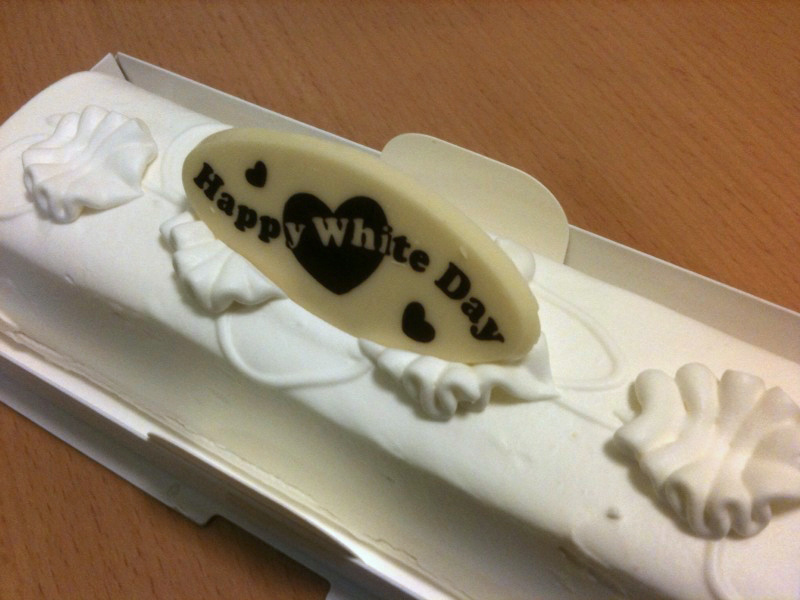
White Day cake
Observed byJapan; regions in East and Southeast Asia
DateMarch 14
Next timeMarch 14, 2026 (2026-03-14)
FrequencyAnnual
Related toValentine's Day
White Day
Chinese name
Traditional Chinese白色情人節
Simplified Chinese白色情人节
Transcriptions
Standard Mandarin
Hanyu PinyinBáisè qíngrén jié
Burmese name
Burmeseအဖြူနေ့
Vietnamese name
VietnameseNgày Valentine Trắng
Korean name
Hangul화이트데이
Transcriptions
Revised RomanizationHwaiteu dei
Japanese name
Katakanaホワイトデー
Transcriptions
RomanizationHowaito Dē
Khmer name
Khmerថ្ងៃពណ៌ស

White Day is celebrated annually on March 14, one month after Valentine's Day, when men give reciprocal gifts to women who gave them gifts on Valentine's Day. It began in Japan in 1978; its observance has spread to several other East Asian regions like China, Taiwan, South Korea and countries worldwide.

Origin

[edit]

Though Valentine's Day was being celebrated in Japan by 1936, it did not begin to be popular until the 1970s, giving the day a different meaning from the Western observation.[1] It was primarily an opportunity for girls to show that they like a boy.[1] In 1977, a Fukuoka-based confectionery company, Ishimuramanseido [ja], marketed marshmallows to men on March 14, calling it Marshmallow Day (マシュマロデー, Mashumaro Dē).[2] White Day was first celebrated in 1978 in Japan.[2] The National Confectionery Industry Association started it as an "answer day" to Valentine's Day on the grounds that men should pay back the women who gave them chocolate and other gifts on Valentine's Day.[2]

Soon thereafter, confectionery companies began marketing white chocolate. Flowers and other gifts are also given on this day.[3]

Observation

[edit]

White Day is celebrated one month after Valentine's Day, on March 14. With countries that observe White Day, typically Valentine's Day is celebrated by women and girls presenting chocolate gifts (either store-bought or handmade), usually to the other men and boys, as an expression of love, courtesy, or social obligation.[4]

On White Day, the reverse happens: men who received a honmei-choco (本命チョコ, 'chocolate of love') or giri-choco (義理チョコ, 'courtesy chocolate')[5] on Valentine's Day are expected to return the favor by giving gifts to the women.[6] Gift exchanges happen between romantic partners, friends, and coworkers.[7] Traditionally, popular White Day gifts include food like white chocolate, marshmallows, candy, cookies, and other "white" accessories like jewelry, bags, lotions, and lingerie.[8][9]

Sometimes the term sanbai kaeshi (三倍返し, 'triple the return') is used to describe the generally recited rule for men that the return gift should be two to three times the worth of the Valentine's gift they received.[2]

In the latter half of the 2010s, sales figures indicated a decline in the popularity of the observation. It was seen as a result of reduced sales of obligation chocolates on Valentine's Day. Another reason given for the reduction of popularity is the changing gender roles within Japanese culture.[10]

International observation

[edit]

Outside of Japan, the practice of giving response gifts one month after Valentine's Day has spread internationally. In those cultures, White Day is, for the most part, observed similarly. Some places where this occurs include China,[11][12] South Korea,[13][11][14] Taiwan,[13][11] and Vietnam.[11][14]

See also

[edit]

References

[edit]
[edit]
Revisions and contributorsEdit on WikipediaRead on Wikipedia
from Grokipedia
White Day is an annual custom observed on March 14 in and other East Asian countries such as , , and , wherein men reciprocate gifts—typically white-colored like marshmallows or —to women who gave them chocolates or other tokens on one month earlier. The tradition originated in during the late as a initiative by the Fukuoka-based firm Ishimura Manseido, which promoted as "return gifts" under the initial moniker "Marshmallow Day," later rebranded as White Day to evoke the pale hue of sugar-based sweets. In Japanese culture, it embodies the principle of otae or okaeshi—the custom of returning favors with items of equivalent or greater value, often three times that received, known as sanbai gaeshi—transforming Valentine's Day's one-sided gifting into a bilateral exchange while boosting sales. Though not an official holiday, White Day has permeated through media and , extending beyond romantic contexts to include obligatory gifts to teachers, colleagues, and family, with distinctions between obligatory (giri-choko equivalents) and obligatory white candies versus heartfelt honmei selections. Its spread to neighboring countries reflects shared commercial influences rather than indigenous roots, underscoring how global adaptations prioritize reciprocity and over historical authenticity.

History

Origins in Japan

White Day originated in in the late as a manufactured reciprocal holiday to , which by then had evolved into a custom where women primarily gifted chocolates (honmei-choko for romantic interests or giri-choko for obligatory social exchanges) to men, though flowers have increasingly gained popularity in modern observance as romantic gifts for both genders, promoted as a more equal and heartfelt alternative and selected according to hanakotoba (Japanese flower language), including red roses symbolizing deep love and passion, pink roses for admiration and gentleness, white roses or lilies for purity and sincerity, tulips, camellias for devoted love, and sunflowers, while avoiding yellow roses due to associations with jealousy. The industry, seeking to capitalize on Valentine's sales, designated —one month later—as the date for men to return favors with candies or other sweets, framing it as an "answer day" (kotae no hi). This initiative was formally launched in 1978 by Japan's National Confectionery Industry Association, which promoted the event nationwide to boost post-Valentine confection sales. A pivotal role was played by Ishimura Manseido, a Fukuoka-based firm founded in , which in 1977 began marketing white specifically as affordable, symbolic return gifts for men—emphasizing their pure white color as representing gratitude and innocence. The company's executive, inspired by a reader's letter in a women's lamenting the lack of male reciprocity on Valentine's, collaborated with the local Iwataya to host the inaugural event on , , initially dubbing it "Marshmallow Day" (Maashumaro no Hi). This marketing ploy proved effective, with positioned as a three-fold return value (sanbai gaeshi) to match the perceived emotional weight of women's chocolates. By 1979, the name shifted to "White Day" to broaden appeal beyond marshmallows, incorporating other white-themed confections like and candies, while retaining the emphasis on lighter, less obligatory returns compared to Valentine's intensity. The tradition's rapid adoption reflected Japan's consumer culture and gendered social norms, where commercial campaigns successfully normalized the reciprocity ritual among youth and office workers, though it remained a confectionery-driven invention rather than an organic .

Spread to East Asia

White Day, first commercially promoted in in 1978 by the National Confectionery Industry Association in collaboration with the Iwataya , rapidly disseminated to neighboring n countries through marketing campaigns emphasizing reciprocity for gifts. This expansion leveraged Japan's postwar economic and cultural influence in the region, with Japanese companies exporting the concept alongside products like marshmallows, which symbolized the "white" theme of pure, obligatory returns. South Korea adopted White Day in the late to early , initially through similar promotional efforts by candy manufacturers targeting the reciprocity norm already established by localized Valentine's traditions, where women give chocolates to men or superiors. By the , it had become a mainstream observance, with men expected to provide gifts valued at two or three times those received, often including white candies, jewelry, or flowers, reflecting heightened commercial stakes compared to . The holiday's integration in also spurred unique extensions, such as Black Day on April 14 for singles, underscoring its adaptation to local amid rapid and shifts. In , White Day took root concurrently with 's adoption, facilitated by cross-strait cultural exchanges and Japanese media influence, evolving into a day where men return favors with white-themed items beyond just sweets, such as accessories or experiences. followed suit in the 1990s, as and exposure to Japanese and Korean pop culture via imports and normalized the practice among urban youth, though observance remains more commercial and less obligatory than in or . Across these nations, the spread amplified gendered gift-giving rituals, with annual sales of White Day confectionery exceeding billions in yen equivalent regionally by the 2000s, driven by rather than organic folklore.

Commercial Promotion and Evolution

The commercial promotion of White Day began in the mid-1970s as a confectionery industry initiative to capitalize on Valentine's Day reciprocity. In 1977, Ishimura Manseido, a Fukuoka-based confectionery company, launched a campaign dubbed "Marshmallow Day" on March 14, encouraging men to return Valentine's gifts with white marshmallows, selected for their color symbolizing purity and to target post-Valentine sales slumps. This effort was formalized in 1978 when Japan's National Confectionery Industry Association rebranded it as White Day, positioning it explicitly as an "answer day" for men to reciprocate with gifts valued at two to three times those received on February 14, thereby extending holiday confectionery demand. Evolutionarily, Day's shifted from niche focus to broader by the , with public campaigns in 1980 promoting diverse white-themed sweets like candies and to sustain engagement. firms, including those exporting to via Lotte's adoption, amplified reciprocity norms through emphasizing obligatory returns, evolving into a multi-billion-yen market by associating non-edible items like jewelry and accessories with "honmei" (true feeling) gifts for romantic intent. This commercialization reinforced gender-specific gifting—men as primary buyers—while adapting to cultural exports, such as in and , where local firms mirrored Japanese tactics but incorporated regional preferences like heart-shaped candies. By the 2000s, promotional strategies incorporated digital media and cross-promotions, with brands leveraging social reciprocity to drive seasonal spikes; for instance, Japan's confectionery sales on White Day reportedly exceed Valentine's by emphasizing premium, obligation-driven purchases. Despite critiques of manufactured sentiment, the holiday's endurance stems from sustained industry investment, evolving from a localized sales ploy to a pan-East Asian event with annual marketing budgets prioritizing experiential tie-ins like themed events over pure product pushes.

Observance and Traditions

Gifts and Reciprocity Rules

On White Day, observed on March 14, men in reciprocate gifts from women through sanbai gaeshi (三倍返し, "triple return"), an unwritten rule stipulating that return gifts should be valued at two to three times the original chocolates' worth to express gratitude and clarify romantic intent. This reciprocity applies selectively: men return gifts only to those who gave them chocolates, distinguishing between honmei-choco (本命チョコ, "true affection" chocolates) given by women to romantic partners such as boyfriends or husbands to express genuine feelings, often higher quality, handmade, or specially selected, and warranting heartfelt, higher-value responses; and giri-choco (義理チョコ, "obligation" chocolates) from colleagues or acquaintances, which receive modest tokens. Recent trends on Valentine's Day include increased self-gifting (jibun-choco), friendship chocolate (tomo-choco), and instances of men giving reverse chocolate (gyaku-choco), though the core tradition of couples' honmei-choco exchanges followed by men's returns on White Day persists. Gifts for honmei reciprocation often include luxurious or personal items such as jewelry, , designer accessories, or high-end confections, signaling mutual romantic interest, while giri returns favor practical or inexpensive sweets to maintain social harmony without implying deeper feelings. Traditional white-themed edibles dominate both categories, with , marshmallows, cookies, and hard candies symbolizing purity and the holiday's name, derived from their pale hues. Failure to reciprocate honmei-choco can imply rejection, underscoring the day's role in emotional signaling, whereas obligatory exchanges reinforce workplace or friendly norms without escalating to romance. These rules, rooted in post-World War II commercial adaptations of Western holidays, prioritize balanced obligation over excess, though modern observance sometimes relaxes strict valuation for practicality.

National Variations in Japan and South Korea

In , White Day observance emphasizes structured reciprocity, with men expected to return gifts valued at two to three times those received from women on , a custom known as sanbai gaeshi. This practice extends beyond romantic partners to include obligatory returns for giri-choko (courtesy chocolates) given by colleagues, teachers, or acquaintances, often in white-themed confections like marshmallows or candies to symbolize purity. Gifts commonly include , cookies, jewelry, or accessories, with romantic honmei (true feelings) returns featuring higher-value items such as or bags to distinguish affection levels. South Korean celebrations, adopted from in the late , retain the core tradition of men reciprocating Valentine's gifts but lack the formalized sanbai gaeshi valuation rule, allowing for more flexible expressions of appreciation without prescribed multiples. Gifts typically feature white chocolates, flowers, or jewelry, though colors and items like gadgets or have broadened in modern practice, reflecting less rigid adherence to original "white" symbolism. Unlike Japan's workplace-oriented exchanges, South Korean White Day prioritizes romantic outings, with couples frequently planning dates or excursions to convey affection or confessions. These differences highlight Japan's commercial and social formality—rooted in its 1978 confectionery promotion—contrasting South Korea's evolution toward personalized romance, though both nations integrate heavy marketing, with Japanese confectionery sales reaching approximately ¥49 billion in 2019.

Adoption in Taiwan, China, and Beyond

In Taiwan, White Day has been adopted as a reciprocal holiday to , with some men presenting gifts such as candies or confections to women who gave them chocolates on , often as a of appreciation toward romantic interests or friends. This practice emerged through cultural exchange with , gaining modest popularity particularly among younger demographics influenced by East Asian media. Unlike in , observance in remains less formalized and widespread, functioning more as an optional social custom rather than a national tradition. In mainland China, March 14 is observed as White Valentine's Day (白色情人节, Báisè Qíngrénjié), where men typically reciprocate gifts received from women on Valentine's Day by offering items like white chocolate, marshmallows, or jewelry, adhering to the "three times the value" reciprocity rule popularized in Japan. The holiday's introduction aligns with the commercialization of Western and Japanese holidays in urban areas since the late 20th century, promoted by retailers and confectionery brands to boost sales during the spring season. Participation is concentrated in major cities like Shanghai and Beijing, though it competes with traditional Chinese festivals such as Qixi, limiting its dominance. Beyond Taiwan and China, White Day has seen limited but enthusiastic uptake in other East Asian contexts, including parts of and expatriate communities in , where it is marketed alongside by international brands. In these regions, the custom often blends with local romantic traditions, emphasizing gift-giving reciprocity but without the same level of societal expectation as in originating countries. Overall, its spread outside core East Asian nations remains niche, driven primarily by global media exports rather than organic cultural integration.

Cultural and Social Impact

Reinforcement of Gender Reciprocity

White Day reinforces gender reciprocity by establishing a structured response to the female-initiated gift-giving of Valentine's Day, where men reciprocate with items of greater value under the sanbai gaeshi principle—typically two to three times the worth of chocolates or confections received. This custom, originating from marketing efforts by confectionery firms in the 1970s and formalized in 1980, addresses the asymmetry of Valentine's rituals, in which women bear the initial burden of expressing affection through obligatory (giri-choco) or sincere (honmei-choco) gifts to male colleagues, superiors, or romantic interests. The expectation of enhanced reciprocation underscores a causal dynamic of mutual obligation, positioning men in a provider-like role that validates female overtures and sustains relational equilibrium. This framework aligns with enduring Japanese cultural norms of indirect communication and hierarchical harmony, where women's proactive signaling on prompts men's demonstrative affirmation on , often via white-themed gifts like marshmallows, jewelry, or candies symbolizing purity and return. Analyses of these rituals highlight how White Day perpetuates gendered power balances by channeling economic expression through male agency, compensating for the women invest upfront while reinforcing traditional courtship patterns over egalitarian alternatives. Commercial promotion has embedded this reciprocity in annual observances, with sales data from the onward evidencing sustained participation that ties to tangible, value-escalating exchanges rather than symmetric . Empirical persistence of these norms is evident in regional adaptations across , where the holiday's core mechanic—male response to female advance—mirrors Japan's model without fully eroding distinct gender expectations, as seen in South Korean variants emphasizing obligatory returns to maintain social face. Such rituals, while commercialized, empirically foster reciprocity as a stabilizing force in interpersonal dynamics, prioritizing causal chains of initiation and fulfillment over fluid role reversals.

Economic and Marketing Dimensions

White Day originated as a targeted marketing initiative by Japan's confectionery industry in the late 1970s, with the National Confectionery Industry Association promoting the exchange of white-colored marshmallows on March 14 as a reciprocal gesture to Valentine's Day gifts, aiming to stimulate off-season sales of sweets. This strategy evolved to encompass a broader "three times rule," encouraging men to return gifts valued at triple the original Valentine's offerings, which confectioners leveraged through themed packaging and advertising to associate white-themed confections—such as white chocolate and candies—with obligation and romance. The holiday generated approximately $578 million in gift sales in 2014, primarily driven by and accessories, positioning it as a significant seasonal retail event though smaller than . However, market size has since contracted to about one-third of that peak by 2024, reflecting reduced participation amid economic pressures, shifting gender expectations, and a preference for less obligatory exchanges. Despite the overall decline, certain segments showed resilience; for instance, sales of obligatory "giri" gifts rose 8.5% year-over-year into 2024, as reported by market research firm Intage, indicating persistent commercial pull among recipients even as givers express fatigue with escalating costs. Marketing efforts have diversified beyond sweets to include jewelry, , and experiences, with retailers using digital campaigns, limited-edition products, and promotions to target younger demographics and sustain revenue amid waning traditional observance. firms continue to emphasize the reciprocity narrative in , framing White Day as an essential social duty that boosts household consumption, though critics within the industry note that evolving consumer attitudes—favoring personalization over obligation—have tempered long-term growth potential. In , the core origin of White Day, participation has declined notably in recent decades, as evidenced by a contraction in the gift market to approximately one-third of its value by 2023. This shrinkage reflects reduced adherence to the tradition of reciprocal gifting, with sales data indicating a broader waning of cultural observance among younger demographics who prioritize less formalized expressions of affection. For instance, between 2018 and 2019 alone, the market diminished by about 8%, equivalent to a ¥4 billion loss, attributed in part to shifting attitudes toward obligatory customs amid evolving dynamics and economic pressures. Surveys underscore this trend: only 45% of male respondents reported celebrating White Day, compared to 67% of female respondents for , suggesting asymmetrical participation and potential fatigue with the reciprocity expectation. In , where the holiday remains embedded in a calendar of multiple romantic observances, data on participation is sparser but points to sustained commercial engagement, though without the same documented market erosion as in . Overall, modern trends favor digital or casual alternatives to traditional candy and accessory exchanges, with e-commerce platforms reporting steady but not expanding volumes in White Day-related categories through 2024.

Criticisms and Debates

Perspectives on Traditional Gender Roles

White Day's structure, wherein men reciprocate women's gifts with confections or other items of ostensibly greater value—often following an informal "sanbai gaeshi" (threefold return) expectation—has been analyzed as embodying traditional Japanese gender norms, with women positioned as emotional initiators and men as material responders. This dynamic echoes historical patterns of gendered exchange, where female expressions of affection precede male demonstrations of commitment or provision, though the holiday itself emerged commercially in 1978 rather than from ancient custom. Academic examinations, such as those by Minowa, Belk, and Matsui, frame White Day as a for "practicing ," wherein men's gift selections and expenditures serve as performances of provider roles, reinforcing expectations of male economic agency in romantic contexts. In workplace settings, as detailed in ethnographic studies of Japanese firms, the reciprocity allows "" (typically non-managerial women) to subtly assert influence over male colleagues through prior Valentine's gestures, yet it ultimately upholds asymmetries, with only about 1% of employed women in managerial roles as of the late , underscoring persistent barriers to equality. Critics from perspectives argue this perpetuates by commodifying , pressuring men into displays of status while confining women to obligatory affective labor, though empirical shifts in participation—declining among younger cohorts amid evolving norms—suggest weakening adherence to these roles. From a causal standpoint, the holiday's design, promoted by firms like Ezaki Glico, leverages consumer culture to embed reciprocity within gendered scripts, but data on gift values indicate men consistently outspend (e.g., average White Day expenditures exceeding Valentine's by factors of 2-3 in surveys from the ), aligning with broader societal patterns where male breadwinning remains normative despite legal advancements like the 1986 Equal Employment Opportunity Law. Proponents of the tradition, including cultural commentators, contend it fosters balanced relational investment without upending biological or social realities of sex differences in mating strategies, yet analyses reveal no substantial evidence of it challenging entrenched inequalities, such as Japan's of approximately 22% as of 2023.

Claims of Commercial Exploitation

White Day has been criticized as a contrived holiday primarily driven by commercial interests rather than organic cultural tradition. In 1977, the Fukuoka-based confectionery company Ishimura Manseido initiated marketing efforts targeting men to purchase marshmallows on March 14 as a reciprocal gesture to Valentine's Day gifts, initially dubbing it "Marshmallow Day" to promote their white-colored products. This campaign was expanded in 1978 by the National Confectionery Industry Association, which formalized the observance as an "answer day" to Valentine's, explicitly aiming to stimulate post-February sales of sweets like white chocolate and candies. Detractors contend that such origins exemplify exploitation by the sector, transforming a simple reciprocity norm into an obligatory spending event that pressures participants, particularly men, to buy gifts valued at two or three times the original Valentine's offerings to convey romantic intent or social courtesy. This dynamic has fueled annual marketing blitzes, with companies leveraging themes of "" symbolism—representing purity and response—to sell themed confections, jewelry, and accessories, generating billions in retail revenue; for instance, Japan's industry reports White Day exceeding those of Valentine's in some years due to the expectation of higher-value returns. Critics, including advocates, highlight how this commodifies interpersonal relationships, akin to obligation-driven "giri-choco" practices on Valentine's, fostering resentment over coerced expenditures amid economic pressures. While proponents note its evolution into a broadly observed custom in and exported to and , skeptics maintain that its commercial inception undermines authenticity, with recent surveys indicating growing fatigue: a 2023 poll by firms showed over 30% of young Japanese men viewing White Day as burdensome or unnecessary, partly due to perceived manipulative . Such claims gain traction from parallels with other holidays, like , where founders later decried over-commercialization, though White Day lacks a non-commercial historical antecedent, reinforcing arguments of pure market invention.

Evidence of Declining Observance

In , the White Day gift market has contracted significantly, shrinking to approximately one-third of its 2014 size by 2023, reflecting reduced participation in reciprocal gifting traditions. Sales data indicate an 8% decline in the market value from 2018 to 2019, amounting to a loss of about ¥4 billion, amid broader trends of diminishing observance. Overall spending on White Day gifts fell in the year prior to 2019, paralleling a 3% drop in expenditures, which underscores weakening commercial engagement with these holidays. Cultural and economic factors contribute to this decline, including shifting gender norms that challenge obligatory male reciprocity and financial pressures making lavish returns less viable. Surveys and reports highlight growing male disillusionment, with some viewing White Day as an outdated marketing ploy rather than a genuine social custom, prompting preferences for forgoing gifts to allocate funds elsewhere. This erosion aligns with parallel reductions in "obligation chocolate" (giri-choco) exchanges on , as younger generations prioritize personal choice over ritualized reciprocity. Evidence for remains more anecdotal, with observance persisting but showing signs of waning enthusiasm tied to similar societal changes, though comprehensive sales data indicate less pronounced declines compared to . In regions like and , where adoption is more recent, no robust longitudinal data confirm equivalent downturns, suggesting the trend is most evident in , the holiday's origin.

References

Add your contribution
Related Hubs
User Avatar
No comments yet.