
Recent from talks
Mensural notation
Knowledge base stats:
Talk channels stats:
Members stats:
Mensural notation
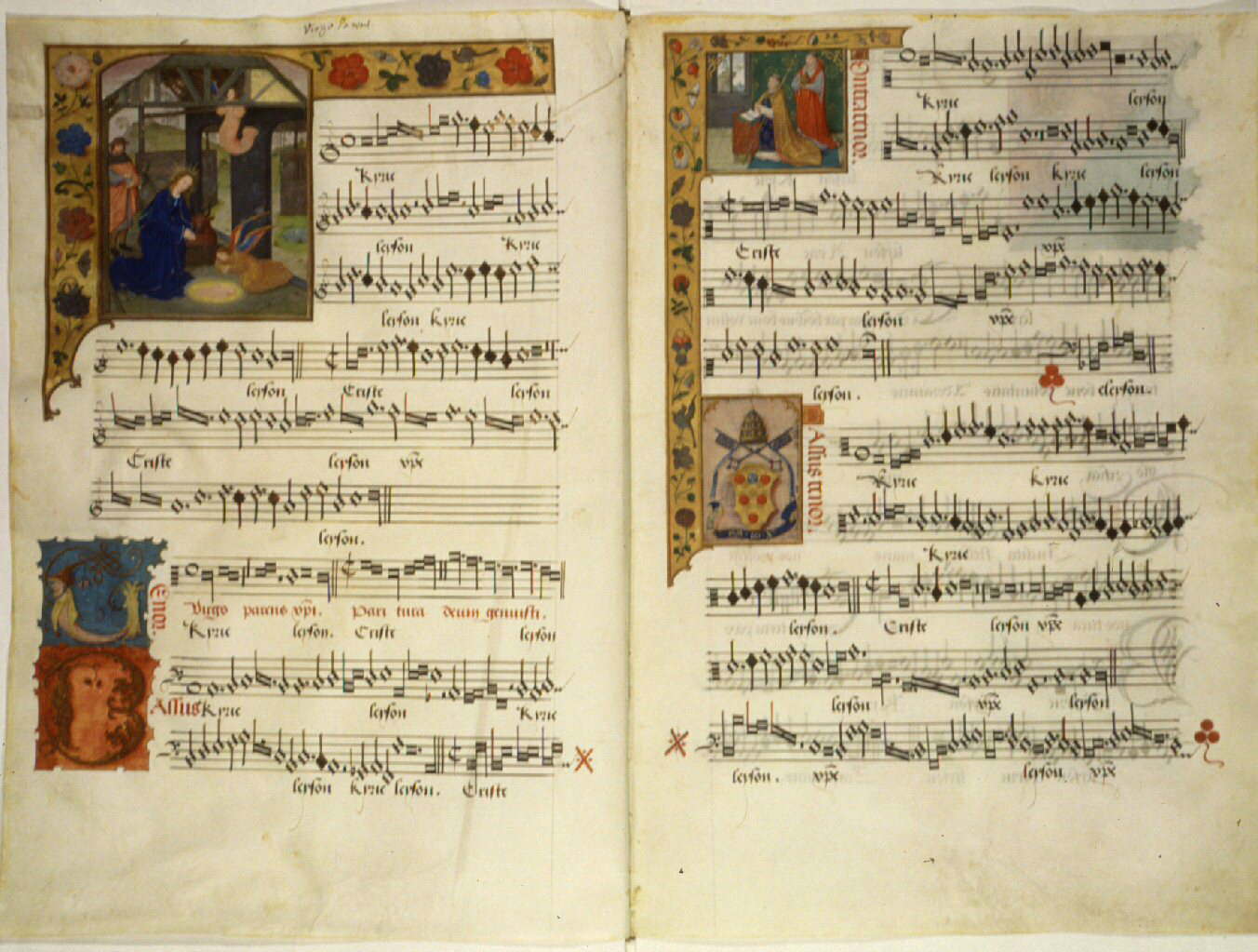
Mensural notation is the musical notation system used for polyphonic European vocal music from the late 13th century until the early 17th century. The term "mensural" refers to the ability of this system to describe precisely measured rhythmic durations in terms of numerical proportions amongst note values. Its modern name is derived from the terminology of medieval theorists, who used terms like musica mensurata ("measured music") or cantus mensurabilis ("measurable song") to refer to the rhythmically defined polyphonic music of their age, as opposed to musica plana or musica choralis, i.e., Gregorian plainchant. Mensural notation was employed principally for compositions in the tradition of vocal polyphony, whereas plainchant retained its own, older system of neume notation throughout the period. Besides these, some solely instrumental music could be written in various forms of instrument-specific tablature notation.
Mensural notation grew out of an earlier, more limited method of notating rhythms in terms of fixed repetitive patterns, the so-called rhythmic modes, which were developed in France around 1200. An early form of mensural notation was first described and codified in the treatise Ars cantus mensurabilis ("The art of measured chant") by Franco of Cologne (c. 1280). A much expanded system allowing for greater rhythmic complexity was introduced in France with the stylistic movement of the Ars nova in the 14th century, while Italian 14th-century music developed its own, somewhat different variant. Around 1400, the French system was adopted across Europe, and became the standard form of notation of the Renaissance music of the 15th and 16th centuries. Over the course of the 17th century, mensural notation gradually evolved into modern measure (or bar) notation.
The decisive innovation of mensural notation was the systematic use of different note shapes to denote rhythmic durations that stood in well-defined, hierarchical numerical relations to each other. While less context dependent than notation in rhythmic modes, mensural notation differed from the modern system in that the values of notes were still somewhat context-dependent. In particular, a note could have the length of either two or three units of the next smaller order, whereas in modern notation these relations are invariably binary. Whether a note was to be read as ternary ("perfect") or binary ("imperfect") was a matter partly of context rules and partly of a system of mensuration signs comparable to modern time signatures. There was also a complex system of temporarily shifting note values by proportion factors like 2:1 or 3:2. Mensural notation used no bar lines, and it sometimes employed special connected note forms (ligatures) inherited from earlier medieval notation. Unlike in the earliest beginnings of the writing of polyphonic music, and unlike in modern practice, mensural notation was usually not written in a score arrangement but in individual parts.
Mensural notation was extensively described and codified by contemporary theorists. As these writings, like all academic work of the time, were usually in Latin, many features of the system are still conventionally referred to by their Latin terms.
The system of note types used in mensural notation closely corresponds to the modern system. The mensural brevis is nominally the ancestor of the modern double whole note (breve); likewise, the semibrevis corresponds to the whole note (semibreve), the minima to the half note (minim), the semiminima to the quarter note (crotchet), and the fusa to the eighth note (quaver). Very rarely, mensural notation also used yet smaller subdivisions, such as the semifusa (corresponding to the sixteenth note or semiquaver). There were also two larger values, the longa (quadruple whole note or long) and the maxima (or duplex longa, called a large in Britain), which are no longer in regular use today.
Despite these nominal equivalences, each note had a much shorter temporal value than its modern counterpart. Between the 14th and 16th centuries, composers repeatedly introduced new note shapes for ever smaller temporal divisions of rhythm, and the older, longer notes were slowed down in proportion. The basic metrical relationship of a long to a short beat shifted from longa–breve in the 13th century, to breve–semibreve in the 14th, to semibreve–minim by the end of the 15th, and finally to minim–semiminim (i.e., half and quarter notes, or minim and crotchet) in modern notation. Thus, what was originally the shortest of all note values used, the semibreve, has become the longest note used routinely today, the whole note.
Originally, all notes were written in solid, filled-in form ("black notation"). In the mid-15th century, scribes began to use hollow note shapes ("white notation"), reserving black shapes only for the smallest note values. This change was probably motivated by the change from parchment to paper for the most common writing material, as paper was less suited to holding large dots of ink.
As with the notes, the shapes of the rest symbols in mensural notation are already similar to their modern descendants (with the smaller values being successively introduced in the course of the period of mensural notation). The rest symbols of the larger values had a clear visual logic reflecting their time durations, based on the breve rest being a vertical stroke the length of one staff space. For the longa rests, a visual distinction was made depending on whether the longa was imperfect (two breves long) or perfect. Accordingly, their signs were visually twice or three times the length of a breve rest respectively, while the semibreve rest was half that length. Maxima rests, in turn, were groups of two or three longa rests combined. If several longa rests followed each other, groups of either two or three of them were written together on the same staff line to indicate whether they were supposed to be grouped into perfect or imperfect maxima units. (The modern forms of the maxima and longa rests refer to their use in traditional multimeasure rests.)
Hub AI
Mensural notation AI simulator
(@Mensural notation_simulator)
Mensural notation
Mensural notation is the musical notation system used for polyphonic European vocal music from the late 13th century until the early 17th century. The term "mensural" refers to the ability of this system to describe precisely measured rhythmic durations in terms of numerical proportions amongst note values. Its modern name is derived from the terminology of medieval theorists, who used terms like musica mensurata ("measured music") or cantus mensurabilis ("measurable song") to refer to the rhythmically defined polyphonic music of their age, as opposed to musica plana or musica choralis, i.e., Gregorian plainchant. Mensural notation was employed principally for compositions in the tradition of vocal polyphony, whereas plainchant retained its own, older system of neume notation throughout the period. Besides these, some solely instrumental music could be written in various forms of instrument-specific tablature notation.
Mensural notation grew out of an earlier, more limited method of notating rhythms in terms of fixed repetitive patterns, the so-called rhythmic modes, which were developed in France around 1200. An early form of mensural notation was first described and codified in the treatise Ars cantus mensurabilis ("The art of measured chant") by Franco of Cologne (c. 1280). A much expanded system allowing for greater rhythmic complexity was introduced in France with the stylistic movement of the Ars nova in the 14th century, while Italian 14th-century music developed its own, somewhat different variant. Around 1400, the French system was adopted across Europe, and became the standard form of notation of the Renaissance music of the 15th and 16th centuries. Over the course of the 17th century, mensural notation gradually evolved into modern measure (or bar) notation.
The decisive innovation of mensural notation was the systematic use of different note shapes to denote rhythmic durations that stood in well-defined, hierarchical numerical relations to each other. While less context dependent than notation in rhythmic modes, mensural notation differed from the modern system in that the values of notes were still somewhat context-dependent. In particular, a note could have the length of either two or three units of the next smaller order, whereas in modern notation these relations are invariably binary. Whether a note was to be read as ternary ("perfect") or binary ("imperfect") was a matter partly of context rules and partly of a system of mensuration signs comparable to modern time signatures. There was also a complex system of temporarily shifting note values by proportion factors like 2:1 or 3:2. Mensural notation used no bar lines, and it sometimes employed special connected note forms (ligatures) inherited from earlier medieval notation. Unlike in the earliest beginnings of the writing of polyphonic music, and unlike in modern practice, mensural notation was usually not written in a score arrangement but in individual parts.
Mensural notation was extensively described and codified by contemporary theorists. As these writings, like all academic work of the time, were usually in Latin, many features of the system are still conventionally referred to by their Latin terms.
The system of note types used in mensural notation closely corresponds to the modern system. The mensural brevis is nominally the ancestor of the modern double whole note (breve); likewise, the semibrevis corresponds to the whole note (semibreve), the minima to the half note (minim), the semiminima to the quarter note (crotchet), and the fusa to the eighth note (quaver). Very rarely, mensural notation also used yet smaller subdivisions, such as the semifusa (corresponding to the sixteenth note or semiquaver). There were also two larger values, the longa (quadruple whole note or long) and the maxima (or duplex longa, called a large in Britain), which are no longer in regular use today.
Despite these nominal equivalences, each note had a much shorter temporal value than its modern counterpart. Between the 14th and 16th centuries, composers repeatedly introduced new note shapes for ever smaller temporal divisions of rhythm, and the older, longer notes were slowed down in proportion. The basic metrical relationship of a long to a short beat shifted from longa–breve in the 13th century, to breve–semibreve in the 14th, to semibreve–minim by the end of the 15th, and finally to minim–semiminim (i.e., half and quarter notes, or minim and crotchet) in modern notation. Thus, what was originally the shortest of all note values used, the semibreve, has become the longest note used routinely today, the whole note.
Originally, all notes were written in solid, filled-in form ("black notation"). In the mid-15th century, scribes began to use hollow note shapes ("white notation"), reserving black shapes only for the smallest note values. This change was probably motivated by the change from parchment to paper for the most common writing material, as paper was less suited to holding large dots of ink.
As with the notes, the shapes of the rest symbols in mensural notation are already similar to their modern descendants (with the smaller values being successively introduced in the course of the period of mensural notation). The rest symbols of the larger values had a clear visual logic reflecting their time durations, based on the breve rest being a vertical stroke the length of one staff space. For the longa rests, a visual distinction was made depending on whether the longa was imperfect (two breves long) or perfect. Accordingly, their signs were visually twice or three times the length of a breve rest respectively, while the semibreve rest was half that length. Maxima rests, in turn, were groups of two or three longa rests combined. If several longa rests followed each other, groups of either two or three of them were written together on the same staff line to indicate whether they were supposed to be grouped into perfect or imperfect maxima units. (The modern forms of the maxima and longa rests refer to their use in traditional multimeasure rests.)
Recent media