Hubbry Logo
Ars novaArs novaMain
Open search
Ars nova
Community hub
Ars nova
logo
8 pages, 0 posts
0 subscribers
Be the first to start a discussion here.
Ars nova
Ars nova
from Wikipedia

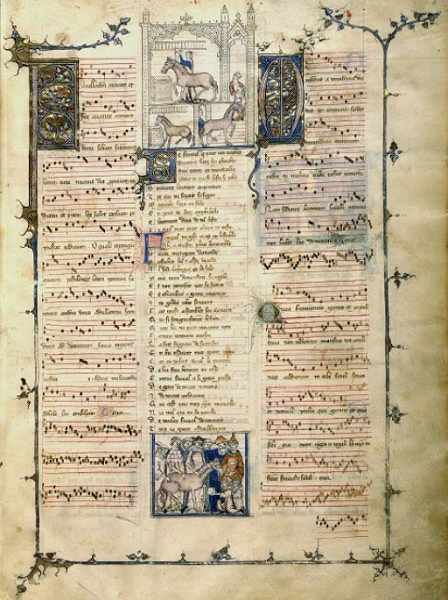
Page of the French manuscript Roman de Fauvel, Paris, B.N. Fr. 146 (c. 1318), "the first practical source of Ars nova music".[1]

Ars nova (Latin for 'new art')[2] refers to a musical style which flourished in the Kingdom of France and its surroundings during the Late Middle Ages. More particularly, it refers to the period between the preparation of the Roman de Fauvel (1310s) and the death of composer Guillaume de Machaut in 1377. The term is sometimes used more generally to refer to all European polyphonic music of the fourteenth century. For instance, the term "Italian ars nova" is sometimes used to denote the music of Francesco Landini and his compatriots, although Trecento music is the more common term for the contemporary 14th-century music in Italy. The "ars" in "ars nova" can be read as "technique", or "style".[3] The term was first used in two musical treatises, titled Ars novae musicae (New Technique of Music) (c. 1320) by Johannes de Muris, and a collection of writings (c. 1322) attributed to Philippe de Vitry often simply called "Ars nova" today.[4] Musicologist Johannes Wolf first applied to the term as description of an entire era (as opposed to merely specific persons) in 1904.[2]

The term ars nova is often used in juxtaposition to two other periodic terms, of which the first, ars antiqua, refers to the music of the immediately preceding age, usually extending back to take in the period of Notre Dame polyphony (from about 1170 to 1320). Roughly, then, ars antiqua refers to music of the thirteenth century, and the ars nova that of the fourteenth; many music histories use the terms in this more general sense.[2]

The period from the death of Machaut (1377) until the early fifteenth century, including the rhythmic innovations of the ars subtilior, is sometimes considered the end of, or late, ars nova but at other times an independent era in music.[2] Other musical periods and styles have at various times been called "new art." Johannes Tinctoris used the term to describe Dunstaple;[5] however, in modern historiographical usage, it is restricted entirely to the period described above.[2]

Versus ars antiqua

[edit]

Stylistically, the music of the ars nova differed from the preceding era in several ways. Developments in notation allowed notes to be written with greater rhythmic independence, shunning the limitations of the rhythmic modes which prevailed in the thirteenth century; secular music acquired much of the polyphonic sophistication previously found only in sacred music; and new techniques and forms, such as isorhythm and the isorhythmic motet, became prevalent. The overall aesthetic effect of these changes was to create music of greater expressiveness and variety than had been the case in the thirteenth century.[6][failed verification] Indeed, the sudden historical change which occurred, with its startling new degree of musical expressiveness, can be likened to the introduction of perspective in painting, and it is useful to consider that the changes to music in the period of the ars nova were contemporary with the great early Renaissance revolutions in painting and literature.[7]

The most famous practitioner of the new musical style was Guillaume de Machaut, who also had a distinguished career as a canon at Reims Cathedral and as a poet. The ars-nova style is evident in his considerable body of motets, lais, virelais, rondeaux and ballades.[8]

Towards the end of the fourteenth century, a new stylistic school of composers and poets centered in Avignon in southern France developed; the highly mannered style of this period is often called the ars subtilior, although some scholars have chosen to consider it a late development of the ars nova rather than separating it into a separate school. This strange but interesting repertory of music, limited in geographical distribution (southern France, Aragon and later Cyprus), and clearly intended for performance by specialists for an audience of connoisseurs, is like an "end note" to the entire Middle Ages.[9]

List of composers

[edit]
Composers of the ars nova style
Name Lifetime Works that survive Ref(s)
Philippe de Vitry 1291–1361 Many works [10]
Jehan de Lescurel fl. early 14th century Many ballades and rondeaus; two "Diz entez" [11]
Guillaume de Machaut c. 1300 – 1377 Substantial amount in various forms
Notably Messe de Nostre Dame, Ma fin est mon commencement and Rose, liz, printemps, verdure
[12]
P. des Molins fl. mid 14th century The ballade De ce que fol pensé and the rondeau Amis, tout dous vis [13]
Jehan Vaillant fl. 1360–1390 Three rondeau a ballades and virelai
Notably Par maintes foys
[14]
Grimace fl. mid-to-late 14th century Three ballades, a virelai and rondeau
Notably A l'arme A l'arme and Se Zephirus/Se Jupiter
[15]
F. Andrieu fl. late 14th century The (double) ballade Armes amours [16]
Briquet fl. early 15th century The rondeau Ma seule amour et ma belle maistresse [17]

Discography

[edit]
  • Chants du XIVème siècle. Mora Vocis Ensemble. France: Mandala, 1999. CD recording MAN 4946.
  • Denkmäler alter Musik aus dem Codex Reina (14./15. Jh.). Syntagma Musicum (Kees Otten, dir.). Das Alte Werk. [N.p.]: Telefunken, 1979. LP recording 6.42357.
  • Domna. Esther Lamandier, voice, harp, and portative organ. Paris: Alienor, 1987. CD recording AL 1019.
  • La fontaine amoureuse: Poetry and Music of Guillaume de Machaut. Music for a While, with Tom Klunis, narrator. Berkeley: 1750 Arch Records, 1977. LP recording 1773.
  • Guillaume de Machaut. Je, Guillaumes Dessus Nommez. Ensemble Gilles Binchois (Dominique Vellard, dir.). [N.p.]: Cantus, 2003. CD recording 9804.
  • Guillaume de Machaut. La Messe de Nostre Dame und Motetten. James Bowman, Tom Sutcliffe, countertenors; Capella Antiqua München (Konrad Ruhland, dir.). Das Alte Werk. Hamburg: Telefunken, 1970. LP recording 6.41125 AS.
  • Guillaume de Machaut. La messe de Nostre Dame; Le voir dit. Oxford Camerata (Jeremy Summerly, dir.). Hong Kong: Naxos, 2004. CD recording 8553833.
  • Guillaume de Machaut. Messe de Notre Dame. Ensemble Organum (Marcel Pérès, dir.). Arles: Harmonia Mundi, 1997. CD recording 901590.
  • Guillaume de Machaut. Messe de Notre Dame; Le lai de la fonteinne; Ma fin est mon commencement. Hilliard Ensemble (Paul Hillier, dir.). London: Hyperion, 1989.
  • Guillaume de Machaut. Motets. Hilliard Ensemble. Munich: ECM Records, 2004.
  • Philippe De Vitry and the Ars Nova—Motets. Orlando Consort. Wotton-Under-Edge, Glos., England: Amon Ra, 1990. CD recording CD-SAR 49.
  • Philippe de Vitry. Motets & Chansons. Sequentia (Benjamin Bagby and Barbara Thornton, dir.) Freiburg: Deutsche Harmonia Mundi, 1991. CD recording 77095-2-RC.
  • Roman de Fauvel. Jean Bollery (speaker), Studio der Frühen Musik (Thomas Binkley, dir.). Reflexe: Stationen europäischer Musik. Cologne: EMI, 1972. LP recording 1C 063-30 103.
  • Le roman de Fauvel. Anne Azéma (soprano, narration), Dominique Visse (countertenor, narration), Boston Camerata and Ensemble Project Ars Nova (Joel Cohen, dir.). France: Erato, 1995. CD recording 4509-96392-2.
  • The Service of Venus and Mars: Music for the Knights of the Garter, 1340–1440. Gothic Voices (Christopher Page, dir.). London: Hyperion, 1987. CD recording CDA 66238.
  • The Spirit of England and France I: Music of the Late Middle Ages for Court and Church. Gothic Voices (Christopher Page, dir.). London: Hyperion Records, 1994. CD recording CDA66739.
  • The Study of Love: French Songs and Motets of the 14th Century. Gothic Voices (Christopher Page, dir.). London: Hyperion Records, 1992. CD recording CDA66619.

Notes

[edit]

References

[edit]

Further reading

[edit]
Revisions and contributorsEdit on WikipediaRead on Wikipedia
from Grokipedia
Ars nova (Latin for "new art") was a transformative musical style that emerged in during the early , distinguished by groundbreaking innovations in rhythmic notation, mensuration, and polyphonic composition that expanded the expressive possibilities of . The term originated from a attributed to the and theorist , written around 1322, which outlined a new system for notating through precise divisions of note values into perfect (triple) and (duple) modes, including semibreves, minims, and semiminims. This period, spanning roughly from 1310 to 1370, marked a shift from the preceding era (c. 1150–1300), introducing greater rhythmic complexity and structural sophistication while building on established polyphonic traditions. Central to ars nova were advancements in mensural notation, which allowed composers to notate duple and triple subdivisions more flexibly, enabling intricate syncopation, hocket (alternating notes between voices), and isorhythm—a technique where a repeating rhythmic pattern (taleae) overlays a sustained melodic line (color) in motets. Philippe de Vitry (1291–1361) pioneered these elements, composing influential isorhythmic motets such as In arboris and Firmissime / Adesto, demonstrating notational prowess. The style's pinnacle was achieved by Guillaume de Machaut (c. 1300–1377), the era's most prominent figure, who perfected polyphonic forms like the motet and secular formes fixes (ballade, rondeau, virelai), and composed the first complete setting of the Ordinary of the Mass, Messe de Nostre Dame (c. 1364), for Reims Cathedral. Ars nova music reflected the cultural transitions of late medieval Europe, including the and growing secular influences, as seen in the satirical anthology Roman de Fauvel (1310–1314), which incorporated early ars nova compositions to lampoon societal vices. Despite papal opposition to rhythmic excesses in a 1324/1325 bull by , the style proliferated, fostering genres like the polyphonic and isorhythmic that bridged medieval and early practices. Its legacy endures in the evolution of Western notation and composition, influencing subsequent generations of musicians.

Historical Context

Origins in France

The Ars nova represented a pivotal stylistic shift in polyphonic music, emerging around 1310–1320 as composers sought to expand rhythmic possibilities beyond the modal system of the preceding . This "new art" emphasized greater notational precision and expressive freedom, particularly in sacred and secular vocal genres, reflecting broader cultural and intellectual ferment in late medieval . The movement's name derives directly from a seminal attributed to the and theorist , composed circa 1322, which formalized these innovations and gave the era its enduring label. This development unfolded against a backdrop of political and social upheaval that elevated music's societal function. The relocation of the papacy to in 1309 under established the city as a cosmopolitan hub, drawing scholars, artists, and musicians to its courts and chapels, where intertwined with liturgical and diplomatic activities. Later, the Black Death's devastation from 1347 to 1351 reshaped communal life, amplifying music's role in mourning, devotion, and renewal—evident in expanded repertoires that addressed themes of mortality and divine mercy. Vitry's Ars nova , one of the earliest theoretical works to codify these changes, introduced proportional notation techniques that permitted duple and triple mensuration—allowing composers to divide musical time into binary or ternary units with flexible proportions. This innovation broke from the predominantly triple-based rhythms of earlier practices, enabling more intricate layering of and . The , preserved primarily in a Vatican manuscript (Barberini 307), along with related versions across European libraries, underscores its influence on subsequent theorists like Johannes de Muris. Paris and Avignon emerged as primary centers for Ars nova cultivation, with 's university fostering academic discourse on notation and among clerics and intellectuals, while 's papal court supported elaborate polyphonic performances in cathedrals and palaces. These locales hosted vibrant exchanges, blending traditions with emerging secular influences from aristocratic patronage. A key catalyst in the 1310s was the resurgence of motet composition, where Vitry's works pioneered isorhythmic techniques—repetitive rhythmic patterns (talea) overlaid on melodic sequences (color) to achieve structural cohesion amid textural complexity. Motets like In arboris / Tuba sacre fidei / Virgo sum exemplify this approach, integrating sacred Latin texts with vernacular elements to comment on contemporary events, thus embedding musical innovation within social and political narratives.

Transition from Ars Antiqua

The , dominant in 13th-century European , emphasized modal rhythms based on fixed patterns using the longa, brevis, and semibrevis as primary note values, alongside relatively simpler forms of such as and early motets. This style, codified in Franco of Cologne's Ars cantus mensurabilis (c. 1260), relied on a system of that prioritized triple divisions (perfection) within rhythmic modes, limiting flexibility in and subdivision. In contrast, the Ars nova emerged as a deliberate stylistic rupture, rejecting the rigid triple-meter framework of the in favor of more fluid duple and triple divisions of notes, which facilitated advanced techniques like and for greater expressive rhythmic complexity. This shift allowed composers to notate smaller note values (e.g., minims) and introduce imperfection more freely, breaking away from the modal constraints that had governed earlier . Theoretical debates underscored this transition, with Johannes de Muris's Ars novae musicae (1319–1321) offering a pointed critique of the 's limitations in handling rhythmic nuance and polyphonic independence, advocating instead for mensural innovations that better supported the evolving demands of composition. The change unfolded gradually: motets from around 1300 often blended hybrid modalities with emerging Ars nova elements, such as tentative duple subdivisions, evolving into a fully realized Ars nova style by the 1320s as seen in treatises and manuscripts from . A representative example of this evolution appears in the comparison between Pérotin's organa from the late 12th to early , which adhered to strict modal rhythms in triple patterns for sustained, chant-based , and the early motets of in the 1310s–1320s, where rhythmic freedom through duple mensuration and created more dynamic, layered textures.

Spread to Italy and the Trecento

The Ars nova style, originating in around 1320, began influencing Italian music through notational and rhythmic innovations transmitted via manuscripts and traveling musicians shortly thereafter. The (1309–1377), serving as a major cultural crossroads between and , played a pivotal role in this exchange by hosting Franco-Italian composers and fostering hybrid motets that blended elements from both traditions. These interactions introduced French mensural techniques to Italian courts, marking the initial adaptation of Ars nova principles in the peninsula. By the 1330s, Ars nova elements had taken root in northern Italian urban centers, flourishing particularly between 1330 and 1370 in cities such as and , where secular thrived under patronage from merchant guilds and civic leaders. Manuscripts from this period, including early fragments datable to around 1330, document the rapid integration of French rhythmic notation into Italian practices, supporting a vibrant local evolution known as the Trecento. This era saw the style's peak in courtly and urban settings, with polyphonic compositions reflecting Italy's growing emphasis on expression. In , Ars nova adapted with a stronger focus on secular genres, such as the —a two-voice form with strophic structure and poetic texts—and the caccia, a canonic piece often depicting hunting scenes or daily life, diverging from the more structurally rigid isorhythmic motets prevalent in . These forms prioritized melodic flow and textual clarity over complex rhythmic repetition, incorporating Italian poetic meters like the while retaining French-derived mensuration for polyphonic interplay. The ballata, another key genre, further emphasized dance-like rhythms suited to Italian tastes, highlighting the Trecento's shift toward accessible, narrative-driven . Theoretical works codified these adaptations, notably Prosdocimo de' Beldomandi's Tractatus practicae cantus mensurabilis ad modum ytalicorum (c. 1408), which systematically described Italian mensural notation, including void notes and proportional signs derived from Ars nova innovations. Earlier treatises, such as Marchettus da Padova's Pomerium (c. 1318), had already bridged French and Italian systems by outlining rhythmic modes tailored to local practices. These texts provided a framework for notating the Trecento's distinctive polyphony, ensuring the style's technical dissemination across Italy. Regional variations marked the Trecento's development, with northern Italy—particularly around , , and —exhibiting stronger French-influenced through direct manuscript imports and performer exchanges. In contrast, southern regions showed subtler integrations, with hints of Ars subtilior complexity emerging in late-century works influenced by Avignon's orbit, though overall activity remained sparser than in the north. This north-south divide reflected differing networks, with northern cities driving the style's most prolific output.

Musical Innovations

Notation and Rhythmic Complexity

The Ars nova period marked a significant advancement in , particularly through the development of proportional notation, which allowed for precise rhythmic divisions beyond the modal system of the . This system employed the minima as the basic unit, with semibreves typically divided into two or three minims, enabling composers to notate duple and triple subdivisions with greater flexibility. Colored notes further facilitated these distinctions: black notation generally signified perfect (triple) divisions, while red or void (unfilled) notes indicated (duple) divisions, such as tempus imperfectum, allowing shifts between binary and ternary rhythms within a single composition. Mensuration signs were introduced to systematize these rhythmic hierarchies, specifying the division of larger note values into smaller ones across multiple levels. Tempus denoted the division of the breve into semibreves—perfect tempus as three (circular sign or three strokes) or imperfect as two ( or two strokes)—while prolation governed the semibreve's subdivision into minims, major prolation as three or minor as two, yielding four primary mensurations. This framework, outlined in Philippe de Vitry's treatise Ars nova (c. 1322), permitted binary and ternary patterns at every level, from the long to the semiminima, contrasting the Ars antiqua's rigid modal patterns and enabling more varied metric structures. A hallmark of Ars nova rhythmic innovation was , a technique structuring the voice through repeating units of talea (rhythmic pattern) and color (pitch sequence), often extending across the entire piece. In Vitry's Tuba sacre fidei/In arboris/Virgo sum (c. 1320), the draws from the "Virgo sum," with the color repeating the melodic fragment while the talea cycles a fixed , such as patterns of minims and semiminima, creating layered repetition independent of the upper voices' texts. This separation allowed for extended durations and structural unity, as the talea could repeat multiple times over a single color, fostering complexity without melodic redundancy. Syncopation emerged as a key expressive tool, achieved by displacing accents through rests, ligatures, and conflicting mensurations between voices. Rests were formally defined to interrupt perfect or imperfect divisions, while ligatures—groups of notes—could alter durations via "imperfection" (e.g., a following note imperfecting a preceding one) or "alteration" (extending a minim in ternary prolation to equal two), contrasting the Ars antiqua's aligned, modal rhythms. These techniques, as in motets with superimposed duple and triple patterns, created rhythmic tension and propulsion. Manuscript evidence, such as the Codex (Biblioteca Capitolare, Ivrea, c. 1360), illustrates the evolution of these practices, containing 37 motets (34 in Ars nova style) notated with mensuration signs, colored notes, and isorhythmic structures like those in "Febus mundo – Lanista vipereus – Cornibus," reflecting a transition to more sophisticated proportional systems. This codex, a for French Ars nova motets, demonstrates the widespread adoption and refinement of Vitry's innovations in rhythmic notation.

Forms and Genres

The emerged as the preeminent of the Ars nova, characterized by its polyphonic structure with two or more texted upper voices typically set to French or Italian , superimposed over a slower-moving derived from plainchant or secular . This form allowed for intricate rhythmic layering, culminating in the isorhythmic motet, where the employs repeating melodic patterns (color) and rhythmic units (talea) that extend across the entire piece, often spanning multiple voice entries for structural unity. Such innovations enabled composers like to create elaborate, symbolic works that blended sacred and secular elements, as seen in early examples like Tribum/Quoniam/MERITO. Secular chansons represented a vital counterpart to , adopting the formes fixes—standardized poetic-musical structures that emphasized symmetry and . The ballade, a common subtype, followed an ABBA rhyme scheme with an ouvert (open) first and clos (closed) subsequent ones, typically in two or three voices with the upper voice carrying the text; this form suited themes and influenced later phrase structures in European song. The rondeau, another key variant, featured a circular design with a bookending two s (AB aA ab AB), often monophonic in earlier examples but evolving to , as in Guillaume de Machaut's settings that highlight melodic refinement over rhythmic complexity. These genres drew on notational advances like to support their repetitive schemata. Early polyphonic settings of the Mass Ordinary marked a significant development in Ars nova sacred music, laying groundwork for the later cyclic mass by unifying movements through shared tenors or stylistic traits. Composers began composing individual sections like the , Gloria, , , and in three-voice , with isorhythmic techniques applied to tenors for coherence; Machaut's (c. 1365) stands as the earliest surviving complete such setting by a single known author, featuring consistent four-voice texture and Marian motifs. These works transitioned from isolated motet-like movements to more integrated liturgical compositions, reflecting growing sophistication in polyphonic worship music. In Italy, the Trecento period adapted Ars nova influences to vernacular forms, producing lighter, more lyrical genres suited to secular performance. The ballata, structured as AAB with a refrain after each stanza, resembled the French virelai but emphasized dance-like rhythms and florid upper voices, as in Francesco Landini's pieces from the Faenza Codex. The madrigal divided into two sections per stanza—a poetic terzetti followed by a ritornello—allowing for textual contrast and rhythmic play in two voices, exemplified by Jacopo da Bologna's Osellecto selvaggio. The caccia, a canonic form evoking pursuit, featured two voices in strict imitation over an untexted tenor, often depicting hunts or chases with programmatic texts and occasional hocket effects. Hybrid genres like the virelai and lai blended narrative elements with rhythmic experimentation, bridging monophonic traditions and polyphony. The virelai employed a refrain-stanza-refrain (AB ba AB) form, often in two voices with the lower providing harmonic support, as in Machaut's En mon cuer where cadences enhance the cyclical return. The lai, more expansive and narrative-driven, consisted of irregular stanzas with varying line lengths, appearing in polyphonic guises in sources like the Roman de Fauvel and allowing for elaborate melodic unfolding akin to the motet. These forms highlighted Ars nova's versatility in fusing poetic storytelling with musical architecture.

Text-Music Relationships

In Ars nova music, composers achieved a close alignment between musical rhythms and the prosody of poetic texts, particularly in French and Italian vernacular works, by matching note durations to counts and natural accents to enhance textual clarity and emotional expression. This prosodic sensitivity is evident in Guillaume de Machaut's ballades, where rhythmic patterns conform to the metrical structure of the poetry, often employing hocket-like alternations between voices to emphasize key phrases and create a sense of that mirrors the text's flow. For instance, in Machaut's , the melody's phrasing subtly varies to accommodate the rondeau's repeating , ensuring that accents fall on stressed s for a naturalistic declamation. Multilingual motets in the Ars nova tradition layered texts across voices to produce symbolic and interpretive depth, with the tenor typically drawn from Latin liturgical sources while upper voices featured vernacular French poems, allowing for contrasts between sacred authority and secular commentary. Philippe de Vitry's motets exemplify this, as in Phi millies/O creator, where the Latin tenor evokes biblical imagery from Daniel, contrasted with French upper voices critiquing contemporary poetic failings, thereby creating ironic or political layers that invite multiple readings. This polytextuality not only highlighted linguistic registers but also enabled subtle social critique, such as allusions to ecclesiastical corruption, without direct confrontation. Isorhythmic structures in Ars nova motets often symbolized textual themes through repetitive patterns that evoked , divine order, or legalistic precision, aligning the music's cyclical talea with conceptual motifs in the . In Vitry's Tuba sacre/In Arboris/VIRGO SUM, the isorhythmic tenor's periodic repetitions mirror themes of natural cycles and Marian devotion, using coloration to denote shifts that parallel the text's allusions to cosmic harmony. Similarly, Machaut's Felix virgo/Inviolata/AD TE SUSPIRA-MUS employs a 32-note color divided by a 12-note talea, reinforcing the Latin tenor's prayerful repetition as a musical of perpetual . The distinction between secular and sacred compositions in Ars nova highlighted differing approaches to text-music integration, with chansons prioritizing melodic contours that followed narrative arcs for emotional immediacy, while motets favored intellectual polytextuality for layered meaning. In secular forms like Machaut's virelais, undulating melodies trace the text's amorous or reflective paths, fostering intimacy through prosodic fidelity, as opposed to the motets' contratenor additions that complicate sacred Latin tenors with vernacular overlays for allegorical effect. Text underlay techniques in Ars nova manuscripts adapted principles of syllable-to-note alignment to accommodate rhythmic complexity, influencing later practices and evident in instrumental intabulations like those in the (c. 1400), where vocal originals' prosodic cues guide embellishments despite the absence of full texts. These underlays ensured that melodic diminutions respected original accentuations, bridging vocal and realms in Trecento-style works.

Major Composers and Works

Philippe de Vitry and Early Figures

(1291–1361) was a French composer, poet, music theorist, and diplomat whose multifaceted career significantly shaped the emergence of the Ars nova style in early fourteenth-century music. Born in Champagne, he studied at the Sorbonne and pursued ecclesiastical roles, eventually becoming bishop of in 1351, while serving in royal courts under figures like Philip VI and . His diplomatic missions involved extensive travels between and , including visits to the papal court in by 1350, where he represented French interests and fostered musical exchanges that bridged regional traditions. These journeys positioned him at the intersection of French and Italian developments, contributing to the dissemination of Ars nova innovations across Europe. Vitry's theoretical writings, notably the treatise Ars nova (c. 1322, attributed to Vitry), played a foundational role in standardizing and enabling greater rhythmic complexity, such as the introduction of colored notes to distinguish note values. This work influenced the transition from the modal rhythms of the to , allowing composers to explore duple and triple divisions of the beat with precision. At the papal court, Vitry's involvement extended to composing music for liturgical and ceremonial contexts, where his motets supported diplomatic and religious functions, reinforcing his status as a key innovator in polyphonic practice. Only 10 to 12 motets attributed to Vitry survive, preserved in manuscripts like the Roman de Fauvel and the Ivrea Codex, showcasing his mastery of isorhythmic structures that repeat rhythmic patterns (talea) and melodic sequences (color) independently. For instance, Firmissime/Adesto employs double isorhythm, where both the tenor and upper voices feature coordinated repeating patterns, creating a layered texture that heightens contrapuntal tension while maintaining structural unity; this technique exemplifies Vitry's push toward more intricate polyphony in motets. Similarly, the motet Tuba sacre fidei/In arboris/Virgo sum demonstrates a sophisticated structure with an isorhythmic tenor drawn from a Gregorian chant, overlaid with French and Latin texts that contrast earthly and divine themes, allowing for rhythmic variation without disrupting the overall form. These works highlight Vitry's emphasis on symbolic and intellectual depth, where notation served not just technical ends but also expressive and allegorical purposes. Another key early figure was Johannes de Muris (c. 1290–1351), whose theoretical works on complemented Vitry's innovations and who composed several isorhythmic motets, such as Rota versat / Falkni / Quoniam.

Guillaume de Machaut

Guillaume de Machaut (c. 1300–1377) was a French poet and composer who emerged as the foremost figure of the Ars nova, blending literary and musical artistry in a career marked by service to European nobility. Born in the Champagne region near , he began his professional life around 1323 as a clerical secretary to John of Luxembourg, King of Bohemia, accompanying him on military campaigns across until John's death in 1346. Later, Machaut entered the orbit of the French royal family, serving as a courtier to Bonne of Luxembourg (John's daughter and wife of King John II of France) and eventually dedicating works to King Charles V, while securing a canonry at by 1340, though he never took priestly orders. His semi-autobiographical poem Le Voir Dit (c. 1363–1365) chronicles a purported late-life romance with a young admirer, Péronne d'Armentières, weaving personal reflection with poetic fiction to document his experiences amid the and the . Machaut's oeuvre represents the pinnacle of Ars nova musical output, encompassing sacred and secular genres that showcase rhythmic sophistication and structural elegance. His (c. 1360s), the earliest complete setting of the Ordinary of the by a single composer, features four-voice polyphony with isorhythmic tenors in the Gloria, , and , marking a milestone in liturgical composition. In , he composed 23 motets, often isorhythmic, and approximately 42 in fixed forms such as ballades and rondeaux, alongside 21 rondeaux, 33 chanson balladées, and 19 lais, with music applied to over 100 of his French poems overall. These works, preserved in author-supervised compilations, reflect his role in synthesizing poetic narrative with musical expression, as seen in his lais where monophonic and polyphonic sections alternate to enhance . Machaut's innovations elevated the Ars nova's emphasis on balanced polyphony and formal precision, particularly in his fixed-form chansons, where equal-voiced textures and syncopated rhythms create interplay between duple and triple meters, departing from the more hierarchical structures of earlier polyphony. In his narrative lais, he integrated music and poetry through symmetrical stanzaic designs—typically 12 stanzas with repetition of the first and last for closure—introducing polyphony in select examples like Le Lay de la Fonteinne (Lai 16), which shifts from monophony to a three-voice canon, thereby fusing melodic elaboration with textual drama. His motets, while rooted in isorhythmic techniques, occasionally incorporate French texts in upper voices, bridging sacred and vernacular traditions without fully resolving their expressive tensions. Machaut's legacy endures through his meticulously produced manuscripts, which served as deluxe vehicles for his and were commissioned for royal patrons, featuring lavish illuminations and careful organization to present him as a unified author of and . Seven primary manuscripts (labeled A–G) survive, including the comprehensive MS-A (Paris, , MS français 1586), which arranges his output thematically and mirrors his . These codices, often executed in the 1350s–1370s, highlight Ars nova's shift toward personalized artistic presentation, with miniatures depicting courtly scenes that contextualize his chansons and lais. A representative example of Machaut's structural mastery is the rondeau Rose, liz, printemps, verdure (R. 10), a four-voice piece that exemplifies the genre's refrains through textual repetition—"Rose, liz, printemps, verdure / Si com je sui en ma pensée"—framing a symmetrical AB aAab AB structure where the voices interweave in balanced , with melismas at cadences underscoring the springtime of renewal. This work, present in all supervised sources, demonstrates his refinement of the rondeau form, using rhythmic and hocketing to heighten the poetic cycle's emotional arc.

Italian Composers

The Italian adaptation of Ars nova principles during the Trecento period emphasized , particularly in genres like the ballata and , with composers drawing on French rhythmic innovations while prioritizing melodic fluency and poetic expression. Key figures emerged in and , blending polyphonic textures with local idioms to create a distinct regional style. Francesco Landini (c. 1325–1397), a blind and the son of the painter Jacopo del Casentino, stands as the most prolific Italian composer of the era, active primarily in and associated with the church of San Lorenzo. He composed over 140 ballate, along with madrigals and a few sacred works, showcasing a synthesis of French Ars nova elements like and isorhythmic patterns with Italian melodic grace; his ballata Non avrà ma più exemplifies subtle ars subtilior influences through intricate rhythmic ornamentation and melodic parallelism. Another representative piece, the three-voice ballata Questa fanciulla, Amor, highlights his rhythmic vitality in vernacular settings, where the text's emotional pleas are mirrored by flowing lines and cadential resolutions typical of Trecento lyricism. Jacopo da Bologna (fl. 1340s), one of the earliest named Trecento composers, bridged French and Italian styles through his s and cacce, which incorporated Ars nova notational precision while favoring Italian poetic forms. His Non al suo amante, set to a Petrarchan text, features a structured ABA BCB CC form with rhythmic fluency that underscores semantic expression, marking an early adaptation of polyphonic techniques to Italian humanism. Other notable figures include Magister Piero (c. 1370), whose works like the Deh che vien' reflect the first generation's experimental secular , and Lorenzo Masini (fl. 1350s; d. 1373), a Florentine canon at San Lorenzo who focused on secular compositions in the second Trecento generation. These composers contributed to the era's emphasis on three-voice textures and idiomatic instrumental elements, as preserved in the Squarcialupi Codex (c. 1410–1415), a lavishly compiling over 350 pieces by Italian masters, including Landini, Jacopo, Piero, and Masini, which documents the evolution of polyphonic .

Cultural and Social Impact

Patronage and Performance

The Ars nova style flourished under the of European nobility and the papacy, particularly during the (1309–1377), where popes such as Clement VI actively supported musical innovation by recruiting composers and theorists associated with the new rhythmic and notational techniques. In , courtly patrons from the aristocracy provided crucial financial and social backing; for instance, received sustained support from John of Luxembourg, King of , from 1323 until the king's death in 1346, enabling Machaut to compose works honoring his patron while traveling in his service. This noble patronage extended to other figures, such as , whose treatise Ars nova (c. 1322) reflected the intellectual environment of royal and princely courts, where music served to enhance prestige and diplomatic ties. In , the Trecento phase of Ars nova benefited from similar aristocratic support, with composers like finding patrons among Florentine guilds and noble families, though the style's dissemination relied heavily on localized networks rather than centralized papal influence. Performance contexts for Ars nova music spanned liturgical and secular spheres, with sacred works often executed in cathedrals and by professional choirs, while secular genres like the and ballade were performed at banquets, tournaments, and entertainments. choirs, comprising clerics and trained singers, handled polyphonic motets and settings in settings, emphasizing vocal precision to convey theological depth. Minstrels, itinerant or court-attached performers, played a key role in secular venues, adapting pieces for mixed ensembles and contributing to the style's spread across regions through oral transmission and . Instruments began to integrate more prominently into performances during this period; the emerged in liturgical to support vocal lines in cathedrals, while the featured in secular settings, often accompanying motets or to add timbral variety without overpowering the voices. Vocal ensembles remained central for motets, typically involving three or four singers to realize the intricate isorhythmic structures. Gender dynamics in Ars nova patronage and performance reflected broader medieval norms, with women largely excluded from professional performing roles due to clerical and guild restrictions, confining them to amateur or domestic singing in noble households. However, noblewomen served as influential patrons, particularly in Italian courts; for example, figures like Caterina Visconti in Milan supported Trecento composers, commissioning works that aligned with courtly ideals of refinement and fostering the genre's development through manuscript commissions. Economic factors shaped the production and survival of Ars nova music, as manuscript copying—undertaken by specialized scribes in scriptoria or court ateliers—incurred high costs for vellum, ink, and labor, limiting dissemination to elite patrons who could afford illuminated codices. The Black Death of 1348 severely disrupted this continuity, decimating urban populations including scribes and performers, which slowed manuscript production and shifted musical activity toward surviving rural and ecclesiastical centers, though the plague's demographic impact ultimately concentrated resources among fewer, wealthier patrons.

Influence on Later Periods

The Ars subtilior, emerging around 1370 and lasting until about 1400, represented a direct evolution of the Ars nova through its intensification of rhythmic and notational experimentation, pushing the boundaries of to achieve unprecedented complexity in polyphonic songs. This style, centered in southern French and Italian courts such as those of the Visconti and , featured extreme , proportional mensurations (e.g., sesquialtera and sesquitertia), and ornate note forms that often exceeded practical performance limits, as seen in the motets of Solage, such as Fumeux fumeux, where intricate rhythmic patterns symbolize thematic content like smoke's transience. Building on Ars nova's innovations in duple and triple divisions, Ars subtilior composers like Jacob de Senleches and Antonello de Caserta refined these techniques for expressive ends, incorporating visual and symbolic elements in notation that reflected elite patronage during the Great Schism. The Ars nova's rhythmic and structural advancements laid essential groundwork for the early , particularly in the development of cyclic masses and imitative by composers such as Guillaume Dufay and . Dufay, active in the early , extended Ars nova isorhythmic s—featuring repeating melodic (color) and rhythmic (taleae) patterns—into grander forms, as in his motet , which employs proportional structures in its voice parts echoing Ars nova mensuration. This paved the way for Josquin's mature cyclic masses, where imitative evolved from Ars nova's layered textures, emphasizing text expression and voice equality in works like the Missa L'homme armé. Through these evolutions, Ars nova notation and polyphonic principles became foundational to the Burgundian school's chansons, preserving fixed forms like the rondeau and ballade schemata in lighter, more homorhythmic settings. English music of the early 15th century also bore the imprint of Ars nova via cultural exchanges at , the papal seat during the , where French styles influenced composers like John Dunstable. Dunstable adopted isorhythmic techniques and syncopated rhythms from Ars nova motets, integrating them into his motets and masses, such as Veni sancte spiritus, which blended continental complexity with English consonance, facilitating the "contenance angloise" style's spread back to the continent. By the 1380s, the Ars nova began to decline amid the disruptions of the Great Schism (1378–1417), which fragmented patronage and shifted musical centers, though its persisted as the standard into the , enabling the polyphonic expansions of the . The isorhythmic legacy endured specifically in Johannes Ockeghem's masses, where structural repetition and techniques recalled Ars nova's organizational rigor, as in the Missa prolationum, with its proportional canons deriving from earlier rhythmic innovations.

Modern Interpretations

The revival of music began in the early with scholarly editions that made medieval manuscripts accessible, notably through Johannes Wolf's 1904 publication Geschichte der Mensural-Notation von 1250–1460, which popularized the term "Ars nova" to describe the historical period's rhythmic innovations and provided transcriptions of key works. This effort aligned with broader musicological interest in historical notation but remained limited to academic circles until the post-World War II movement, which spurred widespread performances and recordings as part of a global push for authentic historical practices led by ensembles and scholars in and . Key 20th- and 21st-century scholars have deepened understanding of Ars nova through focused analyses of its composers and structures. Daniel Leech-Wilkinson, in his 2002 book The Modern Invention of Medieval Music: Scholarship, Ideology, Performance, examines how modern interpretations of Guillaume de Machaut's works reflect ideological biases in editing and performance, arguing that 20th-century editions often imposed Romantic-era aesthetics on the repertory. Margaret Bent has advanced studies of Ars nova notation, particularly in her contributions to Music and Letters, where she critiques the term "Ars nova" as encompassing evolving mensural systems and symbolic uses in motets, emphasizing their role in conveying structural complexity beyond mere rhythm. Performance practices for Ars nova music remain debated, particularly regarding tempi and , as medieval sources lack explicit instructions, leading ensembles to balance proportional theories from treatises like those of with acoustic reconstructions. Discussions on often center on isorhythmic patterns, with some advocating slower, contemplative speeds to highlight rhythmic layering, while others favor faster rates based on influences; pronunciation debates include whether to employ reconstructed 14th-century French phonetics or modern approximations, avoiding the uvular 'r' sound in favor of alveolar articulation for authenticity. Ensembles like Ensemble Organum, founded by Marcel Pérès in 1982, exemplify these approaches through performances emphasizing modal and spatial acoustics, as in their rendition of Machaut's Messe de Notre Dame. Landmark recordings have popularized Ars nova, with the Hilliard Ensemble's 1989 release of Machaut's Messe de Notre Dame on setting a standard for clear, unaccompanied that influenced subsequent interpretations. More recent efforts include digital reconstructions, such as the HeSoAN project (ongoing since 2020), which uses virtual acoustics to simulate 14th-century performance spaces for Ars nova motets, allowing interactive exploration of sonic environments. Current trends in Ars nova reception blend historical fidelity with innovation, as seen in contemporary compositions nodding to its techniques; for instance, incorporated isorhythmic patterns in works like his 1991–1994 Viola Sonata, drawing from Ars nova's repetitive structures to create micropolyphonic textures, as analyzed in scholarly examinations of his medieval influences. Digital analysis tools further this revival, with projects like Measuring Polyphony providing machine-readable encodings of Ars nova manuscripts since 2016, enabling computational studies of rhythmic patterns and aiding performers in transcription. The European Ars Nova project (2019–2024), funded by the ERC, offers a digital critical edition of polyphonic sources, facilitating multilingual text-music and open-access .

References

Add your contribution
Related Hubs
User Avatar
No comments yet.