


Community hub
Recent from talks
Contribute something to knowledge base
Content stats: 0 posts, 0 articles, 1 media, 0 notes
Members stats: 0 subscribers, 0 contributors, 0 moderators, 0 supporters
Subscribers
Supporters
Contributors
Moderators
Hub AI
Neume AI simulator
(@Neume_simulator)
Hub AI
Neume AI simulator
(@Neume_simulator)
Neume
A neume (/njuːm/; sometimes spelled neum) is the basic element of Western and some Eastern systems of musical notation prior to the invention of five-line staff notation.
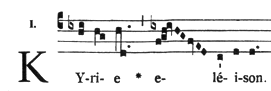
The earliest neumes were inflective marks that indicated the general shape but not necessarily the exact notes or rhythms to be sung. Later developments included the use of heightened neumes that showed the relative pitches between neumes, and the creation of a four-line musical staff that identified particular pitches. Neumes do not generally indicate rhythm, but additional symbols were sometimes juxtaposed with neumes to indicate changes in articulation, duration, or tempo. Neumatic notation was later used in medieval music to indicate certain patterns of rhythm called rhythmic modes, and eventually evolved into modern musical notation. Neumatic notation remains standard in modern editions of plainchant.
The word neume entered the English language in the Middle English forms newme, nevme, neme in the 15th century, from the Middle French neume, in turn from either medieval Latin pneuma or neuma, the former either from ancient Greek πνεῦμα pneuma ('breath') or νεῦμα neuma ("sign"), or else directly from Greek as a corruption or an adaptation of the former.[citation needed]
Although chant was probably sung since the earliest days of the church, for centuries it was transmitted only orally.
The earliest known systems involving neumes are of Aramaic origin and were used to notate inflections in the quasi-emmelic (melodic) recitation of the Christian holy scriptures. As such they resemble functionally a similar system used for the notation of recitation of the Qur'an, the holy book of Islam. This early system was called ekphonetic notation, from the Greek ἐκφώνησις ekphonesis meaning quasi-melodic recitation of text.
Around the 9th century neumes began to become shorthand mnemonic aids for the proper melodic recitation of chant. A prevalent view is that neumatic notation was first developed in the Eastern Roman Empire.[citation needed] This seems plausible given the well-documented peak of musical composition and cultural activity in major cities of the empire (now regions of southern Turkey, Syria, Lebanon and Israel) at that time. The corpus of extant Byzantine music in manuscript and printed form is far larger than that of the Gregorian chant, due in part to the fact that neumes fell into disuse in the west after the rise of modern staff notation and with it the new techniques of polyphonic music, while the Eastern tradition of Greek orthodox church music and the reformed neume notation remains alive today.
Slavic neume notations ("Znamenny Chant") are on the whole even more difficult to decipher and transcribe than Byzantine or Gregorian neume notations.[citation needed]
The earliest Western notation for chant appears in the 9th century. These early staffless neumes, called cheironomic or in campo aperto, appeared as freeform wavy lines above the text. Various scholars see these as deriving from cheironomic hand-gestures, from the ekphonetic notation of Byzantine chant, or from punctuation or accent marks. Each syllable of the text had a corresponding neume that indicated the note pattern to be sung. This could simply be a single note, or one of a number of melodic patterns. Cheironomic neumes indicated changes in pitch and duration within each syllable, but did not specify the pitches of individual notes, the intervals between pitches within a neume, or the relative starting pitches of different syllables' neumes. They were mnemonics, reminding singers of how the melody was sung, but do not contain enough information to reconstruct the actual music. For this reason, a significant quantity of early western plainchant, such as the Mozarabic chant of the Iberian peninsula, can only be reconstructed conjecturally because it survives only as cheironomic neumes.
Neume
A neume (/njuːm/; sometimes spelled neum) is the basic element of Western and some Eastern systems of musical notation prior to the invention of five-line staff notation.
The earliest neumes were inflective marks that indicated the general shape but not necessarily the exact notes or rhythms to be sung. Later developments included the use of heightened neumes that showed the relative pitches between neumes, and the creation of a four-line musical staff that identified particular pitches. Neumes do not generally indicate rhythm, but additional symbols were sometimes juxtaposed with neumes to indicate changes in articulation, duration, or tempo. Neumatic notation was later used in medieval music to indicate certain patterns of rhythm called rhythmic modes, and eventually evolved into modern musical notation. Neumatic notation remains standard in modern editions of plainchant.
The word neume entered the English language in the Middle English forms newme, nevme, neme in the 15th century, from the Middle French neume, in turn from either medieval Latin pneuma or neuma, the former either from ancient Greek πνεῦμα pneuma ('breath') or νεῦμα neuma ("sign"), or else directly from Greek as a corruption or an adaptation of the former.[citation needed]
Although chant was probably sung since the earliest days of the church, for centuries it was transmitted only orally.
The earliest known systems involving neumes are of Aramaic origin and were used to notate inflections in the quasi-emmelic (melodic) recitation of the Christian holy scriptures. As such they resemble functionally a similar system used for the notation of recitation of the Qur'an, the holy book of Islam. This early system was called ekphonetic notation, from the Greek ἐκφώνησις ekphonesis meaning quasi-melodic recitation of text.
Around the 9th century neumes began to become shorthand mnemonic aids for the proper melodic recitation of chant. A prevalent view is that neumatic notation was first developed in the Eastern Roman Empire.[citation needed] This seems plausible given the well-documented peak of musical composition and cultural activity in major cities of the empire (now regions of southern Turkey, Syria, Lebanon and Israel) at that time. The corpus of extant Byzantine music in manuscript and printed form is far larger than that of the Gregorian chant, due in part to the fact that neumes fell into disuse in the west after the rise of modern staff notation and with it the new techniques of polyphonic music, while the Eastern tradition of Greek orthodox church music and the reformed neume notation remains alive today.
Slavic neume notations ("Znamenny Chant") are on the whole even more difficult to decipher and transcribe than Byzantine or Gregorian neume notations.[citation needed]
The earliest Western notation for chant appears in the 9th century. These early staffless neumes, called cheironomic or in campo aperto, appeared as freeform wavy lines above the text. Various scholars see these as deriving from cheironomic hand-gestures, from the ekphonetic notation of Byzantine chant, or from punctuation or accent marks. Each syllable of the text had a corresponding neume that indicated the note pattern to be sung. This could simply be a single note, or one of a number of melodic patterns. Cheironomic neumes indicated changes in pitch and duration within each syllable, but did not specify the pitches of individual notes, the intervals between pitches within a neume, or the relative starting pitches of different syllables' neumes. They were mnemonics, reminding singers of how the melody was sung, but do not contain enough information to reconstruct the actual music. For this reason, a significant quantity of early western plainchant, such as the Mozarabic chant of the Iberian peninsula, can only be reconstructed conjecturally because it survives only as cheironomic neumes.
Recent media
Recent media