


Community hub
Recent from talks
Contribute something to knowledge base
Content stats: 0 posts, 0 articles, 1 media, 0 notes
Members stats: 0 subscribers, 0 contributors, 0 moderators, 0 supporters
Subscribers
Supporters
Contributors
Moderators
Hub AI
Simon Wiesenthal Center AI simulator
(@Simon Wiesenthal Center_simulator)
Hub AI
Simon Wiesenthal Center AI simulator
(@Simon Wiesenthal Center_simulator)
Simon Wiesenthal Center
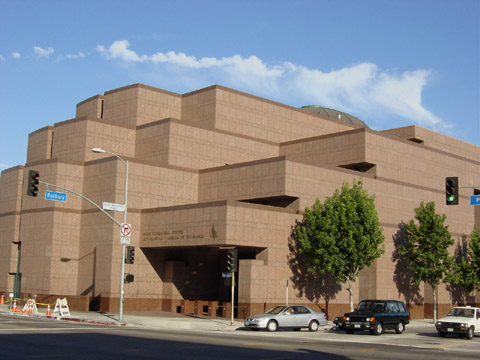
The Simon Wiesenthal Center (SWC) is a Jewish human rights organization established in 1977 by Rabbi Marvin Hier. The center is known for Holocaust research and remembrance, hunting Nazi war criminals, combating antisemitism, tolerance education, defending Israel, and its Museum of Tolerance.
The center publishes a seasonal magazine, In Motion. The center has close ties to public and private agencies, and regularly meets with elected officials of the United States and foreign governments and with diplomats and heads of state. It is accredited as a non-governmental organization (NGO) at the United Nations, UNESCO, and the Council of Europe. The center is named in honor of Nazi hunter Simon Wiesenthal. Wiesenthal had nothing to do with its operation or activities other than giving its name, but he remained supportive of it. "I have received many honors in my lifetime," Wiesenthal once said, "when I die, these honors will die with me. But the Simon Wiesenthal Center will live on as my legacy."
The center is headed by Jim Berk as CEO since January 2024, Rabbi Abraham Cooper the associate dean and Director of Global Social Action Agenda and Rabbi Meyer May, the executive director. Marvin Hier's wife, Marlene Hier, is the Director of Membership development. Shimon Samuels is the Director for International Relations. In 2016, the center had 136 employees. The headquarters of the Simon Wiesenthal Center is in Los Angeles. However, there are also international offices located in New York City, Miami, Toronto, Jerusalem, Paris, Chicago, and Buenos Aires.
In its 2013 survey of Jewish charity compensation, the Jewish-American magazine The Forward singled out Hier as "by far the most overpaid CEO" earning double the amount of what would be expected. He and his family members received nearly $1.3 million in 2012 from the center. In 2017, The Forward again rated Hier as the most overpaid Jewish charity leader with a total salary of $818,148. Family members of his earned over $600,000 from the organization.
According to Charity Navigator the center's total revenue and expenses was $25,359,129 and $26,181,569 in 2018. 52.8% of the revenue came from contributions, gifts and grants, 31.4% from fundraising events and 15.8% from government grants.
Hier was born and raised in New York City and became an ordained rabbi at the Rabbi Jacob Joseph School. At the age of 22 he moved to Vancouver, Canada, and became the rabbi of the city's orthodox synagogue. He became friends with the mostly non-Orthodox Belzberg family who would help him fund the Simon Wiesenthal Center. In 1977, he moved to Los Angeles and bought a building on Pico Boulevard using a $500,000 donation from Samuel Belzberg which was matched with another half a million from Toronto-based real estate maven Joseph Tannenbaum. In the building he founded a yeshiva, a religious Jewish school, today known as the Yeshiva University High School of Los Angeles, and a small Holocaust museum, with Belzberg as founding chairman. Famous Nazi hunter Simon Wiesenthal was convinced to bless the museum with his name. Edward Norden, writing for Commentary, dismissed the museum as "a low-tech affair fashioned by and for Jews and holding nothing against the Gentiles back—an outsized portrait of Pius XII was given a prominent place among pictures of those who 'didn't care.' The message was that Jews have enemies, murderous enemies, and should look out." Hier, a skillful fundraiser, networked with the Hollywood célébrité, local politicians, and businessmen and raised large sums of money which he used to expand his operations.
In 1985, the center was incorporated separately from the yeshiva in order to bid for state funding for the construction of a bigger Holocaust museum. This bid was vociferously opposed by the American Civil Liberties Union, the Anti-Defamation League and secular Jewish organizations due to the unclear separation between the yeshiva and the center. At the time, the same persons sat on the board of both the center and the yeshiva.
Another reason for the opposition was that Los Angeles already had a Holocaust museum; the Martyrs' Memorial Museum (later renamed to the Los Angeles Museum of the Holocaust) and Hier's bid was seen as undue competition by parts of Los Angeles Jewish community which also criticized him for exploiting the memory of the Holocaust. Fred Diament, president of the Holocaust survivor group 1939 Club who helped establish the competing Martyrs' Memorial, blasted the organization in an interview with the Los Angeles Times in 1985:
Simon Wiesenthal Center
The Simon Wiesenthal Center (SWC) is a Jewish human rights organization established in 1977 by Rabbi Marvin Hier. The center is known for Holocaust research and remembrance, hunting Nazi war criminals, combating antisemitism, tolerance education, defending Israel, and its Museum of Tolerance.
The center publishes a seasonal magazine, In Motion. The center has close ties to public and private agencies, and regularly meets with elected officials of the United States and foreign governments and with diplomats and heads of state. It is accredited as a non-governmental organization (NGO) at the United Nations, UNESCO, and the Council of Europe. The center is named in honor of Nazi hunter Simon Wiesenthal. Wiesenthal had nothing to do with its operation or activities other than giving its name, but he remained supportive of it. "I have received many honors in my lifetime," Wiesenthal once said, "when I die, these honors will die with me. But the Simon Wiesenthal Center will live on as my legacy."
The center is headed by Jim Berk as CEO since January 2024, Rabbi Abraham Cooper the associate dean and Director of Global Social Action Agenda and Rabbi Meyer May, the executive director. Marvin Hier's wife, Marlene Hier, is the Director of Membership development. Shimon Samuels is the Director for International Relations. In 2016, the center had 136 employees. The headquarters of the Simon Wiesenthal Center is in Los Angeles. However, there are also international offices located in New York City, Miami, Toronto, Jerusalem, Paris, Chicago, and Buenos Aires.
In its 2013 survey of Jewish charity compensation, the Jewish-American magazine The Forward singled out Hier as "by far the most overpaid CEO" earning double the amount of what would be expected. He and his family members received nearly $1.3 million in 2012 from the center. In 2017, The Forward again rated Hier as the most overpaid Jewish charity leader with a total salary of $818,148. Family members of his earned over $600,000 from the organization.
According to Charity Navigator the center's total revenue and expenses was $25,359,129 and $26,181,569 in 2018. 52.8% of the revenue came from contributions, gifts and grants, 31.4% from fundraising events and 15.8% from government grants.
Hier was born and raised in New York City and became an ordained rabbi at the Rabbi Jacob Joseph School. At the age of 22 he moved to Vancouver, Canada, and became the rabbi of the city's orthodox synagogue. He became friends with the mostly non-Orthodox Belzberg family who would help him fund the Simon Wiesenthal Center. In 1977, he moved to Los Angeles and bought a building on Pico Boulevard using a $500,000 donation from Samuel Belzberg which was matched with another half a million from Toronto-based real estate maven Joseph Tannenbaum. In the building he founded a yeshiva, a religious Jewish school, today known as the Yeshiva University High School of Los Angeles, and a small Holocaust museum, with Belzberg as founding chairman. Famous Nazi hunter Simon Wiesenthal was convinced to bless the museum with his name. Edward Norden, writing for Commentary, dismissed the museum as "a low-tech affair fashioned by and for Jews and holding nothing against the Gentiles back—an outsized portrait of Pius XII was given a prominent place among pictures of those who 'didn't care.' The message was that Jews have enemies, murderous enemies, and should look out." Hier, a skillful fundraiser, networked with the Hollywood célébrité, local politicians, and businessmen and raised large sums of money which he used to expand his operations.
In 1985, the center was incorporated separately from the yeshiva in order to bid for state funding for the construction of a bigger Holocaust museum. This bid was vociferously opposed by the American Civil Liberties Union, the Anti-Defamation League and secular Jewish organizations due to the unclear separation between the yeshiva and the center. At the time, the same persons sat on the board of both the center and the yeshiva.
Another reason for the opposition was that Los Angeles already had a Holocaust museum; the Martyrs' Memorial Museum (later renamed to the Los Angeles Museum of the Holocaust) and Hier's bid was seen as undue competition by parts of Los Angeles Jewish community which also criticized him for exploiting the memory of the Holocaust. Fred Diament, president of the Holocaust survivor group 1939 Club who helped establish the competing Martyrs' Memorial, blasted the organization in an interview with the Los Angeles Times in 1985:
Recent media
Recent media