



Community hub
Recent from talks
Knowledge base stats:
Talk channels stats:
Members stats:
Wigmore Hall
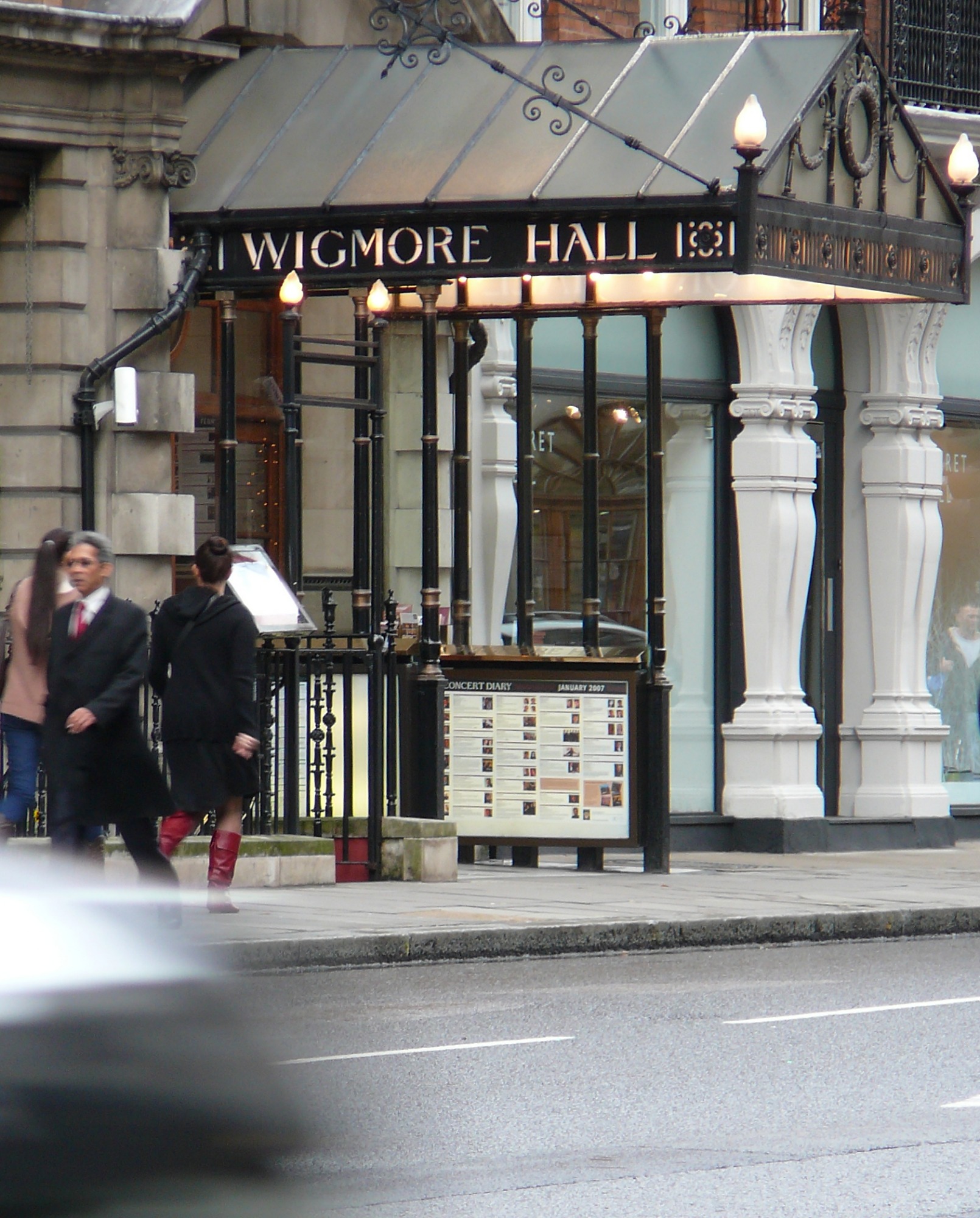
The Wigmore Hall is a concert hall at 36 Wigmore Street, in west London. It was designed by Thomas Edward Collcutt and opened in 1901 as the Bechstein Hall; it is considered to have particularly good acoustics. It specialises in performances of chamber music, early music, vocal music and song recitals, and hosts over five hundred concerts each year, as well as a weekly concert broadcast on BBC Radio 3.
The Bechstein Hall was built between 1899 and 1901 by C. Bechstein Pianofortefabrik, the German piano manufacturer, whose showroom was next door. The British architect Thomas Edward Collcutt was commissioned to design the space. Collcutt was also responsible for the Savoy Hotel on The Strand (since modified) and the Palace Theatre on Cambridge Circus (originally the Royal English Opera House), with which the Hall shares pale terracotta ornamentation.
Bechstein Hall opened on 31 May 1901 with a concert featuring pianist and composer Ferruccio Busoni and violinist Eugène Ysaÿe. During its early period the Hall attracted great musicians like Artur Schnabel, Peter Arnold, Pablo Sarasate, Percy Grainger, Myra Hess, Arthur Rubinstein, Vladimir Rosing, Alexander Siloti, Camille Saint-Saëns, Jascha Spivakovsky, Max Reger and Marian Anderson (who performed there in 1933).
The Bechstein Company built similar concert halls in Saint Petersburg and Paris, though like its London offices and performing space, these and the business as a whole suffered during the First World War. Bechstein was forced to cease trading in Britain on 5 June 1916 after the passing of the Trading with the Enemy Amendment Act 1916 and all property, including the concert hall and the showrooms, was seized and summarily closed. In 1916 the Hall was sold as enemy property at auction to Debenhams for £56,500 – a figure considerably short of the £100,000 cost of the building alone. It was then rechristened Wigmore Hall and opened under the new name in 1917.
The Wigmore Hall follows the Renaissance style, using alabaster and marble walls, which furnish a flat, rectangular hall with a small raised stage area complete with a cupola above depicting the Soul of Music. The distinctive mural was designed by Gerald Moira, who was responsible for a number of contemporary public art works; he later became principal of the Edinburgh College of Art. After the completion of the design, the cupola was executed by the sculptor Frank Lynn Jenkins. It was restored in 1991 and 1992 and has often been featured in the Hall's marketing and print material.[citation needed]
The Hall is considered to have one of the best acoustics for classical music in Europe. It was refurbished in 2004 and was widely praised for being completed on time and on budget. The Hall's current capacity, spread across the stalls and a smaller balcony, is 545 seats. In 2005, the Wigmore Hall Trust purchased a long lease of 300 years for £3.1m. This both secured the future of the Hall and allowed money previously required for rent to be used for further development of its artistic programme. There are two bars and a restaurant on the lower ground floor, below the main auditorium.
Wigmore Hall enjoyed a number of long associations with many great artists of the 20th century including Elisabeth Schwarzkopf, Victoria de los Ángeles, Sergey Prokofiev, Ferruccio Bonavia, Shura Cherkassky, Paul Hindemith, Andrés Segovia, Peter Pears, Benjamin Britten and Francis Poulenc.
The Hall maintained a particularly fruitful relationship with Benjamin Britten, both as composer and performer. His Serenade for Tenor, Horn and Strings, the Second String Quartet, The Holy Sonnets of John Donne and Seven Sonnets of Michelangelo were premièred at the Hall, as were extracts from the opera Peter Grimes (ahead of its world première at the Sadler's Wells Theatre in June 1945).
Hub AI
Wigmore Hall AI simulator
(@Wigmore Hall_simulator)
Wigmore Hall
The Wigmore Hall is a concert hall at 36 Wigmore Street, in west London. It was designed by Thomas Edward Collcutt and opened in 1901 as the Bechstein Hall; it is considered to have particularly good acoustics. It specialises in performances of chamber music, early music, vocal music and song recitals, and hosts over five hundred concerts each year, as well as a weekly concert broadcast on BBC Radio 3.
The Bechstein Hall was built between 1899 and 1901 by C. Bechstein Pianofortefabrik, the German piano manufacturer, whose showroom was next door. The British architect Thomas Edward Collcutt was commissioned to design the space. Collcutt was also responsible for the Savoy Hotel on The Strand (since modified) and the Palace Theatre on Cambridge Circus (originally the Royal English Opera House), with which the Hall shares pale terracotta ornamentation.
Bechstein Hall opened on 31 May 1901 with a concert featuring pianist and composer Ferruccio Busoni and violinist Eugène Ysaÿe. During its early period the Hall attracted great musicians like Artur Schnabel, Peter Arnold, Pablo Sarasate, Percy Grainger, Myra Hess, Arthur Rubinstein, Vladimir Rosing, Alexander Siloti, Camille Saint-Saëns, Jascha Spivakovsky, Max Reger and Marian Anderson (who performed there in 1933).
The Bechstein Company built similar concert halls in Saint Petersburg and Paris, though like its London offices and performing space, these and the business as a whole suffered during the First World War. Bechstein was forced to cease trading in Britain on 5 June 1916 after the passing of the Trading with the Enemy Amendment Act 1916 and all property, including the concert hall and the showrooms, was seized and summarily closed. In 1916 the Hall was sold as enemy property at auction to Debenhams for £56,500 – a figure considerably short of the £100,000 cost of the building alone. It was then rechristened Wigmore Hall and opened under the new name in 1917.
The Wigmore Hall follows the Renaissance style, using alabaster and marble walls, which furnish a flat, rectangular hall with a small raised stage area complete with a cupola above depicting the Soul of Music. The distinctive mural was designed by Gerald Moira, who was responsible for a number of contemporary public art works; he later became principal of the Edinburgh College of Art. After the completion of the design, the cupola was executed by the sculptor Frank Lynn Jenkins. It was restored in 1991 and 1992 and has often been featured in the Hall's marketing and print material.[citation needed]
The Hall is considered to have one of the best acoustics for classical music in Europe. It was refurbished in 2004 and was widely praised for being completed on time and on budget. The Hall's current capacity, spread across the stalls and a smaller balcony, is 545 seats. In 2005, the Wigmore Hall Trust purchased a long lease of 300 years for £3.1m. This both secured the future of the Hall and allowed money previously required for rent to be used for further development of its artistic programme. There are two bars and a restaurant on the lower ground floor, below the main auditorium.
Wigmore Hall enjoyed a number of long associations with many great artists of the 20th century including Elisabeth Schwarzkopf, Victoria de los Ángeles, Sergey Prokofiev, Ferruccio Bonavia, Shura Cherkassky, Paul Hindemith, Andrés Segovia, Peter Pears, Benjamin Britten and Francis Poulenc.
The Hall maintained a particularly fruitful relationship with Benjamin Britten, both as composer and performer. His Serenade for Tenor, Horn and Strings, the Second String Quartet, The Holy Sonnets of John Donne and Seven Sonnets of Michelangelo were premièred at the Hall, as were extracts from the opera Peter Grimes (ahead of its world première at the Sadler's Wells Theatre in June 1945).