Hubbry Logo
Will CarletonWill CarletonMain
Open search
Will Carleton
Community hub
Will Carleton
logo
8 pages, 0 posts
0 subscribers
Be the first to start a discussion here.
Will Carleton
Will Carleton
from Wikipedia

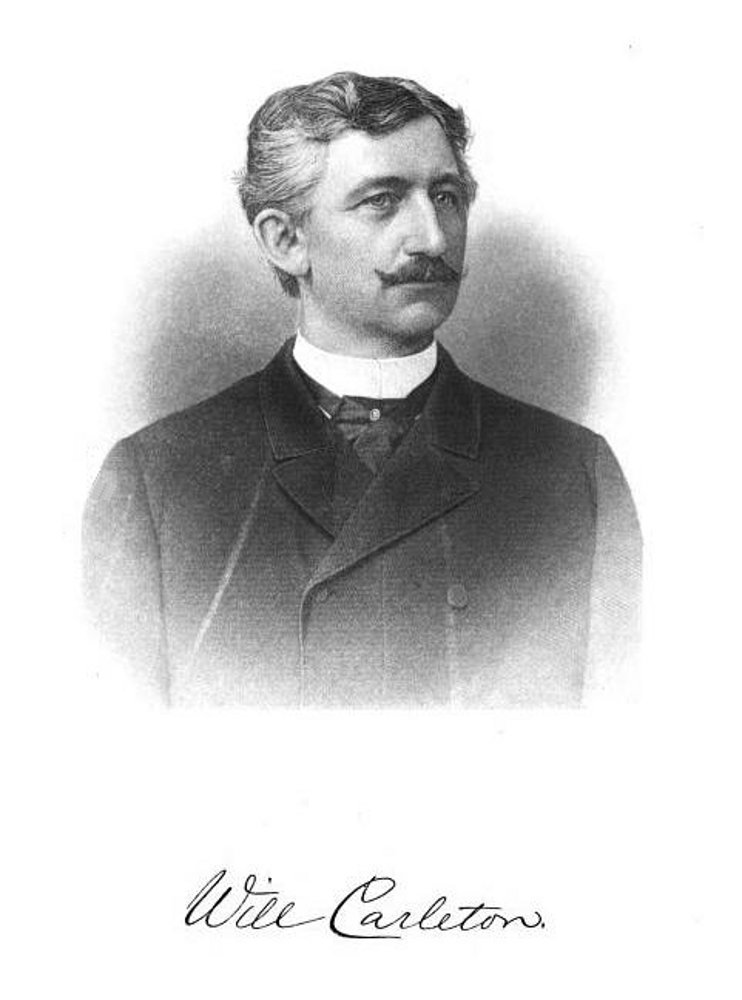
William McKendree Carleton (October 21, 1845 – December 18, 1912) was an American poet from Michigan. Carleton's poems were most often about his rural life.[1]

Key Information

Biography

[edit]

Carleton was born on October 21, 1845, in rural Lenawee County, Hudson, Michigan, Carleton was the fifth child of John Hancock and Celeste (Smith) Carleton.[2] In 1869, he graduated from Hillsdale College, (where he was a member of Delta Tau Delta fraternity) and delivered on that occasion the poem, "Rifts in the Cloud".[3]

After graduating from college in 1869, Carleton first worked as a newspaper journalist in Hillsdale. He had been in the habit of writing poetry as a youngster. His first significant work published was "Betsey and I Are Out", a humorous verse about a divorce that was first printed in the Toledo Blade, and reprinted by Harper's Weekly. Carleton wrote this poem at the age of 25, when he worked as editor of the Detroit Weekly Tribune.[3] In 1872 he published "Over the Hill to the Poor House", exploring the plight of the aged and those with indifferent families. This piece captured national attention and catapulted Carleton into literary prominence—a position he held the rest of his life as he continued to write and to lecture from coast to coast".[1]

In 1878, Carleton moved to Boston, an important literary and publishing center. There he married Anne Goodell. They moved to New York City in 1882. Carleton remained active in his college fraternity and served as the New York City Delta Tau Delta alumni chapter's president.[4] In 1907, he returned to Hudson as a renowned poet. Carleton's quotes became well known in the US during his lifetime.[5][6]

Legacy and honors

[edit]

With the Public Act 51 of 1919, the Michigan legislature required teachers to teach at least one of his poems to their students, and October 21 was officially named as Will Carleton Day in Michigan.[2][7] Schools in Michigan named for him include Will Carleton Academy in Hillsdale, and Will Carleton Middle School in Sterling Heights.[8] A section of the M-99 in Hillsdale is dubbed Will Carleton Road. The village of Carleton in Monroe County, Michigan, is named for him, and the road on Carleton's northern border, separating Monroe and Wayne counties, is Will Carleton Road.[citation needed]

On June 24, 2007, it was reported that "the neglected burial plot of the family of rural Michigan poet, Will Carleton, whose 1872 work, Over the Hill to the Poor House, thrust him into national prominence, is getting a makeover".[9]

Musician Van Dyke Parks is his grand-nephew. He took the title for his album Clang of the Yankee Reaper from one of Carleton's poems.[10]

His works

[edit]

"What Robert Burns did for the Scottish cotter and the Reverend William Barnes has done for the English farmer, Will Carleton has done for the American—touched with the glamour of poetry the simple and monotonous events of daily life, and shown that all circumstances of life, however trivial they may appear, possess those alternations of the comic and pathetic, the good and bad, the joyful and sorrowful, which go to make up the days and nights, the summers and winters, of this perplexing world".[3]

  • Rifts in the Cloud (1869)[3]
  • Poems (1871)[11]
  • Betsy and I Are Out (1871)[12]
  • Over the Hill to the Poorhouse (1872)[1]
  • Farm Ballads[13] (1873)[14]
  • Farm Legends (1875)[15]
  • Young Folks' Centennial Rhymes (1876)[3]
  • Our Travelled Parson (1879)[16]
  • Farm Festivals (1881)[3]
  • The First Settler's Story (1881)[17]
  • Her Tour (1882)[18]
  • The Old Reading Class (1883)[19]
  • The Hero of the Tower (1884)[20]
  • City Ballads (1885)[15]
  • The Convict's Christmas Eve (1887)[21]
  • An Ancient Spell (1887)[22]
  • City Legends (1889)
  • City Festivals (1892)[23]
  • The Vestal Virgin (1893)[24]
  • Four Dogs (1894)[25]
  • Rhymes of Our Planet (1895)[26]
  • The Lianhan Shee (1900)[27]
  • Out of the Old House, Nancy (1900)[28]
  • Songs of Two Centuries (1902)[29]
  • The Little Black-Eyed Rebel (1906)[30]
  • A Thousand Thoughts with Index of Subjects (1908)

References

[edit]

General sources

[edit]
[edit]
Revisions and contributorsEdit on WikipediaRead on Wikipedia
from Grokipedia
Will Carleton is an American poet known for his sentimental farm ballads and accessible poems that portrayed the everyday joys, hardships, and emotional realities of rural Midwestern life in the late 19th century. His works, often written in a simple, direct style with elements of dialect, resonated widely with the public and made him one of the most popular poets of his era. Born William McKendree Carleton on October 21, 1845, in Hudson, Michigan, he grew up on a family farm, attended district school, and later studied at Hillsdale College, graduating in 1869 after his education was briefly interrupted by the need to help on the farm during the Civil War. He supported himself by writing for local newspapers during college and began his professional career in journalism in cities including Hillsdale, Detroit, and Chicago. Carleton achieved national recognition in 1871 when his poem "Betsey and I Are Out" appeared in Harper's Weekly, followed in 1872 by "Over the Hill to the Poorhouse," inspired by his visits to a local poorhouse where he listened to stories of abandonment and neglect. His poetry collections, including Farm Ballads (1873) and Farm Festivals (1881), sold more than 100,000 copies despite economic challenges and solidified his reputation for capturing nostalgic and heartfelt scenes of farm life, family dynamics, and small-town existence. Carleton published twelve books of poetry in total, lectured extensively across the country, moved to Boston in 1878 and New York City in 1882, and later edited his own national literary magazine in the early 1900s. The state of Michigan honored him with the unofficial title of Poet Laureate, and his influence persisted through commemorations such as the establishment of Will Carleton Day on October 21 and historic sites like the Will Carleton Poorhouse in Hillsdale. He died on December 18, 1912.

Early life

Birth and family background

Will Carleton was born on October 21, 1845, in rural Lenawee County, Michigan, near the township now known as Hudson. He was the son of John Carleton and Celeste Carleton. Carleton grew up on the family farm in a pioneer setting on the edge of southern Michigan's frontier, where he performed hard labor as a young boy. The household included siblings, among them a brother named Henry who later enlisted in the Union Army during the Civil War, after which Carleton returned home to assist further on the farm. This rural childhood amid agricultural hardships and isolated farm life formed the backdrop of his early years.

Education and early influences

Will Carleton received his early education at the district school in Hudson, Michigan, where he first began composing poetry while helping on the family farm. His formal higher education started at Hillsdale College, with an initial enrollment in the late 1850s or early 1860s that was interrupted by family needs during the Civil War. During a multi-year absence from college, Carleton taught at a district school in Michigan to earn money for tuition and supported his own learning by studying Greek and Latin in his spare time. He returned to Hillsdale College around 1865 and immersed himself in literary and extracurricular pursuits, including joining literature and forensics clubs, composing essays in verse, forming a brass band, and writing for out-of-town newspapers to supplement his income. These college experiences nurtured his poetic talents, as he produced political verse such as the lengthy poem "Fax," which he read at rallies during the 1868 vice-presidential campaign of Schuyler Colfax and published as a pamphlet to help cover his senior-year tuition. Carleton graduated from Hillsdale College in 1869. The combination of self-directed study, teaching, and regular contributions to newspapers during this period laid the foundation for his emerging voice as a poet drawing from rural life and everyday realities.

Literary career

Breakthrough and early poetry

Will Carleton achieved his national breakthrough with the poem "Betsy and I Are Out," first published on March 17, 1871, in the Toledo Blade. The work, which presented an ironic first-person account of a farmer informing his wife of their divorce amid rural property divisions, drew from Carleton's observations of divorce cases in a local country courtroom and represented typical characters from that social class. It became an instant hit across America immediately upon publication. The poem was quickly reprinted in hundreds of newspapers, including Harper’s Weekly, where editor S.S. Conant requested permission to republish it with illustrations after seeing it in a New York paper. This widespread circulation and Carleton's own account of the poem being copied extensively fueled its rapid popularity, establishing him as a prominent voice in American poetry. The success prompted Carleton to begin early lecture tours and public readings of his work, including an appearance at the Congregational Church in Jackson, Michigan, on March 7, 1872, where he recited poetry to a fair-sized audience before his fame had fully peaked. These recitations, combined with the poem's broad dissemination, helped solidify its place in public consciousness and launched Carleton's career as a sought-after performer of his dialect-infused rural verse.

Major publications and collections

Carleton's most notable contributions to American literature came through his poetry collections, which popularized dialect verse depicting everyday rural and later urban life. His breakthrough collection, Farm Ballads, appeared in 1873 and gathered poems previously published in periodicals, including the sentimental favorites "Betsy and I Are Out" and "Over the Hill to the Poor-House." These pieces used homespun dialect to explore themes of family strife, divorce, and rural hardship, resonating widely with readers and establishing Carleton's reputation for accessible, moralistic storytelling. The volume achieved significant popularity, appearing in multiple editions during his lifetime. He followed with Farm Legends in 1875, continuing the rural focus with additional narrative poems on similar themes of poverty, domestic challenges, and folksy wisdom. In 1876, Carleton published Young Folks' Centennial Rhymes, a lighter collection tailored for younger audiences to mark the United States centennial, blending patriotic sentiments with his characteristic style. This was followed by Farm Festivals in 1881, further developing rural themes. Carleton later expanded his scope to urban settings, beginning with City Ballads in 1885, which applied his dialect approach to city experiences and social observations. He extended this direction with City Legends in 1889 and City Festivals in 1892, maintaining themes of human struggle, sentiment, and moral reflection while shifting from farm to city contexts. Across these major collections, Carleton's work consistently featured sentimental narratives, dialect rendering of common speech, and sympathetic portrayals of ordinary people facing life's difficulties.

Magazine editing and other literary activities

In September 1894, Will Carleton founded the monthly magazine Every Where, which he edited, published, and to which he served as the chief contributor. .pdf) The sixteen-page periodical, issued by the Every Where Publishing Company in New York, combined news of the month with poems, short stories, and other literary articles. .pdf) Carleton's editorial approach reflected his personal style, including distinctive punctuation habits and preferences in phrasing, while he contributed much of the content himself, including poems and short stories often published under pseudonyms. .pdf) The magazine also featured works by notable writers such as Ella Wheeler Wilcox, Margaret E. Sangster, and Kate Upson Clark. .pdf) Every Where achieved commercial success in its early years and was particularly welcomed by Carleton's large base of admirers. .pdf) It continued for eighteen years, through the end of his life in 1912, though later revenues failed to cover operational costs such as multiple offices and excess staff, resulting in the publishing company's insolvency shortly after his death. .pdf) Beyond magazine work, Carleton maintained an active schedule on the lecture circuit, delivering poetry recitals across the United States and abroad to support his literary endeavors.

Personal life

Marriage and family

Will Carleton married Anne Goodell in Boston in 1878, the same year he relocated to that city to advance his literary pursuits. The couple moved to New York City in 1882, where they resided while Carleton edited magazines and lectured across the country. No children from the marriage are documented in available biographical sources. His domestic life remained relatively private, with limited contemporary accounts detailing further aspects of his family circumstances. Carleton's poetry occasionally engaged with themes of rural family life and marital strain, as seen in "Betsy and I Are Out," though that work drew from observed incidents rather than his personal experience.

Later years and death

Final years

In his final years, Will Carleton made his home in Brooklyn, New York, after earlier residing in Boston following his move there in 1878. He continued to write poetry and deliver lectures across the United States, maintaining an active public presence as a popular dialect poet and speaker well into the early 20th century. His last major publications appeared around 1908, after which his output slowed. Carleton's health began to decline in the years leading up to his death, limiting his lecturing and writing activities as he advanced in age. He remained in Brooklyn, where he spent his final decade quietly amid his family and literary interests.

Death

Will Carleton died on December 18, 1912, at his home in Brooklyn, New York, of pneumonia after a short illness. He was 67 years old. His death was announced in newspapers the following day, noting his career as a poet, newspaperman, and lecturer. Carleton was buried in Green-Wood Cemetery in Brooklyn.

Legacy

Influence on American literature

Will Carleton contributed significantly to the tradition of sentimental dialect poetry in late-nineteenth-century American literature, popularizing vernacular speech to depict rural life, family struggles, and social issues in an accessible, emotionally direct manner. His use of "country talk" and homespun language, though initially dismissed by some editors as unpolished, distinguished his work from more formal verse and helped make poetry appealing to a broad, non-elite readership. As a forerunner in the sentimental humor tradition, Carleton's ballads—often centered on nostalgia, domestic life, and rural hardships—achieved massive commercial success and set the stage for later regional writers. He prepared an audience for poets like James Whitcomb Riley, who drew on similar conventions of provincial subjects, dialect, and emotional appeals to nostalgia during the "old homestead period" of American poetry. Carleton's commercially dominant style in the 1870s demonstrated how sympathetic sentiment and local color could be profitably combined, influencing the wider school of sentimental dialect poets that emerged in subsequent decades across regions. His preference for dialect verse represented a step toward inclusivity in American poetry, bringing ordinary rural voices and concerns into the mainstream at a time when formal innovation was secondary to memorability and emotional resonance. However, Carleton's reputation declined after 1900 as literary tastes shifted toward modernism, with his sentimental approach increasingly seen as lacking formal depth and dismissed by critics and modernist poets who rejected its values. Later scholarly assessments view his work as popular but trite, effective in reaching millions and shaping attitudes on social issues yet without claim to lasting distinction as poetry.

Honors and memorials

The state of Michigan conferred upon Will Carleton the honorary title of Poet Laureate in recognition of his popular rural-themed poetry. In 1919, Michigan established Will Carleton Day on October 21 (his birthday) by state law, commemorating his contributions through annual observances. Several memorials were erected posthumously in Michigan, where he was born and spent his early life. A historical marker erected in 1921 by the Lenawee County Federation of Women's Clubs commemorates his birthplace near Hudson in Lenawee County, inscribed "Birth place of Will Carleton 1845 - Poet - 1912." In the same county, Will Carleton Park serves as a recreational area named in his honor, reflecting his enduring association with the region. In Hillsdale, where Carleton attended college and drew inspiration for his famous poem "Over the Hill to the Poor-House," a street was renamed Carleton Road in 1926 following a petition by local residents. The preserved cobblestone building that formed part of the county poorhouse inspiring that poem was designated the Will Carleton Poorhouse in 1987 by the Hillsdale County Historical Society, and a historical marker erected by the Will Carleton Memorial Association notes its connection to his work.
Add your contribution
Related Hubs
User Avatar
No comments yet.