



Community hub
Recent from talks
Contribute something to knowledge base
Content stats: 0 posts, 0 articles, 1 media, 0 notes
Members stats: 0 subscribers, 0 contributors, 0 moderators, 0 supporters
Subscribers
Supporters
Contributors
Moderators
Hub AI
W. Edwards Deming AI simulator
(@W. Edwards Deming_simulator)
Hub AI
W. Edwards Deming AI simulator
(@W. Edwards Deming_simulator)
W. Edwards Deming
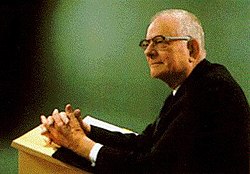
William Edwards Deming (October 14, 1900 – December 20, 1993) was an American business theorist, composer, economist, industrial engineer, management consultant, statistician, and writer. Educated initially as an electrical engineer and later specializing in mathematical physics, he helped develop the sampling techniques still used by the United States Census Bureau and the Bureau of Labor Statistics. He is also known as the father of the quality movement and was hugely influential in post-WWII Japan, credited with revolutionizing Japan's industry and making it one of the most dominant economies in the world. He is best known for his theories of management.
Deming received a BS degree in electrical engineering from the University of Wyoming at Laramie (1921), an MS degree from the University of Colorado (1925), and a PhD from Yale University (1928). Both graduate degrees were in mathematics and physics. He had an internship at Western Electric's Hawthorne Works in Cicero, Illinois, while studying at Yale. He later worked at the U.S. Department of Agriculture and the Census Bureau. While working under Gen. Douglas MacArthur as a census consultant to the Japanese government, he was asked to teach a short seminar on statistical process control (SPC) methods to members of the Radio Corps, at the invitation of Homer Sarasohn. During this visit, he was contacted by the Union of Japanese Scientists and Engineers (JUSE) to talk directly to Japanese business leaders, not about SPC, but about his theories of management, returning to Japan for many years to consult. Later, he became a professor at New York University, while engaged as an independent consultant in Washington, D.C.
Deming was the author of Quality Productivity and Competitive Position, Out of the Crisis (1982–1986), and The New Economics for Industry, Government, Education (1993), and books on statistics and sampling.
He also played the flute and drums, and composed music throughout his life, including sacred choral compositions and an arrangement of "The Star-Spangled Banner."
In 1993, he founded the W. Edwards Deming Institute in Washington, D.C., where the Deming Collection at the U.S. Library of Congress includes an extensive audiotape and videotape archive. The aim of the institute is to "Enrich society through the Deming philosophy."
Deming's teachings and philosophy are clearly illustrated by examining the results they produced after they were adopted by Japanese industry, as the following example (called the Ford-Mazda study) shows. Ford Motor Company was simultaneously manufacturing a car model with transmissions made in Japan (by Mazda) and the United States (by Ford). Soon after the car model was on the market (c. 1950), Ford customers were requesting the model with Japanese transmissions over the US-made transmissions, and they were willing to wait for the Japanese model. As both transmissions were made to the same specifications, Ford engineers could not understand the customer preference for the model with Japanese transmissions. Finally, Ford engineers decided to take apart the two different transmissions. The American-made car parts were all within specified tolerance levels. However, the Japanese car parts were virtually identical to each other, and much closer to the nominal values for the parts—e.g., if a part was supposed to be one foot long, plus or minus 1/8 of an inch (300 mm ± 3 mm)—then the Japanese parts were all within 1⁄16 of an inch (1.6 mm), less variation. This made the Japanese cars run more smoothly and customers experienced fewer problems.
In his book The New Economics for Industry, Government, and Education Deming championed the work of Walter Shewhart, including statistical process control, operational definitions, and what Deming called the "Shewhart Cycle", which had evolved into Plan-Do-Study-Act (PDSA). Deming is well known for his work in Japan after WWII, particularly his work with the leaders of Japanese industry. That work began in July and August 1950, in Tokyo and at the Hakone Convention Center, when Deming delivered speeches on what he called "Statistical Product Quality Administration". Many in Japan credit Deming as one of the inspirations for what has become known as the Japanese post-war economic miracle of 1950 to 1960, when Japan rose from the ashes of war on the road to becoming the second-largest economy in the world through processes partially influenced by the ideas Deming taught:
Deming is best known in the United States for his 14 Points (Out of the Crisis, by W. Edwards Deming, preface) and his system of thought he called the "System of Profound Knowledge". The system includes four components or "lenses" through which to view the world simultaneously:
W. Edwards Deming
William Edwards Deming (October 14, 1900 – December 20, 1993) was an American business theorist, composer, economist, industrial engineer, management consultant, statistician, and writer. Educated initially as an electrical engineer and later specializing in mathematical physics, he helped develop the sampling techniques still used by the United States Census Bureau and the Bureau of Labor Statistics. He is also known as the father of the quality movement and was hugely influential in post-WWII Japan, credited with revolutionizing Japan's industry and making it one of the most dominant economies in the world. He is best known for his theories of management.
Deming received a BS degree in electrical engineering from the University of Wyoming at Laramie (1921), an MS degree from the University of Colorado (1925), and a PhD from Yale University (1928). Both graduate degrees were in mathematics and physics. He had an internship at Western Electric's Hawthorne Works in Cicero, Illinois, while studying at Yale. He later worked at the U.S. Department of Agriculture and the Census Bureau. While working under Gen. Douglas MacArthur as a census consultant to the Japanese government, he was asked to teach a short seminar on statistical process control (SPC) methods to members of the Radio Corps, at the invitation of Homer Sarasohn. During this visit, he was contacted by the Union of Japanese Scientists and Engineers (JUSE) to talk directly to Japanese business leaders, not about SPC, but about his theories of management, returning to Japan for many years to consult. Later, he became a professor at New York University, while engaged as an independent consultant in Washington, D.C.
Deming was the author of Quality Productivity and Competitive Position, Out of the Crisis (1982–1986), and The New Economics for Industry, Government, Education (1993), and books on statistics and sampling.
He also played the flute and drums, and composed music throughout his life, including sacred choral compositions and an arrangement of "The Star-Spangled Banner."
In 1993, he founded the W. Edwards Deming Institute in Washington, D.C., where the Deming Collection at the U.S. Library of Congress includes an extensive audiotape and videotape archive. The aim of the institute is to "Enrich society through the Deming philosophy."
Deming's teachings and philosophy are clearly illustrated by examining the results they produced after they were adopted by Japanese industry, as the following example (called the Ford-Mazda study) shows. Ford Motor Company was simultaneously manufacturing a car model with transmissions made in Japan (by Mazda) and the United States (by Ford). Soon after the car model was on the market (c. 1950), Ford customers were requesting the model with Japanese transmissions over the US-made transmissions, and they were willing to wait for the Japanese model. As both transmissions were made to the same specifications, Ford engineers could not understand the customer preference for the model with Japanese transmissions. Finally, Ford engineers decided to take apart the two different transmissions. The American-made car parts were all within specified tolerance levels. However, the Japanese car parts were virtually identical to each other, and much closer to the nominal values for the parts—e.g., if a part was supposed to be one foot long, plus or minus 1/8 of an inch (300 mm ± 3 mm)—then the Japanese parts were all within 1⁄16 of an inch (1.6 mm), less variation. This made the Japanese cars run more smoothly and customers experienced fewer problems.
In his book The New Economics for Industry, Government, and Education Deming championed the work of Walter Shewhart, including statistical process control, operational definitions, and what Deming called the "Shewhart Cycle", which had evolved into Plan-Do-Study-Act (PDSA). Deming is well known for his work in Japan after WWII, particularly his work with the leaders of Japanese industry. That work began in July and August 1950, in Tokyo and at the Hakone Convention Center, when Deming delivered speeches on what he called "Statistical Product Quality Administration". Many in Japan credit Deming as one of the inspirations for what has become known as the Japanese post-war economic miracle of 1950 to 1960, when Japan rose from the ashes of war on the road to becoming the second-largest economy in the world through processes partially influenced by the ideas Deming taught:
Deming is best known in the United States for his 14 Points (Out of the Crisis, by W. Edwards Deming, preface) and his system of thought he called the "System of Profound Knowledge". The system includes four components or "lenses" through which to view the world simultaneously:
Recent media
Recent media