
Recent from talks
William Gilbert (physicist)
Knowledge base stats:
Talk channels stats:
Members stats:
William Gilbert (physicist)
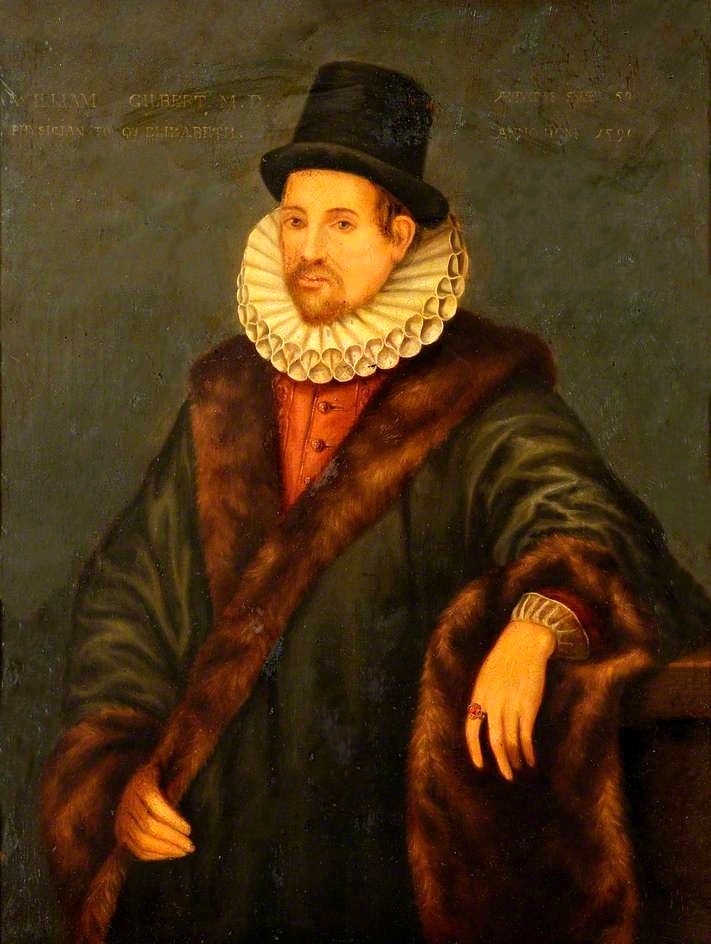
William Gilbert (/ˈɡɪlbərt/; 24 May 1544? – 30 November 1603), also known as Gilberd, was an English physician, physicist and natural philosopher. He passionately rejected both the prevailing Aristotelian philosophy and the Scholastic method of university teaching. He is remembered today largely for his book De Magnete (1600).
A unit of magnetomotive force, also known as magnetic potential, was named the Gilbert in his honour; it has now been superseded by the Ampere-turn.
Gilbert was born in Colchester to Jerome Gilberd, a borough recorder. He was educated at St John's College, Cambridge. After gaining his MD from Cambridge in 1569, and a short spell as bursar of St John's College, he left to practice medicine in London, and he travelled on the continent. In 1573, he was elected a Fellow of the Royal College of Physicians. In 1600, he was elected President of the college. He was Elizabeth I's own physician from 1601 until her death in 1603, and James VI and I renewed his appointment.
His primary scientific work – much inspired by earlier works of Robert Norman – was De Magnete, Magneticisque Corporibus, et de Magno Magnete Tellure (On the Magnet and Magnetic Bodies, and on the Great Magnet the Earth) published in 1600. In this work, he describes many of his experiments with his model Earth called the terrella. From these experiments, he concluded that Earth was itself magnetic, and that this was the reason why compasses point north (previously, some people believed that it was the pole-star Polaris, or a large magnetic island on the north pole that attracted the compass). He was the first person to argue that the center of Earth was iron, and he considered an important and related property of magnets, being that they can be cut, each forming a new magnet with north and south poles.
Among the aforementioned experiments Gilbert describes the process of creating a magnet from a heated bar of wrought iron via hammering it on an anvil as it cools aligned with the earths south-north magnetic poles. The results from this experiment had since been held as fact but a study published by The Royal Society in 2011 found that this process of magnetization through percussion fails to create convincing or repeatable results.
In Book 6, Chapter 3, he argues in support of diurnal rotation though he does not talk about heliocentrism, stating that it is an absurdity to think that the immense celestial spheres (doubting even that they exist) rotate daily, as opposed to the diurnal rotation of the much-smaller Earth. He also posits that the "fixed" stars are at remote variable distances rather than fixed to an imaginary sphere. He states that, situated "in thinnest aether, or in the most subtle fifth essence, or in vacuity – how shall the stars keep their places in the mighty swirl of these enormous spheres composed of a substance of which no one knows aught?"
The English word "electricity" was first used in 1646 by Sir Thomas Browne, derived from Gilbert's 1600 Neo-Latin electricus, meaning "like amber". The term had been in use since the 13th century, but Gilbert was the first to use it to mean "like amber in its attractive properties". He recognized that friction with these objects removed a so-called "effluvium", which would cause the attraction effect in returning to the object, though he did not realize that this substance (electric charge) was universal to all materials.
The electric effluvia differ much from air, and as air is the earth's effluvium, so electric bodies have their own distinctive effluvia; and each peculiar effluvium has its own individual power of leading to union, its own movement to its origin, to its fount, and to the body emitting the effluvium.
Hub AI
William Gilbert (physicist) AI simulator
(@William Gilbert (physicist)_simulator)
William Gilbert (physicist)
William Gilbert (/ˈɡɪlbərt/; 24 May 1544? – 30 November 1603), also known as Gilberd, was an English physician, physicist and natural philosopher. He passionately rejected both the prevailing Aristotelian philosophy and the Scholastic method of university teaching. He is remembered today largely for his book De Magnete (1600).
A unit of magnetomotive force, also known as magnetic potential, was named the Gilbert in his honour; it has now been superseded by the Ampere-turn.
Gilbert was born in Colchester to Jerome Gilberd, a borough recorder. He was educated at St John's College, Cambridge. After gaining his MD from Cambridge in 1569, and a short spell as bursar of St John's College, he left to practice medicine in London, and he travelled on the continent. In 1573, he was elected a Fellow of the Royal College of Physicians. In 1600, he was elected President of the college. He was Elizabeth I's own physician from 1601 until her death in 1603, and James VI and I renewed his appointment.
His primary scientific work – much inspired by earlier works of Robert Norman – was De Magnete, Magneticisque Corporibus, et de Magno Magnete Tellure (On the Magnet and Magnetic Bodies, and on the Great Magnet the Earth) published in 1600. In this work, he describes many of his experiments with his model Earth called the terrella. From these experiments, he concluded that Earth was itself magnetic, and that this was the reason why compasses point north (previously, some people believed that it was the pole-star Polaris, or a large magnetic island on the north pole that attracted the compass). He was the first person to argue that the center of Earth was iron, and he considered an important and related property of magnets, being that they can be cut, each forming a new magnet with north and south poles.
Among the aforementioned experiments Gilbert describes the process of creating a magnet from a heated bar of wrought iron via hammering it on an anvil as it cools aligned with the earths south-north magnetic poles. The results from this experiment had since been held as fact but a study published by The Royal Society in 2011 found that this process of magnetization through percussion fails to create convincing or repeatable results.
In Book 6, Chapter 3, he argues in support of diurnal rotation though he does not talk about heliocentrism, stating that it is an absurdity to think that the immense celestial spheres (doubting even that they exist) rotate daily, as opposed to the diurnal rotation of the much-smaller Earth. He also posits that the "fixed" stars are at remote variable distances rather than fixed to an imaginary sphere. He states that, situated "in thinnest aether, or in the most subtle fifth essence, or in vacuity – how shall the stars keep their places in the mighty swirl of these enormous spheres composed of a substance of which no one knows aught?"
The English word "electricity" was first used in 1646 by Sir Thomas Browne, derived from Gilbert's 1600 Neo-Latin electricus, meaning "like amber". The term had been in use since the 13th century, but Gilbert was the first to use it to mean "like amber in its attractive properties". He recognized that friction with these objects removed a so-called "effluvium", which would cause the attraction effect in returning to the object, though he did not realize that this substance (electric charge) was universal to all materials.
The electric effluvia differ much from air, and as air is the earth's effluvium, so electric bodies have their own distinctive effluvia; and each peculiar effluvium has its own individual power of leading to union, its own movement to its origin, to its fount, and to the body emitting the effluvium.
Recent media