Hubbry Logo
Magnetic scalar potentialMagnetic scalar potentialMain
Open search
Magnetic scalar potential
Community hub
Magnetic scalar potential
logo
8 pages, 0 posts
0 subscribers
Be the first to start a discussion here.
Magnetic scalar potential
from Wikipedia

Magnetic scalar potential, ψ, is a quantity in classical electromagnetism analogous to electric potential. It is used to specify the magnetic H-field in cases when there are no free currents, in a manner analogous to using the electric potential to determine the electric field in electrostatics. One important use of ψ is to determine the magnetic field due to permanent magnets when their magnetization is known. The potential is valid in any simply connected region with zero current density, thus if currents are confined to wires or surfaces, piecemeal solutions can be stitched together to provide a description of the magnetic field at all points in space.

Magnetic scalar potential

[edit]
Magnetic scalar potential of flat cylinder magnets encoded as color from positive (magenta) through zero (yellow) to negative (cyan).

The scalar potential is a useful quantity in describing the magnetic field, especially for permanent magnets.

Where there is no free current and no displacement current, so if this holds in simply connected domain we can define a magnetic scalar potential, ψ, as[1] The dimension of ψ in SI base units is , which can be expressed in SI units as amperes.

Using the definition of H: it follows that

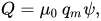
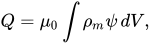
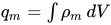
Here, ∇ ⋅ M acts as the source for magnetic field, much like ∇ ⋅ P acts as the source for electric field. So analogously to bound electric charge, the quantity is called the bound magnetic charge density. Magnetic charges never occur isolated as magnetic monopoles, but only within dipoles and in magnets with a total magnetic charge sum of zero. The energy of a localized magnetic charge qm in a magnetic scalar potential is and of a magnetic charge density distribution ρm in space where µ0 is the vacuum permeability. This is analog to the energy of an electric charge q in an electric potential .

If there is free current, one may subtract the contributions of free current per Biot–Savart law from total magnetic field and solve the remainder with the scalar potential method.

See also

[edit]

Notes

[edit]

References

[edit]
Revisions and contributorsEdit on WikipediaRead on Wikipedia
from Grokipedia
The magnetic scalar potential, denoted as Φm\Phi_m or ψ\psi, is a scalar field in classical electromagnetism that describes the magnetic field intensity H\mathbf{H} in regions free of free currents, where H=Φm\mathbf{H} = -\nabla \Phi_m. This potential is analogous to the electric scalar potential in electrostatics, enabling the representation of irrotational magnetic fields (×H=0\nabla \times \mathbf{H} = 0) as the negative gradient of a scalar function, which simplifies calculations in magnetostatics by reducing the problem to solving scalar differential equations rather than vector ones. In current-free regions, the magnetic scalar potential satisfies 2Φm=0\nabla^2 \Phi_m = 0, allowing for analytical or numerical solutions similar to those in . When magnetic materials are present, such as in hard ferromagnets with M\mathbf{M}, the potential obeys 2Φm=ρm/μ0\nabla^2 \Phi_m = -\rho_m / \mu_0, where ρm=M\rho_m = -\nabla \cdot \mathbf{M} represents the volume magnetic charge density, and surface charges σm=Mn^\sigma_m = \mathbf{M} \cdot \hat{\mathbf{n}} arise at boundaries. Boundary conditions for Φm\Phi_m include continuity across interfaces except where currents cause discontinuities, and the potential may be multi-valued in multiply connected domains enclosing net currents, reflecting the topological nature of . This formulation is particularly useful in applications, such as designing permanent magnets, solenoids, and magnetic circuits, where it facilitates the computation of H\mathbf{H} and B=μ0(H+M)\mathbf{B} = \mu_0 (\mathbf{H} + \mathbf{M}) without directly solving for the A\mathbf{A}. In time-harmonic or dynamic fields, extensions incorporate additional terms, but the remains valuable for decoupling equations in regions with magnetic sources.

Fundamentals

Definition

The magnetic scalar potential, denoted as ϕm\phi_m, is a scalar quantity employed in classical electromagnetism to describe the magnetic field strength H\mathbf{H} in regions devoid of free currents, where ×H=0\nabla \times \mathbf{H} = 0. This condition allows H\mathbf{H} to be expressed as the negative gradient of ϕm\phi_m, simplifying the analysis of magnetostatic fields by reducing vector problems to scalar ones analogous to those in electrostatics. Introduced in the by in 1824, the concept drew direct analogy to the electric scalar potential, enabling the modeling of magnetic effects through hypothetical "magnetic poles" and surface/volume densities, much like electric charges. This framework was further refined in magnetostatics by William Thomson () and others, who integrated it into broader electromagnetic theory during the mid-1800s. In SI units, ϕm\phi_m is measured in amperes (A), as it represents the line integral of H\mathbf{H} along a path, yielding a unit consistent with the ampere definition in magnetostatics. The convention H=ϕm\mathbf{H} = -\nabla \phi_m incorporates the negative sign to align with the conservative nature of such fields, ensuring the potential decreases in the direction of H\mathbf{H}, similar to gravitational or electric potentials. This scalar approach contrasts with the magnetic vector potential A\mathbf{A}, which is necessary in regions with currents where ×H0\nabla \times \mathbf{H} \neq 0./09%3A_Magnetic_Potential/9.02%3A_The_Magnetic_Vector_Potential)

Mathematical Formulation

In magnetostatics, the magnetic scalar potential ϕm\phi_m is introduced in regions where the free Jf=0\mathbf{J}_f = 0. From Ampère's law in the form ×H=Jf\nabla \times \mathbf{H} = \mathbf{J}_f, the absence of free currents implies ×H=0\nabla \times \mathbf{H} = 0, meaning H\mathbf{H} is irrotational and can be expressed as the negative gradient of a : H=ϕm\mathbf{H} = -\nabla \phi_m. Combining this with , B=0\nabla \cdot \mathbf{B} = 0, and the constitutive relation B=μ0(H+M)\mathbf{B} = \mu_0 (\mathbf{H} + \mathbf{M}) in materials with M\mathbf{M}, yields (H+M)=0\nabla \cdot (\mathbf{H} + \mathbf{M}) = 0, or H=M\nabla \cdot \mathbf{H} = -\nabla \cdot \mathbf{M}. Substituting H=ϕm\mathbf{H} = -\nabla \phi_m gives the Poisson equation for the : 2ϕm=M.\nabla^2 \phi_m = \nabla \cdot \mathbf{M}. This equation treats M\nabla \cdot \mathbf{M} as an effective magnetic source, analogous to ρ\rho in . In source-free regions where M=0\mathbf{M} = 0 and the permeability μ\mu is constant (typically μ=μ0\mu = \mu_0 in vacuum), the equation simplifies to Laplace's equation: 2ϕm=0.\nabla^2 \phi_m = 0. Solutions to this equation in such regions describe the potential in a manner similar to electrostatics, with ϕm\phi_m harmonic and determined by boundary values. For non-constant μ\mu, the more general form is (μϕm)=0\nabla \cdot (\mu \nabla \phi_m) = 0. Boundary conditions for ϕm\phi_m arise from the continuity of the tangential component of H\mathbf{H} and the normal component of B\mathbf{B} across interfaces in current-free regions. The tangential continuity implies ϕm\phi_m is continuous: ϕm1=ϕm2\phi_{m1} = \phi_{m2}. The normal continuity of B\mathbf{B} requires μ1ϕm1n=μ2ϕm2n\mu_1 \frac{\partial \phi_{m1}}{\partial n} = \mu_2 \frac{\partial \phi_{m2}}{\partial n}, where nn is the normal direction; in the absence of surface magnetization charges, there is no jump in the normal derivative. These conditions ensure the potential and its derivative match appropriately at material boundaries or interfaces.

Relation to Magnetic Fields

In Current-Free Regions

In regions devoid of free currents, the magnetic field intensity H\mathbf{H} satisfies ×H=0\nabla \times \mathbf{H} = 0, making H\mathbf{H} irrotational and expressible as the negative of a magnetic scalar potential ϕm\phi_m, such that H=ϕm\mathbf{H} = -\nabla \phi_m. This condition holds because Ampère's law in the absence of free currents (Jf=0\mathbf{J}_f = 0) implies the curl-free nature of H\mathbf{H}. Consequently, ϕm\phi_m satisfies 2ϕm=0\nabla^2 \phi_m = 0 in vacuum or regions of uniform permeability, derived from B=0\nabla \cdot \mathbf{B} = 0 and B=μH\mathbf{B} = \mu \mathbf{H}. To compute H\mathbf{H}, one solves for ϕm\phi_m subject to appropriate boundary conditions, such as specified values of ϕm\phi_m or its normal on surfaces enclosing the . These boundary conditions typically arise from the continuity of the tangential component of H\mathbf{H} (ensuring ϕm\phi_m is continuous) and the normal component of B\mathbf{B} across interfaces. Once ϕm\phi_m is determined, H\mathbf{H} follows directly from the operation. A representative example is the interior of a long , where the is approximately uniform and directed along the axis (z-direction), H=H0z^\mathbf{H} = H_0 \hat{z}, far from the current-carrying windings. In this case, the takes the simple form ϕm=H0z\phi_m = -H_0 z, satisfying H=ϕm\mathbf{H} = -\nabla \phi_m and in the current-free interior. This linear potential reflects the uniformity of the field, analogous to electrostatic potentials in uniform fields. The use of the magnetic scalar potential offers significant advantages by transforming vector field problems into scalar ones, specifically solving Laplace's (or Poisson's in more general cases) equations rather than full vector formulations. This simplification facilitates analytical solutions in symmetric geometries and enhances efficiency in numerical methods, such as the finite element method, where scalar variables reduce computational complexity compared to vector potentials. In regions with varying permeability, such as magnetizable materials, the formulation extends to a more general equation (μϕm)=0\nabla \cdot (\mu \nabla \phi_m) = 0, but the core principles remain rooted in current-free conditions.

In Magnetizable Materials

In regions containing magnetizable materials, the magnetic scalar potential ϕm\phi_m is defined such that the magnetic field intensity H=ϕm\mathbf{H} = -\nabla \phi_m, analogous to current-free regions but now accounting for M\mathbf{M}. From Maxwell's equation B=0\nabla \cdot \mathbf{B} = 0 and the constitutive relation B=μ0(H+M)\mathbf{B} = \mu_0 (\mathbf{H} + \mathbf{M}), it follows that H=M\nabla \cdot \mathbf{H} = -\nabla \cdot \mathbf{M}, leading to 2ϕm=M\nabla^2 \phi_m = \nabla \cdot \mathbf{M}. Here, M\nabla \cdot \mathbf{M} acts as an effective source term, analogous to magnetic ρm=M\rho_m = -\nabla \cdot \mathbf{M}, which arises from the divergence of magnetization within the material. The magnetization M\mathbf{M} also gives rise to bound currents, with volume bound current density Jb=×M\mathbf{J}_b = \nabla \times \mathbf{M} and surface bound current density Kb=M×n^\mathbf{K}_b = \mathbf{M} \times \hat{n}, where n^\hat{n} is the outward normal. These bound currents produce effects equivalent to the magnetic charges in sourcing the scalar potential, particularly in regions without free currents, leading to discontinuities or jumps in ϕm\phi_m or its derivatives at material interfaces due to surface bound charges σm=Mn^\sigma_m = \mathbf{M} \cdot \hat{n}. In the scalar potential formulation, these are incorporated through the source terms rather than directly via Ampère's law. For linear isotropic media, where M=χmH\mathbf{M} = \chi_m \mathbf{H} and permeability μ=μ0(1+χm)=μrμ0\mu = \mu_0 (1 + \chi_m) = \mu_r \mu_0 with μr\mu_r, the relation simplifies to B=μH\mathbf{B} = \mu \mathbf{H}. Substituting into B=0\nabla \cdot \mathbf{B} = 0 yields the governing equation (μϕm)=0\nabla \cdot (\mu \nabla \phi_m) = 0 in regions of constant μ\mu, reducing to 2ϕm=0\nabla^2 \phi_m = 0 within uniform material domains. At interfaces between materials with permeabilities μ1\mu_1 and μ2\mu_2, continuity of the normal component of B\mathbf{B} implies μ1ϕmn1=μ2ϕmn2\mu_1 \frac{\partial \phi_m}{\partial n}\big|_1 = \mu_2 \frac{\partial \phi_m}{\partial n}\big|_2
Add your contribution
Related Hubs
User Avatar
No comments yet.