Hubbry Logo
St. Anthony HallSt. Anthony HallMain
Open search
St. Anthony Hall
Community hub
St. Anthony Hall
logo
8 pages, 0 posts
0 subscribers
Be the first to start a discussion here.
St. Anthony Hall
St. Anthony Hall
from Wikipedia

St. Anthony Hall or the Fraternity of Delta Psi is an American fraternity and literary society. Its first chapter was founded at Columbia University on January 17, 1847, the feast day of Saint Anthony the Great. The fraternity is a non–religious, nonsectarian organization. In 1879, William Raimond Baird's American College Fraternities characterized the fraternity as having "the reputation of being the most secret of all the college societies."[1] A 2015 writer for Vanity Fair says the fraternity is "a cross between Skull and Bones and a Princeton eating club, with a large heaping of Society and more than a dash of Animal House."[2] Nearly all chapters of St. Anthony Hall are coed.

Key Information

References to St. Anthony Hall have appeared in the works of F. Scott Fitzgerald, John O'Hara, and Tom Wolfe.

History

[edit]

According to Baird's Manual, the Alpha chapter of the Fraternity of Delta Psi was founded at Columbia University on January 17, 1847 by John Hone Anthon, Sam. F. Barger, Charles Arms Budd, and William Myn Van Wagener.[1][3] In The Review magazine, the fraternity says Anthon was a founder and the first leader of the fraternity.[4] (He would later serve as grand master, i.e. president, of Freemasons in New York, for the term 1870-71.)[4][5] Another source says Delta Psi was started by the fifteen-year-old Edward Forbes Travis who came to Columbia University from England "with an odd fascination for St. Anthony the Great, the gnarled fourth-century mystic."[2][6] In this scenario, Travis shared "certain rituals" with a Charles Arms Budd on the saint's feast day, creating "a sacred bond that was soon extended to others."[2][6]

According to its national website, Delta Psi was founded on the feast day of Saint Anthony the Great as a "fraternity dedicated to the love of education and the well-being of its members."[7] It is a non–religious, nonsectarian organization.[8][9] The fraternity developed "a literary flavor: members would spend hours reading essays to one another for general critique or amusement."[2] By 1853, it was holding an Annual Literary Festival and Dinner.[10] It also held evenings featuring orators and poets, often publishing the poems or speeches.[11][12][13][14]

A Beta chapter was formed at New York University on January 17, 1847.[1] However Beta was short-lived; the Columbia College's Record lists the New York University founders alongside its students.[15] In 1879, Baird's listed seventeen chapters opening throughout the Northeast and South during the mid-19th-century.[1]

During the Civil War, formal contact ended between the Northern and Southern chapters, and all of the Southern chapters closed.[16][1][17] In fact, 25% of the fraternity's membership died in the Civil War, with 90 of the 109 deaths coming from the Southern chapters.[18] In December 1865, the fraternity held its annual convention in New York City. The New York Times reported, "Attendance from all the Northern chapters was large, and measures were taken to give the most cordial assistance in response to applications for the rehabilitation of the Southern chapters in such of their colleges are again in operation."[19]

Three of the Southern chapters resumed operations: the University of Virginia, the University of Mississippi, and Washington and Lee.[18][20][16] In April 1867, eleven members of the Williams College chapter commissioned a life-sized portrait of a fallen brother; the portrait was displayed at the Schwabe Gallery of Fallen Heroes in Boston, along with the portraits of four other Delta Psi brothers.[21] Members from many Southern chapters attended a commemorative dinner in New York City in December 1871.[22]

In 1894, Yale's Sigma chapter built a dormitory and named it St. Anthony Hall, apparently the first use of that name.[23][24][25] The Fraternity of Delta Psi also became known as the Order of St. Anthony and St. Anthony Hall.[26]

Following the respective traditions of each chapter, St. Anthony Hall is now self-described and referred to on its various campuses as a fraternity or coed fraternity, a secret society or literary society, or a private club.[27][28] A former Yale chapter president said, "Chapters have a range of degrees of secrecy."[27] In 2006, a Yale member said, "Our secret aspects are truly secret, and our non-secret aspects are truly non–secret."[27]

Symbols

[edit]
Fraternity of Delta Psi badge, from Baird's Manual, 1883 edition

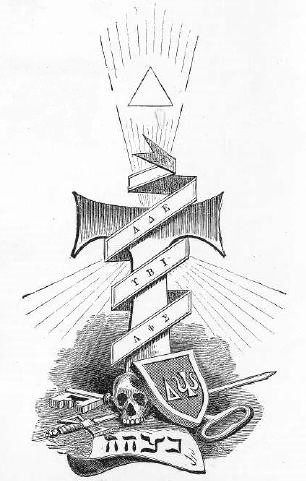
The 1879 edition of Baird's Manual describes the fraternity's badge as a "Saint Anthony's cross, with curved sides. The cross bears a shield in blue enamel displaying the letters "ΔΨ". On the bar of the cross are engraved four Hebrew letters, and beneath the shield the skull and bones."[1] The badge was designed by fraternity member Henry Steel Olcott in 1850.[4]

The 1873 University of Pennsylvania yearbook illustration (see infobox above) shows a tau cross or Saint Anthony's cross, a flat-topped shield with the letters "ΔΨ", a skull, a sword, a key, a floating triangle, and four Hebrew letters.[29] The sword and the key are crossed, with the skull on top.[29]

In 1860 when the Civil War seemed inevitable, fraternal medallions were made for the brothers to attach to their uniforms so they would be recognized as a member of Delta Psi on the battlefield.[18] A photograph of a medallion in the fraternity's archives shows a round, gold coin with a skull as its central figure.[18] Beneath the skull are a crossed sword and key.[18] Encircling the outer edge of the medallion are a list of each chapter's Greek letter and the foundation date.[18]

Chapters

[edit]

Following are the chapters of St. Anthony Hall, with active chapters indicated in bold and inactive chapters in italics.

  1. ^ Members all transferred to Columbia University and joined the chapter there.
  2. ^ a b Burlington College of New Jersey operated from 1846 to 1881. The Delta chapter of ΔΨ appears to have been the only fraternity established on the Burlington campus. That chapter moved to UPenn in 1854.
  3. ^ Chapter was suspended for hazing through June 30, 2026.
  4. ^ Chapter was formed from the Zeta chapter of Zeta Psi in 1848.
  5. ^ The Lambda chapter closed in 1970 when Williams College banned Greek organizations. For years following its closure, there were reports of the chapter either operating underground or having reformed as a different off-campus group. These reports have never been confirmed by St. Anthony Hall or the Lambda alumni association.
  6. ^ The Yale chapter began at Sheffield Scientific School, part of Yale College.
  7. ^ The Tau chapter is known as Number 6 Club on the MIT campus.

There have been rumors that the Lambda chapter operates underground; Williams College banned all fraternities in the 1960s, phasing them out by 1970.[33][32] In 2003, The Williams Record reported that the fraternity began operating as the coed Vermont Literary Society as early as 1973.[32] At that time, the Vermont Literary Society was meeting outside of Williamstown at a place in Vermont referred to as "The Barn".[32] The college offered amnesty to any students who came forward; however, none took advantage of the offer.[32] Again in 2020, there were reports that the Vermont Literary Society was still active as the underground Lambda chapter.[33] The Williams Record's investigation noted that Williams College graduates from 2016 were serving on the board of the Lambda chapter's alumni association.[33] However, the paper later reported that the group disbanded in August 2020.[34]

That the now-inactive Delta Psi local fraternity at the University of Vermont (1850–2004) was never affiliated.[1][16]

Membership

[edit]

Members of St. Anthony Hall call each other "brother", "sister", or "sibling" according to individual preference.[2][35] In 1961, the Yale chapter was the first fraternity on campus to admit a person of color.[36] The University of North Carolina chapter was the first fraternity at its campus to admit African-American members in 1967, followed by the University of Mississippi chapter.[37] In recent times, the fraternity's membership has become more multicultural.[2]

In 1969, the Yale chapter was the first to go coed, also becoming the first Yale society to accept women.[36] Additional chapters subsequently turned coed, including Columbia University, MIT in 1969, the University of North Carolina in 1971, and Trinity College in 1985.[38][16][39][40] Other chapters were reestablished as coed including, Brown University in 1983, Princeton University in 1986, and the University of Rochester in 2010.[16][31] The University of Pennsylvania, the University of Mississippi, and the University of Virginia chapters remain all-male.[16]

In 2016, Town & Country included the Columbia University chapter of St. Anthony Hall in its list of the "six most exclusive clubs of the Ivy League".[41]

Activities

[edit]

St. Anthony Hall members pursue their literary mandate through different programs at the various chapters. The Brown chapter publishes a literary and visual arts magazine called The Sketchbook and hosts bi-weekly literary readings.[42][31] The UNC chapter hosts open mic nights, poetry readings, and art shows.[43][44] The Delta chapter at the University of Pennsylvania hosts an annual lecture series with nationally significant speakers and also organizes a book drive and reading program for a local public school.[45][46][47] The MIT chapter hosts a scholarly lecture series, coffee hours, and participates in charitable activities.[40] The Yale chapter sponsors a public series of Sigma Seminars every two to three weeks on literature, poetry, art, and current affairs; a recent speaker was Pap Souleye Fall, a Senegalese–American interdisciplinary and comic artist.[27][48] The Trinity chapter hosts its annual Clement Lectures.[49] The Columbia chapter hosts writers to discuss their works at least once a semester and also engages in charitable fundraising.[2]

The Trinity chapter endows a St. Anthony Professorship in Art History, several annual prizes for Trinity students, and the annual Martin W. Clement lecture. In 1970 when it went coed, the Yale chapter endowed a scholarship at Yale for women.[27] The Yale chapter also offers the St. Anthony Hall Chase Coggins Fellowship.[50]

1879 Alpha chapter house and St. Anthony Club of New York

Chapter houses and buildings

[edit]
Current Alpha chapter house
1889 Delta chapter house and St Anthony Club of Philadelphia
Current Delta chapter house
Upsilon chapter house in 1903
Epsilon chapter house
Kappa chapter house
Former Lambda chapter house
1894 Sigma chapter house and dormitory
Tau chapter house and St. Anthony Club of Boston, 1912
Current Tau chapter house
Former St. Anthony Club of New York
Becton Center

Many of the St. Anthony Hall chapter houses were designed by well-known 19th and early 20th-century architects such as Henry Forbes Bigelow, J. Cleveland Cady, Cope and Stewardson, Wilson Eyre, Heins & LaFarge, Charles C. Haight, Henry Hornbostel, J. Harleston Parker, William Hamilton Russell, and Stanford White.[51][2][52][53][54][36][55][23][56][57]

An 1891 newspaper feature article on American college societies illustrated fifteen chapter houses, including three from Delta Psi—Trinity, Williams, and Yale.[58]

Alpha: Columbia University

[edit]

The Alpha chapter originally met at the Simon DeWitt Bloodgood house. In 1879, a new building was constructed at 29 East 28th Street for the Alpha chapter and its alumni group, the St. Anthony Club of New York.[59][60][3] According to the New-York Tribune, it was "the first of the Greek letter societies to establish in New York a club which presents many of the features of the other social clubs in the city."[59] The Alpha chapter's Renaissance-inspired lodge in red and yellow brick was designed by William Hamilton Russell, a member of St. Anthony Hall and an architect with the firm of James Renwick, Jr.[51][61] The Hartford Courant wrote, "The decorations of the interior are most elaborate, and altogether it is said to be one of the most beautiful college secret society buildings in the country."[61]

In 1885, a small addition was added to the back of the building.[62] The St. Louis Globe–Democrat wrote, "The lodge room on the Delta Psi fraternity in New York is magnificently furnished in Egyptian designs especially imported from Thebes for this purpose, at the cost of thousands of dollars..."[58] In 1990, the New York Times wrote, "Old photographs show...the figure of an owl on the peaked [pyramid] roof and a plaque with the Greek letters Delta Psi over the windowless chapter room."[63] Later alterations were made by J.A. Moore in 1899 and 1918, including adding 1.5 stories that replaced the original pyramid roof; the stone shield remains between the fourth-floor windows.[51]

In 1895, Columbia University moved its campus north of the city to Morningside Heights.[64] To be closer to the new campus, the Alpha chapter purchased land on 434 Riverside Drive on March 23, 1897.[64][65] To design a new chapter house, they hired Henry Hornbostel and George Carnegie Palmer (a member of St. Anthony Hall) of the firm of Wood, Palmer and Hornbostel.[65][64] The architects' plans were filed with the city on August 26, 1898, and the building was completed in 1898.[64] The resulting five-story plus basement structure is a combination of Beaux Arts and French Renaissance revival styles.[64] It is constructed of red brick, is trimmed liberally in limestone, and has dormers covered in copper.[64][65] At the top of the building is carved relief of the Greek letters ΔΨ.[64] The interior included reception rooms, a billiard room, a dining room, a library, and bedrooms for twenty members.[64] In 1996, it was added to the National Register of Historic Places as Delta Psi, Alpha chapter.[66] The chapter house is also a contributing building to the Broadway-Riverside Drive National Register Historic District.[65]

Delta: University of Pennsylvania

[edit]

Regarded as the first purpose-built fraternity house on the University of Pennsylvania campus, the original Delta Psi house was a Florentine or Renaissance Revival style design by Wilson Eyre.[52][17] It is located at 32 South 22nd Street, across the Schuykill from Penn's West Philadelphia campus.[52] It opened in January 1889 and also housed the St. Anthony Club of Philadelphia.[67][68] It served the fraternity from 1889 to 1908.[52][17]

In 1907, Cope and Stewardson designed the chapter's next house in the Academic Gothic style.[53] Saint Anthony is depicted in a stained glass window in the stairway landing of the first floor; as seen in the photo to the right, a stone tau cross is also above the second-story windows on the exterior.[53] This brick and limestone three-story house was added to National Register of Historic Places in 2005 as St. Anthony Hall House.[69][53] This chapter house is described and pictured in George E. Nitzsche's University of Pennsylvania: Its History, Traditions, Buildings, and Memorials: Also a Brief Guide to Philadelphia.[70]

Upsilon: University of Virginia

[edit]

The University of Virginia's brick chapter house with two-story tall columns and a spacious portico was the third fraternity house constructed on Grounds—although it was the first with residential use in mind.[71] Built in 1902, this Colonial Revival or Jeffersonian style house is "beautifully situated on 'Page Hill'" and blends well with the campus architecture designed by Thomas Jefferson.[72] The Upsilon chapter house was designed by J. Harleston Parker, founder of the Harleston Parker Medal.[54] It cost $20,000 (equivalent to $744,231 in 2023) to build.[73] The interior was "furnished with taste throughout", and included ten bedrooms, a library, a billiard room, and a 20 by 30 feet (6.1 by 9.1 m) reception room that was paneled in oak.[71][73] There was also electric lighting, running hot and cold water, and steam heat.[71][73] The house is included The Architecture of Jefferson Country: Charlottesville and Albemarle County, Virginia" by K. Edward Lay.[54]

Epsilon: Trinity College

[edit]

A gift of fraternity member and recent graduate Robert Habersham Coleman, the granite lodge of the Trinity College chapter was designed in the High Victorian Gothic-style by J. Cleaveland Cady in 1878.[74][36] Cady was a member of Trinity's Epsilon chapter.[36] This was one of the most expensive fraternity houses in America at the time and was also a "radical departure from the customary tomb-like structures of the secret societies of other campuses".[75] Added in 1985 to the National Register of Historic Places, as Saint Anthony Hall, the Epsilon chapter home is the oldest St. Anthony Hall building still in use by the fraternity.[36] It is also the oldest fraternity house at Trinity and one of the oldest buildings on campus.[36]

Kappa: Brown University

[edit]

The Brown University chapter house at 154 Hope Street in Providence, Rhode Island, was designed by Stone, Carpenter & Wilson in the Colonial Revival style in 1895.[76] The house features ogee gables and a conservatory, as well as an addition added in 1961.[76] Originally a private residence for Alice and Robert W. Taft, the brick building was later owned by Bryant University which called it Taft Hall and used it as its administration building from 1947 through 1969.[77][76] When Brown acquired the building in 1969, it was renamed King House in 1974 in honor of Lida Shaw King, former dean of Pembroke College.[78][76] Brown provides King House to the Kappa chapter as a residential student program house.[79]

Lambda: Williams College

[edit]

The former Williams College chapter house dates from 1886 and was designed by Stanford White of McKim, Mead and White.[55][80] White had just designed a New York City townhouse for fraternity member Frederick Ferris Thompson, who provided White to create the Lamba chapter house.[81] The chapter house was constructed in of blue freestone and combines early Norman and Old English styles.[82][55] It has been described as "a witty paraphrase of a Dutch Colonial house, compact in silhouette and terminating in proud stepped gables. But no such Dutch house ever had such an audacious tower, tapered in the fashion of an Egyptian pylon."[81] The interior has "an elaborate interplay of crossbeams on the ceiling combined with heroically oversized fireplaces..."[81]

In 1905, an addition was added to the southwest end that had electricity and included nine bedrooms, a library, four studies, and three bathrooms.[55][80] However, the addition was destroyed by a fire in May 1926, probably the result of faulty electrical wiring.[55][80] Architect Roger Bullard and local contractors restored the wing.[55][80] However, on January 21, 1927, another fire destroyed the new southwest wing, and the dining room ceiling collapsed, blowing out the windows on the first floor.[55][80] Another addition was added to the south, but does not impact the main view of the house.[81]

Because fraternities were banned at Williams in the 1960s, Lambda chapter sold its building to the college in 1970.[80] The still-named Saint Anthony Hall now houses the college's Center for Developmental Economics.[83] The 17,540 square feet (1,630 m2) building was renovated and refurbished in 1996.[83][55] It still includes a bronze relief memorial to fraternity member Frederick Ferris Thompson, designed in 1906 by Augustus Saint-Gaudens.[81]

Sigma: Yale University

[edit]

The original Sigma chapter house was built in 1879 and no longer exists.[84] This five-story building was said to be "the finest thing of the kind in any university in the country".[84] In 1885, the chapter built a new house, also no longer in existence, that was designed by Harrison W. Lindsley who was a member of the Yale chapter.[85][56] It was a Richardsonian Romanesque style structure built of red sandstone.[56][85] In 1894, the chapter started construction of a dormitory building designed by George Lewis Heins and Christopher Grant LaFarge of the firm Heins & LaFarge.[23] Located at 133 College Street, the dormitory housed 26 men and was named St. Anthony Hall—perhaps the first use of that name.[23] It was built of East Haven sandstone to match the nearby chapter house and featured large parlors, a 20 by 30 feet (6.1 by 9.1 m) library filled with books, a porch with carved stone decorations, and servants quarters.[23]

Around 1903, fraternity member Frederick William Vanderbilt commissioned a gift of two limestone residential halls adjacent to the chapter house.[56] These were constructed between 1903 and 1906.[56][86] Next, Vanderbilt hired Charles C. Haight to create a matching Neo-Gothic style chapter house which was completed in 1913 at 483 College Street.[56][27] The ornamental iron gates from the second chapter house were re-used at the corner entrance of the new octagonal tower.[56] It is believed that Rafael Guastavino Jr. built the domed ceiling in a basement room called The Crypt; Guastavino previously worked on Biltmore Estate for Vanderbilt's younger brother.[86] The Crypt "has a wonderful sound parabola, where someone standing in one corner can whisper and be heard across the room by someone standing in the opposite corner".[86] The New York Times called it "the most expensive and elaborate secret society building in the United States".[87]

The flanking residential halls are now part of Silliman College; St. Anthony Hall donated them to the university when Yale started a campus residential system in the 1930s.[8]

Tau: Massachusetts Institute of Technology

[edit]

The first Tau chapter house was designed by J. P. Fuller and built circa 1834–37 in the Greek Revival style. It was located at 6 Louisburg Square in Boston's Beacon Hill neighborhood.[40] The building also housed the St. Anthony Club of Boston.[20] This address is the origin of the nickname for the Tau chapter—the Number Six Club.[16][40] The chapter's current multi-stored structure at 428 Memorial Drive was first occupied in 1916.[40] It was designed by Boston architect Henry Forbes Bigelow, an alumnus of the Tau chapter.[57]

St. Anthony Club of New York

[edit]

Designed by architect S. E. Gage, the former St. Anthony Club of New York was located at 16 East 64th Street in New York City.[88] Originally built between 1878 and 1879, Gage redesigned the building between 1902 and 1904 in the Neo-Federal style.[89][88] The five-story brownstone includes limestone columns, a detailed, wrought-iron front door and gate, a limestone and marble entry foyer, and a bronze and wrought-iron main staircase.[90][91] In addition, the townhouse boasted ornate moldings, high ceilings, skylights, oak Versailles parquet floors, and six wood-burning fireplaces.[89] The building is on a historically distinguished residential street and is included in the walking tour of 64th Street.[90]

Beginning in 1951, St. Anthony Hall used this building as an alumni city club and as headquarters for its national offices; the fraternity (Delta Psi, Inc.) purchased the building in 1952.[92] In the early 1970s, the Barnard College Club leased space in the St. Anthony Club building.[93] The fraternity closed its club and sold the building in 1990; the former club is now a private residence.[94]

[edit]

Yale chapter member and benefactor Henry Becton donated the Becton Center to Yale.[95][96] Designed by Marcel Breuer, the Becton Center opened in 1970.[97] Located at 15 Prospect Street in New Haven, the building's most distinctive feature is an arcade of monumental tau cross-shaped concrete columns.[97][95]

Alumni groups

[edit]

Foundations

[edit]

The St. Anthony Educational Foundation Inc. is a charitable entity that supports the educational and cultural programs and activities of the fraternity through grants and scholarships to its chapters.[98][99]

Graduate organizations

[edit]

St. Anthony Hall has several incorporated graduate chapter associations that exist to support its chapters and/or buildings. The first such group was the Anthony Trust Association, which was chartered in Connecticut in 1874 and operates as a national nonprofit organization.[100][101] Known graduate chapters include:

Clubs and area organizations

[edit]

Historically, there were several alumni social clubs associated with the fraternity—the 1890 edition of Baird's Manual credits the Delta Psi with being "a pioneer in the development of this form of social life".[3] These clubs usually adopted the name St. Anthony Club because the fraternity's badge was a St. Anthony's cross.[3]

St. Anthony Club of New York

[edit]

Founded in 1879, the St. Anthony Club of New York was the first and longest-running of these establishments.[3][4] It was also the first fraternity-related club in New York City.[3] In 1883, it was housed at 29 East 28th Street in a building it shared with the undergraduates of the Columbia chapter.[3]

In 1885, the club added an addition to the rear of the building, and The New York Times gave its readers a rare peek inside the club:

The front room is a parlor with tables for cards. In cases on the mantlepiece are "Goodwood Cups," trophies of which the club is justly proud. The furniture and fittings here are cherry, with harmonious upholstery and walls. Several fine prints are to be seen, including views of buildings of the Delta Psi at Yale, Trinity, and other colleges. A passageway, richly decorated in the baronial style of the twelfth century, leads from the office past the buffet, in a crypt under the stairs, to a large room, which, with a noble open fireplace, offers, in cosy [sic] leather cushions, in stalls in the corners and more spacious chairs, a quiet retreat. The fantastic and unique latticework of the windows attracts attention, with the bold and artistic studding of the ceiling, and ornate chandeliers especially manufactured emit their jets of gas from imitation candles...This is the smoking and lounging room.[62]

The club also included a billiard room with high oak wainscotting and walls of a blueish-green with hints of gold, an entire floor dedicated to its library, and a national fraternity office decorated with illustrations of the temptations of St. Anthony.[62] It was also noted that the membership and dues were low, "so as to prevent no one who is eligible from joining".[62] Membership was limited to alumni of the Delta Psi fraternity, and no others could gain entry.[62] In 1893, St. Anthony Hall was referred to by the New-York Tribune as "the most exclusive organization of the kind in the United States".[113]

On July 4, 1912, the St. Anthony Club purchased the house of Edith S. Logan, widow of John A. Logan, located at 17 West 56th Street in New York City.[59] The club used its 1879 Alpha chapter house as a partial payment to Logan.[59] In 1929, the club purchased the Junior League's five-story clubhouse at 133–35 61st Street, selling 17 West 56th Street in 1931.[114] In 1936, the club and the fraternity's office were jointly housed in a penthouse of the Berkshire Hotel at 21 East 52nd Street.[115] The club relocated to an apartment at 270 Park Avenue in 1944.[115] However, by the early 1980s, the club was located in a brownstone at 16 East 64th Street and was no longer financially sustainable.[88][92] With the city's property boom, by 1988 the brownstone was worth $3.5 million versus $1 million in 1984. The fraternity decided to close the club and liquidate the asset to free funds for other projects.[92] In 1989, the fraternity borrowed money to fix structural problems and other issues with the building.[94] The St Anthony Club of New York building sold in 1990 for $3,250,000 (equivalent to $8,009,106 in 2023), although the net to the organization was significantly less because of debts, stockholder payouts, and taxes.[94]

Other historic clubs

[edit]

Known as the St. Andrews Club, the alumni group in Detroit, Michigan, started meeting annually in 1883.[116] The St. Anthony Club in Philadelphia was established sometime before 1888 when moved into a new building with the undergraduate chapter.[67][68] There was also a St. Anthony Club in Rochester, New York before 1890.[3] The St. Anthony Club in Boston was established before 1898 and shared a building in Beacon Hill with the undergraduate chapter at MIT.[117][20] The St. Anthony Club of the Northwest was organized in 1890 after having semi-annual dinner gatherings.[118][119] In 1904, the St. Anthony Club of Bar Harbor, Maine gathered for its annual dinner.[120] There was also a St. Anthony Club of Bermuda.[4]

Modern clubs

[edit]

Known modern alumni social groups include the Paris St. Anthony Hall Association, the St. Anthony Association of New Jersey, the St. Anthony Association of Nova Scotia, the St. Anthony Association of Rhode Island, the St. Anthony Association of Southern Arizona, the St. Anthony Association of Washington, D.C., and the St. Anthony Club of Philadelphia.[121][122][123]

Notable members

[edit]

As 2025, St. Anthony Hall has 530 undergraduate members and more than 9,800 living members in nearly 100 countries.[124] Some notable members include Nobel Prize in Physics recipient Andrea M. Ghez;[125] Jonathan Yardley, Pulitzer Prize winning book critic with the Washington Post;[126] Charles Kuralt, journalist who received winner of twelve Emmy Awards and two Peabody Awards;[127][128] Charles Edison; Governor of New Jersey and U.S. Secretary of the Navy;[129] Alex Gibney, Oscar and Emmy winning film director and producer;[130] Jeff MacNelly, three-time Pulitzer Prize–winning editorial cartoonist and creator of the comic strip Shoe;[127] George Herbert Walker IV, managing director of Lehman Brothers;[125] and John Cromwell Bell Jr., chief justice of the Supreme Court of Pennsylvania and Governor of Pennsylvania.[129]

[edit]
  • The exclusive Hamilton House secret society from the television show Gossip Girl was based on St. Anthony Hall's Columbia chapter.[28][2][131] However, when the character Van der Woodsen is denied admission to Hamilton House, she says, “It’s fine, I joined St. A’s instead."[132]
  • The "St. Ray's" fraternity in Tom Wolfe's I Am Charlotte Simmons is modeled after the University of Pennsylvania chapter where Wolfe attended a cocktail party in 2001 while conducting research for the book.[133]
  • The cover art of rock band Vampire Weekend's first album is of the Columbia chapter's ballroom chandelier, taken at one of the band's early shows.[2][131]
  • In June 1971, Vogue magazine featured the newly coed University of North Carolina chapter in an article called "Vogue's Eye View on Girl Power".[134]
  • The society tabloid Gawker said "In the constellation of collegiate societies—fraternities, sororities, eating clubs, final clubs, and the like—few are more exclusive, and WASPy, as St. Anthony Hall, or St. A's as it is commonly known..."[135]
  • The Official Preppy Handbook says, "St. A's appeals to the 'cool element' of Preppies at Yale; this means Preppies who don't iron their shirts. It isn't rowdy: parties there conform to the intellectual self-image Yalies hold dear."[136]
  • The University of Mississippi chapter house is said to be haunted by a brother, Jim Bridges, who died in a car wreck on the way back from a LSU football game in 1964.[137]
  • During a fellowship on campus in December 1967, California Governor Ronald Reagan was filmed by public television informally debating Yale students at St. Anthony Hall. Nancy Reagan was also present, as the Yalies quiz the governor on Vietnam and various social justice issues.[138]
  • Mama Dip (Mildred Cotton Council), an icon of Southern cooking who was a guest at the White House, once was the cook at the University of North Carolina chapter.[139]
  • During the Klondike Gold Rush in 1897, Jack London befriend two mining engineers who were members of the Yale chapter—Marshall Latham Bond and Louis Whitford Bond.[140] They designated their cabin a chapter house, and let London camp by it for six weeks.[140] Buck, the canine protagonist of London's Call of the Wild, was inspired by the Bond brothers' dog.[140] The Bond's father, Judge Hiram Bond from California, is lightly fictionalized in Call of the Wild as Judge Miller.[140]
  • John O'Hara, in his 1960 novel Ourselves to Know, uses St. Anthony Hall membership in the characterizations of the protagonists:[133][141]
    • "'Did you join a fraternity at Penn?' I said. 'Yes I did. St Anthony–Delta Psi. But I think they were sorry that they invited me.' ...I happened to know, because I had seen it, that he had a Delta Psi Tea Company gold charm on his watch chain, but the reason he did not show it was one of delicacy; in 1908 they had not accepted his resignation but he kept the insigne hidden..."
    • "He and Robert quickly looked at each other's watch-chain and the Delta Psi charm and smiled."
  • F. Scott Fitzgerald refers to the Pump and Slipper, an annual party at the Yale chapter since 1911, in several of his short stories:[27][133]
    • "May Day" in Tales of the Jazz Age: "'My name's Dean, Philip Dean,' he said cheerfully. 'You don't remember me, I know, but you used to come up to New Haven with a fellow I roomed with senior year, Gordon Sterrett.' Edith looked up quickly. 'Yes, I went up with him twice—to the Pump and Slipper and the Junior prom.'"
    • "Bernice Bobs Her Hair": "Warren was nineteen and rather pitying with those of his friends who hadn't gone East to college. But, like most boys, he bragged tremendously about the girls of his city when he was away from it. There was Genevieve Ormonde, who regularly made the rounds of dances, house-parties, and football games at Princeton, Yale, Williams, and Cornell; there was black-eyed Roberta Dillon, who was quite as famous to her generation as Hiram Johnson or Ty Cobb; and, of course, there was Marjorie Harvey, who besides having a fairylike face and a dazzling, bewildering tongue was already justly celebrated for having turned five cart-wheels in succession during the last pump-and-slipper dance at New Haven."
    • "A Short Trip Home", Saturday Evening Post, January 17, 1927: "There was talk of the Pump and Slipper dance at New Haven and the Princeton Prom, and then, in various moods, we four left and separated quickly outside."

Scandals and member misconduct

[edit]
  • In 1889, a death was reported in a hazing incident at the Yale chapter.[142] According to the news report, a pledge was placed in a coffin and lowered outside a window with a rope.[142] When the coffin was pulled up, the pledge, who was of a "nervous temperament", was found dead.[142]
  • In 1896, the fraternity revoked the charter of the University of Rochester Iota chapter without warning.[143] At the time, Iota had existed for 44 years, had 56 members in good academic standing, owned a chapter house with a mortgage balance of just $3,000 (equivalent to $116,100 in 2023), and had an active alumni club.[143] The Rochester Democrat and Chronicle concluded that the issue was with the college itself, rather than Iota chapter, writing, "The fraternity is comparably small and very exclusive and desires to remain so...Rochester is not sufficiently aristocratic".[143] The Iota chapter did not reopen until 2010.[16]
  • In 1901, there was a kidnapping attempt of member R. H. Rogers of the Williams chapter.[144][145] He was rescued from the kidnapper's carriage by another student who had a revolver.[144][145]
  • On July 11, 1915, Daniel Leroy Dresser committed suicide at the Columbia chapter house over financial problems.[146] Dresser was the brother-in-law of George Washington Vanderbilt II of Biltmore Estate.[146]
  • In October 1961, members of the University of Virginia chapter chartered an airplane to Connecticut to try and stop the Yale chapter from admitting the fraternity's first black member, Wendell Mottley.[147] However, Yale University warned that a fraternity showing discrimination "would not be welcome on the Yale campus".[147] Mottley became a member of St. Anthony Hall.[148]
  • In 1990, a member from the University of Pennsylvania chapter was kidnapped by members of Psi Upsilon (Castle).[149][150] As a result, Castle was banned from the university.[149]
  • On January 11, 2003, the fraternity held a private black-tie dinner-dance at the Metropolitan Club of Washington, D.C.[151] According to The Washington Post. the $38,000 (equivalent to $66,507 in 2022 money) event "turned into a bacchanal" with same-sex dancing, the theft of decorative items, under-aged drinking, and sexual encounters in the locker rooms.[151] The Metropolitan Club suspended Charlie Ingersoll and Jack Shaw, the St. A. members who sponsored the event, for one month.[151] The letter sent to Shaw and Ingersoll by the Metropolitan Club president said, "The behavior was grossly inappropriate and offensive to many of the staff who worked during the event and violated the standards of our Club."[151]
  • In September 2005, the University of North Carolina chapter was charged with running "a speakeasy of sorts".[152] The fraternity's president and the bartender were charged with selling alcohol without a state permit.[153] However, the president was cleared of charges because the law enforcement officer failed to read her the Miranda rights.[154]
  • In 2011, St. Anthony Hall alumnus Walter Perry was convicted of embezzling $650,000 (equivalent to $930,288 in 2022) from the Columbia undergraduate chapter.[2] He served two years in prison and was ordered to pay restitution.[2] Perry was also expelled from the fraternity.[2]

See also

[edit]

References

[edit]
[edit]
Revisions and contributorsEdit on WikipediaRead on Wikipedia
from Grokipedia
St. Anthony Hall, formally known as the Fraternity of Delta Psi (ΔΨ), is a selective American collegiate and founded on January 17, 1847, at in . The organization derives its name from Saint Anthony the Great, with the founding date coinciding with his feast day, and it originally focused on promoting literary culture, intellectual discourse, and fraternal bonds among members. Distinguished by its emphasis on privacy and exclusivity, St. Anthony Hall has historically been characterized as one of the most secretive college societies, eschewing typical Greek-letter publicity in favor of discreet operations and enduring traditions./Delta_Psi) The fraternity maintains active undergraduate chapters at eleven institutions, including , the , and the , where it has operated continuously since the mid-19th century in some cases. Many chapters occupy architecturally notable houses, such as the Gothic Revival building at and the clubhouse at MIT's Number Six Club, reflecting the organization's commitment to creating distinctive communal spaces for meetings and events. Alumni associations, often structured as St. Anthony Clubs in major cities like New York and , extend the fraternity's network beyond college years, fostering professional connections while upholding the society's reserved ethos. No major public controversies have prominently defined its history, with its defining traits centering on intellectual selectivity and operational discretion rather than expansive or athletics./Delta_Psi)

History

Founding and Early Expansion (1847–1860s)

The Fraternity of Delta Psi, commonly known as St. Anthony Hall, was established on January 17, 1847, at in by John Hone Anthon, a junior, along with associates including Charles Augustus Budd./Delta_Psi) The founding date coincided with the feast day of Saint Anthony the Great, from whom the organization derives its informal name, though it operates as a non-religious entity emphasizing literary pursuits, mutual support, and fraternal bonds among members rather than devotional practices. Initial membership was drawn from Columbia's student body, with the group forming as a secret society focused on intellectual discourse and amid the era's burgeoning college ./Delta_Psi) Expansion commenced rapidly, reflecting the fraternity's appeal in northeastern academic circles. The Beta chapter was chartered at New York University in the same year, 1847, marking the second installation./Delta_Psi) This was followed by the Gamma chapter at Rutgers College in 1848, establishing a presence in New Jersey. The Delta chapter originated in 1849 at Burlington College in New Jersey, founded by Warren Livingston and others, before transferring to the University of Pennsylvania in 1854 due to institutional shifts and administrative challenges at Burlington. The Epsilon chapter at Trinity College in Hartford, Connecticut, was established in 1850, utilizing rented downtown spaces initially before later constructing dedicated facilities. By the mid-1850s, further growth extended southward, with the chapter founded at the in 1855. This period saw the fraternity navigate the antebellum college landscape, prioritizing selective recruitment of undergraduates committed to its tenets of and camaraderie, while chapters operated discreetly without permanent houses, relying on members' residences or leased rooms. The chapter at the , installed on April 20, 1860, represented the organization's southernmost early foothold, initiated by a cadre of undergraduates seeking a counterpoint to existing societies. Through the , amid national tensions preceding the Civil War, the fraternity maintained chapters north and south, though some faced dormancy or relocation due to institutional instability, underscoring its adaptive resilience in fostering enduring networks./Delta_Psi)

Growth and Institutionalization (1870s–1900s)

Following the American Civil War, St. Anthony Hall experienced a period of recovery, with surviving Southern chapters rejoining the fraternity and select chapters in the South and Northeast being refounded, though specific new chapter establishments in this era were limited compared to the pre-war expansion. The organization's focus shifted toward consolidation and permanence, maintaining its selective nature with approximately ten active chapters by the late 19th century, emphasizing literary and social bonds over numerical growth. This phase marked a transition from transient meeting spaces to institutionalized structures, reflecting the fraternity's maturation amid expanding American higher education. Institutionalization accelerated through the construction of dedicated chapter houses and alumni clubs, symbolizing stability and exclusivity. In 1878, the Epsilon Chapter at Trinity College completed its Gothic-style hall in , designed by alumnus J. Cleaveland Cady. The following year, 1879, saw the opening of the St. Anthony Club of New York at 29 East 28th Street, architected by James Renwick Jr., serving as a hub for graduate members with facilities including a and dining rooms. At the , the Delta Chapter's St. Anthony Hall opened in January 1889, supported by the Delta Alumni Association. By the 1890s, further developments underscored this trend. Ground was broken in 1894 for a new dormitory by the Delta Psi chapter at Yale University's , enhancing residential and communal aspects. The Alpha Chapter at relocated to a purpose-built house at 434 Riverside Drive in 1898–1899, featuring specialized rooms akin to city clubs, amid the university's uptown move. These investments in architecture and networks fortified the fraternity's status, fostering enduring traditions while navigating evolving collegiate environments.

20th Century Adaptations and Challenges

During and , St. Anthony Hall chapters endured substantial losses and operational disruptions, as numerous members enlisted in military service, leading to suspended activities and crises in chapter continuity across institutions. Undergraduate enrollment declined sharply due to wartime drafts and priorities, straining the fraternity's literary programs and recruitment, though networks provided some resilience through financial and advisory support. Postwar cultural shifts, including the expansion of coeducation at in the late 1960s, prompted adaptations to maintain relevance amid declining male-only fraternity models. The Yale chapter pioneered female membership in , the same year Yale College admitted women, allowing the society to integrate scholarly women while preserving its secretive, literary ethos; this move was framed by members as aligning with the organization's progressive historical roots rather than external pressure. Challenges intensified in the 1960s and 1970s with anti-fraternity sentiments and outright bans at select colleges, such as Williams, where St. Anthony Hall operated covertly as the co-ed from the 1970s until its public acknowledgment in 2003, evading dissolution by reorienting toward literary pursuits over social partying. Similarly, the College chapter transitioned to coeducation via member vote in 1984, adapting to institutional pushes for inclusivity while chapters at male-only holdouts like UVA resisted until later decades. These responses prioritized intellectual continuity over rigid traditions, enabling survival against broader declines in participation during economic and social upheavals.

Post-2000 Developments and Institutional Pressures

In the early , several chapters of St. Anthony Hall encountered institutional pressures related to university policies on gender equity and single-sex organizations, stemming from interpretations of . At College's Epsilon Chapter, ongoing scrutiny since the 1970s culminated in the fraternity admitting women starting in 1983–1984 to address unoccupied rooms and comply with federal regulations prohibiting sex-based discrimination in education programs; by 1984–1985, plans aimed for equal male-female representation in housing. This shift reflected broader campus efforts to mitigate legal risks, though the chapter retained its Delta Psi affiliation and operated as a co-ed entity into the . Hazing investigations emerged as a recurring challenge, prompting sanctions despite the organization's emphasis on literary and intellectual pursuits over traditional rituals. In January 2020, Trinity College placed the Epsilon Chapter on a one-semester following unspecified violations, as revealed through requests by student journalists. More severely, on July 13, 2023, the chapter received a three-year suspension until June 30, 2026, after a college probe confirmed of potential and new members, breaching the student handbook and state law; consequences included bans on Greek life participation for 2022–2023 members, closure of the chapter house (Ogilby Hall), and support from national and alumni bodies for the penalties. At , where fraternities were banned in 1968 (effective 1970), the local chapter transitioned to underground operations, evading official recognition while maintaining activities post-2000. filings for the affiliated 1853 Foundation showed assets of $451,544 as of 2018, with annual transfers of approximately $20,000 to the Vermont Literary Society (an alias for the chapter), and inclusion of recent graduates (e.g., class of 2016) on its board; national records noted recruitment as late as 2004 and governance updates in 2016–2017, though the society's legal status ended on September 28, 2020. This persistence highlighted resistance to institutional bans but exposed chapters to risks of undetected non-compliance. Financial and internal scandals also surfaced, as seen at Columbia University's Alpha Chapter in , where alumni treasurer Walter was convicted of embezzling $650,000 from chapter funds between 2001 and 2012, leading to heightened scrutiny of governance in secretive societies. Overall, these episodes underscored tensions between St. Anthony Hall's traditional autonomy and post-2000 university emphases on , transparency, and risk mitigation amid national Greek life reforms.

Organizational Principles and Symbols

Core Tenets and Literary Focus

St. Anthony Hall, formally the Fraternity of Delta Psi, was established on January 17, 1847, at as a emphasizing intellectual and educational pursuits over typical social activities. Its foundational principles center on fostering a bond of union among members selected for their moral, social, and intellectual qualities, promoting mutual improvement through shared values of equality and . These tenets prioritize the well-being of members alongside a dedication to , distinguishing the from more conventional Greek-letter groups by integrating scholarly rigor with fraternal support. The society's core ethos includes encouraging personal introspection, creativity, and intellectual growth, often through activities that challenge conventional norms while maintaining a focus on artistic and literary development. This approach stems from its origins on the feast day of Saint Anthony the Great, symbolizing a commitment to contemplative and erudite traditions rather than overt social dominance. Nationally, chapters adhere to these principles by balancing social cohesion with programs that enhance members' ethical and cognitive capacities, as outlined in organizational bylaws that stress lawful conduct and institutional alignment. Literary focus remains a hallmark, with chapters hosting events such as readings and "Pancakes and Poetry" gatherings to cultivate artistic expression and discussion. Unlike many fraternities oriented toward or networking, St. Anthony Hall positions itself as a co-educational and literary entity, evolving from 19th-century literary societies to sustain programs that prioritize engagement and creative output. This emphasis manifests in chapter-specific traditions that reinforce the national commitment to intellectual heritage, including support for writing, , and cultural , thereby preserving its identity as a venue for substantive literary endeavor amid collegiate life.

Symbols, Insignia, and Rituals

St. Anthony Hall employs the Tau cross as its primary symbol, drawn from the traditional iconography of its patron saint, Anthony the Great, who is often depicted with this T-shaped emblem signifying protection and monastic discipline. This symbol appears in chapter house architecture, such as carved stone Tau crosses over windows at the University of Pennsylvania's former Delta chapter house, and in historical engravings from 1873 depicting the fraternity's insignia. The fraternity's badge, a key piece of , features a variant of the Saint Anthony's cross with curved arms, overlaid with a enamel displaying the Greek letters Delta and Psi, sometimes accompanied by Hebrew characters or a motif for esoteric emphasis. Historical descriptions from 1879 fraternity directories note this design's distinctiveness, distinguishing it from standard Greek-letter badges, while extant pins from the late 19th and early 20th centuries, often in 14-karat gold, replicate these elements for members' wear. Rituals within St. Anthony Hall are conducted in , focusing on ceremonies that instill loyalty and tradition among members, with chapter-specific variations such as oaths sworn to a hooded figure termed the Most Noble at the Princeton chapter. These practices, borrowed in part from literary and fraternal precedents, emphasize intellectual commitment over social revelry, though public accounts remain limited due to the organization's emphasis on discretion; historical records confirm structured initiations dating to at least 1902, but details are withheld from non-members to preserve their symbolic weight.

Membership and Recruitment

Selection Criteria and Process

Membership in St. Anthony Hall, the Fraternity of Delta Psi, is restricted to individuals who are undergraduates, graduates, or otherwise affiliated with universities, colleges, theological seminaries, or degree-conferring institutions such as or schools. Selection emphasizes qualities including , literary aptitude, personal character, loyalty, and potential to contribute to the organization's cultural and social objectives, rather than solely academic metrics or social prominence. This approach aligns with the fraternity's founding principles as a , prioritizing members capable of engaging in its programs over broad accessibility. The recruitment process operates on an invitation-only basis across chapters, eschewing formal open rushes typical of many Greek organizations in favor of a discreet, observational model. Prospective members, often sophomores or upperclassmen, are initially identified through informal interactions, such as visits to chapter houses' public spaces or attendance at events, where active members assess compatibility. At chapters like Yale's , tapping occurs in the fall semester, extending invitations to select sophomores after preliminary exposure, with the full process remaining partially veiled to preserve the society's traditions. Once invited, candidates undergo , which reinforces commitment to the fraternity's tenets, though specifics are not publicly detailed due to the organization's secretive nature. This selective mechanism ensures a small, cohesive membership, typically limiting each chapter to 20-40 actives, fostering depth over volume in intellectual and fraternal bonds.

Historical and Modern Inclusivity

Historically, St. Anthony Hall, founded as the Fraternity of Delta Psi in at , maintained exclusive membership criteria limited to white male undergraduates of elite social and intellectual standing, reflecting the norms of 19th-century institutions. Early expansion to chapters at Yale (1849) and other selective universities prioritized candidates from affluent, Protestant backgrounds, with no recorded admissions of women or racial minorities until the mid-20th century. This selectivity emphasized literary and gentlemanly qualities over broad accessibility, as evidenced by the fraternity's secretive rituals and focus on a small cadre of initiates per chapter. Racial integration began in the at certain chapters amid broader civil rights pressures. The Xi Chapter at the admitted its first African-American member in 1967, becoming the first formerly all-white fraternity on that campus to do so. Similarly, the chapter at the pioneered black admissions among white fraternities there during the same era. These steps preceded many peers but were not uniform across the national organization, with other chapters, such as at Columbia and Yale, retaining predominantly white memberships into the late due to and social networks. Gender inclusivity emerged unevenly in the late , driven by chapter-specific decisions rather than national mandate. The Tau Chapter at MIT transitioned to mixed-gender membership in 1969, evolving into one of the most diverse fraternity-sorority-life groups on campus by drawing from varied socioeconomic and ethnic backgrounds. The Yale chapter tapped its first female members prior to 2006, positioning itself as progressive among Yale societies. UNC's Xi Chapter now operates as explicitly co-educational and gender-inclusive, emphasizing diversity in arts and literary pursuits. However, chapters like Columbia's Alpha remain male-only, preserving traditional fraternal structures focused on intellectual brotherhood without co-ed expansion. In the , inclusivity claims vary by chapter autonomy, with official narratives highlighting early integrations as evidence of adaptability, yet empirical diversity remains limited by the fraternity's emphasis on selective, merit-based recruitment favoring demonstrated literary engagement over demographic quotas. Active chapters at UNC and MIT report broader representation, including minorities and women, but national membership skews toward affluent, white males due to historical legacies and opaque selection processes. No centralized data tracks overall demographics, underscoring the organization's decentralized structure and resistance to external pressures for quantified inclusivity metrics.

Activities and Internal Life

Intellectual and Literary Programs

St. Anthony Hall chapters organize intellectual and literary programs to cultivate members' creative expression and , often through structured meetings and events centered on , , and interdisciplinary discourse. These activities distinguish the fraternity from conventional social organizations by prioritizing substantive engagement over casual socializing. Weekly chapter meetings typically feature member-led presentations and discussions on diverse topics, including , , , philosophy, culture, and music, fostering a cultured understanding of complex subjects via and feedback. At the Xi Chapter (), members share ideas and projects during these gatherings, receiving constructive input to refine their work in writing, , and . Similarly, the Chapter (MIT's Number Six Club) hosts regular sessions where undergraduates prepare and deliver talks, emphasizing self-expression as a core function. Creative events extend this mandate into public and community-oriented formats. The Xi Chapter runs "Poetry, Prose and Pancakes," an open-mic series combining literary readings with informal breakfast gatherings, alongside art exhibitions and special dinners featuring guest speakers from academia and . These initiatives support experimentation in , , sculpture, and design, often tying into broader community projects. Lecture series at chapters like further invite distinguished speakers for post-event dialogues, promoting intellectual exchange among members and affiliates. While programs vary by chapter to reflect local traditions, they collectively uphold the fraternity's historical emphasis on letters and intellect, dating to its 1847 founding as a . Such activities have sustained member involvement in pursuits, though specific outputs like publications remain chapter-discretionary rather than standardized.

Social and Networking Functions

St. Anthony Hall chapters maintain social functions that integrate with their literary and intellectual pursuits, providing dedicated spaces within chapter houses for members to host informal gatherings, meals, and events. These activities foster camaraderie among undergraduates, often utilizing architectural features like bars, , or common areas designed for communal use. For instance, the Yale chapter's facilities include a bar area and where members convene for brunches and other social meals, which also serve as venues for study and casual interaction. Similarly, the MIT Chapter, known as the Number Six Club, emphasizes a vibrant as an enhancement to campus life, hosting discussions that blend social engagement with topics in arts, politics, and culture. Undergraduate social life extends to structured events that encourage participation, such as open-mic sessions, exhibitions, and guest speaker dinners, which allow members to "hang out" and build relationships in a relaxed setting. The UNC Xi Chapter, for example, organizes "Poetry, Prose and Pancakes" gatherings alongside community service-oriented dinners, promoting both creative expression and interpersonal bonds. These functions underscore the fraternity's role in developing social skills alongside intellectual growth, as activities are intended to encourage individual expression and mutual support among a selective membership. Networking extends beyond undergraduate years through a structured system, where graduate clubs and associations organize social and professional events for members distant from active chapters. This ensures continuity in relationships, with alumni integrated into a national network accessible both online and in person, preventing isolation post-graduation. Annual national meetings further facilitate reunions and professional connections, drawing from the fraternity's historical emphasis on lifelong brotherhood since its founding in 1847. Such mechanisms have historically supported members' transitions into careers, leveraging the organization's presence at elite institutions for enduring affiliations.

Chapters and Infrastructure

Active Undergraduate Chapters

St. Anthony Hall sustains 11 active undergraduate chapters, forming the core of its national organization and spanning prestigious institutions across the . Each chapter operates autonomously with unique traditions, blending literary societies, intellectual programs, and social elements, while connected through annual national conventions and support from centralized officers. The chapters are as follows:
Greek LetterUniversityLocation
AlphaNew York, NY
DeltaPhiladelphia, PA
EpsilonTrinity CollegeHartford, CT
IotaRochester, NY
ThetaPrinceton, NJ
KappaProvidence, RI
XiChapel Hill, NC
PhiOxford, MS
UpsilonCharlottesville, VA
SigmaNew Haven, CT
TauCambridge, MA
These entities receive backing from alumni networks and the St. Anthony Educational Foundation, fostering continuity and resource sharing among members. Variations exist in operational style, with some chapters maintaining prominent literary profiles and others aligning more closely with conventional models.

Suspended or Underground Chapters

The Epsilon Chapter at College was suspended by the college administration for three years beginning in September 2023, following an investigation that substantiated allegations of practices directed at potential new members and pledges. The chapter, established in 1850 as the first instance of St. Anthony Hall beyond its founding institutions, had previously faced a one-semester in 2020 for unspecified conduct violations revealed through college documents. These disciplinary measures reflect broader scrutiny of fraternity activities at , where the Epsilon Chapter, known locally as "The Hall," operates within a selective framework but encountered enforcement of anti-hazing policies. The Lambda Chapter at has operated underground since the institution's prohibition on fraternities, maintaining discreet activities despite lacking official recognition. Established in 1853, the chapter persists as a secretive entity, with tax records from associations indicating financial operations and potential ongoing membership as recently as 2020. This covert status aligns with Williams' policy against Greek organizations, positioning the Lambda Chapter—also referenced in some contexts with the Vermont Literary Society—as a clandestine rather than a sanctioned . Other historical chapters, such as those in the South, became inactive after the Civil War due to disrupted communications and regional upheaval, but no recent evidence confirms their revival in suspended or underground forms. The Upsilon Chapter at the faced disciplinary action in for violations of standards of conduct, including pleading guilty to infractions, though it was not formally suspended and appears to have continued operations post-resolution. These instances highlight patterns of administrative intervention or institutional bans prompting either temporary halts or concealed persistence among St. Anthony Hall chapters.

Graduate and Alumni Networks

St. Anthony Hall sustains a network of graduate and organizations that promote lifelong connections, professional networking, and support for undergraduate chapters across multiple cities and nationally. These entities, including city-based clubs and chapter-specific associations, host social events, programs, and annual gatherings to maintain the fraternity's emphasis on intellectual and social bonds. The Anthony Trust Association, chartered in in 1874, functions as a national nonprofit overseeing key properties and facilitating broader alumni engagement. It manages assets such as the Sigma Chapter house at , acquired circa 1893, and supports organizational governance. Chapter-affiliated groups, like the Delta Alumni Association of the , incorporated in 1912, operate independently while aligning with national objectives, owning facilities such as the St. Anthony Club of established in 1889. City clubs exemplify alumni infrastructure, with the St. Anthony Club of New York serving as a social hub for Alpha Chapter graduates since 1879 and the St. Anthony Association of linked to the Tau Chapter at MIT. These venues provide clubhouses for events and networking, extending the fraternity's reach to distant from undergraduate chapters. The St. Anthony Educational Foundation further bolsters this ecosystem by funding educational initiatives. Annual national meetings convene members to address fraternity affairs and strengthen interpersonal ties.

Architectural and Historic Facilities

St. Anthony Hall chapters maintain purpose-built houses designed to foster literary and social gatherings, often featuring period-specific architecture that underscores the fraternity's elite status. These facilities, constructed primarily in the late 19th and early 20th centuries, include , Renaissance Revival, and Victorian styles, with several achieving historic designation or preservation. The Alpha Chapter at occupies a five-story Renaissance Revival building at 434 Riverside Drive, erected in 1898–1899 shortly after the university's uptown relocation. Faced in white limestone over red brick, it includes basement level and ornate detailing such as arched windows and balconies, marking it as one of the earliest purpose-built houses in the area. At the , the Delta Chapter's house at 3637 Locust Walk was designed by Cope & Stewardson in 1907 and completed in 1908, embodying elements like pointed arches and stone integrated into the campus landscape. The associated St. Anthony Club of , at 32 South 22nd Street, adopts Venetian Revival styling with a palazzo facade, arched fenestration, and decorative cornices, commissioned specifically for and undergraduate use. The Epsilon Chapter at Trinity College utilizes Saint Anthony Hall in , a High Victorian Gothic stone edifice built in 1877–1878. This two-story, ten-room structure, sited on Summit Street, features robust masonry, steep gables, and intricate stonework, earning listing in 1985 for its architectural and associative value. Other chapters, such as at , formerly housed in a dedicated building later repurposed as the after 1966 acquisition by the college, reflect amid evolving campus needs. Tau Chapter at MIT, known as the Number Six Club, originated from a address around 1886, with early 20th-century facilities supporting both undergraduate housing and alumni networking.

Notable Members and Contributions

Literary and Cultural Figures

(1934–1997), a member of the Xi Chapter at the , was an award-winning journalist, author, and broadcaster who hosted from 1979 to 1994, earning multiple for his narrative storytelling style that emphasized everyday American life. His books, including On the Road with Charles Kuralt (1985) and A Life on the Road (1990), drew from his "On the Road" segments, blending travelogue with reflective prose and reaching wide audiences through print and television. Jonathan Yardley (born 1939), also from the UNC Xi Chapter, served as the chief book critic for from 1983 to 2011, winning the 1982 for Distinguished Criticism for his incisive reviews that often challenged literary conventions and championed overlooked works. Yardley's essays and biographies, such as Ring: A Biography of Ring Lardner (1977), demonstrated rigorous analysis of American literary figures, influencing public discourse on canon formation. Jeff MacNelly (1947–2000), another Xi Chapter alumnus from UNC, was a three-time Pulitzer Prize-winning (1972, 1978, 1985) whose satirical illustrations appeared in the and syndicated nationally, critiquing politics and society through sharp visual wit. He created the comic strip in 1977, a long-running anthropomorphic series that parodied media and human foibles, and co-developed the MacNelly Brothers animation style, impacting graphic journalism and humor in print media. Charles Green Shaw (1892–1974), initiated at , was a multifaceted and associated with American abstract art, producing geometric paintings exhibited in New York galleries during the 1930s and contributing to the Whitney Museum's collections. Shaw authored novels like Night Life (1931) and poetry volumes, alongside journalistic pieces for , bridging modernist visual culture with literary experimentation in form and urban themes.

Political and Public Leaders

Several members of St. Anthony Hall, formally the Fraternity of Delta Psi, have served in prominent public offices, particularly in the and municipal leadership. , a member of the Yale chapter where he served as president in 1976–77, was elected of , serving two terms from January 2, 1999, to January 2, 2007. During his tenure, Williams focused on fiscal reforms, including balancing the city's budget and reducing crime rates from over 47,000 violent crimes in 1997 to approximately 31,000 by 2006, while overseeing economic revitalization projects like the construction of . His administration emphasized public-private partnerships and , crediting collaborations with federal officials and business leaders for transforming D.C. from near-bankruptcy to a surplus-generating entity by 2003. William S. Reyburn, initiated into the fraternity at Yale's , represented as a Republican in the U.S. from March 4, 1911, to March 3, 1913. Reyburn, born December 17, 1882, in , succeeded his father Joseph J. Reyburn in politics and focused on local infrastructure and Republican Party priorities during his single term. William M. Whittington, an alumnus of the chapter at the , served as a Democrat in the U.S. House from Mississippi's 2nd district for seven terms, from March 4, 1925, to January 3, 1951. As chairman of the House Committee on Public Works from 1949, Whittington influenced post-World War II infrastructure projects, including flood control on the and the Yazoo Basin, advocating for federal investment in southern agriculture and navigation improvements that authorized over $1 billion in appropriations by 1950. John Hone Anthon, a co-founder of the Alpha chapter at in 1847, was a prominent and leader in the Apollo Hall , a reformist faction of the Democratic Party in 1871 that challenged Tammany Hall's corruption under William M. "Boss" , contributing to Tweed's eventual prosecution and in 1873. Anthon, who died October 29, 1874, also taught medical jurisprudence at the New York College of Medicine.

Business and Professional Achievers

Jeff Gates (UVA '68), an attorney and merchant banker, served as counsel to the U.S. Committee on from 1980 to 1987 and advised on financial policy for 35 countries; he practiced law with Senators Russell Long and , acted as counsel to Kelso & Co. in New York, and was a partner at Powell, Goldstein, Frazer & Murphy. Brock Saunders (UVA '06) held the position of Global Head of Equity Trading at in and previously served as Director of Marketing and Head of Trading at Pleasant Lake Partners in New York. Lewis West Oehmig Jr. (UVA '71) was a travel industry executive who owned and Oehmig Travel Consultancy, and chaired the API/ advisory board. Cole Walton (UVA '05) works in private wealth management at Kanos Capital Management in , . Eustis Paine, a Yale chapter member of the Delta Psi Fraternity (St. Anthony Hall), was an who served as board chairman and former president of a major firm until his death in 1953 at age 59. Kenneth Gleason, a Phi Chapter initiate at the , founded and operated a corporate firm.

Societal Impact and Criticisms

Positive Legacies in Networks and Excellence

St. Anthony Hall's foundational charter as the Fraternity of Delta Psi emphasized establishing enduring bonds among college students, enhancing members through literary exercises, and cultivating lifelong friendships that extend beyond graduation. This structure has promoted intellectual rigor and , with activities centered on , , and the liberal arts, equipping members for distinguished careers in diverse fields. The fraternity's selective membership process prioritizes individuals demonstrating potential for excellence, fostering a culture where mutual encouragement drives achievement. Alumni networks, including city-based St. Anthony Clubs in locations such as New York and , serve as hubs for ongoing professional support, mentorship, and social connection, ensuring undergraduates benefit from seasoned guidance while graduates maintain influential ties. These organizations facilitate counsel on career trajectories and preserve the fraternity's legacy through financial contributions to undergraduate chapters and educational foundations, enabling sustained operational excellence across campuses. Notable alumni exemplify these legacies, such as , a pioneering who hosted Sunday Morning for nearly two decades and served as editor of the Daily Tar Heel during his undergraduate years at UNC. Similarly, Jonathan Yardley, a Pulitzer Prize-winning book critic for , and Jeff MacNelly, a three-time Pulitzer recipient for editorial cartooning, highlight contributions to and cultural commentary from the Xi Chapter. In athletics, , who coached the UNC women's soccer team to 21 NCAA championships and over 1,000 wins, demonstrates leadership excellence sustained by early fraternal networks. These outcomes reflect the fraternity's role in connecting high-caliber individuals, amplifying their impact through shared resources and camaraderie rather than mere affiliation.

Critiques of Elitism and Exclusivity

St. Anthony Hall's membership selection process, which involves invitations extended to undergraduates deemed compatible with its literary and social ethos, has drawn critiques for reinforcing social hierarchies and exclusivity on campuses where it operates. At , the society's deliberations have been described as evaluating candidates based on "social competence and ‘coolness,’" a practice seen as entrenching , competitiveness, and stratification within the institution while establishing power imbalances between insiders and outsiders. In the broader context of collegiate secret societies, organizations like St. Anthony Hall encountered accusations of and amid rising demands for inclusivity, leading several, including St. Anthony chapters, to adopt coeducational policies as universities transitioned to admitting women. This shift, prompted by Yale's coeducation in 1969 and similar changes elsewhere, reflected responses to external pressures against perceived gender-based exclusion, though male-only traditions persisted in some affiliated alumni clubs until later decades. Critics from student publications have argued that the society's retention of secretive rituals and limited transparency exacerbates perceptions of it as a privileged enclave, potentially prioritizing legacy connections and cultural affinity over meritocratic diversity, despite its self-presentation as a literary open to invitation by any sophomore at certain chapters. Such selectivity, while contributing to its enduring prestige, has been linked in campus discourse to broader concerns over Greek life's role in perpetuating socioeconomic divides, with St. Anthony Hall's national structure amplifying alumni networking advantages for a narrow cohort.

Hazing Allegations and Institutional Responses

In July 2023, Trinity College suspended its St. Anthony Hall chapter for three years after an institutional investigation substantiated allegations of directed at potential new members and pledges. The probe, initiated in response to reports of prohibited activities, confirmed practices that violated college policies on student conduct and operations, though specific details of the —such as physical or psychological elements—were not publicly disclosed by administrators. This suspension barred the chapter from all activities, , and recognition until at least 2026, reflecting Trinity's broader enforcement against Greek organizations engaging in coercive rituals. The fraternity's national organization, Delta Psi, did not issue a public statement on the incident, consistent with its emphasis on internal and limited transparency. Trinity officials emphasized the decision prioritized student safety and adherence to anti-hazing standards, which prohibit any actions causing emotional distress, humiliation, or physical harm during membership processes. Prior to the suspension, the chapter had operated without prior formal sanctions at the college, underscoring the event as an isolated but significant breach amid ongoing scrutiny of secretive societies' recruitment practices. No other verified hazing allegations against St. Anthony Hall chapters have resulted in comparable institutional actions in recent decades, though the fraternity's selective and opaque selection processes have occasionally drawn informal complaints at institutions like the , where a 2022 suspension was later clarified as unrelated to charges.

Financial Mismanagement and Disputes

In 2011, Walter , a longtime alumnus and former president of the alumni board for the chapter of St. Anthony Hall (Delta Psi), was convicted of grand for embezzling approximately $650,000 from the chapter's funds over a six-year period ending in 2008. Prosecutors established that Perry had written 362 to himself from a chapter account, which he managed with limited oversight; he was sentenced to 2 to 6 years in prison, serving about one year before in November 2013. Perry maintained that the payments represented legitimate reimbursements for unreimbursed personal expenses and contributions to chapter operations, including maintenance of the hall's historic building at 434 Riverside Drive, but court evidence, including bank records and lack of supporting documentation, contradicted this defense. The incident stemmed from an internal audit initiated in 2006 by graduate treasurer Vance Thurston, who uncovered irregularities in the chapter's finances, prompting Perry's resignation from the board and the formation of an audit committee. The alumni board, which holds primary control over the chapter's assets—including annual revenues of around $300,000 from undergraduate dues ($400 per semester), meal plans ($1,800 per semester), and residential fees ($2,200 per semester)—referred the matter to the District Attorney's office in 2008, leading to Perry's indictment in May 2011 under then-DA . Perry alleged that the board's actions reflected a personal vendetta and broader in opaque financial practices, but the board denied these claims, asserting a duty to report suspected crimes; the conviction affirmed the prosecution's case without implicating other members. This case highlighted longstanding disputes over alumni dominance in financial governance and transparency at St. Anthony Hall chapters, where graduate boards often manage endowments and properties with minimal undergraduate input or external audits. In the early 2000s, Columbia undergraduates had raised concerns about alumni control of house assets lacking sufficient disclosure, exacerbating tensions that contributed to the Perry investigation. Similar issues of fiscal opacity have arisen elsewhere, such as a 2008 case where the Delta Psi chapter at the contested property tax assessments on its residential hall, arguing nonprofit exemption but ultimately losing on appeal, which strained chapter resources without evidence of internal mismanagement. These episodes underscore the challenges of decentralized financial structures in a secretive organization, where reliance on volunteer treasurers can enable undetected discrepancies until internal whistleblowers intervene.

Secrecy and Public Scrutiny

St. Anthony Hall maintains a tradition of partial , with internal rituals, membership selection processes, and certain organizational bonds shielded from public view, though the degree varies across chapters. Founded in as the , it emphasizes discretion in its literary and social activities, including loyalty oaths and hooded initiations reported at some locations, such as Princeton's "Most Noble " ceremonies. A former Yale chapter president noted in 2006 that "chapters have a range of degrees of ," while a Yale member described the approach as "our secret aspects are truly secret, and our public aspects are truly public." This duality allows for guarded elements like hidden rooms and a at Columbia's chapter house, alongside overt operations such as dues collection and staff employment. Public scrutiny has arisen from the society's opacity, particularly where it operates in tension with institutional policies or legal transparency requirements. At , where fraternities have been prohibited since the 1960s, the chapter persisted underground as the Vermont Literary Society into at least 2016, hosting weekly literary meetings while evading official recognition; student investigations by The Williams Record in 2003 and 2020 uncovered its activities via tax records showing $20,000 annual donations from the 1853 Foundation. Administrators, including Dean Joan Edwards in 1992, warned of disciplinary action, and critics like student Ben Cronin argued in 2005 that "St. Anthony Hall, and any other secret frats that may be here, are by their very existence contrary to [the college's] spirit." The chapter eventually disbanded following an amnesty offer, highlighting tensions over undisclosed exclusivity. Legal proceedings have further pierced the veil, as in the 2011 conviction of Columbia chapter alumnus Walter Perry for embezzling $650,000 through 362 unauthorized checks between 1995 and 2008, a case uncovered during an and prosecuted after the society opted for criminal charges over civil resolution. The trial exposed financial details, including annual revenues of approximately $300,000 from dues ($400 per semester) and meal plans ($1,800 per semester), amid Perry's claims of missing exonerating records and a "coordinated, biased attack" enabled by insular operations. Media coverage, including a 2015 Vanity Fair profile, amplified perceptions of the society as an "elite, secret campus society," with nicknames like "St. Asshole" reflecting broader critiques of its guarded , though members maintain the fosters a "sacred bond" rather than impropriety. Such episodes underscore how the organization's discretion invites suspicion, prompting occasional exposés while chapters like Yale's counter with public lectures and events to mitigate fully clandestine reputations.

Representations in Culture

Media Portrayals and Fictional Depictions

In the television series (2007–2012), St. Anthony Hall served as the model for the fictional Hamilton House, an elite at a prestigious attended by the show's characters. Hamilton House was portrayed as a selective undergraduate group emphasizing intellectual and social exclusivity, reflecting St. Anthony Hall's reputation as a literary with secretive rituals and high-caliber membership at . The organization's Columbia chapter declined production requests to film interiors, preserving its privacy amid the series' depiction of upper-class intrigue. Beyond this instance, St. Anthony Hall has rarely appeared in fictional works, consistent with its emphasis on discretion and aversion to public . No major films, novels, or other television programs have directly featured the or its chapters as central elements, though its and aura of mystery have occasionally informed broader cultural narratives about secret societies.

Scholarly and Journalistic Accounts

Scholarly examinations of St. Anthony Hall, formally the Fraternity of Delta Psi, are sparse, largely attributable to the organization's emphasis on privacy and limited public disclosure of internal operations. Archival records from member universities, such as the University of Pennsylvania's Delta Chapter holdings, describe its founding objectives as fostering enduring interpersonal bonds among undergraduates, promoting literary and intellectual exercises, and cultivating lifelong associations among accomplished individuals, rather than prioritizing typical social activities. These primary documents, including member catalogs compiled as early as 1889, serve as foundational historical accounts but offer minimal analytical depth beyond enumerating alumni achievements in fields like , , and media. Journalistic coverage has occasionally highlighted the society's adaptability amid changing campus norms. A 1973 New York Times report noted St. Anthony Hall's persistence at through internal reforms, contrasting it with other fraternities shuttered during coeducation transitions and . Similarly, a 2004 Yale Alumni Magazine article framed its evolution within Yale's landscape, tracing origins to 19th-century literary societies that morphed into selective final clubs blending fraternity elements with senior-year exclusivity. Such pieces portray the Hall as a resilient network prioritizing intellectual discourse and alumni connections over overt partying, though they rely on public observations rather than insider access. Broader journalistic treatments embed St. Anthony Hall within discussions of collegiate networks. A 2016 Town & Country profile of clubs identified its Columbia chapter as among the most storied, emphasizing selective membership and historical prestige without delving into operational critiques. Accounts from student publications, such as the Williams Record's 2021 investigation into post-ban persistence, reveal underground operations like a co-ed literary chapter active since the 1970s, underscoring evasion of administrative oversight while maintaining a veneer of cultural refinement. These reports, while informative on survival strategies, highlight a pattern: the society's opacity constrains rigorous external scrutiny, yielding descriptive rather than causal analyses of its influence on members' trajectories.

References

  1. https://commons.wikimedia.org/wiki/Category:Tau_cross_of_St_Anthony
Add your contribution
Related Hubs
User Avatar
No comments yet.