


Community hub
Recent from talks
Contribute something to knowledge base
Content stats: 0 posts, 0 articles, 1 media, 0 notes
Members stats: 0 subscribers, 0 contributors, 0 moderators, 0 supporters
Subscribers
Supporters
Contributors
Moderators
Hub AI
Winnipeg Stadium AI simulator
(@Winnipeg Stadium_simulator)
Hub AI
Winnipeg Stadium AI simulator
(@Winnipeg Stadium_simulator)
Winnipeg Stadium
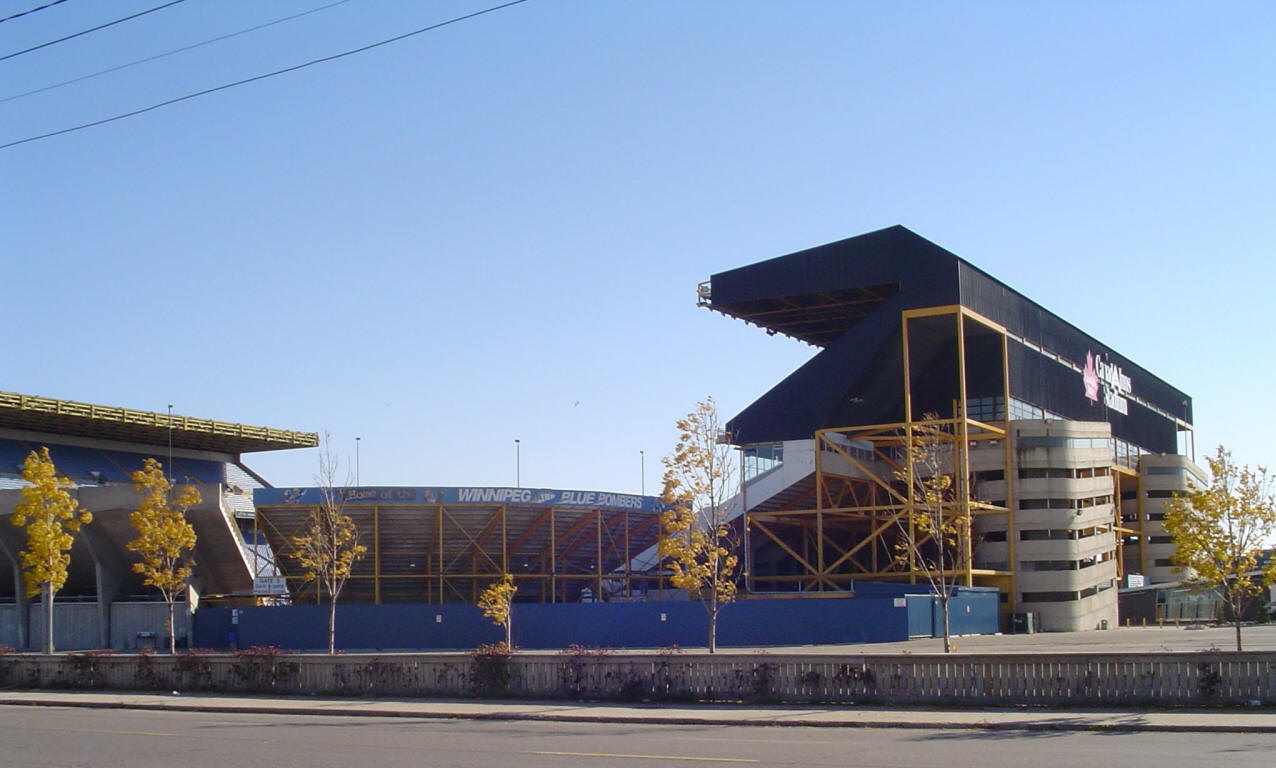
Winnipeg Stadium (also known as Canad Inns Stadium) was a multipurpose stadium in Winnipeg, Manitoba, Canada.
The stadium was located at the corner of St. James Street and Maroons Road, immediately north of the Polo Park Shopping Centre and the now-defunct Winnipeg Arena. Although built for the Canadian Football League's Winnipeg Blue Bombers, the stadium also accommodated baseball and soccer, and was used by various iterations of the Winnipeg Goldeyes and Winnipeg Whips. The stadium was demolished after the Blue Bombers moved to the stadium known then as Investors Group Field in 2013.
During the Blue Bombers' early years, the team played at Osborne Stadium, a much smaller venue located near the Manitoba Legislative Buildings. The fast passing-dominated play of Bombers quarterback Jack Jacobs dramatically increased attendance at Blue Bombers games and precipitated the need for a new, larger stadium.
In the wake of several unsuccessful proposals for a new stadium, Winnipeg Enterprises Corporation, a newly created non-profit organization led by Winnipeg Football Club president Culver Riley, presented a plan for the construction of a new 15,700 seat stadium in the Polo Park district. The City of Winnipeg approved the plan in August 1952. Winnipeg Stadium was officially opened on August 14, 1953, with a fundraising gala to benefit the Winnipeg Unit of the Shriners Hospitals for Children. Foster Hewitt served as the master of ceremonies as 12,000 spectators watched an array of Shriners, athletes, politicians, and actress Corinne Calvet inaugurate the stadium. The following night, the Blue Bombers played the first football game at the new stadium against the Ottawa Rough Riders. The stadium became known as "the house that Jack built" in recognition of the contributions of Jack Jacobs.
The on-field success of the Blue Bombers and their growing fan base led to numerous expansions of the facility beginning in 1954, when capacity was raised to 17,995. Of those seats, only 10,166 were on permanent concrete grandstands, with the remainder being temporary seating in the stadium corners. Further additions included the construction of new north end-zone seating in 1966 and expansion of the west side grandstands, including a new upper deck, in 1972. In 1978, the east side grandstands were expanded, with a new upper deck, raising capacity to 32,946. Seats were also added in 1987 when the stadium was configured to accommodate baseball, at which point its capacity peaked at 33,675.
AstroTurf was installed in time for the 1988 season (when it was installed, the Edmonton Eskimos became the last CFL team to have a natural grass surface, but it would switch to a next-generation artificial surface in 2010), which the team welcomed with a Grey Cup victory that year at Lansdowne Park in Ottawa. In 1999, the lower deck benches were replaced by theatre-style seats, the press boxes were enlarged, and a club lounge was added. As a result, seating capacity was reduced to 29,533 and remained that way until the stadium's closure. The artificial turf was replaced by a next-generation AstroPlay surface in 2003.
Winnipeg-based hotel chain Canad Inns acquired the naming rights to Winnipeg Stadium in 2001, after which the facility became known as Canad Inns Stadium. In 2004, Winnipeg Enterprises Corporation was dissolved and operation of the facility was turned over to the Winnipeg Football Club.
The original baseball grandstands were built in 1954, at a cost of $184,000, and located in the southwest corner of the complex. The grandstands housed the original incarnation of the Winnipeg Goldeyes and the Winnipeg Whips, the Class AAA affiliate of the Montreal Expos. The grandstands were demolished in the early 1980s to make way for the Blue and Gold Room and, for nearly a decade, baseball could not be accommodated at the stadium.
Winnipeg Stadium
Winnipeg Stadium (also known as Canad Inns Stadium) was a multipurpose stadium in Winnipeg, Manitoba, Canada.
The stadium was located at the corner of St. James Street and Maroons Road, immediately north of the Polo Park Shopping Centre and the now-defunct Winnipeg Arena. Although built for the Canadian Football League's Winnipeg Blue Bombers, the stadium also accommodated baseball and soccer, and was used by various iterations of the Winnipeg Goldeyes and Winnipeg Whips. The stadium was demolished after the Blue Bombers moved to the stadium known then as Investors Group Field in 2013.
During the Blue Bombers' early years, the team played at Osborne Stadium, a much smaller venue located near the Manitoba Legislative Buildings. The fast passing-dominated play of Bombers quarterback Jack Jacobs dramatically increased attendance at Blue Bombers games and precipitated the need for a new, larger stadium.
In the wake of several unsuccessful proposals for a new stadium, Winnipeg Enterprises Corporation, a newly created non-profit organization led by Winnipeg Football Club president Culver Riley, presented a plan for the construction of a new 15,700 seat stadium in the Polo Park district. The City of Winnipeg approved the plan in August 1952. Winnipeg Stadium was officially opened on August 14, 1953, with a fundraising gala to benefit the Winnipeg Unit of the Shriners Hospitals for Children. Foster Hewitt served as the master of ceremonies as 12,000 spectators watched an array of Shriners, athletes, politicians, and actress Corinne Calvet inaugurate the stadium. The following night, the Blue Bombers played the first football game at the new stadium against the Ottawa Rough Riders. The stadium became known as "the house that Jack built" in recognition of the contributions of Jack Jacobs.
The on-field success of the Blue Bombers and their growing fan base led to numerous expansions of the facility beginning in 1954, when capacity was raised to 17,995. Of those seats, only 10,166 were on permanent concrete grandstands, with the remainder being temporary seating in the stadium corners. Further additions included the construction of new north end-zone seating in 1966 and expansion of the west side grandstands, including a new upper deck, in 1972. In 1978, the east side grandstands were expanded, with a new upper deck, raising capacity to 32,946. Seats were also added in 1987 when the stadium was configured to accommodate baseball, at which point its capacity peaked at 33,675.
AstroTurf was installed in time for the 1988 season (when it was installed, the Edmonton Eskimos became the last CFL team to have a natural grass surface, but it would switch to a next-generation artificial surface in 2010), which the team welcomed with a Grey Cup victory that year at Lansdowne Park in Ottawa. In 1999, the lower deck benches were replaced by theatre-style seats, the press boxes were enlarged, and a club lounge was added. As a result, seating capacity was reduced to 29,533 and remained that way until the stadium's closure. The artificial turf was replaced by a next-generation AstroPlay surface in 2003.
Winnipeg-based hotel chain Canad Inns acquired the naming rights to Winnipeg Stadium in 2001, after which the facility became known as Canad Inns Stadium. In 2004, Winnipeg Enterprises Corporation was dissolved and operation of the facility was turned over to the Winnipeg Football Club.
The original baseball grandstands were built in 1954, at a cost of $184,000, and located in the southwest corner of the complex. The grandstands housed the original incarnation of the Winnipeg Goldeyes and the Winnipeg Whips, the Class AAA affiliate of the Montreal Expos. The grandstands were demolished in the early 1980s to make way for the Blue and Gold Room and, for nearly a decade, baseball could not be accommodated at the stadium.
Recent media
Recent media