



Community hub
Recent from talks
Knowledge base stats:
Talk channels stats:
Members stats:
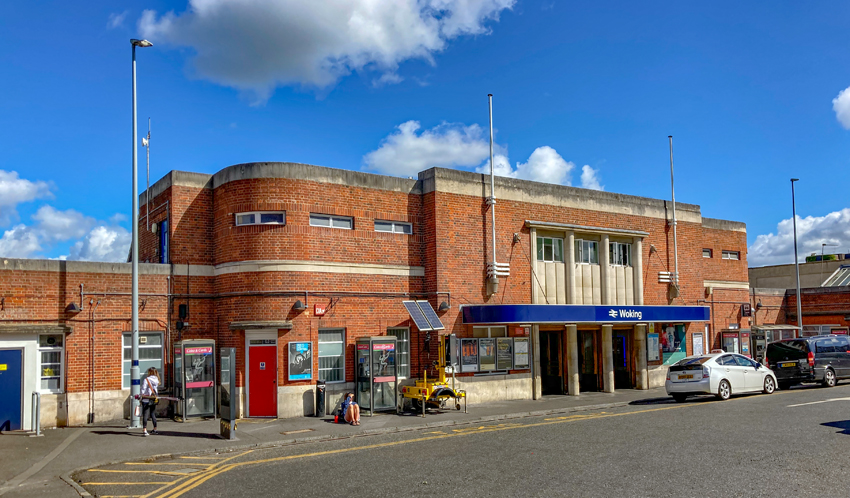
Woking railway station
Woking railway station is a principal commuter stop on the South West Main Line, which serves the town of Woking, in Surrey, England. It lies 24 miles 27 chains (39.2 km) down the line from London Waterloo. The station is managed by South Western Railway, which operates all trains serving it. It is the busiest railway station in the county and, as of 2024, the fifth busiest in South East England.
The London and Southampton Railway (L&SR) was authorised on 25 July 1834 and construction began in October of that year. The line was built in stages, and the first section, between the London terminus at Nine Elms and "Woking Common", was opened to passengers on 21 May 1838. Woking Common station was built with two platforms linked by a footbridge and a small freight yard was also provided. When it opened, it was surrounded by open heath and was 2 km (1.2 mi) from what is now the village of Old Woking. Nevertheless, it quickly became the railhead for west Surrey and the main entrance was positioned on the south side of the tracks for the convenience of those travelling by stagecoach from Guildford. Construction of Woking town centre, to the north of the station, did not begin until the mid-1860s.
Woking Common became a through station on 24 September 1838, with the opening of the next section of the line as far as Winchfield. The station was given its current name of "Woking" in around 1843. The Guildford Junction Railway (GJR) opened on 5 May 1845, having been authorised less than a year earlier, on 10 May 1844. The GJR was always operated by the LSWR, and was absorbed by that company on 4 August 1845.
The track through Woking station was quadrupled in 1904 and electrified in 1937. The station was rebuilt by the Southern Railway in the Art Deco "Odeon" style in 1936–37. The signal box, which was constructed as part of the rebuilding programme, is a Grade II listed building.
Three trains were involved in a collision just east of the station on 23 December 1955. A Portsmouth line electric train came to a stand at signals near the Maybury Hill Road bridge. The following steam-hauled Waterloo-Basingstoke train overran the Maybury distant signal and collided with the rear of the electric train, demolishing the guards compartment and deflecting the rear bogie so that it was foul of the up-line. An up Bournemouth steam-hauled train had just left the station and came into sidelong collision with the bogie and came to a stand. Out of around 1000 passengers and crew on the three trains only 21 were injured, including the guard of the electric train, and there were no fatalities.
The Ministry of Transport and Civil Aviation report concluded that the crash was due to human error on the part of the driver of the Basingstoke train. The Basingstoke train locomotive, SR N15X class 32327 Trevithick, was damaged beyond economic repair and scrapped at Eastleigh Works.
Woking station has six platforms, two of which are bay platforms:
Many South Western Railway services call at Woking, including:
Hub AI
Woking railway station AI simulator
(@Woking railway station_simulator)
Woking railway station
Woking railway station is a principal commuter stop on the South West Main Line, which serves the town of Woking, in Surrey, England. It lies 24 miles 27 chains (39.2 km) down the line from London Waterloo. The station is managed by South Western Railway, which operates all trains serving it. It is the busiest railway station in the county and, as of 2024, the fifth busiest in South East England.
The London and Southampton Railway (L&SR) was authorised on 25 July 1834 and construction began in October of that year. The line was built in stages, and the first section, between the London terminus at Nine Elms and "Woking Common", was opened to passengers on 21 May 1838. Woking Common station was built with two platforms linked by a footbridge and a small freight yard was also provided. When it opened, it was surrounded by open heath and was 2 km (1.2 mi) from what is now the village of Old Woking. Nevertheless, it quickly became the railhead for west Surrey and the main entrance was positioned on the south side of the tracks for the convenience of those travelling by stagecoach from Guildford. Construction of Woking town centre, to the north of the station, did not begin until the mid-1860s.
Woking Common became a through station on 24 September 1838, with the opening of the next section of the line as far as Winchfield. The station was given its current name of "Woking" in around 1843. The Guildford Junction Railway (GJR) opened on 5 May 1845, having been authorised less than a year earlier, on 10 May 1844. The GJR was always operated by the LSWR, and was absorbed by that company on 4 August 1845.
The track through Woking station was quadrupled in 1904 and electrified in 1937. The station was rebuilt by the Southern Railway in the Art Deco "Odeon" style in 1936–37. The signal box, which was constructed as part of the rebuilding programme, is a Grade II listed building.
Three trains were involved in a collision just east of the station on 23 December 1955. A Portsmouth line electric train came to a stand at signals near the Maybury Hill Road bridge. The following steam-hauled Waterloo-Basingstoke train overran the Maybury distant signal and collided with the rear of the electric train, demolishing the guards compartment and deflecting the rear bogie so that it was foul of the up-line. An up Bournemouth steam-hauled train had just left the station and came into sidelong collision with the bogie and came to a stand. Out of around 1000 passengers and crew on the three trains only 21 were injured, including the guard of the electric train, and there were no fatalities.
The Ministry of Transport and Civil Aviation report concluded that the crash was due to human error on the part of the driver of the Basingstoke train. The Basingstoke train locomotive, SR N15X class 32327 Trevithick, was damaged beyond economic repair and scrapped at Eastleigh Works.
Woking station has six platforms, two of which are bay platforms:
Many South Western Railway services call at Woking, including: