
Recent from talks
Eastleigh Works
Knowledge base stats:
Talk channels stats:
Members stats:
Eastleigh Works
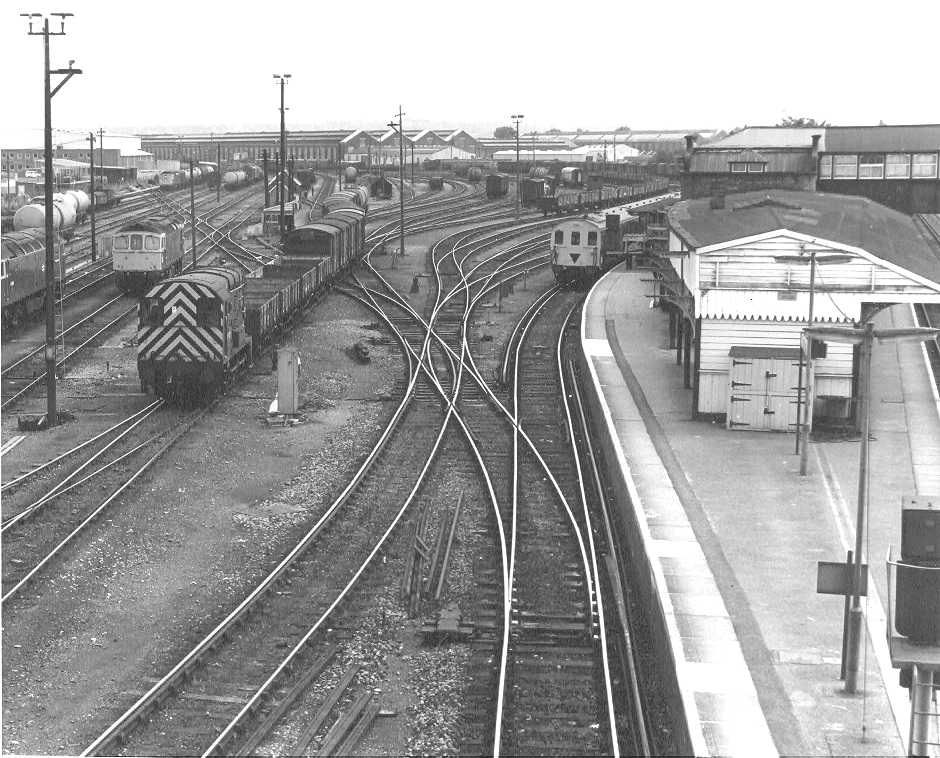
Eastleigh Works is a locomotive, carriage and wagon building and repair facility in the town of Eastleigh, in the county of Hampshire in England.
The London and South Western Railway (LSWR) opened a carriage and wagon works at Eastleigh in 1891. In 1903, the Chief Mechanical Engineer, Dugald Drummond, oversaw the construction of a large motive power depot in the town; replacing the existing maintenance and repair shops at Northam, Southampton. In January 1910, locomotive building was likewise transferred to the new workshops at Eastleigh from Nine Elms in London.
The first locomotives built at Eastleigh were the two S14 0-4-0T delivered in September 1910, and these were followed by Eastleigh's first tender locomotives, the five P14 4-6-0, delivered between October 1910 and February 1911.
Among the other locomotives produced by the LSWR under Drummond at Eastleigh, were the M7 0-4-4 tank engines, the T14 4-6-0, and D15 4-4-0, classes. Following the appointment of Robert Urie as Chief Mechanical Engineer in 1912, the works were responsible for the construction of the H15, S15, and N15 (King Arthur) 4-6-0 classes, and the G16 4-8-0, and H16 4-6-0 tank engines.
Following the merger of the LSWR and other railways in southern England to form the Southern Railway, as part of the Railways Act grouping of 1923, Eastleigh was to become the principal works for the new railway. The new Chief Mechanical Engineer, Richard Maunsell re-organised the works and directed the design and construction of various new classes.
Like most of the railway works, Eastleigh was heavily involved in the war effort, producing, in 1938, sets of parts to convert Blenheim bombers so that they could be used as fighters. The works was also part of a joint venture with other workshops, railway and private, to produce Horsa gliders for the D-Day airborne assault. With Lancing works, it turned out 200 tail units. It also produced 1,500 anti-tank gun barrels and, with Brighton railway works, 240 multiple rocket launchers, plus landing craft, fuel tenders and harbour launches.
Under the Southern Railway, the works were responsible for building the Maunsell SR Lord Nelson Class 4-6-0, the Schools 4-4-0, U1 2-6-0, W class 2-6-4 tanks, and Q class 0-6-0 locomotives. Under the regime of Oliver Bulleid, after 1937, Eastleigh works constructed all thirty of the SR Merchant Navy Class and six of the West Country 4-6-2. During the Second World War, Eastleigh works built 23 examples of the London Midland and Scottish Railway designed 8F 2-8-0s. By the end of 1947, the works had built 304 locomotives with a further 16 before steam locomotive building ceased in 1950.
In 1945, the carriage works began constructing all-steel carriages, both electric and steam hauled. It pioneered the use of plastics and glass fibre reinforced resin for doors, seating and roof sections.
Hub AI
Eastleigh Works AI simulator
(@Eastleigh Works_simulator)
Eastleigh Works
Eastleigh Works is a locomotive, carriage and wagon building and repair facility in the town of Eastleigh, in the county of Hampshire in England.
The London and South Western Railway (LSWR) opened a carriage and wagon works at Eastleigh in 1891. In 1903, the Chief Mechanical Engineer, Dugald Drummond, oversaw the construction of a large motive power depot in the town; replacing the existing maintenance and repair shops at Northam, Southampton. In January 1910, locomotive building was likewise transferred to the new workshops at Eastleigh from Nine Elms in London.
The first locomotives built at Eastleigh were the two S14 0-4-0T delivered in September 1910, and these were followed by Eastleigh's first tender locomotives, the five P14 4-6-0, delivered between October 1910 and February 1911.
Among the other locomotives produced by the LSWR under Drummond at Eastleigh, were the M7 0-4-4 tank engines, the T14 4-6-0, and D15 4-4-0, classes. Following the appointment of Robert Urie as Chief Mechanical Engineer in 1912, the works were responsible for the construction of the H15, S15, and N15 (King Arthur) 4-6-0 classes, and the G16 4-8-0, and H16 4-6-0 tank engines.
Following the merger of the LSWR and other railways in southern England to form the Southern Railway, as part of the Railways Act grouping of 1923, Eastleigh was to become the principal works for the new railway. The new Chief Mechanical Engineer, Richard Maunsell re-organised the works and directed the design and construction of various new classes.
Like most of the railway works, Eastleigh was heavily involved in the war effort, producing, in 1938, sets of parts to convert Blenheim bombers so that they could be used as fighters. The works was also part of a joint venture with other workshops, railway and private, to produce Horsa gliders for the D-Day airborne assault. With Lancing works, it turned out 200 tail units. It also produced 1,500 anti-tank gun barrels and, with Brighton railway works, 240 multiple rocket launchers, plus landing craft, fuel tenders and harbour launches.
Under the Southern Railway, the works were responsible for building the Maunsell SR Lord Nelson Class 4-6-0, the Schools 4-4-0, U1 2-6-0, W class 2-6-4 tanks, and Q class 0-6-0 locomotives. Under the regime of Oliver Bulleid, after 1937, Eastleigh works constructed all thirty of the SR Merchant Navy Class and six of the West Country 4-6-2. During the Second World War, Eastleigh works built 23 examples of the London Midland and Scottish Railway designed 8F 2-8-0s. By the end of 1947, the works had built 304 locomotives with a further 16 before steam locomotive building ceased in 1950.
In 1945, the carriage works began constructing all-steel carriages, both electric and steam hauled. It pioneered the use of plastics and glass fibre reinforced resin for doors, seating and roof sections.
Recent media